
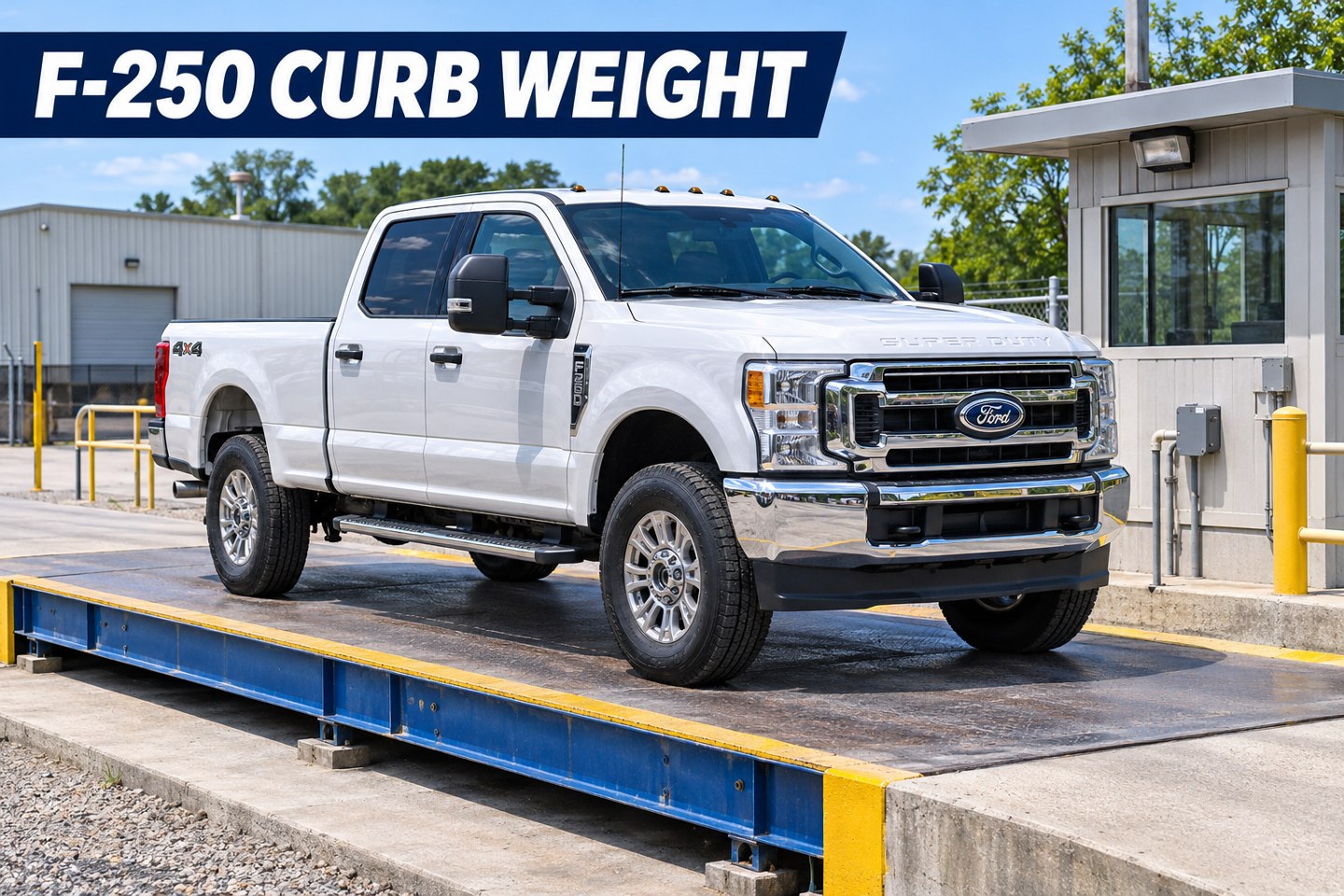
Ford F-250 Curb Weight Chart by Cab, Bed, and Engine

Ford lists 5,691 lb for the 2026 F-250 7.3L gas Regular Cab 4×2 with the 8-foot bed and 7,645 lb for the 2026 F-250 High-Output 6.7L diesel Crew Cab 4×4 with the 8-foot bed. Those are the low and high entries in Ford’s published 2026 F-250 single-rear-wheel base curb weight table. The 1,954-lb spread compares complete factory configurations.
For the 2026 short-bed Crew Cab 4×4, Ford gives 6,396 lb with the 6.8L gas V8, 6,370 lb with the 7.3L gas V8, 7,178 lb with the standard 6.7L diesel and 7,321 lb with the High-Output diesel. Match the cab, box, engine and drivetrain before choosing a figure. If you need the actual weight of an individual truck, record its equipment and fuel condition and use a suitable vehicle scale.


2026 Ford F-250 Base Curb Weight by Engine and Cab
| SRW cab and box | Drive | 6.8L gas | 7.3L gas | 6.7L diesel | 6.7L H.O. diesel |
|---|---|---|---|---|---|
| Regular Cab, 8 ft | 4×2 | 5,697 | 5,691 | 6,455 | 6,598 |
| Regular Cab, 8 ft | 4×4 | 6,093 | 6,082 | 6,853 | 6,996 |
| SuperCab, 6.75 ft | 4×2 | 5,995 | 5,968 | 6,870 | 6,885 |
| SuperCab, 6.75 ft | 4×4 | 6,415 | 6,389 | 7,140 | 7,283 |
| SuperCab, 8 ft | 4×2 | 6,074 | 6,087 | 6,871 | 7,014 |
| SuperCab, 8 ft | 4×4 | 6,459 | 6,447 | 7,228 | 7,371 |
| Crew Cab, 6.75 ft | 4×2 | 6,041 | 6,014 | 6,835 | 6,978 |
| Crew Cab, 6.75 ft | 4×4 | 6,396 | 6,370 | 7,178 | 7,321 |
| Crew Cab, 8 ft | 4×2 | 6,264 | 6,238 | 7,082 | 7,225 |
| Crew Cab, 8 ft | 4×4 | 6,699 | 6,673 | 7,502 | 7,645 |
Units are pounds. These ten configuration rows come from the F-250 portion of Ford’s 2026 Super Duty pickup technical specifications, under the single-rear-wheel base curb weight heading. Read across from the cab, box, and drive combination to the exact engine column. An individual trim or equipment package can change the vehicle’s scale weight and availability. The table is specific to the U.S. F-250 SRW pickup figures Ford published.
2025 Ford F-250 Base Curb Weight for Comparison


| SRW cab and box | Drive | 6.8L gas | 7.3L gas | 6.7L diesel | 6.7L H.O. diesel |
|---|---|---|---|---|---|
| Regular Cab | 4×2 | 5,697 | 5,801 | 6,455 | 6,598 |
| Regular Cab | 4×4 | 6,148 | 6,232 | 6,868 | 7,011 |
| SuperCab long wheelbase | 4×2 | 6,104 | 6,187 | 6,871 | 7,014 |
| SuperCab long wheelbase | 4×4 | 6,504 | 6,587 | 7,258 | 7,401 |
| Crew Cab short wheelbase | 4×2 | 6,041 | 6,124 | 6,835 | 6,978 |
| Crew Cab short wheelbase | 4×4 | 6,396 | 6,480 | 7,203 | 7,346 |
| Crew Cab long wheelbase | 4×2 | 6,264 | 6,348 | 7,082 | 7,225 |
| Crew Cab long wheelbase | 4×4 | 6,699 | 6,783 | 7,517 | 7,680 |
The 2025 Super Duty technical specifications use short-wheelbase and long-wheelbase labels for Crew Cab and show only the long-wheelbase SuperCab in this table. The two diesel values appear together in Ford’s source, with the standard diesel first and the High-Output diesel second. The chart separates those figures into columns for easier comparison.
Some cells match across the two years. For example, Ford lists 6,396 lb for the 6.8L short-bed Crew Cab 4×4 in both references. Other cells differ. The 7.3L Crew Cab long-bed 4×4 appears at 6,783 lb in the 2025 sheet and 6,673 lb in the 2026 sheet. That 110-lb difference describes the published base configurations. The sheets do not identify a specific part or production change as the cause. Use the table for the year of the truck you are checking.
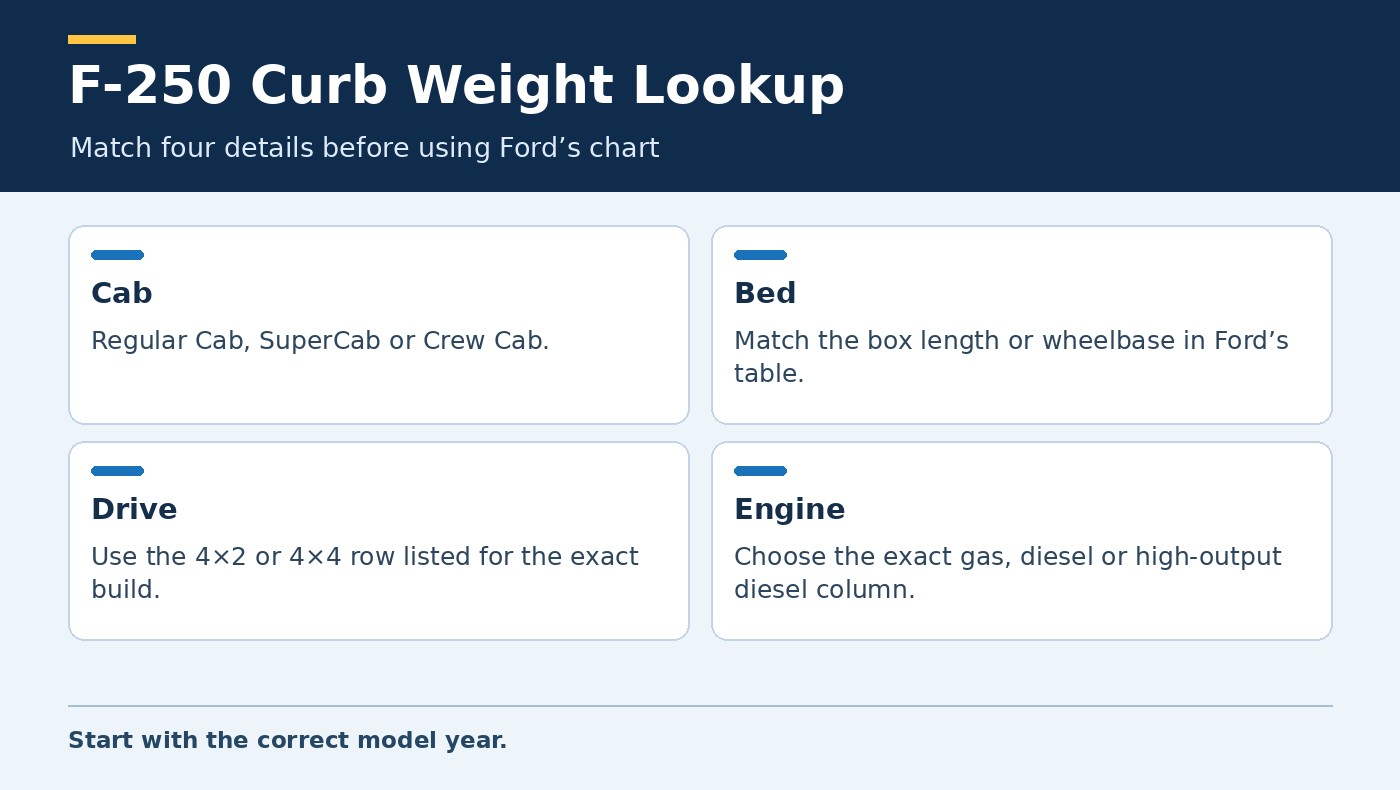
How Engine, Cab, and Drive Change the Base Weight


Compare gas and diesel within the same body configuration
In the 2026 Crew Cab 4×4 with the 6.75-foot box, Ford lists the 6.8L gas V8 at 6,396 lb and the standard 6.7L diesel at 7,178 lb. Subtract the gas figure from the diesel figure to get 782 lb between the published base trucks. Move to the High-Output diesel and the same table shows 7,321 lb, 143 lb more than the standard diesel in that row.
These numbers compare complete configurations. They do not establish the bare weight of an engine or a component. The two diesel variants warrant their own lookup because they share displacement. If a seller says “6.7 diesel” without naming the version, check Ford’s build record or the original paperwork. The long-box High-Output Crew Cab 4×4 and a short-box standard-output diesel both use a 6.7L engine, yet the base figures in Ford’s source differ by 467 lb.
Check the cab and box before comparing two Crew Cabs


For a 2026 6.8L gas Crew Cab 4×4, Ford shows 6,396 lb with the 6.75-foot box and 6,699 lb with the 8-foot box. The two base vehicles differ by 303 lb. A sales listing that describes both as Crew Cab 4×4 leaves out the part of the configuration needed to explain that published difference.
A short or long box can affect how the truck fits in a work area as well as which weight cell applies. Record the nominal box length from the factory paperwork and check the model year. Older sources may use wheelbase instead of box length. Use the corresponding Ford dimensions table or help from a dealer if the relationship is unclear. Keep wheelbase and bed length as separate fields in your notes.


Read the 4×2 and 4×4 entries side by side
The 2026 6.8L Regular Cab entries are 5,697 lb for 4×2 and 6,093 lb for 4×4. That is a 396-lb difference. For the same engine with Crew Cab and the 8-foot box, the 4×2 and 4×4 entries are 6,264 lb and 6,699 lb, a 435-lb difference. There is no need to estimate an across-the-line four-wheel-drive weight adjustment when the two published configurations have their own entries.


This matters when you compare listings on different sites. Some listing templates repeat a base weight across trim pages even when the drivetrain changes. If the seller cannot explain how a weight was obtained, compare it with the Ford table and ask whether it is a factory reference or a scale result. Those figures can be different even when the seller has identified the truck correctly.
What Base Curb Weight Includes
Ford’s RV and Trailer Towing Guide defines the base figure around standard equipment and a full tank of fuel. Ford treats optional equipment, occupants and cargo separately. That definition is useful for comparing a short-box gas truck with a long-box diesel, and for explaining why a work truck can weigh more than the corresponding base entry.
For a used F-250, account for installed equipment. A service rack, heavy bumper, winch, fixed toolbox, auxiliary tank, or fifth-wheel hitch can remain aboard when the bed looks empty. If you are creating an empty baseline, record which equipment stays, what removable gear is taken out, who was in the vehicle, and the fuel condition at the time of weighing. If you later remove something, the notes make the two scale tickets comparable.



Registration records or vehicle listings may carry a weight value. Ask what the field represents before copying it into a transport form. The number may describe a published base configuration, a registration class, a weight rating, or a measured truck. Use Ford’s base table for configuration comparisons. Use a current scale ticket when someone needs to know the truck’s weight in its present condition.
Curb Weight, Payload, and GVWR Answer Different Questions
Base curb weight is the published starting weight for a given factory configuration. Actual vehicle weight is what the scale reads with the truck, its equipment, and whatever is aboard. Gross vehicle weight rating, or GVWR, is a maximum rating for the truck as loaded. The front and rear axle ratings address the load supported at each axle. The truck’s Tire and Loading Information label gives the combined occupant-and-cargo limit for that vehicle.
For a hypothetical example, a truck with a 10,000-lb GVWR and a measured 7,200-lb weight has a 2,800-lb arithmetic gap to GVWR in the weighed condition. If a driver was already aboard for that weighing, the ticket includes that person. A planned load still has to satisfy the vehicle’s applicable occupant and cargo limit, axle ratings and any towing or equipment limits. The remaining gap to GVWR does not tell you how the load is distributed.
If you are checking a trailer combination, include the load that the trailer places on the truck. Depending on the setup, that may be tongue weight or pin weight. Have the combination weighed in its intended travel condition when the numbers affect a loading decision. Compare the relevant readings with the labels and model-year ratings, and resolve any uncertainty about the hitch or axle before loading further. The Ford F-250 payload capacity guide covers the labels and model-year payload comparisons in more detail.
How to Look Up and Weigh Your F-250
- Confirm the model year and series. Use the VIN and factory records. Check that the document is for an F-250 pickup and that you are reading its SRW row.
- Identify the cab and bed. Record Regular Cab, SuperCab, or Crew Cab. If the technical table uses short and long wheelbase, identify which body combination the labels describe for that year.
- Confirm the exact engine. Record 6.8L gas, 7.3L gas, 6.7L diesel, or 6.7L High-Output diesel for the years in these charts.
- Confirm 4×2 or 4×4. Read the appropriate drivetrain cell for the cab and bed. Preserve Ford’s original model-year reference with the number.
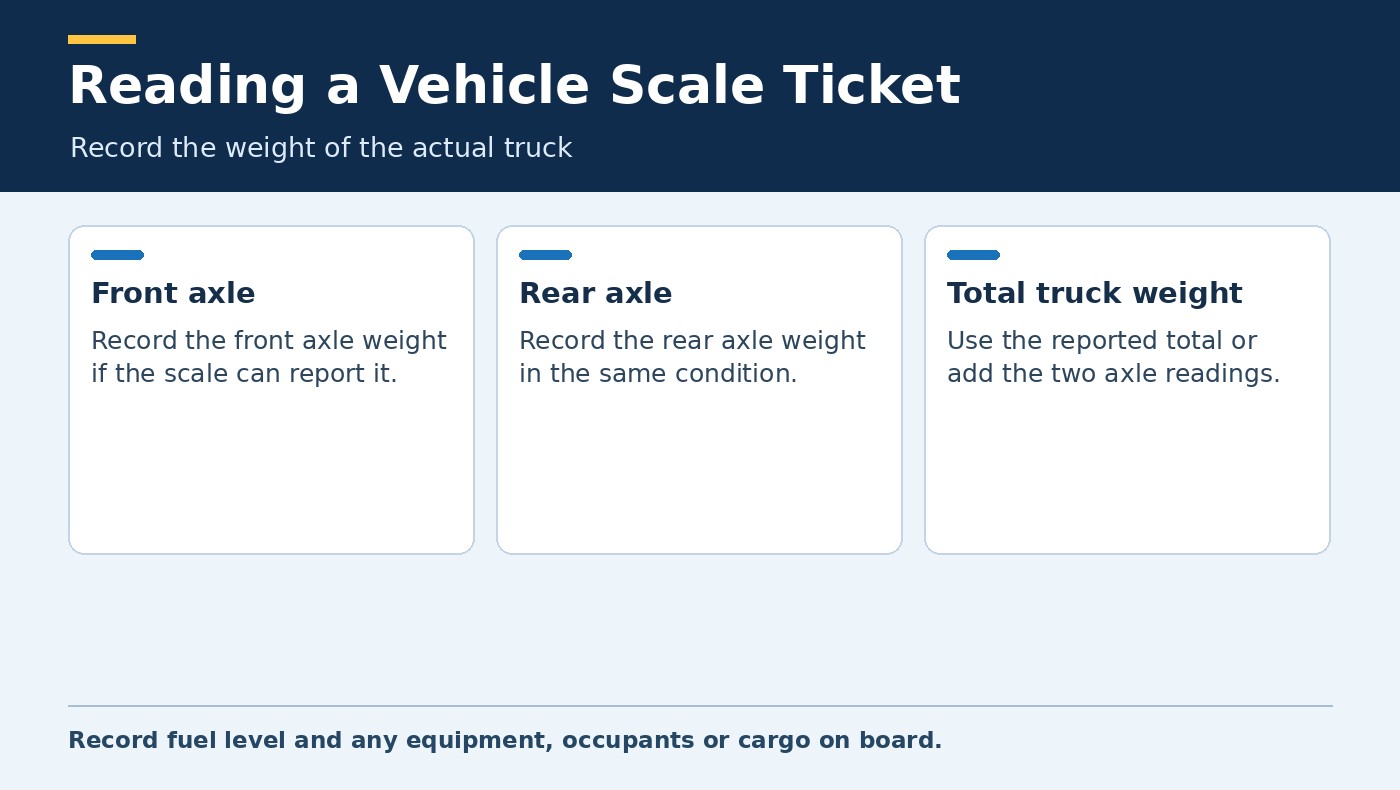
- Weigh the truck for a vehicle-specific figure. Choose a suitable scale and document the fuel, occupants, cargo, and installed equipment. If you are examining load distribution, ask the scale operator how to record axle readings.
For a truck built before the years shown, look for that model year’s Ford technical specifications. Ford’s powertrain choices, cab offerings and weight tables can change. If an older source publishes a different breakdown, use the fields it actually provides. A valid specification still needs a match between the vehicle and the figures in the source.
Three Examples of Reading the Right Weight
A quote gives only the trim and engine


Suppose a quote describes a 2026 F-250 XLT with the standard 6.7L diesel and four-wheel drive. Ask for the cab and box before assigning it a number. If it is a 6.75-foot-box Crew Cab, Ford’s base figure is 7,178 lb. The same cab and engine with an 8-foot box are listed at 7,502 lb. The 324-lb difference comes from subtracting one published configuration from the other. If a dealer installed a heavy accessory, record that separately when comparing the particular vehicles on a scale.
A work truck will carry the same equipment every day
Weigh the truck in a condition that represents the job. If a rack and toolbox will always be aboard, leave them on and record that fact. Note which consumables, removable equipment, and people were present. Ask the scale operator for axle readings if weight distribution matters. A rear-mounted assembly can change the rear axle reading more than a total-weight comparison suggests. Keep the first ticket with the truck’s service records. If you install a body, swap a rack, or change the truck’s assignment, the saved baseline gives you a documented comparison point.
Two specifications give different answers for the same model name


Write down each specification’s year, cab, box or wheelbase, engine, and drive. One may come from a model-year table and another from a dealer listing that leaves out an equipment field. You might also be comparing Ford’s base curb weight with a figure derived from a payload table. A calculation that subtracts a published cargo rating from GVWR describes the conditions attached to that cargo rating. Ford’s direct base curb weight entry is a separate manufacturer figure. Use the direct entry for the chart lookup and use a scale ticket if the question concerns the truck now.
An owner may find a brochure total and a scale weight that differ even after checking every model detail correctly. Check whether the fuel level, occupants, bed contents, installed options, or attachments differ from the base definition. Avoid assigning the full difference to one component unless the truck was weighed in comparable conditions before and after that specific change. The recorded setup matters as much as the number when you are trying to explain a difference later.
Which Weight Belongs on the Transport Form?
Ask the operator what they need before filling in the field. They may be requesting the current measured weight, with equipment aboard, so they can choose suitable transport equipment. If you only have a base specification, label it as a Ford factory reference and give the operator the exact configuration it describes. A weight rating from the door is a different figure from what the truck actually weighs.
Frequently Asked Questions
How much does an empty F-250 weigh?
Ford’s 2026 SRW base table runs from 5,691 to 7,645 lb across the factory configurations listed. Your truck’s scale weight depends on its equipment, fuel condition, occupants and cargo. Use the matching model-year row for a base reference and a scale reading for the truck as it sits.
How much does a 2026 diesel F-250 Crew Cab 4×4 weigh?
Ford lists 7,178 lb for the standard 6.7L diesel with the 6.75-foot box and 7,502 lb for the same engine with the 8-foot box. The corresponding High-Output figures are 7,321 and 7,645 lb. Verify both the box and diesel variant before relying on the chart.
Is the 7.3L gas version always heavier than the 6.8L?
The 2026 table shows the 7.3L Regular Cab 4×2 at 5,691 lb and the 6.8L version at 5,697 lb. In the 8-foot-box SuperCab 4×2 comparison, Ford gives 6,087 lb for the 7.3L and 6,074 lb for the 6.8L. The order changes between these two configurations. Read the exact row.
Can I use the same figures for an F-350?
Ford gives the F-350 its own entries. Verify the correct series, year, and rear-wheel configuration before taking a number from the Super Duty specification sheet. Ford combines multiple series in the PDF, so check the row heading even if the cab and engine look familiar.