Ford F150 Idle Air Control Valve Location: Year and Engine 2026

The Ford F150 idle air control valve location is normally on or directly beside the throttle body on F-150 engines that use a separate IAC valve. On most 1997-2003 trucks, you can find it by following the large intake tube from the air box to the throttle body.
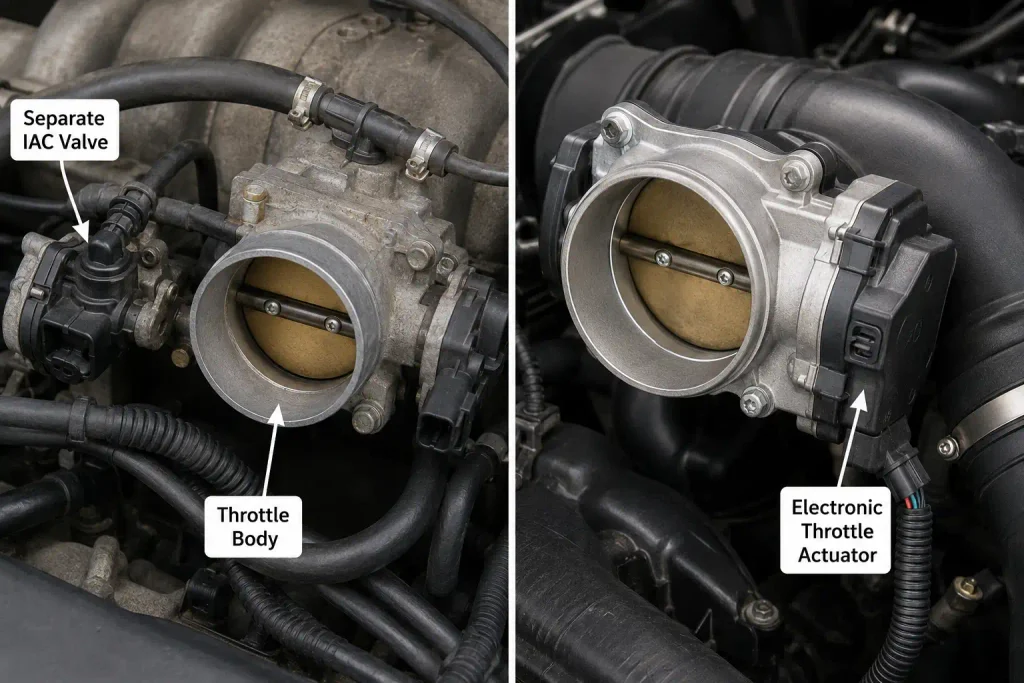
The catch is that not every F-150 has a separate IAC valve. Ford moved many engines to electronic throttle control, where the PCM controls idle by moving the throttle plate instead of opening a separate idle air bypass valve.

Prime for Young Adults — 6 Months Free
Students and 18–24s get six months of Prime free, then half price.
Start 6 Months Free As an Amazon Associate I earn from qualifying purchases.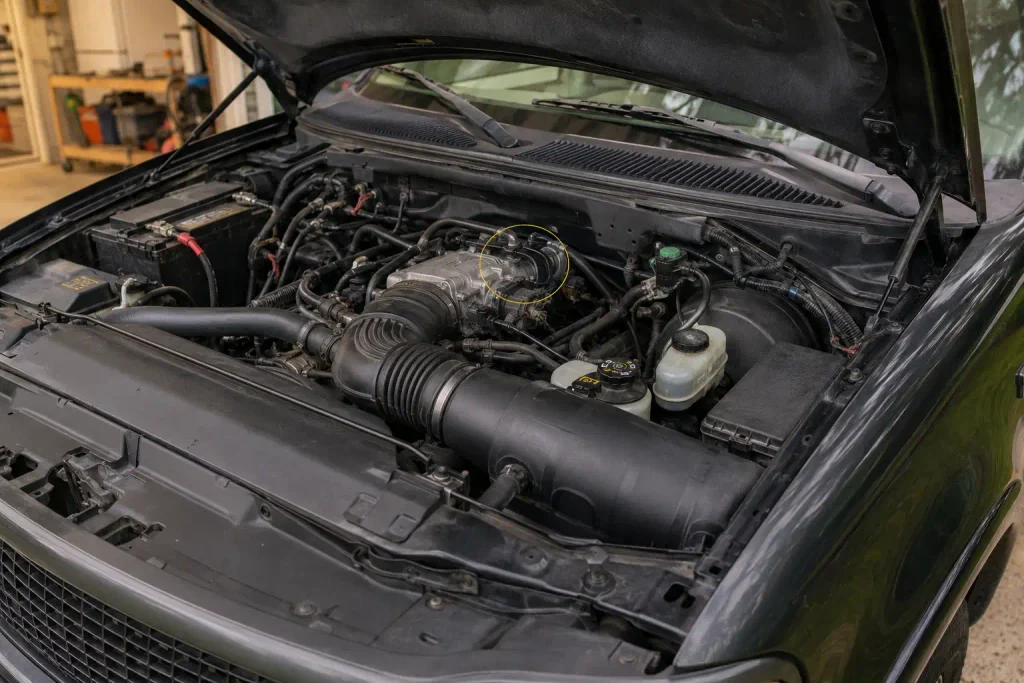
Your model year and engine therefore matter more than the general phrase “F-150 IAC location.”
Ford F150 IAC Valve Location by Year and Engine
Start with your engine and throttle-body design. Older F-150s often use a separate idle air control valve, while electronic-throttle trucks control idle through the throttle body itself.
Quick F-150 IAC Lookup
4.2L V6 · 4.6L V8 · 5.4L 2V V8
These engines commonly use a standalone idle air bypass valve.
4.6L V8 · 5.4L 2V V8
The old-body Heritage retained the earlier idle-control hardware.
Electronic-throttle V8 configurations
The PCM controls idle airflow by commanding the electronic throttle plate.

Audible — Listen Free for 30 Days
One free credit a month and thousands of titles included.
Listen Free for 30 Days As an Amazon Associate I earn from qualifying purchases.4.2L V6
The 4.2L continued using a dedicated idle air control valve.
4.6L and 5.4L V8
Idle airflow is managed through the electronic throttle-body system.
Older trucks and 2004 transition models
Do not order an IAC based only on the year shown in a generic parts listing.
Traditional IAC System
Older F-150 engines use a separate bypass valve to regulate air while the throttle plate is closed.
- Separate electrical connector
- Small valve near throttle body
- Common two-bolt mounting design
- Air bypasses the closed throttle plate
Electronic Throttle System
Later F-150 engines let the PCM move the throttle plate itself to maintain idle speed.
- No conventional standalone IAC
- Electronic motor on throttle body
- PCM controls throttle opening
- Diagnosis follows a different path
The 2004 model year includes Heritage and redesigned trucks with different idle-control hardware. Confirm the engine and body generation before buying an IAC valve.
Which Ford F150 Years Have an IAC Valve
Recommended Best Deal Products


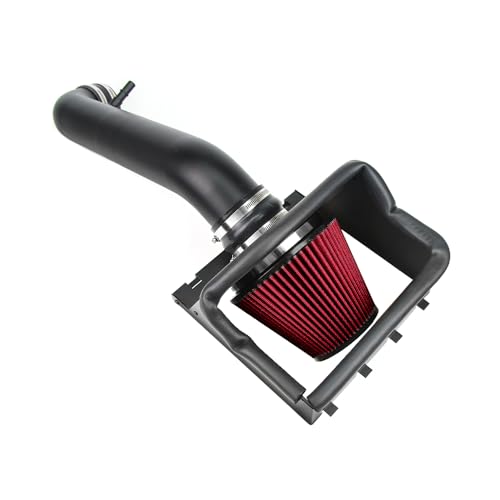
The quickest way to avoid looking for a part that is not there is to identify your engine first.
Audible Premium Plus — Annual Membership
12 audiobook credits up front, plus the full Audible catalogue.
See Annual Plans As an Amazon Associate I earn from qualifying purchases.Here is the practical F-150 lookup.
| F-150 Year and Engine | Separate IAC Valve | Where to Look |
|---|---|---|
| 1997-2003 4.2L V6 | Yes | Throttle body and intake area |
| 1997-2003 4.6L V8 | Yes | On or beside throttle body |
| 1997-2003 5.4L 2V V8 | Yes | Throttle body area |
| 2004 F-150 Heritage 4.6L | Yes | Throttle body area |
| 2004 F-150 Heritage 5.4L 2V | Yes | Throttle body area |
| 2004 redesigned F-150 4.6L | No separate IAC | Electronic throttle body |
| 2004 redesigned F-150 5.4L 3V | No separate IAC | Electronic throttle body |
| 2005-2008 4.2L V6 | Yes | Throttle body area |
| 2005-2008 4.6L and 5.4L V8 | No separate IAC | Electronic throttle body |
| Later electronic throttle F-150 engines | No separate IAC | PCM controls idle through throttle body |
Ford parts listings identify the IAC as base part 9F715, described as the throttle air bypass valve. A 2004 F-150 Heritage 4.6L parts catalog, for example, lists a separate 2L1Z-9F715-BA IAC valve. The Heritage 5.4L catalog likewise lists YL3Z-9F715-AA.
The redesigned truck is different. Service information for later 4.6L trucks describes an accelerator pedal position sensor and an electronic throttle body, while 5.4L 3V information confirms that idle speed is managed through the electronic throttle plate rather than a separate valve.
The 4.2L V6 stayed with a separate bypass valve longer. OEM listings for the 2005 F-150 identify 1L3Z-9F715-AA specifically for the 4.2L engine.
For pre-1997 EFI F-150s, Ford also used standalone idle-control valves on many applications. Exact mounting and configuration vary more by engine, so verify the engine or VIN before ordering a replacement.
Where Is the Ford F150 IAC Valve Located
Start at the air filter housing instead of searching around the entire engine bay.
- Open the hood and locate the air-filter box.
- Find the large air-intake tube leaving the air box.
- Follow that tube toward the engine.
- The point where the intake tube ends is the throttle-body area.
- On an IAC-equipped engine, inspect the throttle body and nearby intake manifold for a small electrically controlled bypass valve.
- Look for its electrical connector and mounting flange.
Ford’s 1997-2003 F-150 repair information places the IAC on or near the throttle body. Replacement procedures show the valve secured by two 8 mm fasteners on the covered applications.
The IAC lets a controlled amount of air bypass the closed throttle plate. That bypass air keeps the engine running when your foot is off the accelerator.
A later electronic throttle body does the same job differently. Instead of opening a separate bypass valve, the PCM slightly moves the throttle plate to maintain the commanded idle.
Where Is the 4.2L F150 IAC Valve
Recommended Best Deal Products


On the 4.2L V6, look around the throttle-body and upper-intake area after following the intake duct from the air cleaner.
The 1997-2003 4.2L uses a separate IAC valve, and parts data continues to show a dedicated throttle-air bypass valve for the 2005 4.2L F-150.
Look for three clues:
- An electrical connector attached to the valve
- A small bypass-air housing connected to the intake
- A mounting flange rather than a sensor attached to the throttle shaft
Do not mistake a nearby vacuum component for the IAC. A vacuum leak can also produce unstable idle, stalling, or lean-running symptoms.
If hoses around your 4.2L intake are cracked or disconnected, use the Ford 4.2L V6 intake vacuum diagram to verify the routing before replacing the valve.
Finding the throttle body first makes the IAC much easier to identify.
Where Is the 4.6L F150 IAC Valve
The answer for a 4.6L F-150 depends heavily on generation.
On 1997-2003 trucks, the 4.6L has a conventional IAC around the throttle body. Ford parts data lists base number 9F715 for the 4.6L, while repair procedures show the electrical connector and removable valve mounted in the throttle-body area.
The 2004 Heritage old-body 4.6L also carries a separate throttle-air bypass valve.
The redesigned truck changed the setup. By the 2005 model year, Ford service information for the 4.6L describes electronic throttle control circuits connecting the PCM, accelerator pedal position sensor, and electronic throttle-body position sensor.
That means you should not automatically buy an IAC because the truck has a 4.6L badge.
If you have an older cable-throttle 4.6L and a rough idle, inspect the hoses around the intake as well. The F150 4.6 engine vacuum line diagram can help identify vacuum routing that may affect idle quality.
Where Is the 5.4L F150 IAC Valve
Recommended Best Deal Products


The 5.4L F-150 is where year and body style become critical.
5.4L Two Valve Engines
The earlier 5.4L 2V uses a conventional idle air control valve.
On 1997-2003 F-150s, look around the throttle body after removing the intake or throttle-body cover if it blocks your view. Ford-Trucks’ 1997-2003 procedure specifically covers the removable IAC used on these trucks.
The old-body 2004 F-150 Heritage 5.4L also has a separate IAC. Ford parts data lists YL3Z-9F715-AA as the idle-air-control or throttle-air-bypass valve for that configuration.
If a 5.4L 2V idles poorly, also inspect its vacuum and PCV plumbing. The Ford 5.4 Triton vacuum hose diagram is a better reference when you need to trace those lines.
5.4L Three Valve Engines
The redesigned 2004 F-150 5.4L 3V does not have the conventional standalone IAC valve used on the older truck.
Its electronic throttle body controls idle airflow. The PCM commands small throttle-plate movements based on operating conditions instead of operating a separate bypass valve. Contemporary 2004 diagnostic information and later 5.4L references agree on this distinction.
So if you own a new-body 2004 5.4L or a later electronic-throttle 5.4L and cannot find an IAC, you probably are not overlooking it.
You should be inspecting the electronic throttle body and its related control system instead.
Why the 2004 F150 IAC Location Is Different
The 2004 F-150 is the model year most likely to cause IAC confusion because Ford sold two substantially different truck designs around the transition.
The F-150 Heritage carried the previous-generation body and powertrain hardware. Parts catalogs for Heritage 4.6L and 5.4L engines show standalone 9F715 idle-air-control valves.
The redesigned F-150 introduced electronic throttle-control hardware on the V8 configurations. On these trucks, the throttle body includes an electronic actuator and receives throttle commands through the PCM.
Before ordering an IAC for a 2004 truck, check:
- Whether the truck is an F-150 Heritage
- Engine displacement
- Whether the throttle body has an electronic actuator
- VIN-specific parts fitment
Do not rely on the model year alone.
This is also why online parts listings sometimes appear to contradict one another. Both a separate IAC and an electronic throttle system can appear in results labeled “2004 Ford F-150” because the underlying truck configurations are different.
What Does an F150 IAC Valve Look Like
A traditional F-150 IAC is a relatively small valve assembly attached to the intake or throttle-body area.
On common 1997-2003 configurations, look for:
- An electrical connector
- A compact metal valve housing
- A two-bolt mounting flange
- Air passages connecting the valve to the intake
- Ford base part number 9F715 or an equivalent replacement designation
Do not confuse it with the throttle position sensor.
| Component | What Identifies It |
|---|---|
| IAC valve | Separate bypass valve with electrical connector |
| Throttle position sensor | Small sensor attached to throttle shaft |
| EGR valve | Connected to the exhaust-gas recirculation system |
| Electronic throttle body | Large throttle housing with integrated electric actuator |
| MAF sensor | Located upstream between air cleaner and throttle body |
Ford’s OBD service documentation describes the IAC as an electrically controlled component and provides electrical resistance, wiring, and inlet-air checks when diagnosing idle concerns.
If you see a large electronic actuator attached directly to the throttle-body housing and no separate bypass valve, check whether your truck uses electronic throttle control before searching any further.
What To Check Before Replacing the IAC
A rough idle does not automatically mean the IAC valve has failed.
Ford’s diagnostic procedure checks more than the valve itself. The factory diagnostic path includes IAC electrical supply, valve resistance, wiring faults, inlet-air blockage, and other causes before condemning the component.
Check these areas first:
- Confirm that your engine actually has an IAC. Electronic-throttle engines require a different diagnostic path.
- Inspect the throttle body. Carbon around the throttle plate or air passages can affect idle airflow.
- Inspect the IAC connector. Look for damaged terminals, corrosion, loose pins, or broken wiring.
- Check vacuum and PCV hoses. Unmetered air can create rough or unstable idle.
- Inspect the intake duct. Cracks or loose connections between the MAF sensor and throttle body can alter measured airflow.
- Scan for diagnostic codes. Use the codes as diagnostic clues rather than proof that one specific part has failed.
If the throttle body itself is heavily contaminated, compare it with the examples in what a dirty throttle body looks like before buying an idle-control part.
What P0505 Means on an F150
P0505 means the PCM has detected an idle control system malfunction. It does not automatically translate to “replace the IAC valve.”
Ford’s older IAC diagnostic chart specifically includes P0505 but then directs the technician through power, resistance, wiring, air-inlet, and functional checks.
On an electronic-throttle F-150, the same idle complaint may lead you toward the throttle body, throttle actuator, deposits, air leaks, wiring, or learned idle settings instead.
After battery disconnection or throttle-body work on an electronic-throttle truck, the PCM may also need to relearn its idle strategy. The Ford F150 throttle reset procedure covers that process separately.
How To Find Your F150 IAC in 3 Steps
You can reduce the entire location search to three checks.
1. Identify Your Engine
Find the engine displacement from the emissions label, VIN information, owner documentation, or engine identification data.
Knowing only that you own an F-150 is not enough.
2. Find the Throttle Body
Follow the large intake tube from the air-filter box toward the intake manifold.
That tube leads directly to the throttle-body area, which is the main landmark for both traditional IAC and electronic throttle systems.
3. Identify the Idle Control Design
If your truck uses a separate valve around the throttle body with its own connector and bypass passages, you have the traditional IAC setup.
If the throttle body has an integrated electronic actuator and no separate IAC, the PCM controls idle through the throttle plate.
| What You See | Likely System |
|---|---|
| Separate valve beside intake or throttle body | Conventional IAC |
| Two-bolt bypass valve with electrical connector | Conventional IAC |
| Large electronic throttle actuator | Electronic throttle control |
| No standalone valve on 5.4L 3V | Normal electronic throttle setup |
| 2004 truck with uncertain configuration | Verify Heritage status and engine |
This identification step prevents the most common mistake: replacing or searching for an IAC that the engine never used.
Which F150 Idle Control Setup Do You Have
The Ford F150 idle air control valve location is straightforward once you identify the correct engine setup. Traditional IAC-equipped F-150s place the valve around the throttle body, where it controls bypass airflow while the throttle plate is closed.
The 1997-2003 4.2L, 4.6L, and 5.4L engines are common examples of this design. The 2004 Heritage also retains older hardware on applicable engines.
Redesigned electronic-throttle F-150s are different. If your engine uses an electronic throttle body, there may be no separate IAC to locate or replace.
Check your year, engine, and throttle-body design before ordering parts. That one verification can save you from diagnosing the wrong system.
5 Common Ford F150 IAC Location Questions
Does Every Ford F150 Have an Idle Air Control Valve?
No. Older F-150 engines commonly use a separate IAC valve, but many later engines use electronic throttle control. On those trucks, the PCM adjusts the throttle plate itself to maintain idle instead of operating a standalone bypass valve.
Where Is the IAC Valve on a 5.4 F150?
On older 5.4L 2V F-150 engines, the IAC sits in the throttle-body and intake area. The redesigned 2004 5.4L 3V and later electronic-throttle versions do not use the same standalone IAC, so identify the engine generation first.
Where Is the IAC Valve on a 4.6 F150?
On 1997-2003 4.6L F-150s and the applicable 2004 Heritage configuration, look on or near the throttle body for the separate IAC. Redesigned electronic-throttle 4.6L trucks use a different idle-control strategy.
Does a 2004 Ford F150 Have an IAC Valve?
It depends on the exact 2004 configuration. The Heritage 4.6L and 5.4L use separate IAC valves, while the redesigned electronic-throttle V8 trucks use the throttle body for idle control. Verify the body generation and engine before purchasing a valve.
Can a Dirty Throttle Body Cause F150 Idle Problems?
Yes. Deposits that interfere with airflow or throttle-plate movement can contribute to rough idle, low idle, or stalling. Vacuum leaks, intake restrictions, electrical faults, and IAC problems can cause similar symptoms, so diagnose the system before replacing parts.