Ford Explorer Camshaft Position Sensor Location: All Years and Engines

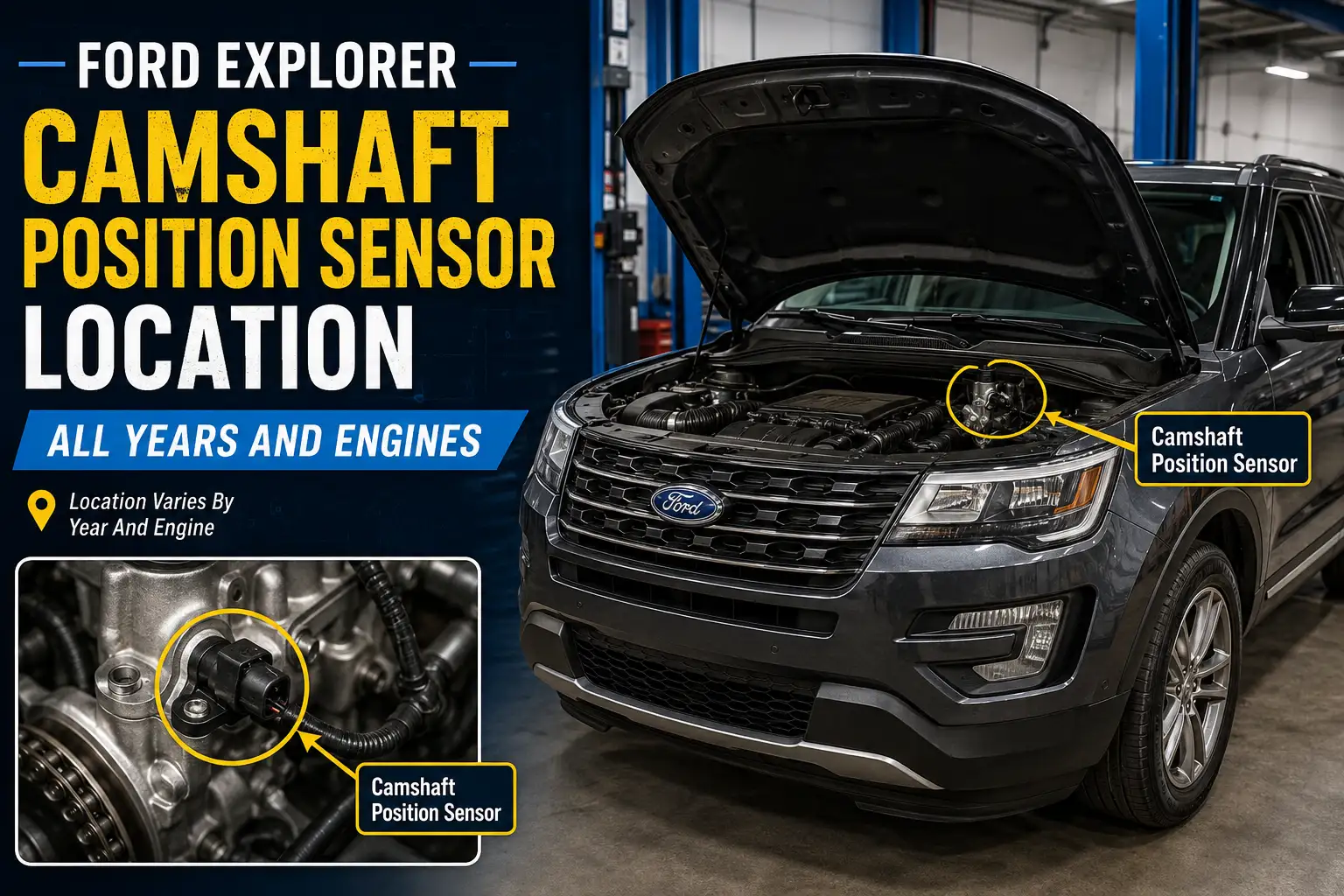
The Ford Explorer camshaft position sensor location depends on the model year and engine. Older 4.0L OHV Explorers place the sensor at the rear of the engine on top of the camshaft synchronizer, while 4.0L SOHC, 4.6L V8, 3.5L V6, 2.3L EcoBoost, and 3.0L EcoBoost engines use different cylinder-head-mounted layouts.
Do not order a sensor based only on the words “Ford Explorer camshaft sensor.” First confirm the engine, then check whether your trouble code identifies Bank 1, Bank 2, Sensor A, or Sensor B.

Prime for Young Adults — 6 Months Free
Students and 18–24s get six months of Prime free, then half price.
Start 6 Months Free As an Amazon Associate I earn from qualifying purchases.
This guide maps those differences so you can identify the correct component before unplugging anything.
Camshaft Position Sensor Location at a Glance
Use the engine layout, bank position, sensor designation, and stored OBD code together. The exact CMP location changes across Explorer engines, so one generic location does not fit every model year.
Identify the 3.5L Engine Orientation
On the transverse 3.5L Explorer, Bank 1 is the rear bank nearest the firewall. Bank 2 is the forward bank nearest the radiator.
Match the OBD Code to the Bank
A stored code helps narrow the correct CMP circuit before you unplug a sensor.
Do Not Confuse CMP and VCT Parts
These parts can sit close together, but they perform different jobs and often have different shapes.
CMP Sensor
- Reads camshaft position
- Sends a signal to the PCM
- Usually a compact electrical sensor
- Commonly linked with P034x codes
VCT Solenoid
- Controls oil flow for cam timing
- Works with the cam phaser system
- Often has a longer solenoid body
- Commonly linked with timing control codes
Use This 5-Step Identification Order
Follow this order before buying or removing a camshaft position sensor.
A P034x code does not automatically mean the camshaft position sensor has failed. Wiring faults, connector problems, VCT faults, and mechanical timing issues can trigger related codes. Match the code and engine layout before replacing parts.
How to Identify Your Explorer Engine First
Recommended Best Deal Products


The safest way to find the CMP sensor is to identify the engine before looking for the part. Ford used several very different engine families in the Explorer.
| Explorer Application | Engine | Basic CMP Layout |
|---|---|---|
| Earlier Explorer | 4.0L OHV V6 | Sensor on camshaft synchronizer at rear of engine |
| Late 1990s to 2010 applications | 4.0L SOHC V6 | Sensor mounted at cylinder-head or valve-cover area |
| 1996 to 2001 V8 models | 5.0L V8 | Sensor mounted on synchronizer near top front of engine |
| 2002 to 2010 V8 models | 4.6L V8 | Separate left and right cylinder-head CMP sensors |
| 2011 to 2019 models | 3.5L V6 | Multiple intake and exhaust CMP sensors |
| Later fifth-generation models | 2.3L EcoBoost | Two CMP sensors on the inline-four engine |
| 2020 and newer performance models | 3.0L EcoBoost | CMP sensors on both cylinder heads |
Ford parts data for the 2016 Explorer confirms that the 3.5L Ti-VCT engine uses separate intake and exhaust camshaft position sensors. The catalog lists two intake sensors and two exhaust sensors for applicable naturally aspirated 3.5L engines.

Audible — Listen Free for 30 Days
One free credit a month and thousands of titles included.
Listen Free for 30 Days As an Amazon Associate I earn from qualifying purchases.For older engines, the difference between OHV and SOHC matters even more. Our Ford Explorer 4.0 V6 engine component diagram can help you identify which 4.0L layout is under the hood before searching for the CMP sensor.
Once you know the engine, the location becomes much easier to narrow down.
Where Is the Ford Explorer Camshaft Position Sensor
The CMP sensor can be at the rear of the block, in a valve-cover area, or on the cylinder head depending on the Explorer engine.
4.0L OHV Sensor Location
On the 4.0L OHV V6, the camshaft position sensor is at the rear of the engine near the firewall. It mounts on top of the camshaft synchronizer, which occupies a location similar to where a distributor would sit on an older engine.
Ford service information for a 1998 Explorer 4.0L VIN X identifies the CMP sensor as being near the rear of the engine.
Owner documentation for 1995 and 2000 4.0L OHV Explorers further describes the assembly as being at the top rear of the engine, close to the firewall and difficult to see from directly above.
Do not confuse this synchronizer-mounted arrangement with the 4.0L SOHC sensor.
4.0L SOHC Sensor Location
The 4.0L SOHC uses a different layout. On late-1990s SOHC Explorers, the CMP sensor is mounted at the driver-side cylinder-head or valve-cover area, rather than on the OHV synchronizer at the back of the block.
Explorer owners with 1998 and 1999 SOHC engines identify the CMP sensor around the driver-side valve-cover area, with several references locating it close to the oil-fill area.
This distinction matters because searching for a generic “4.0 Explorer cam sensor” can return instructions for the wrong engine.
Audible Premium Plus — Annual Membership
12 audiobook credits up front, plus the full Audible catalogue.
See Annual Plans As an Amazon Associate I earn from qualifying purchases.If a 4.0L SOHC also has timing correlation symptoms or chain noise, the Ford 4.0 timing chain layout provides useful context for the camshaft and jackshaft arrangement.
5.0L V8 Sensor Location
On the 5.0L V8 Explorer, the CMP sensor mounts on top of the camshaft synchronizer near the upper front portion of the engine, around the area beneath or near the ignition coil-pack bracket.
Explorer owner repair discussions consistently describe the sensor as sitting on the synchronizer assembly, with coil-pack hardware sometimes obstructing access.
If only the sensor cap is being inspected, do not rotate or remove the synchronizer body unless you understand its alignment procedure. Synchronizer position affects the PCM’s camshaft reference.
4.6L V8 Sensor Locations
The 4.6L V8 does not use the older single synchronizer-mounted arrangement. It uses separate right-hand and left-hand camshaft position sensors on the cylinder heads.
Ford’s 2007 Explorer workshop documentation specifically instructs technicians to disconnect both the RH and LH CMP sensor connectors and separately identifies the RH and LH VCT solenoids.
For the 4.6L 3V, Bank 1 is the passenger side and Bank 2 is the driver side. A P0345 therefore directs diagnosis toward the Bank 2 CMP circuit on the driver-side cylinder head.
The V8 layout is one reason you should use the stored code rather than replacing whichever sensor is easiest to reach.
Where Are the 3.5L Explorer Cam Sensors
Recommended Best Deal Products


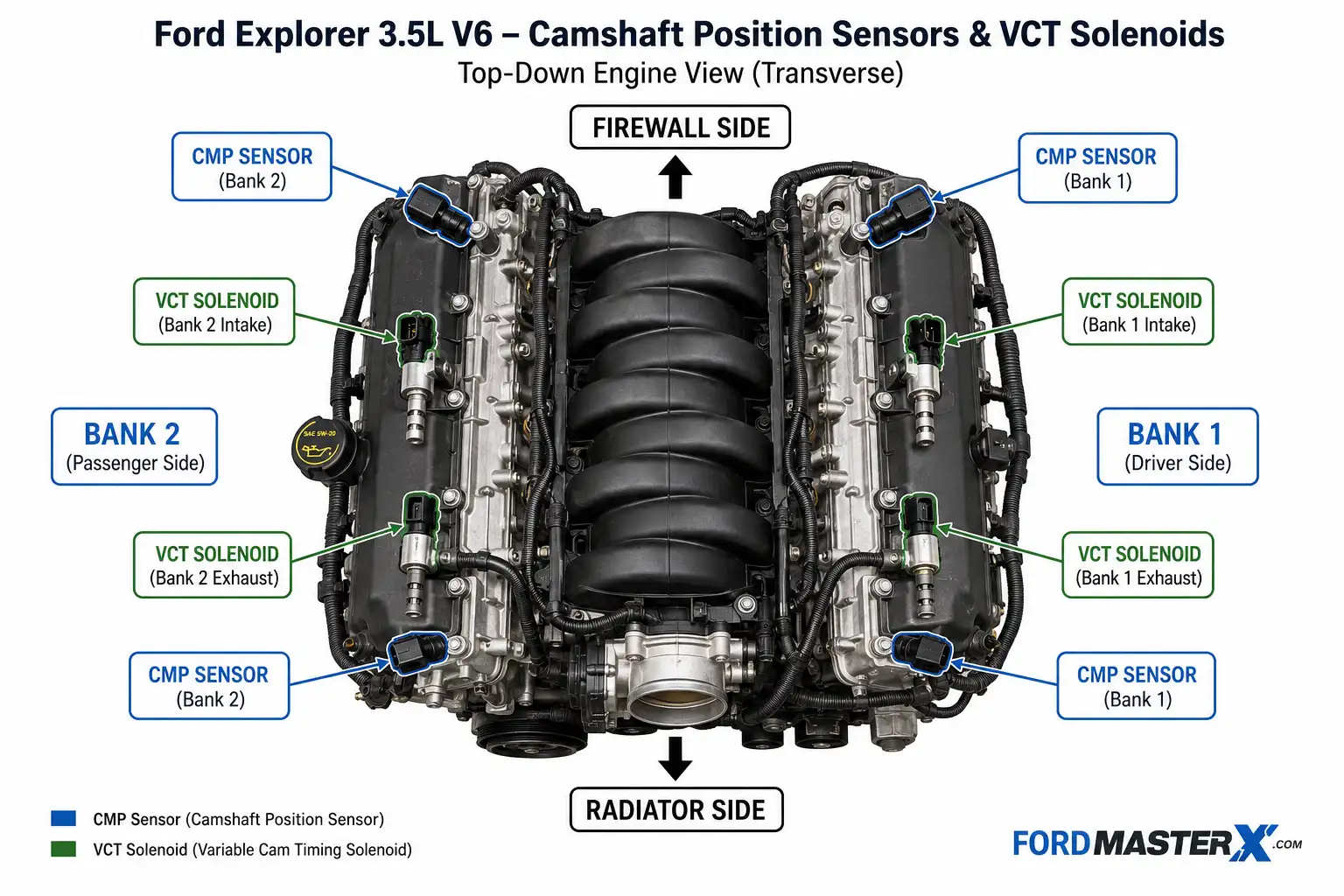
The 2011 to 2019 3.5L Explorer causes the most confusion because the engine is mounted transversely and uses multiple camshaft sensors.
On the naturally aspirated 3.5L Ti-VCT engine, Ford parts data identifies two intake CMP sensors and two exhaust CMP sensors.
Find Bank 1
On the transverse 3.5L Explorer, Bank 1 is the rear cylinder bank closest to the firewall. It contains cylinders 1, 2, and 3.
A documented 2016 Explorer 3.5L diagnosis confirms this orientation and identifies the rear bank as Bank 1.
Standing in front of the SUV, do not assume that the closest physical side to you is Bank 1.
Find Bank 2
Bank 2 is the forward cylinder bank, closer to the radiator. It contains cylinders 4, 5, and 6 on the 3.5L configuration discussed in Ford diagnostic references.
Using “firewall bank” and “radiator bank” is often clearer than relying only on left and right.
Find Sensor A
Ford’s OBD terminology uses Sensor A for the camshaft sensor identified by codes such as P0340 on Bank 1 and P0345 on Bank 2.
On the 2016 3.5L naturally aspirated Explorer, diagnostic information identifies the Bank 1 Sensor A circuit with the intake camshaft position sensor.
The intake sensor on this application uses a different electrical configuration from the exhaust sensor, so matching the connector and part by VIN is safer than choosing by appearance alone.
Find Sensor B
The engine also monitors the exhaust camshaft. On the 3.5L Ti-VCT configuration, separate exhaust CMP sensors are installed for the two banks. Ford parts data lists two exhaust CMP sensors for the naturally aspirated 3.5L application.
If your Explorer has the 3.5L EcoBoost rather than the naturally aspirated 3.5L, verify the VIN and exact engine before ordering parts. For more specific EcoBoost identification, see our 3.5 EcoBoost Bank 1 Sensor A guide.
Where Are the 2.3L and 3.0L Sensors
Later Explorers changed the layout again, so the 2011 to 2019 transverse 3.5L orientation should not be applied to a 2020 or newer SUV.
2.3L EcoBoost Sensor Location
The 2020 Explorer 2.3L EcoBoost uses two camshaft position sensors. Ford replacement-parts data lists the JX6Z-6B288-B sensor for the 2.3L and specifies a required quantity of two.
These sensors mount to the cylinder-head area and monitor the intake and exhaust camshafts of the inline-four engine. Because there is only one cylinder bank, Bank 1 versus Bank 2 identification is not used the same way it is on a V6.
Use the exact code and connector position to distinguish the intake and exhaust circuits.
3.0L EcoBoost Sensor Location
The 2020 Explorer 3.0L EcoBoost uses CMP sensors on both the driver-side and passenger-side cylinder heads.
Ford parts catalog information lists BL3Z-6B288-C camshaft sensors for the 3.0L with both driver-side and passenger-side locations.
Access is more crowded than on the older Explorer engines because turbocharger plumbing and intake components occupy much of the engine bay. Confirm the exact bank and cam designation before removing a sensor.
Which Cam Sensor Matches Your OBD Code
Recommended Best Deal Products


The trouble code is often the fastest way to determine which CMP circuit you need to inspect.
Ford’s published OBD-II code list defines the main CMP Sensor A codes this way.
| Code | Ford Definition | Bank |
|---|---|---|
| P0340 | Camshaft Position Sensor A Circuit | Bank 1 or single sensor |
| P0341 | Sensor A Circuit Range or Performance | Bank 1 or single sensor |
| P0342 | Sensor A Circuit Low | Bank 1 or single sensor |
| P0344 | Sensor A Circuit Intermittent | Bank 1 or single sensor |
| P0345 | Camshaft Position Sensor A Circuit | Bank 2 |
| P0346 | Sensor A Circuit Range or Performance | Bank 2 |
| P0349 | Sensor A Circuit Intermittent | Bank 2 |
P0340 Points to Bank 1
On a V-engine Explorer, P0340 normally directs you to Sensor A on Bank 1. On an engine with a single applicable bank, it refers to that Sensor A circuit.
For the 2016 naturally aspirated 3.5L Explorer, that means the rear firewall-side bank.
P0345 Points to Bank 2
P0345 identifies Camshaft Position Sensor A Circuit Bank 2.
On a 4.6L Explorer V8, Bank 2 is the driver side. On the transverse 3.5L Explorer, Bank 2 is the front bank toward the radiator.
Correlation Codes Need More Diagnosis
A camshaft-related trouble code does not automatically prove that the CMP sensor itself has failed.
Codes involving crankshaft-to-camshaft correlation can also point toward mechanical timing, variable cam timing operation, wiring, connectors, or related components. Replacing a sensor without checking the rest of the code set can waste time and money.
That distinction becomes especially important on engines with Ti-VCT or EcoBoost cam-phaser systems.
Camshaft Sensor vs VCT Solenoid Location
The camshaft position sensor and the VCT solenoid are different components even though they may sit close together.
The CMP sensor measures camshaft position and sends that information to the PCM. The VCT solenoid controls oil flow used to adjust camshaft timing.
| Component | Main Job | Typical Identification |
|---|---|---|
| CMP sensor | Reports camshaft position | Small electrical sensor at cylinder head |
| VCT solenoid | Controls variable cam timing oil flow | Longer solenoid mounted through or near valve cover |
| Cam phaser | Mechanically changes cam timing | Located inside timing system |
This distinction is especially important on the 3.5L Explorer. In a documented 2016 diagnosis, components initially thought to be cam sensors were actually VCT solenoids, while the CMP sensors were positioned at the ends of the cylinder heads.
If you are working on a 3.5L EcoBoost, our 3.5 EcoBoost VCT solenoid location guide can help you distinguish the timing-control solenoids from the actual CMP sensors.
What to Check Before Replacing the Sensor
Finding the correct sensor does not confirm that it is defective.
Before buying a replacement, perform these checks:
- Confirm the stored code. Write down every P034x, P039x, P001x, or P002x code before clearing anything.
- Inspect the connector. Look for loose terminals, broken locks, oil contamination, corrosion, or pulled wires.
- Inspect the harness. Follow the wiring several inches away from the sensor and look for rubbing or heat damage.
- Check for timing-related codes. Cam and crank correlation faults can indicate mechanical timing or VCT issues.
- Verify the engine and bank. Make sure the part being tested actually corresponds to the bank named by the code.
Real owner reports show why this matters. In one 4.6L Explorer case, P0340 remained after multiple components had been replaced, illustrating that a camshaft sensor circuit code should be diagnosed rather than treated as automatic proof of a failed sensor.
If the engine also has chain noise, unstable cam timing, or several correlation codes, diagnose the timing system before repeatedly replacing CMP sensors.
Quick Explorer CMP Location Summary
Use this table as a final orientation check before unplugging a sensor.
| Engine | General CMP Location | Key Identification |
|---|---|---|
| 4.0L OHV | Top rear of engine near firewall | Mounted on cam synchronizer |
| 4.0L SOHC | Driver-side cylinder-head or valve-cover area | Different from OHV synchronizer layout |
| 5.0L V8 | Upper engine near synchronizer and coil-pack area | Sensor sits on synchronizer |
| 4.6L V8 | Left and right cylinder heads | Separate Bank 1 and Bank 2 sensors |
| 3.5L Ti-VCT V6 | Ends of both cylinder heads | Four CMP sensors on NA application |
| 3.5L EcoBoost | Both cylinder-head areas | Verify bank and intake or exhaust sensor |
| 2.3L EcoBoost | Cylinder head | Two CMP sensors |
| 3.0L EcoBoost | Driver and passenger cylinder heads | Multiple bank-specific CMP positions |
The two layouts most likely to cause an identification error are the older 4.0L OHV versus SOHC engines and the transverse 3.5L V6.
Always match the engine before using a sensor-location diagram.
Find the Right Sensor Before Removing It
The Ford Explorer camshaft position sensor location is not one fixed spot across every Explorer generation. A 4.0L OHV can place the sensor at the rear of the engine on a synchronizer, while newer DOHC engines use cylinder-head-mounted sensors for individual camshafts and banks.
Start with your model year and engine. Then read the stored OBD code and determine whether it points to Bank 1, Bank 2, Sensor A, or another cam circuit.
Once those details match, inspect the connector and wiring before replacing the sensor. That approach prevents the most common mistake: removing a nearby VCT solenoid or buying a CMP sensor for the wrong Explorer engine.
Ford Explorer Camshaft Sensor FAQ
Where Is the Camshaft Position Sensor on a Ford Explorer?
The location depends on the engine. A 4.0L OHV places it near the top rear of the engine, while newer 4.6L, 3.5L, 2.3L, and 3.0L engines mount CMP sensors on the cylinder heads.
Where Is Bank 1 on a Ford Explorer 3.5L?
On the transverse 3.5L Explorer, Bank 1 is the rear cylinder bank closest to the firewall. The documented 2016 3.5L layout places cylinders 1, 2, and 3 on that rear bank.
How Many Camshaft Position Sensors Does a Ford Explorer Have?
It depends on the engine. The 2016 naturally aspirated 3.5L uses two intake and two exhaust CMP sensors, while the 2020 2.3L EcoBoost parts catalog specifies two CMP sensors.
Does P0340 Mean the Camshaft Sensor Is Bad?
No. P0340 means the PCM detected a problem with the Camshaft Position Sensor A circuit for Bank 1 or the single applicable sensor. Wiring, connectors, signal problems, and mechanical timing faults can also require diagnosis.
What Is the Difference Between Sensor A and Sensor B?
Sensor A and Sensor B identify different camshaft sensing positions on engines that monitor multiple cams. On applicable Ford DOHC engines, the designation can correspond to intake versus exhaust cam monitoring, so use the exact engine and code rather than assuming both sensors are interchangeable.