
Ford Code P0171 and P0174: Strategically Diagnosed and Fixed

Seeing the Check Engine Light flicker on with Ford code P0171 and P0174 is a frustration every owner dreads, but it isn’t necessarily a death sentence for your engine. These codes indicate a “system too lean” condition on both banks, signaling that your engine is struggling to find the perfect balance of air and fuel. In this guide, we will walk you through the professional approach to diagnosing and fixing these codes, helping you avoid costly, unnecessary parts replacements.

Understanding the Ford Code P0171 And P0174 Lean Condition
📤 Share Image
What Does a Lean Condition Mean?
At its core, a “lean” condition means the Powertrain Control Module (PCM) has determined there is an excess of oxygen in the exhaust gases relative to the amount of fuel being injected. Think of it like a fireplace: if you pump in too much air and not enough wood, the fire burns thin, inefficiently, and much hotter than it should. Your engine requires a precise chemical balance to maintain performance and prevent damage to internal components.

Why Both Banks Fail Simultaneously
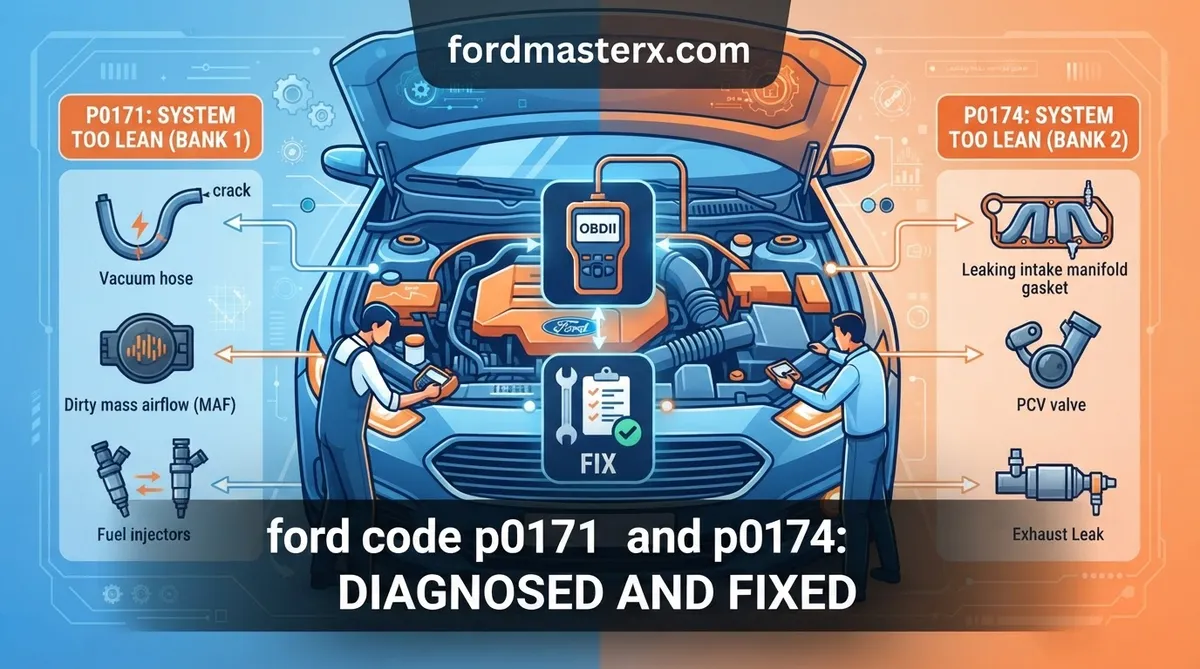
Code P0171 refers to Bank 1, and P0174 refers to Bank 2. When they pop up together, it is a clear diagnostic signal. Since Bank 1 and Bank 2 have separate exhaust streams but share the same intake system, a simultaneous fault tells the expert technician that the problem is “upstream.” It is not an issue with the fuel injectors or valves of one specific cylinder head; it is a global issue—likely unmetered air entering the engine after the Mass Air Flow (MAF) sensor has already taken its reading.
The Role of Stoichiometric Ratios
The ideal stoichiometric ratio for a gasoline engine is 14.7 parts air to 1 part fuel. The PCM uses the MAF sensor to measure incoming air and calculates fuel delivery based on that. If air sneaks into the engine through a torn rubber boot or a cracked vacuum line, the engine burns “lean.” The O2 sensors detect the extra oxygen in the exhaust, and the PCM triggers these codes to protect the engine from the damage caused by these high-temperature, lean-burn conditions.
Analyzing Fuel Trim Data for Ford Code P0171 And P0174
Short Term vs. Long Term Fuel Trim Explained
To perform a professional diagnosis, you need a quality OBD-II scanner capable of reading live data. Short Term Fuel Trim (STFT) shows real-time adjustments the computer makes to maintain the 14.7:1 ratio. Long Term Fuel Trim (LTFT) represents the persistent, learned corrections the PCM has applied over time to compensate for a steady lean condition. If your LTFT is high—usually above +10%—the engine is fighting a chronic issue.
Interpreting High Fuel Trim Data
Research and industry experience confirm that when LTFT values exceed +20% or +25%, the PCM is nearing the limit of its adjustment range. If the scan tool shows high positive numbers at idle but they decrease when you rev the engine, this is a classic “smoking gun” for a vacuum leak. If the numbers stay high even at higher RPMs, you are likely looking at a fuel delivery issue, such as a failing fuel pump or a clogged fuel filter.
Pitfalls of Replacing O2 Sensors Early
One of the most common mistakes I see in the shop is the “shotgun approach”—replacing all oxygen sensors immediately. In 90% of cases, the O2 sensors are doing their job perfectly; they are accurately reporting that the engine is lean. Replacing them is a waste of money because the sensor is not the cause, it is the messenger.
By The Numbers
Typical LTFT threshold for concern
Common PCM diagnostic limit
Step-by-Step Ford P0171 And P0174 Repair Procedures
📋
Professional Diagnosis Workflow
Inspect all rubber intake boots for cracks. Use a smoke machine to pressurize the intake manifold; smoke will escape from any hairline fractures in lines, PCV elbows, or intake gaskets.
Use an aerosol MAF sensor cleaner. Never touch the delicate wires with a cloth. If the sensor is contaminated with debris, it will miscalculate airflow, leading to lean codes.
Attach a fuel pressure gauge to the test port. Compare your readings to your specific model’s factory specifications. A failing pump or a clogged filter will result in a drop in pressure under load.

Audible — Listen Free for 30 Days
One free credit a month and thousands of titles included.
Listen Free for 30 Days As an Amazon Associate I earn from qualifying purchases.Ford P0171 And P0174 Troubleshooting Fallbacks
If your initial inspection reveals no obvious vacuum leaks or MAF sensor contamination, follow these advanced steps:
- Intake Manifold Gaskets: On engines with higher mileage, particularly those with plastic intakes, the gaskets can dry out and shrink. This is a common failure point that is often invisible to the naked eye.
- Exhaust Leaks: A leak before the upstream oxygen sensor can draw in outside air, tricking the sensor into reporting a lean condition. Inspect exhaust manifolds and downpipes for soot trails.
- Road Test Cycles: After any repair, clear the trouble codes. Take the vehicle through at least two complete drive cycles—including cold starts and highway driving—to ensure the fuel trim values reset and stabilize at near-zero levels.
- Professional Intervention: If your fuel trims remain erratic, it is time to consult a professional. Electrical issues, such as a failing PCM or harness ground, are rare but possible, requiring advanced diagnostic equipment like an oscilloscope to confirm.
Safety and Long-Term Impact of Engine Lean Codes
Ignoring these codes is not advisable. A lean engine runs significantly hotter than the factory design dictates, which dramatically increases the stress on internal components like valves and pistons. This excess heat is the primary cause of eventual catalytic converter failure; if the engine misfires due to a lean condition, raw oxygen and unburned fuel hit the catalyst, leading to a meltdown of the precious metals inside.
Driving under lean conditions frequently leads to ignition misfires. If you notice a flashing Check Engine Light, stop driving immediately. A misfire confirms the engine can no longer sustain combustion, and further operation will cause permanent, expensive damage to your catalytic converters.
In summary, P0171 and P0174 suggest a common source of unmetered air or fuel delivery failure. Always prioritize fuel trim data diagnostics over swapping parts like O2 sensors. Common culprits include vacuum leaks, dirty MAF sensors, and failing PCV components. If your fuel trims remain erratic after following these steps, reach out to a trusted Ford specialist to perform a professional smoke test to identify the leak.
Ford Code p0171 and p0174: Frequently Asked Questions
Can a dirty MAF sensor cause these codes?
Yes. A dirty Mass Air Flow (MAF) sensor is a very common cause for P0171 and P0174. When the sensor’s heating element is coated with oil or debris, it under-reports the amount of air entering the engine. The PCM subsequently limits fuel flow, causing the system to run lean. Cleaning the sensor with professional-grade MAF cleaner is a standard first step in diagnostics.
Is it safe to drive with these codes?
It is generally not recommended to drive long-term with these codes. A lean condition results in higher combustion temperatures, which can lead to engine misfires and, more critically, severe damage to your catalytic converters. The repair costs associated with replacing a catalytic converter far exceed the costs of addressing a vacuum leak or sensor issue early on.
Could bad gas cause these codes?
While rare, bad or low-octane fuel can theoretically cause performance issues. However, P0171 and P0174 are typically indicative of mechanical failures rather than fuel quality. If you recently refueled before the codes appeared, it is possible, but you should prioritize checking for vacuum leaks and MAF sensor health before assuming the fuel itself is the root cause of the error.
Is this a sign that my fuel pump is failing?
Yes, a failing fuel pump is a frequent cause for these codes. If your fuel pump is unable to maintain the necessary pressure at the fuel rail, the engine will run lean under load. You can verify this by checking the fuel pressure with a mechanical gauge. If the pressure drops significantly during acceleration, the fuel pump is likely reaching the end of its service life.
Why do P0171 and P0174 often appear at the same time?
These codes appear simultaneously because the defect exists in a system common to both cylinder banks. Because the air intake and fuel delivery systems serve the entire engine, a fault like a vacuum leak in the main intake manifold or a low-pressure fuel supply will register as a lean condition across both banks, triggering both diagnostic codes at the same time.
Audible Premium Plus — Annual Membership
12 audiobook credits up front, plus the full Audible catalogue.
See Annual Plans As an Amazon Associate I earn from qualifying purchases.