
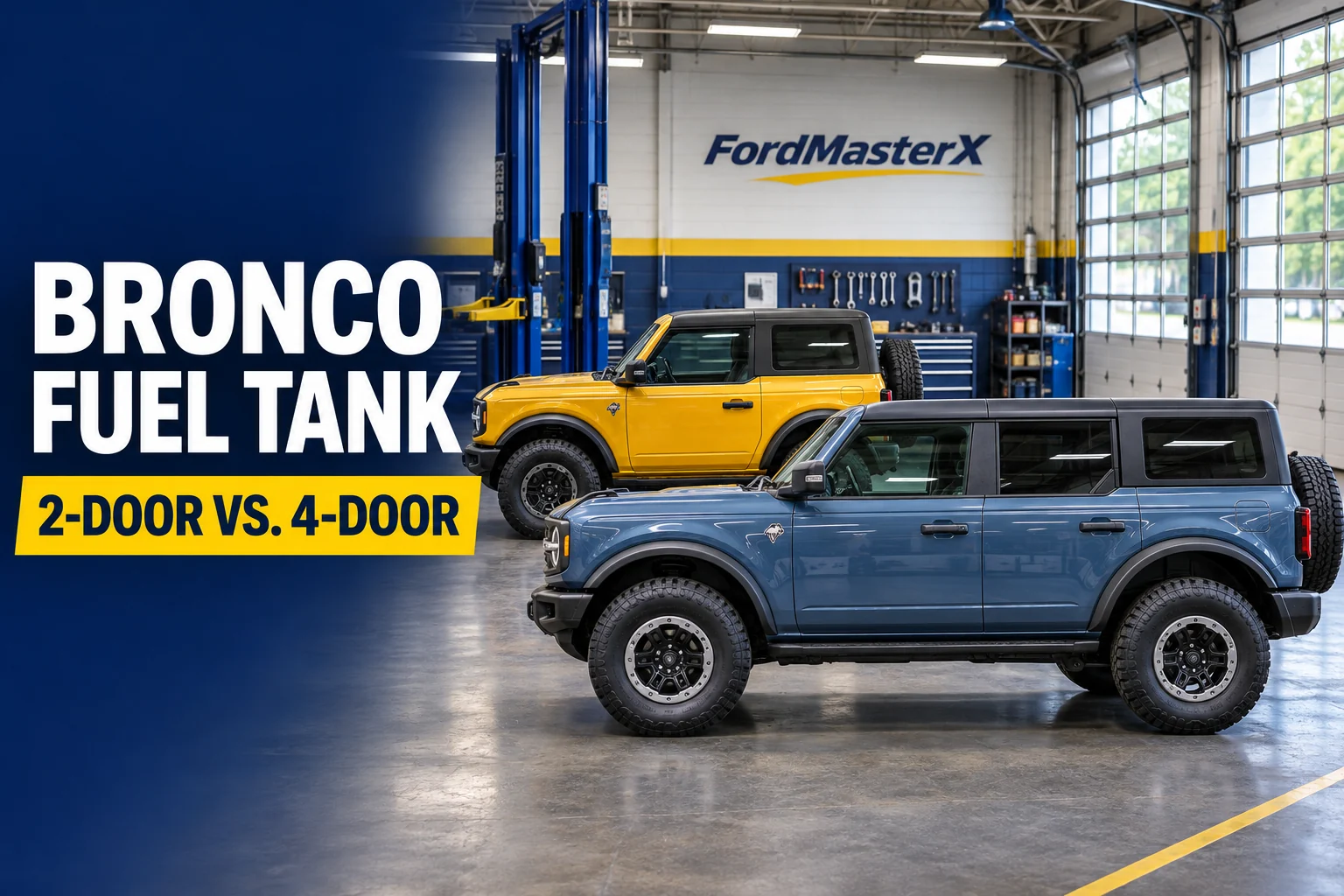
Ford Bronco Fuel Tank Capacity: 2-Door vs. 4-Door

Ford’s 2026 Bronco technical specifications list a 16.9-US-gallon tank for the two-door and 20.8 US gallons for the four-door. The 2026 owner’s manual gives a different pair: 17.4 gallons for the short wheelbase and 21.1 gallons for the long wheelbase. Both are Ford figures, and the short- and long-wheelbase labels refer to the two- and four-door versions, respectively, in the full-size Bronco specifications.
Use the chart below to compare the same source across the two body styles. If you need a number for your particular vehicle, use the fuel-capacity section of the manual that matches your model year and build. When planning a trip, use your actual fuel economy and allow a margin between refueling stops. A pump receipt is a record of fuel added on that stop.


Ford Bronco fuel tank capacity chart
- 2-door, technical specifications
- 16.9 US gal
- 4-door, technical specifications
- 20.8 US gal
- Short wheelbase, owner's manual
- 17.4 US gal (66 L)
- Long wheelbase, owner's manual
- 21.1 US gal (80 L)
Ford publishes two sets of figures. Confirm the applicable model-year manual for your vehicle.
| 2026 U.S. full-size Bronco | Ford technical specifications | Ford owner’s manual |
|---|---|---|
| Two-door, short wheelbase | 16.9 US gal | 17.4 US gal (66 L) |
| Four-door, long wheelbase | 20.8 US gal | 21.1 US gal (80 L) |
Ford’s 2026 Bronco technical specifications give the first column in the Fuel Tank Capacity table. The 2026 Bronco owner’s manual, in Fuel and Refueling, gives the second under “Capacities.” The technical specifications list wheelbases of 100.4 inches for the two-door and 116.1 inches for the four-door, which is why the owner-manual rows map to those body styles.
The differences are 0.5 gallon for the two-door and 0.3 gallon for the four-door between these publications. Ford does not explain that discrepancy in the capacity tables cited here. The manual describes advertised capacity and empty reserve separately, but it does not say that the difference between these two publications is the reserve. Avoid using the difference to estimate how much fuel remains after the gauge reads empty.
Why you may see different capacity numbers

A dealer specification, a Ford media sheet, and an owner’s manual can give you different answers while all referring to a Bronco. For an apples-to-apples comparison, keep the model year, market, body style, and publication the same. The capacity figures in the technical-specification table use door count. The manual’s table uses wheelbase. A listing that gives only an engine or trim can leave you without the detail you need to choose the right row.
Consider a listing for a two-door Badlands that quotes 17.4 gallons. Another listing for a two-door quotes 16.9. Those two figures appear in the official sources above, so the difference alone does not establish that either truck has an upgraded tank. First ask which document the listing used, then verify the actual body style and model year. If you need the tank assembly for a repair, verify parts compatibility using the VIN and the truck’s exact build.
The 2025 Bronco owner’s manual is a better starting point for a 2025 owner than a generic current-model comparison. Search the manual for “Fuel Tank Capacity” and use the applicable row. Ford may revise documentation over time, so keep the edition and market together when sharing a capacity figure with a dealer or shop.
Which number should I use?
For a comparison between 2026 two- and four-door vehicles, the Ford technical sheet provides a clear door-count comparison. If you’re standing beside your own truck and want the operating reference, use the corresponding entry in the exact-year owner’s manual. If you are deciding how far to drive before refueling, build a plan around observed consumption and the route. Each of those tasks uses the published figure differently.
Published capacity is especially easy to misuse on a used Bronco. The presence of aftermarket equipment, previous damage, or repairs is a separate question from the original design. A used-vehicle listing gives you a starting point. Inspect the actual vehicle and verify with parts records when there is a reason to believe the tank or related components have changed.


Does the engine or trim change the answer?


The 2026 Ford media capacity table groups the full-size Bronco by door count. It does not give separate capacities in that table for the 2.3-liter and 2.7-liter engines. If you are comparing a 2.3-liter four-door to a 2.7-liter four-door, check both against the four-door source entry, then compare fuel economy separately. Tank capacity and miles per gallon are different inputs to range.


The Raptor is a four-door in the 2026 technical specifications. Use the four-door row when reading that particular capacity table, and confirm the capacity and applicable instructions in the manual or Ford data for the specific Raptor you own. The same approach helps with special editions, where the model name by itself does not tell you how a past year or package was configured. The Bronco model comparison helps establish which model and door configuration you are comparing.
On a used truck, check the doors in the photographs and verify the written body style before comparing two listings. A description like “Bronco Badlands” can refer to a full-size Bronco or a Bronco Sport. Check the complete model name before choosing a table or trying to identify parts.
Bronco Sport tank capacity is separate


The 2026 Bronco Sport owner’s manual specifies 16.9 US gallons (64 L), including reserve. That is the Bronco Sport’s own published figure. It happens to match the number in the 2026 full-size two-door technical sheet. It does not make the two models, tank assemblies, or manuals interchangeable.


If an online listing shows a four-door vehicle with a 16.9-gallon tank, first establish whether it is a Bronco Sport. Every Bronco Sport has a different model identity from the full-size Bronco, even if the listing shortens the name. Our Bronco and Bronco Sport comparison explains the distinction. For maintenance or repair work, record the exact model and year before looking up parts.
Why the pump may take less than the published capacity
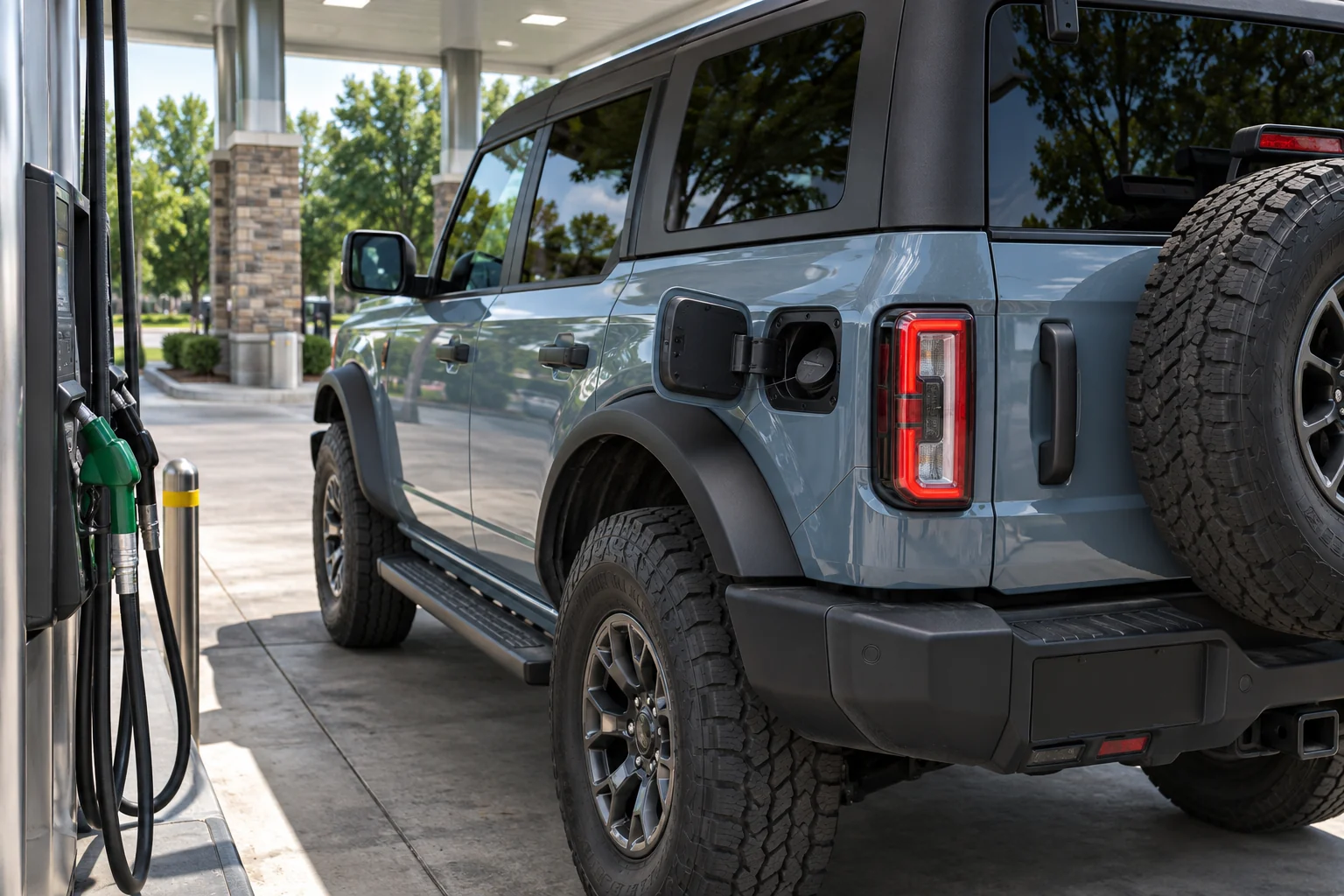
Ford’s owner manual explains that an empty reserve remains when the gauge indicates empty, and that a refill can take less than the advertised capacity. The amount that goes into the tank also depends on how much was there at the start. Neither a low-fuel warning nor a low distance-to-empty reading tells you the actual gallons that a pump will dispense.
A four-door owner who puts in 17 gallons after a low-fuel warning has learned the size of that refill. It is not proof that the tank holds only 17 gallons. Similarly, a pump that shuts off with a reading that differs from the manual does not by itself identify a problem. Follow the normal refueling instructions and stop after the first automatic nozzle shutoff, following the Ford manual.
If you see a persistent change in fill behavior, note the gauge level at the start and whether the pump repeatedly stops early. A pump-specific result is easier to distinguish when you have receipts from more than one station. If the cluster reports a refueling fault, follow its instructions and have an ongoing issue checked. Avoid using a single refill to calculate empty reserve or diagnose a fault.
What distance to empty is telling you
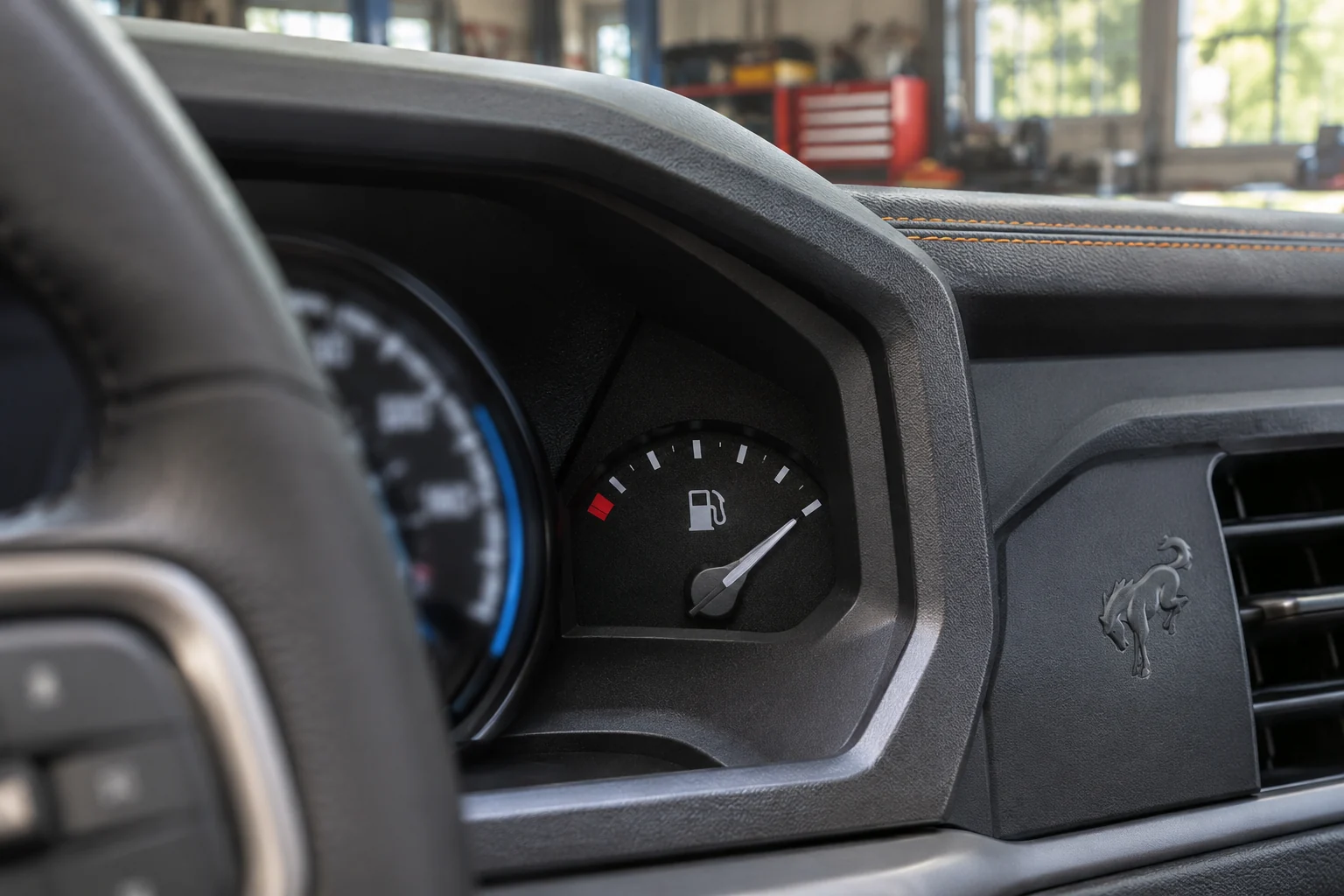
Distance to empty is an estimate of remaining driving distance. It changes as driving conditions and fuel consumption change. A trip that begins on a highway can turn into slow climbing, traffic, or trailer towing. The vehicle has not lost tank capacity when its estimated miles remaining change faster than the miles you drove.
Treat a low-fuel warning as a prompt to refuel as soon as possible rather than a chance to measure the reserve. This is particularly important away from familiar stations. When a route has long gaps between stops, choose your next stop with extra room for changing conditions, closures, or a detour.
How much more range can the four-door provide?
The 2026 technical sheet gives the four-door 3.9 gallons more than the two-door. If both vehicles average a hypothetical 18 mpg, multiplying 3.9 by 18 gives about 70 miles of additional mathematical range. That example isolates the capacity difference. It is neither an EPA rating nor a prediction of how far you can safely drive.
| Illustrative calculation using the technical-sheet figures | Two-door | Four-door |
|---|---|---|
| Published capacity | 16.9 gal | 20.8 gal |
| Assumed average fuel economy | 18 mpg | 18 mpg |
| Capacity multiplied by assumed MPG | 304 mi, rounded | 374 mi, rounded |
Actual consumption may differ between vehicles because of configuration and use. Tires, speed, cargo, weather, towing, terrain, and time spent idling affect the result. You can use the same equation with your own observed MPG as a comparison tool, but the output assumes the entire published amount is used. A route plan should leave a margin and use known fuel stops.
To get a useful real-world MPG estimate, record distance traveled and gallons added over multiple fills with a consistent refueling routine. Divide the total distance by the total gallons added. A multi-fill result is more useful than one tank that happened to include unusually favorable or difficult conditions. For a towing or off-road trip, use readings from similar driving where you have them.
Compare US gallons and liters without mixing units
Ford’s U.S. documents use U.S. gallons. If an imported listing uses imperial gallons or lists liters only, normalize the units before concluding that the tanks differ. One U.S. gallon is about 3.785 liters. The 16.9- and 20.8-US-gallon figures therefore convert to about 64.0 and 78.7 liters, respectively. Ford’s manual rounds 17.4 and 21.1 gallons to 66 and 80 liters in its own table. Keep each liters figure paired with the gallons figure from the same document.
A listing that says “80 liters” points toward the long-wheelbase number in the 2026 manual. A listing that says “78.7 liters” is consistent with the 20.8-US-gallon technical-sheet figure. The source difference remains after conversion. Using the same unit can reveal an apparent mismatch from rounding or conversion, but does not reconcile every published difference.
Turn an observed fuel log into a trip plan
Suppose you covered 320 miles over two fills totaling 20 gallons in similar driving. Your observed average is 16 mpg. At that rate, a 180-mile leg would use an estimated 11.25 gallons. Starting with a known full tank and scheduling a station along the route gives you a way to use the estimate without relying on fuel below the gauge’s empty mark. If the next leg includes sand, sustained climbing, or towing, plan for higher consumption or choose an earlier stop.
Calculate each trip leg separately when services are sparse. Distinguish a station that is reliably open from one that merely appears in a map listing. For a range estimate, keep an allowance for changing consumption and an unexpected detour rather than using the entire published tank capacity as your budget.
Common fuel tank capacity questions
Is the Ford Bronco tank 16.9, 17.4, 20.8, or 21.1 gallons?


All four figures appear across the two 2026 Ford documents cited here. The technical sheet uses 16.9 and 20.8 gallons for two- and four-door models. The owner’s manual uses 17.4 and 21.1 for short and long wheelbases. Quote the document and body style when using a figure for comparison or service.
Does the four-door always travel farther on a tank?
It has more listed capacity within each of the source comparisons above. Actual driving range also depends on MPG. A four-door Bronco operating under heavier load can use fuel more quickly than a two-door on an easy drive. Use a consistent fuel-economy assumption if you want to isolate capacity, then replace it with realistic figures for the vehicles and trip you are comparing.
Can I find tank capacity from a pump receipt?


A receipt shows how much fuel went in after the fuel already in the tank. Use the manual or Ford’s vehicle specification to identify published capacity. Receipts are useful for tracking fuel consumption over time and documenting a pattern that you can describe to a repair shop.
What do I tell a parts counter?
Give the parts counter the VIN, model year, model name, door count, and the component you need. If you know that a replacement tank or other related hardware is already fitted, mention it. Two vehicles with the same published capacity do not necessarily use interchangeable hardware, and the capacity figure alone is not enough to order a replacement tank or fuel-system part.
What is the quickest way to resolve two different numbers?
Check the document title, model year, and market first. Then match “short wheelbase” or “long wheelbase” to the two- or four-door configuration. If both figures are from Ford and both documents cover your model year, keep them labeled as separate published figures. For service or a configuration-specific concern, ask Ford or a dealer to verify against your VIN. For refueling decisions, follow the exact-year manual and your vehicle’s active warnings.