
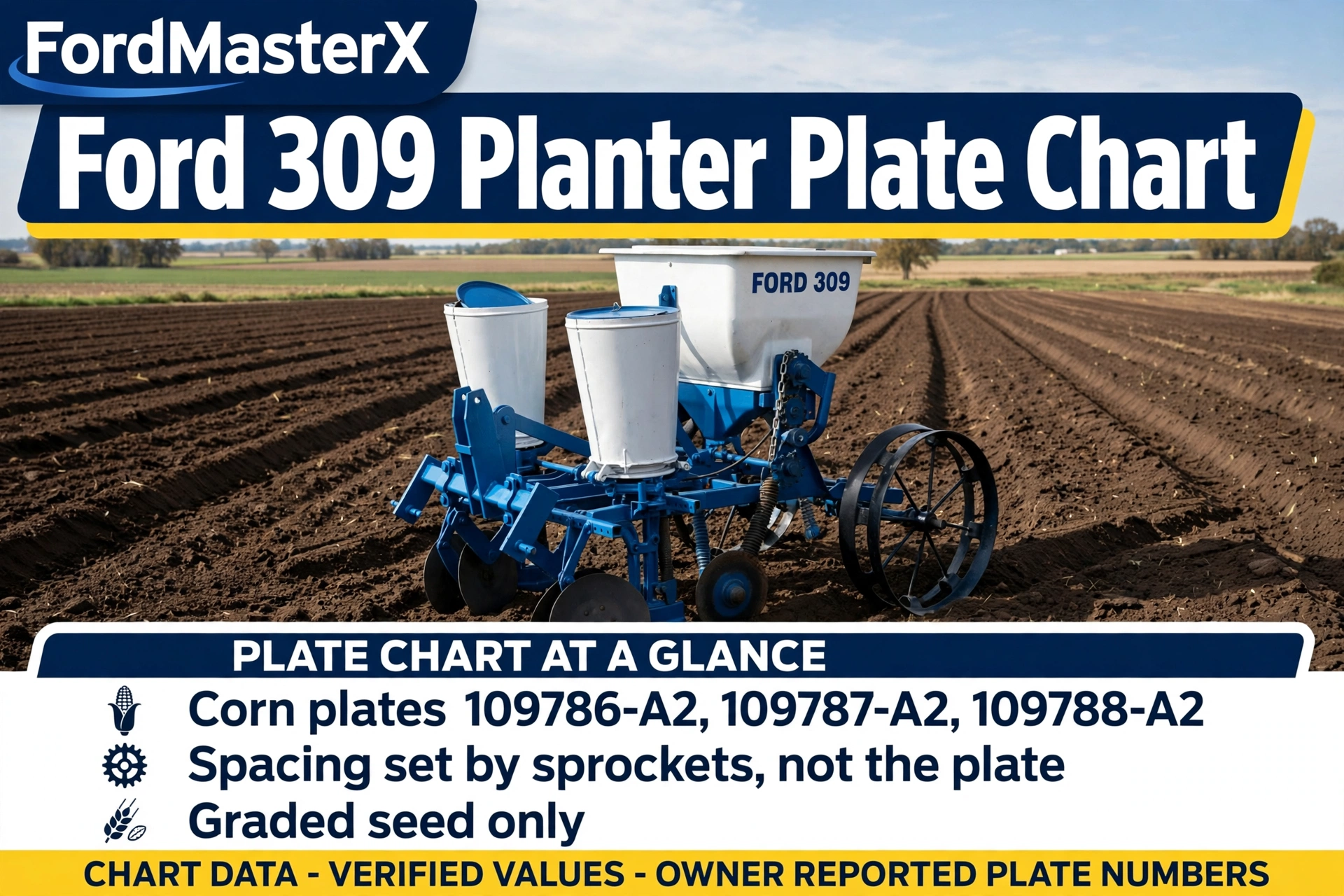
Ford 309 Planter Plate Chart 2026: Complete Seed Plate Guide

The ford 309 planter plate chart has one direct answer. Match the plate to your graded seed size, and set spacing with the drive sprockets, not the plate.
Three corn plate numbers show up in owner hands. They are 109786-A2, 109787-A2, and 109788-A2.
Ford built the 309 as a mechanical plate planter. New Holland parts records for the 309 series start in January 1955.
FordMasterX built this guide for owners who run a vintage 309 today. It gives the plate chart by crop. It also shows how to match a plate, set spacing, and find parts.


The Short Answer in 5 Facts


Five facts answer most questions about this chart. The table holds them. The infographic below gives the same facts to save or share.
| Fact | What it means for you |
|---|---|
| Three verified corn plates | 109786-A2, 109787-A2, and 109788-A2, all owner-reported plastic plates |
| Plate picks the seed size | The plate notch must fit your graded seed |
| Sprockets set the spacing | The plate never sets seed spacing on a 309 |
| Round plates suit odd seed | Round plates handle ungraded or odd-shaped seed better |
| Manuals still exist | New Holland still carries the operator manual and parts manual |
.fmx-309-plate-chart{font-family:Arial,Helvetica,sans-serif;max-width:760px;margin:24px auto;color:#1a2733}
.fmx-309-plate-chart h3{font-size:20px;margin:0 0 4px;color:#0b2a4a}
.fmx-309-plate-chart p.fmx-sub{font-size:14px;color:#4a5a68;margin:0 0 16px}
.fmx-309-plate-chart table{width:100%;border-collapse:collapse;font-size:14px;line-height:1.45}
.fmx-309-plate-chart th{background:#0b2a4a;color:#fff;text-align:left;padding:10px 12px}
.fmx-309-plate-chart td{padding:10px 12px;border-bottom:1px solid #d5dde4;vertical-align:top}
.fmx-309-plate-chart tr:nth-child(even) td{background:#f2f6f9}
.fmx-309-plate-chart .fmx-callout{background:#0b2a4a;color:#fff;border-radius:8px;padding:14px 16px;margin:16px 0 0}
.fmx-309-plate-chart .fmx-callout strong{color:#ffc72c}
.fmx-309-plate-chart .fmx-callout p{margin:0;font-size:14px;line-height:1.5}
.fmx-309-plate-chart .fmx-note{font-size:13px;color:#4a5a68;margin:14px 0 0}
@media (max-width:560px){.fmx-309-plate-chart table{font-size:13px}.fmx-309-plate-chart th,.fmx-309-plate-chart td{padding:8px}}
Ford 309 Plate Chart at a Glance
Plate types and verified plate numbers, from owner reports and New Holland records.
| Crop | Plate to use | Verified number |
|---|---|---|
| Corn, graded seed | Flat or round corn plate | 109786-A2, 109787-A2, 109788-A2 |
| Sweet corn, odd-shaped seed | Round plate | 109787-A2, owner-reported |
| Beans | Bean plate | None verified |
| Cotton | Cotton plate | None verified |
| Pumpkins and large seed | Blank plate | None verified |
Direct answer: Match the plate notch to your graded seed size. Set seed spacing with the drive sprockets, never with the plate.
Sources: Yesterday’s Tractors owner threads; New Holland MyCNH parts records for the 309 series. Plate numbers are owner-reported, not factory-confirmed. The New Holland parts book holds the full seed plate size chart.
The chart above is the short version. The rest of this guide gives the full chart by crop. It also gives the plate matching steps and the sprocket spacing test.
Ford 309 Planter Plate Chart by Crop
The plate does one job. It picks up one seed at a time and drops it into the furrow. The notch size decides which seed it can pick up.
That is why the seed grade matters more than the crop name. A plate notch fits one seed size. It does not fit every seed of one crop.
The Yesterday’s Tractors plate numbers thread makes this point in plain terms. There is no sweet corn plate or field corn plate. Plate notches are sized for a graded seed size.
Buy graded seed to match the plate you own. Or buy the plate to match the graded seed you can get.
Either order works. Mixing them does not.
| Crop | Plate to use | Verified number | What to know |
|---|---|---|---|
| Corn, graded seed | Flat or round corn plate | 109786-A2, 109787-A2, 109788-A2 | Owner-reported numbers; match graded seed to the notch |
| Sweet corn, odd-shaped seed | Round plate | 109787-A2 | One owner links it to Silver Queen; treat it as a lead, not a factory spec |
| Beans | Bean plate | None verified | Bean plates exist; check the NH seed plate size chart |
| Cotton | Cotton plate | None verified | NH lists a corn and cotton hopper for the 309 |
| Pumpkins and large seed | Blank plate | None verified | Cut your own notches; blank plates cost extra |
Three numbers in that chart need care. All three come from owners, not from a factory chart.
Two owners report holding 109786-A2 and 109788-A2 plastic plates. A third owner reports a set of 109787-A2 plates.
The Silver Queen link is weaker still. One owner wrote that his 109787-A2 plates were for Silver Queen, and added that he only thought so. Use that number as a lead to check, not as a confirmed match.
Flat plates and round plates both exist for corn. Flat plates suit round, uniform seed. Round plates suit odd-shaped seed that does not sit flat in a cell.
Owners report that a round plate does better with ungraded seed. Sweet corn kernels vary in shape, so a round plate copes with them better than a flat plate does.


For beans and cotton, no plate number could be verified. Owners confirm that bean plates and cotton plates exist. The New Holland parts book holds the full seed plate size chart, and that book is the place to look up those numbers.
Sellers also list plates for soybeans and other crops. No factory chart we could check confirms a soybean plate number for the 309. Check the parts book before you buy one of those.
Use the chart to pick the plate type first. Then confirm the number in the parts book. The number on the plate itself is the final check.
How a Ford 309 Seed Plate Works
The 309 is a mechanical plate planter. No electronics meter the seed. A chain drive turns the seed plate, and the plate drops seed into the furrow.
New Holland lists the 309 under its rear lift planter line. The planter mounts behind the tractor and lifts on the hitch.
Each row unit has its own seed box, plate, seed tube, and press wheel. The parts work as one chain from the box to the soil.
The Plate and Seed Cup


The seed plate sits at the bottom of the seed box. It turns slowly as the planter moves. Each notch in the plate picks up one seed.
The seed cup holds the seed against the plate until the notch passes the drop point. Then the seed falls through the seed tube into the furrow.
A worn plate picks up two seeds at once. A dirty plate picks up none. Both faults show up as uneven stands in the field.
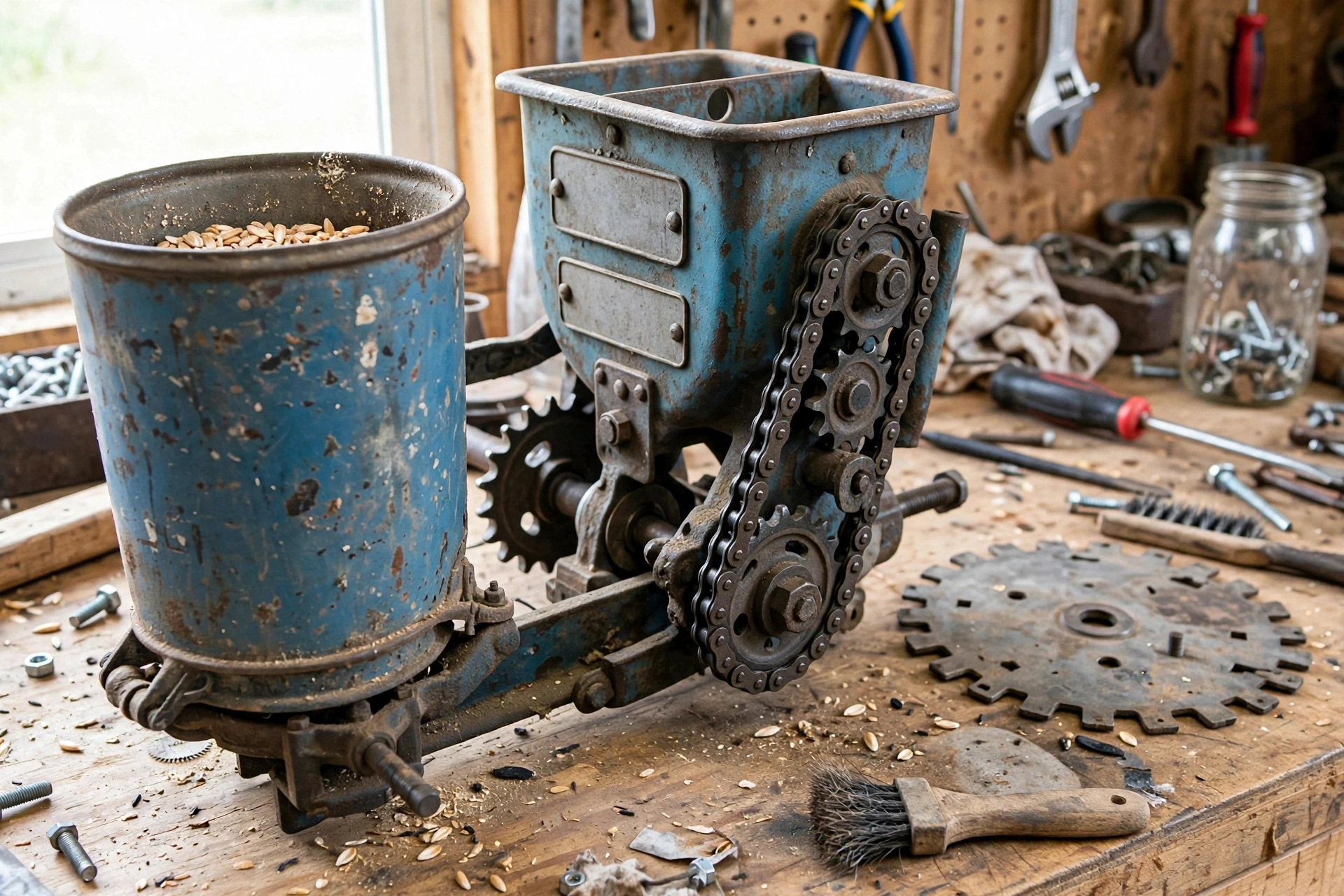
AI-generated illustration: a close-up of a Ford 309 planter seed plate and metering unit for a ford 309 planter plate chart guide. It shows the notched plate, seed cup, and drive chain.
The photo shows the metering unit on a bench. The notched plate, the seed cup, and the drive chain are all in view.
The Chain Drive and Sprockets
A chain drive links the press wheel to the seed plate. The press wheel turns as the planter rolls. The chain carries that motion to the plate shaft.
Sprockets on the axle and on the plate drive shaft set the gear ratio. That ratio sets how fast the plate turns for each foot the planter travels.
Change the sprockets and the plate turns faster or slower. The seed spacing in the row changes with it.
The Press Wheel and Runner
The runner opens the furrow in front of the seed tube. The seed drops into that furrow. The press wheel follows and firms soil over the seed.
The press wheel also drives the whole metering system. That is why the spacing test in this guide uses the press wheel as its measure.
Once you see how the parts link together, the spacing rule makes sense. The next sections use that rule to match plates and set spacing.
How to Match a Plate to Your Seed
Match the plate before planting day. A wrong plate wastes seed and leaves gaps in the row. A right plate gives even stands with little waste.
Work in this order: seed first, plate second, test third. Each step depends on the one before it.
Buy Graded Seed First
Buy graded seed for the plate you own. Graded seed has a known size range. The plate notch is cut for that range.
Ask the seed seller for the grade, not just the variety. A variety name tells you nothing about kernel size. The grade tells you what the plate will see.
If you already own seed, read its grade from the bag tag. Then look up the plate that matches that grade in the parts book.
Match the Notch to Seed Size
Hold a few kernels in the plate notch. Each notch should hold one kernel with a snug fit.
A kernel that rattles in the notch will double up. A kernel that will not sit in the notch will skip.
Check the notch size against the plate number. The number is stamped on the plate. Match it to the parts book entry for your seed grade.
For odd-shaped seed, pick a round plate. Round plates grip the narrow end of the seed. Flat plates work best with round, uniform kernels.
Test the Plate Before Planting
Turn the plate by hand with seed in the box. Watch each notch pass the drop point. Count singles, doubles, and skips over twenty drops.
A good match gives mostly singles. Frequent doubles mean the notch is too big for the seed. Frequent skips mean the notch is too small, or the plate is worn.
Fix the match now, not in the field. A plate swap takes minutes in the shop. A replant takes a whole day.
How to Set Seed Spacing With Sprockets
The plate never sets seed spacing on a 309. The sprockets set it. Owners who learn this rule first save themselves a season of wrong stands.
The Yesterday’s Tractors 309 planter thread states the rule in plain terms. The sprocket on the axle and the shaft for the seed plate drive will determine the spacing. The plate will not.
Set spacing by test, not by guess. The field test below takes about fifteen minutes per row unit.
Measure the Press Wheel First
Lift the planter into transport mode. Measure the circumference of the press wheel. Write that number down.
Put a catch container under the seed chute. Place a mark on the press wheel so you can count its turns.
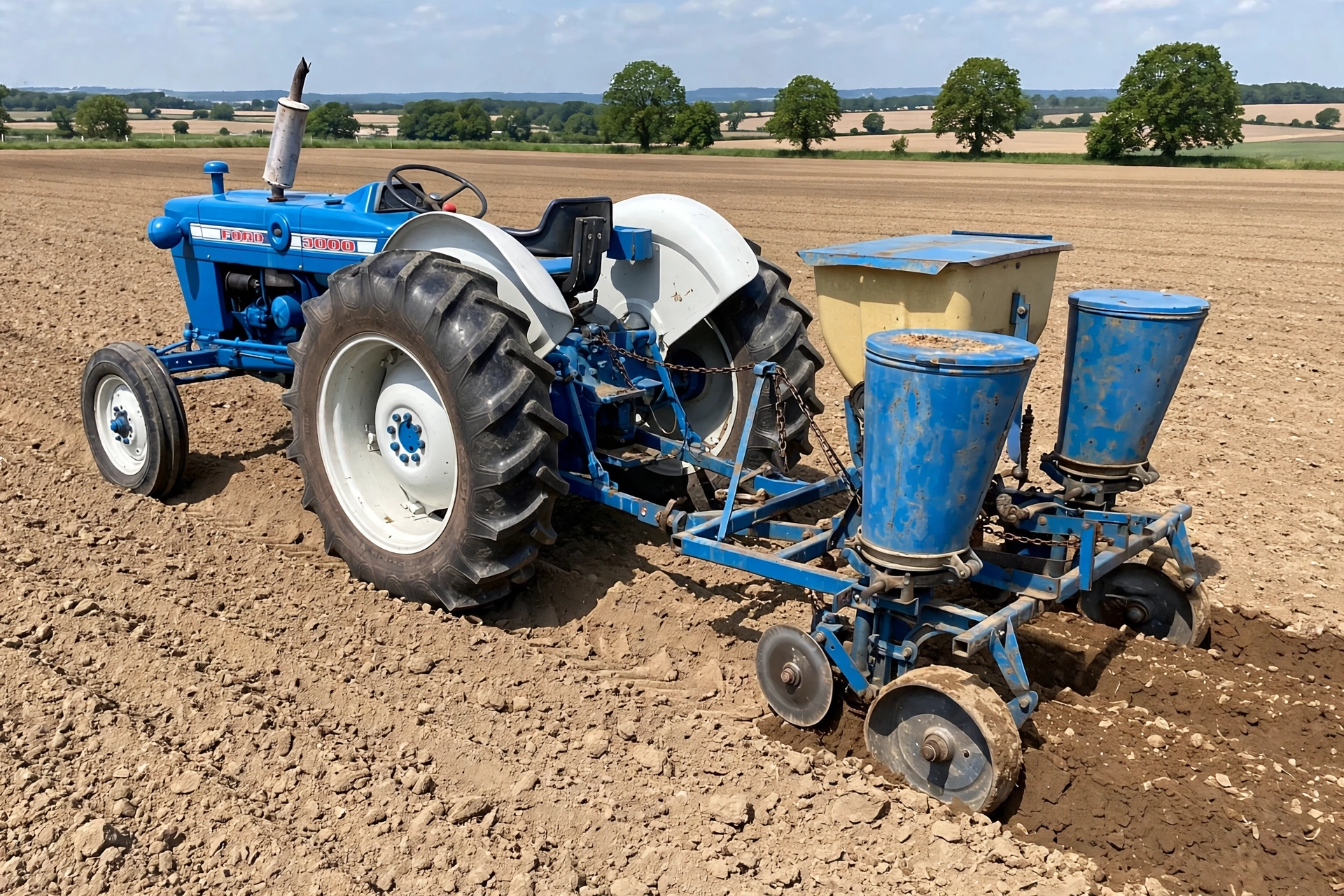
AI-generated illustration: a vintage Ford tractor pulling a 2-row Ford 309 planter through a tilled field for a ford 309 planter plate chart guide. The seed boxes and press wheels are in view.
The photo shows a 309 at work behind a vintage Ford tractor. The seed boxes, press wheels, and fresh rows are all in view.
Count Seed Over 10 Feet
Turn the press wheel until it would have traveled about 10 feet. Count the seed in the container. Divide the count by the distance to get seeds per foot.
Repeat the test a few times until you get an average count. One run can mislead you. Three runs give a fair reading.
Compare the average with the spacing you want. If the count is high, the seeds sit too close. If the count is low, they sit too far apart.
Change Gears and Test Again
Change the drive gears and repeat the test. A different sprocket pair changes the plate speed. Keep testing until the spacing lands where you want it.
The operator manual lists the gear settings for common spacings. If you own the manual, start from its chart. Then confirm with the field test.
Most 2-row 309s have no row markers, although markers were an option. Owners set the tractor wheels out to 72 inches for 36-inch rows. Then they follow the wheel track back on each round.
Ford 309 Planter Years and Hopper Options
The 309 is a mid-century machine. New Holland parts records for the 309 series start in January 1955. The records run through the early 1970s for most parts.
The New Holland parts store lists the 309 series parts with their date ranges. Those dates give a solid way to date a planter from its parts.
| 309 series part | Dates in NH records |
|---|---|
| Disc coverers | Jan 1955 to Dec 1970 |
| Spoon coverers, pair | Jan 1955 to Dec 1959 |
| 4-row disc markers | Mar 1957 to Dec 1982 |
| 4-row hook markers | Jan 1960 to Dec 1972 |
| One-bushel corn hopper | Jan 1955 to Dec 1957 |
| Half-bushel corn hopper | Jan 1959 to Dec 1972 |
| One-bushel corn and cotton hopper | Jan 1959 to Dec 1972 |
| Depth control check chain kit | Jan 1965 to Dec 1972 |
The hopper dates are the most useful for dating a planter. The one-bushel corn hopper ran from 1955 to 1957. The half-bushel hopper ran from 1959 to 1972.
Owners describe the half-bushel boxes as 10-inch boxes. If your planter has those boxes, its hopper dates from 1959 or later.
Four-row setups existed too. New Holland lists 4-row disc markers from March 1957 to December 1982. Most owner reports describe 2-row units, so the 2-row is the common setup today.
The 309 worked behind the Ford tractors of its era. Our best Ford tractor guide ranks the vintage models owners still run. A 309 pairs well with the small and mid-size tractors on that list.
3 Plate Mistakes That Waste Seed
Most 309 planting faults come from three mistakes. All three are easy to avoid. All three are costly to fix after planting.
Ungraded Seed and Double Drops
Ungraded seed is the first mistake. Kernels of mixed size do not fit one notch size.
Large kernels double up in the notch. Small kernels slip through and skip.
Owners who plant ungraded seed accept frequent double drops. They pick a plate sized for the larger kernels and set spacing with that in mind.
That works for an acre or two. It wastes too much seed for a large field.
Buy graded seed. The grade costs little next to the seed it saves.
Wrong Plate for the Crop
The second mistake is using one plate for every crop. Corn plates are for corn. Bean plates are for beans.
Each crop needs its own plate.
A corn plate in a bean box gives skips and doubles. A bean plate in a corn box does the same. Keep plates sorted by crop and labeled by number.
When a plate number is unknown, check the parts book first. Guessing from a look-alike plate is how a wrong plate ends up in the box.
Worn Plates and Seed Buildup
The third mistake is running worn or dirty plates. Notches wear wider with use. Seed residue builds up in the seed box and binds the plate.
Owners report that buildup in the seed box can bind and break an old plastic plate. Clean the boxes before each season. Check each plate for wear and cracks.
Metal plates last longer than plastic plates. Owners report that metal plates hold up well if they stay out of fertilizer. Plastic plates deteriorate over time, like all plastic.
Where to Find Ford 309 Plates and Manuals
Plates are still available, but the supply is thin. New Holland is the first place to check. Used dealers and auction sites fill the gaps.
The Yesterday’s Tractors corn planter thread gives the dealer route in plain terms. The planter plates are available at your local New Holland dealer. The dealer also has the parts book and a seed plate size chart.
New Holland still carries the operator manual and the parts manual. Owners confirm both books are still available to order. The parts book is also listed on a New Holland dealer website.
Used equipment dealers are the second source. Owners report used plates at $40 to $100 a pair.
One owner reported sweet corn plates at about $100 from a New Holland dealer, in a 2002 thread. Treat that price as dated, not current.
Online auction sites carry a few plates. Owners report that 309 plates are less common there than Deere or IH plates. They also bring higher prices than the common brands.
Blank plates are available to cut your own notches. Owners use them for pumpkins and other large seed. One owner reported that a blank plate cost about $40 more than what he paid for the whole planter.
Used 309 planters trade at low prices. Owner reports from the 2000s and 2010s range from $75 at auction to $450 for a working unit.
One dealer listing reached $1,000. Those figures are dated, but they show the price range.
Care for the planter after each use. Fertilizer corrodes the distributor and the frame. Owners wash the planter down after use to fight that corrosion.
A 309 often works behind an 8N. If that tractor needs fuel work first, our 8N Ford tractor carburetor guide covers replacement options.
Questions Owners Ask About Ford 309 Plates
What Plate Fits Ford 309 Corn
Three corn plate numbers show up in owner hands: 109786-A2, 109787-A2, and 109788-A2. All three are owner-reported plastic plates. Match your graded seed to the notch, and confirm the number in the New Holland parts book before you plant this season.
How Flat and Round Plates Differ
Flat plates suit round, uniform seed that sits flat in a cell. Round plates suit odd-shaped seed that does not sit flat. Owners report that round plates do better with ungraded seed, such as sweet corn with varied kernel shapes.
Does the Seed Plate Set Seed Spacing
No, the seed plate never sets spacing on a 309. The drive sprockets set spacing on a 309. Turn the press wheel about 10 feet, count the seed, divide by the distance, and change gears until the spacing lands where you want it.
Where to Buy Ford 309 Plates
Start at a New Holland dealer, which carries plates, the parts book, and the seed plate size chart. Try used equipment dealers and auction sites next. Owners report used plates at $40 to $100 a pair, though 309 plates are less common than Deere or IH plates.
What Year Is My Ford 309 Planter
New Holland parts records for the 309 series start in January 1955. The one-bushel corn hopper dates from 1955 to 1957, and the half-bushel hopper from 1959 to 1972. Check your hopper size and the parts book to narrow the date.
Can a Ford 309 Plant Pumpkins
Yes, with a blank plate. Blank plates are available to cut your own notches for pumpkins and other large seed. One owner reported that a blank plate cost about $40 more than the planter itself, so price the plate before you commit.
What to Do Next With Your 309
You now have the ford 309 planter plate chart, the plate matching steps, and the sprocket spacing test in one place. Start with the plate number stamped on the plate you own. Check it against the parts book and your seed grade.
Buy graded seed to match that plate. Test the plate by hand before planting day. Then set spacing with the sprocket test, not with a guess.
Get the operator manual and the parts manual from a New Holland dealer. Those two books answer the gear settings and plate questions this guide could not cover. A 309 with the right plate and the right gears plants an even stand, season after season.