

Ford 3.3 V6 Engine Diagram With 2018 F-150 Service Points

For a Ford 3.3 V6 engine diagram, start with the diagram for the correct vehicle and model year. Ford’s 2018 F-150 owner manual identifies eight under-hood service points, labeled A through H. They cover the power distribution box, oil filler, dipstick, brake fluid, air filter, coolant reservoir, battery, and washer reservoir.
The component key below follows those published labels. It helps you identify the right service area before opening a cap or requesting a part. It is not an internal engine assembly drawing, wiring diagram, hose-routing map, or bolt-tightening sequence. Those jobs require their own application-specific service information.
Read the Eight Verified Diagram Labels
| Ford label | Component in the 2018 F-150 3.3L overview | First identification question |
|---|---|---|
| A | Power distribution box | Are you looking at the correct electrical enclosure? |
| B | Engine oil filler cap | Have you identified the oil fill point? |
| C | Engine oil dipstick | Are you using the correct level indicator? |
| D | Brake fluid reservoir | Have you separated the brake system from other fluids? |
| E | Air filter assembly | Are you identifying the complete housing or its element? |
| F | Engine coolant reservoir | Is the cooling system fully cool before any service? |
| G | Battery | Is this identification or electrical work? |
| H | Windshield washer fluid reservoir | Have you confirmed the washer-fluid opening? |
2018 F-150 3.3L Component Key
Eight labels, four task groups
| Ford label | Component in the 2018 F-150 3.3L overview | First identification question |
|---|---|---|
| A | Power distribution box | Are you looking at the correct electrical enclosure? |
| B | Engine oil filler cap | Have you identified the oil fill point? |
| C | Engine oil dipstick | Are you using the correct level indicator? |
| D | Brake fluid reservoir | Have you separated the brake system from other fluids? |
| E | Air filter assembly | Are you identifying the complete housing or its element? |
| F | Engine coolant reservoir | Is the cooling system fully cool before any service? |
| G | Battery | Is this identification or electrical work? |
| H | Windshield washer fluid reservoir | Have you confirmed the washer-fluid opening? |
Conceptual component key, not a spatial drawing. Match letters to Ford's original 2018 F-150 3.3L illustration.
Compare this key with Ford’s original under-hood illustration. The letters refer to that specific drawing. Do not place them on another engine photograph and assume they retain the same meaning.
The accompanying component map groups these points by task. Its boxes are a reading aid, not a scale drawing of the engine bay. Use the Ford illustration to establish physical location, then the appropriate maintenance section to establish the procedure. Keeping those two references separate prevents a location label from being mistaken for permission to dismantle the component.
Confirm the Truck Before Comparing the Picture
Record the model year, model, and engine from reliable vehicle information. For this article, the documented reference is the 2018 F-150 3.3L. A search result containing Ford V6 is too broad to establish that a photograph matches your truck.
Check the section heading inside the manual rather than relying on the document’s cover alone. One F-150 manual can contain several under-hood diagrams. The 3.3L and 2.7L entries, for example, have different letter assignments. Choosing the adjacent page can produce a believable identification with the wrong label key.
Keep your own photograph in its original orientation. A mirrored image can make two sides appear reversed, while a cropped picture removes the surrounding landmarks needed to understand it. Photograph the full engine bay first and a close-up second. Do not rotate or annotate the only original image.
If a component does not match the illustration, stop and document the difference. The truck might have a replacement part, accessory installation, or other change. That possibility calls for confirmation; it does not justify guessing which hidden connection matches a line in an unrelated diagram.
Identify the Oil Filler and Dipstick as Separate Points
Check the destination of a manual cross-reference as carefully as the overview heading. A shared gasoline maintenance page can display a link labeled for another engine. That link should not silently become a 3.3L capacity or oil specification. Return to the correct engine’s specifications section and confirm the application before choosing service materials. Keep the location finding and the specification finding as two separate entries in your notes. This is particularly useful when navigating an online manual that presents shared maintenance text alongside several engine-specific branches.
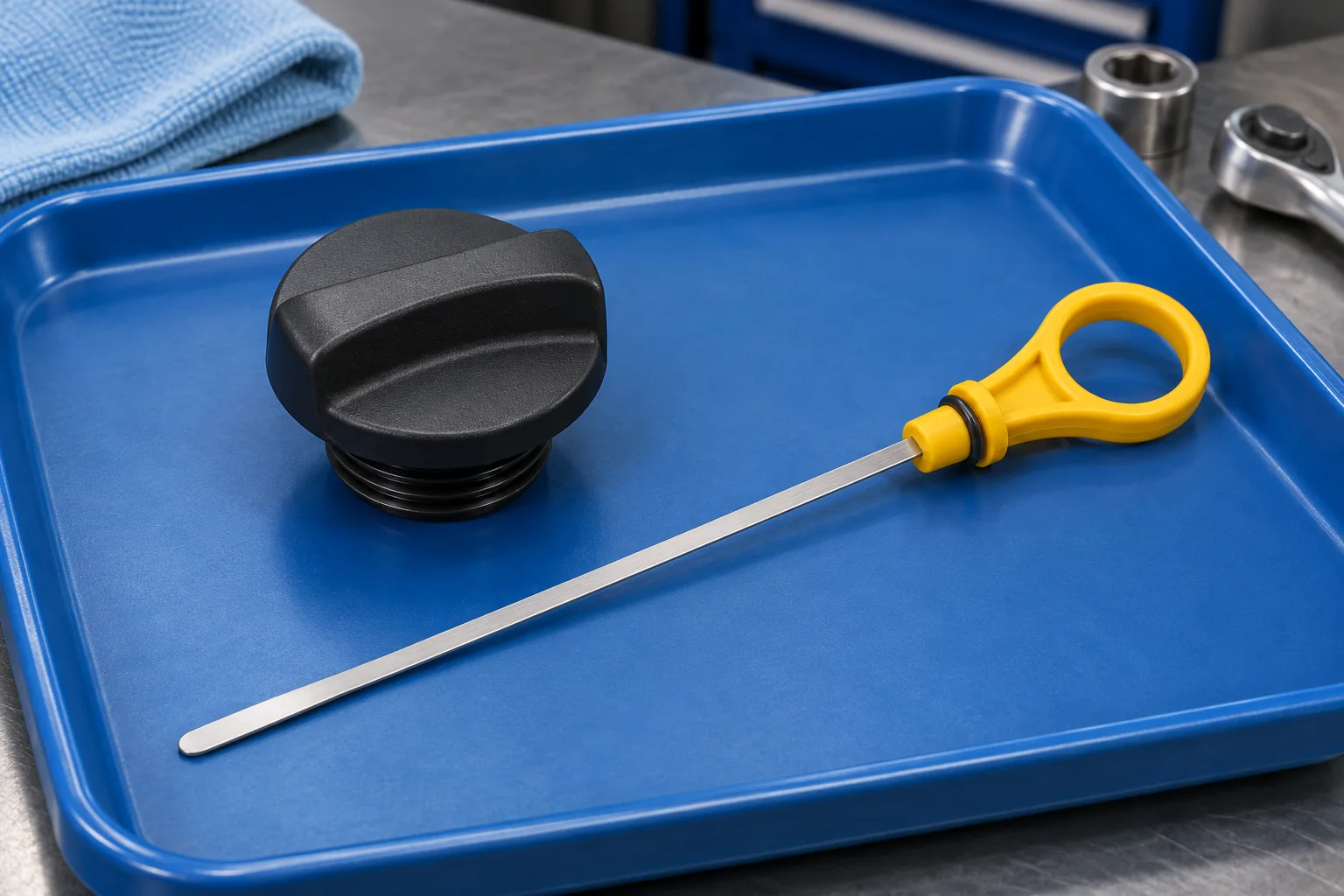
Labels B and C serve different purposes. B identifies where oil is added. C identifies the dipstick used to read the oil level. Recognizing one does not establish that you have found the other, and neither label specifies the required oil grade or refill amount.
Ford’s gasoline engine oil check instructions describe an accurate reading on level ground after the engine is shut down and oil has had time to return to the pan. The cited procedure specifies a 15-minute wait after shutdown. Follow the complete procedure for your vehicle rather than reading immediately after stopping and treating that result as final.
The same section warns against filling above the maximum mark. A low-looking first reading is therefore a reason to verify the method before adding oil. Record the reading conditions and use the specified oil if a top-up is actually required. Do not use this location guide as an oil-change quantity chart.
Before removing a filler cap, identify it positively and clean the surrounding area. Keep loose objects and dirt away from openings. If the cap, dipstick, or surrounding parts differ from the reference, obtain the correct component information before ordering a replacement or adding fluid.
When the question is refill volume, the F-150 oil capacity chart organizes capacities by year and engine. Confirm the refill quantity for the actual truck using the Ford manual.
Keep the Three Fluid Reservoirs Distinct
The Ford key separates D, F, and H because they belong to different systems. D is brake fluid, F is engine coolant, and H is washer fluid. A container’s apparent color or position in a distant photograph is weaker evidence than its label, the correct diagram, and a confirmed connection to the relevant system.
Start with identification while the engine is off and cool. You can document a reservoir and its markings without removing its cap. If a mark is difficult to see, improve lighting and change your viewing angle before deciding that the reservoir needs filling.
Ford’s coolant-check section warns against opening the reservoir when the engine is running or the cooling system is hot. A diagram cannot make a pressurized, hot cooling system safe to open. If there is steam, overheating, or uncertainty about temperature and pressure, leave the cap alone and obtain help.
That section also warns against putting coolant in the washer reservoir. If you suspect that the wrong fluid has already been added, stop the task and explain exactly what was added, where, and how much is known. Do not operate the affected system merely to see whether it still works.
Use the Coolant Point for Identification Before Diagnosis
Label F gives you the correct reservoir in the illustrated application. It does not show every coolant hose, the thermostat position, water-pump internals, or a procedure for bleeding air. Avoid using this simplified overview to select a hose or decide which connection to disconnect.
For an inspection, record the coolant level with the engine cold and compare it with the reservoir markings. Note visible wetness or residue without identifying an unverified source. A stained area below a hose is an observation; a conclusion that the hose itself is defective needs closer inspection.
Ford specifies using coolant meeting the applicable requirements and cautions that automotive fluids are not interchangeable. Consult the correct specifications before purchasing coolant. A product described as universal by a seller still needs to be checked against the vehicle requirement.
Repeatedly adding fluid is not a diagnosis. If the level drops again, or an overheating warning accompanies the concern, arrange inspection rather than treating the reservoir as the whole system. Keep the vehicle-specific cooling instructions available for any subsequent repair.
Treat the Brake Reservoir as a Safety System
Label D identifies the brake fluid reservoir. Recognizing it is useful when describing a concern to a technician, but an under-hood overview does not explain the cause of a brake warning, authorize bleeding the brakes, or establish the correct replacement part.
If braking feels abnormal or a warning persists, arrange prompt professional assessment. Do not assume that adding fluid is the complete repair. A location diagram answers where to look; diagnosis must address why the system is showing a concern.
When documenting the reservoir, capture its label and any visible level markings without introducing dirt. Avoid handling fluid or opening the system simply to make a better photograph. If you need service instructions, use Ford’s Brake Fluid Check section for the correct application and a qualified technician for unresolved faults.
Keep brake-related observations separate from engine observations in your notes. A service request saying that the engine fluid is low can send the inspection toward the wrong system. Identify the reservoir by its actual function and include the warning message or symptom as a separate item.
Distinguish the Air Filter Housing From Its Element
Label E identifies the air filter assembly. The housing, lid, intake duct, and replaceable filter element are related parts, but they are not interchangeable descriptions on a parts order. State which item is damaged or due for service.
Ford’s gasoline air-filter instructions warn against removing the cleaner while the engine runs or starting the engine with it removed. They also caution against allowing foreign material into the air induction system. Treat the assembly as part of the engine’s protection, not a convenient opening for investigating an unrelated noise.
For a replacement element, use the correct application listing. A filter that appears to fit the housing in a photograph is not a verified match. Preserve the vehicle details and any existing part identifier, then confirm the supplied item with the parts catalog.
If the lid, clamps, or duct has been modified, document that before ordering. An aftermarket intake may change the visible assembly from Ford’s overview. The correct response is to identify the installed equipment rather than forcing a stock illustration onto a changed installation.
Keep the Battery and Power Distribution Box Separate
Labels G and A both concern the electrical system, but they identify different components. G is the battery. A is the power distribution box. Finding the battery does not tell you which fuse protects an accessory, and finding the enclosure does not supply a wiring diagram.
Use the correct fuse reference for the circuit. Record the exact symptom and whether it occurs with the ignition off, on, or during starting. Avoid replacing unrelated parts because they appear near the battery in the picture.
Do not bridge terminals, bypass fuses, or substitute a higher-rated fuse to test a theory. If a protective device fails repeatedly, the fault needs investigation. The under-hood key gives no basis for changing circuit protection or touching an unidentified connection.
For a no-start complaint, report what actually happens: no crank, cranking without starting, or an intermittent response. Those observations are more useful than declaring that the battery is bad because label G appears in the same area as a sound or warning.
Build a Component Request That a Shop Can Verify
Separate a location question from a specification question on the work order. Write the component name first, then list the missing information, such as a replacement identifier or fluid specification. For oil selection, the existing Ford engine oil recommendation chart provides broader context, but the vehicle’s own manual determines the applicable requirement. This two-part request prevents a correct component identification from being treated as a complete maintenance instruction. It also lets a supplier explain which additional reference or vehicle detail is needed before a part can be confirmed.
Provide the vehicle details, the relevant diagram label, a wide photograph, and a close photograph. Then describe the observation in ordinary language. For example, report visible residue near the coolant reservoir rather than stating that the water pump has failed without confirming its source.
Include any part number that can be read without disassembly. Copy the entire marking and explain which component carries it. Numbers on a neighboring hose, cover, or bracket may describe that component rather than the assembly you want to replace.
Ask the supplier to confirm the exact item and application. A matching diagram name is a starting point, not proof of interchangeability. If the repair involves a connector, hose end, or mounting revision, obtain the detailed parts illustration needed to distinguish the options.
Keep your original notes after the inspection. If a technician identifies a different source, add the finding rather than rewriting your earlier observation as if it had been certain. This creates a useful history of what was seen, what was tested, and what was actually repaired.
Know When the Overview Has Reached Its Limit
An effective question also identifies the reference you already checked. Send the manual year and the 3.3L section heading with the component photograph. This lets the person helping you see whether the uncertainty concerns the diagram, the installed equipment, or the intended service task. If the reply relies on another engine’s page, ask for application confirmation before acting. Preserve the original photograph and the answer together so the identification can be reviewed later without reconstructing the conversation.
An owner-level engine bay diagram is useful for routine identification and communication. It is insufficient for timing chains, cylinder-head work, internal coolant passages, fuel-pressure service, or electrical troubleshooting at a connector-pin level. Those tasks need more detailed references and appropriate skill.
If you cannot positively identify a component, leave it connected and closed. Do not remove adjacent equipment to make the diagram seem easier to follow. Photograph the area and ask for application-specific assistance.
Likewise, do not infer a torque setting from the component name. The bolt holding a bracket, the fastener sealing a housing, and a nearby electrical stud can need different procedures. This guide deliberately supplies no tightening values because its verified source is an identification overview.
Finish With the Correct Component and Reference
Use the 2018 F-150 3.3L key to match the eight named service points, then move to the manual section for the task. Keep the oil filler distinct from its dipstick, keep fluid reservoirs separate, and treat electrical and brake concerns as system-specific work. A confirmed component identity should lead to the correct next reference, not an improvised repair based on a general engine picture.
Questions About the 3.3L Diagram
Where Is the Oil Filler?
Ford marks the oil filler cap B in the 2018 F-150 3.3L overview. Use the photograph in the Ford manual to identify its physical location before opening it.
Which Letter Marks the Dipstick?
C marks the engine oil dipstick in this drawing. Check the oil on level ground using the waiting period and reading procedure in the manual.
Which Reservoir Holds Engine Coolant?
F marks the engine coolant reservoir, while H marks washer fluid. Leave the coolant cap closed while the engine is running or the cooling system is hot.
Is A the Battery Location?
A marks the power distribution box and G marks the battery. The fuse section identifies protected circuits and fuse ratings for the vehicle.
Does This Diagram Apply to Every F-150?
The eight letters refer to Ford’s 2018 F-150 3.3L drawing. Select the model-year and engine-specific overview before using its labels on another truck.
Source method: Ford’s 2018 F-150 online manual, under-hood overview and linked maintenance sections, checked November 19, 2026. Additional references without clickable links: Brake Fluid Check, Fuses, and Washer Fluid Check in that manual. No physical inspection or repair testing was performed for this article. The manual originally supplied with the vehicle remains Ford’s advised primary reference when online content differs.