
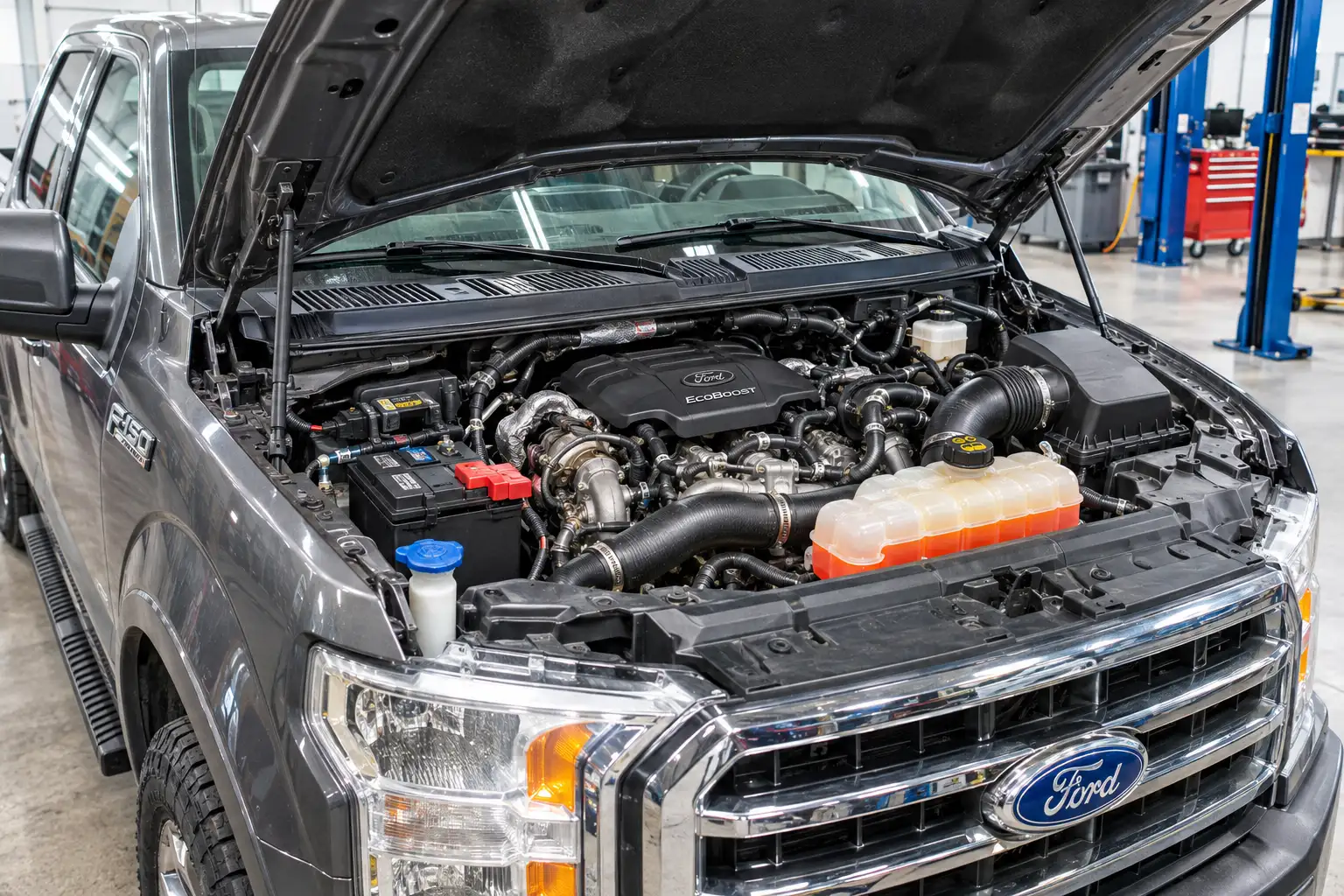
Ford 2.7 EcoBoost Coolant Hose Diagram by Year and Location 2026

A Ford 2.7 EcoBoost coolant hose diagram identifies the upper and lower radiator hoses, coolant pump connections, degas bottle lines, heater hoses, and turbocharger cooling tubes on the F-150’s twin-turbo V6. The right diagram depends on your truck’s model year. A 2015 routing reference should not automatically be used to identify every connection on a 2021 or newer truck.
The reference diagrams and numbered component tables below let you locate the main hoses before checking for leaks or buying a replacement. Start with your F-150’s model year, then match the component number to the correct service-reference illustration.


Coolant Hose & Component Locator
Use these verified service-diagram label numbers to identify key radiator hoses, reservoir lines and cooling components. Select the reference year before tracing the physical hose.
Three hose groups to recognize
Upper hose, lower hose and coolant pump connections.
Degas bottle, radiator-to-bottle hose and heater core.
Left and right turbochargers and their year-specific coolant lines.
Simplified main radiator circuit
Conceptual flow only. Thermostat, bypass, heater, turbo and auxiliary circuits are not drawn. This is not an installation or physical routing schematic.
Diagram callout numbers by year
Scroll sideways on mobile| Component | 2015 | 2018 | 2021 |
|---|---|---|---|
| Radiator | 1 | 1 | 1 |
| Lower radiator hose | 2 | 2 | 2 |
| Coolant pump | 3 | 3 | 4 |
| Upper radiator hose | 16 | 16 | 6 |
| Degas bottle | 13 | 13 | 7 |
| Radiator-to-degas bottle hose | 12 | 12 | 8 |
| Heater core | 33 | 38 | 18 |
| Right turbocharger | 15 | 15 | 20 |
| Left turbocharger | 31 | 36 | 25 |
Reference basis: Ford-attributed 2.7L EcoBoost engine cooling component-location legends for 2015, 2018 and 2021. FordMasterX editorial summary.
Which 2.7 EcoBoost Diagram Fits Your F-150 Year


Ford introduced the 2.7L EcoBoost in the F-150 for 2015 and updated the engine for 2018. The later F-150 generation also uses revised cooling-system documentation. Identify your truck by its model year, engine, and build information rather than choosing a diagram based only on displacement.
| F-150 model year | Best reference to start with | What to verify |
|---|---|---|
| 2015–2017 | First-generation 2.7L service layout | Coolant pump inlet, thermostat, turbo inlet and outlet tubes |
| 2018–2020 | Revised 2.7L service layout | EGR cooler plumbing, auxiliary connections, and hose revisions |
| 2021–2026 | Matching year-specific 2.7L service information | EGR cooler, oil cooler, heater and transmission-cooler plumbing; later-year changes |
For comparison, consult the indexed 2015 2.7L cooling component diagram, the 2018 2.7L cooling component diagram, and the 2021 2.7L cooling component diagram. These are Ford-attributed service illustrations hosted by a third-party archive, not Ford’s official service website. The 2015 and 2018 archive URLs appear under other vehicle listings but explicitly identify the 2.7L F-150 cooling-system variant.


The 2021 illustration is a useful later-generation example, not a confirmed universal diagram for every 2022–2026 F-150. Use the service information for your exact year and VIN when identifying a hidden hose or ordering parts. Our Ford 2.7 EcoBoost specifications guide provides additional background on the engine itself.
How to Read the 2.7 EcoBoost Hose Diagram


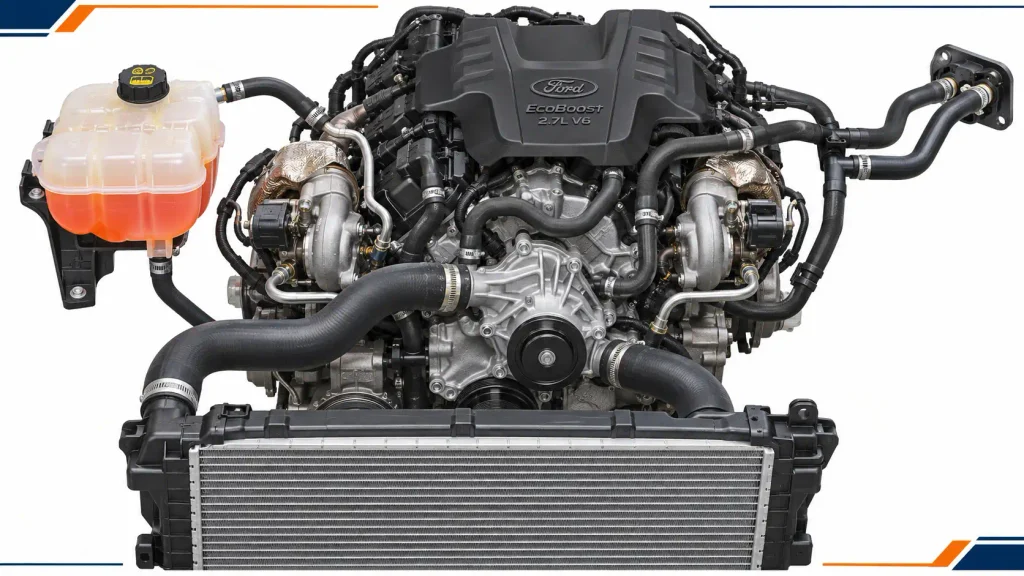
A cooling-system diagram uses numbered labels for both hoses and hard components. Start with the radiator at the front of the truck, then find the lower radiator hose, coolant pump, upper hose, and pressurized coolant reservoir, which Ford calls the degas bottle. Follow the smaller branches only after those main connections are clear.
The table uses the actual item numbers from the 2015, 2018, and 2021 service-reference legends. A different number does not necessarily mean Ford relocated a part; the illustrations use different numbering systems.

| Component | 2015 label | 2018 label | 2021 label |
|---|---|---|---|
| Radiator | 1 | 1 | 1 |
| Lower radiator hose | 2 | 2 | 2 |
| Coolant pump | 3 | 3 | 4 |
| Upper radiator hose | 16 | 16 | 6 |
| Degas bottle | 13 | 13 | 7 |
| Radiator-to-degas bottle hose | 12 | 12 | 8 |
| Heater core | 33 | 38 | 18 |
| Right turbocharger | 15 | 15 | 20 |
| Left turbocharger | 31 | 36 | 25 |
For the first-generation engine, the 2015 diagram additionally labels the thermostat as 6, coolant pump inlet hose as 8, and coolant outlet connector hose as 19. On the 2018 diagram, the thermostat is 6, the coolant pump inlet hose is 8, and the EGR cooler is 25. The 2021 legend separately lists an EGR cooler at 16, an oil cooler at 12, and a transmission oil cooler at 30.
These are identification labels, not hose part numbers or instructions to connect components in numerical order. Before disconnecting anything, trace the installed line from end to end and compare both connections with the year-correct diagram.
Where Do F-150 2.7 Radiator Hoses Connect


The radiator hoses are the easiest place to begin because they are larger than most heater, reservoir, and turbocharger cooling lines. Both connect the radiator to the engine’s main cooling circuit, but they serve different parts of that circuit.


Upper Radiator Hose Location


Find the upper radiator hose at item 16 in the 2015 and 2018 diagrams or item 6 in the 2021 diagram. It is the principal hose on the radiator’s upper connection and leads toward the engine’s hot coolant outlet side.
With the engine completely cold, visually follow the hose from its radiator connection to its engine-side fitting. Look for dried coolant residue, a split rubber section, swelling, or moisture around the clamp. Do not confuse a smaller hose running toward the degas bottle with the upper radiator hose.
Lower Radiator Hose Location


The lower radiator hose is item 2 in all three reference diagrams. It connects the radiator’s lower outlet side with the engine’s coolant-pump inlet circuit, through the associated plumbing specified for that model year.
Its low position can make a leak difficult to see from above. Inspect the hose ends, clamps, and nearby connectors using a light after the engine has cooled. If access requires working underneath, support the truck properly rather than relying on a jack alone.
Where Do 2.7 EcoBoost Turbo Coolant Lines Run
The 2.7L EcoBoost has two turbochargers, and its cooling-system diagrams include plumbing associated with both sides of the engine. These smaller metal tubes and hose connections must not be mistaken for the larger radiator hoses or nearby turbocharger oil lines.
In the 2015 diagram, the right turbocharger inlet and outlet tubes are items 24 and 23. The left inlet and outlet tubes are items 29 and 30. The 2018 diagram labels the right inlet and outlet tubes 26 and 23, with the left inlet and outlet tubes 34 and 35.
The 2021 diagram identifies the turbochargers as items 20 and 25, along with adjacent coolant outlet tubes and cylinder-head connector hoses. It does not use the same separate turbo inlet/outlet numbering scheme. Copying a 2015 label directly onto the 2021 illustration would be misleading.
If you suspect a turbo-area coolant leak, examine the fitting and trace the line before buying a turbo coolant hose. Fluid on a heat shield or under the turbocharger can originate from a different connection above it. A repair shop can confirm the source with a controlled cooling-system pressure test.
How F-150 2.7 Heater and Reservoir Hoses Connect
The heater and degas-bottle branches are smaller than the main radiator hoses, but they are part of the engine cooling system. Identifying them correctly matters when coolant appears near the firewall or the top of the engine bay.
Heater Core Hose Connections
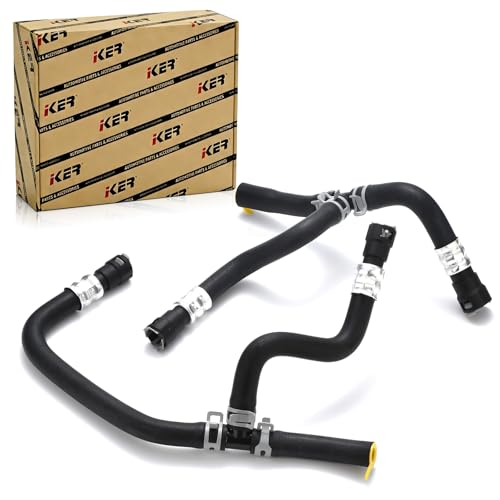


The heater core sits within the cabin heating circuit. Ford’s 2015 diagram labels the heater inlet at 18, the heater outlet hose at 10, the cabin heater coolant pump at 11, and the heater core at 33.
The 2018 diagram lists its heater inlet and outlet as 18 and 10, and its cabin heater coolant pump as 11. On the 2021 reference, the heater hose assembly is 13, the cabin heater coolant pump is 14, and the heater core is 18. Use these labels to distinguish the heater branches from turbo and radiator lines.
Degas Bottle Hose Connections


The degas bottle is the pressurized coolant reservoir. The 2015 and 2018 diagrams mark it as 13, while the 2021 reference marks it as 7. Its radiator connection is labeled 12 in the earlier diagrams and 8 in 2021.
A narrow reservoir hose is not interchangeable with the lower or upper radiator hose. If you find a wet connection near the reservoir, check the bottle seam, the attached hose and clamp, and any nearby fitting before deciding which component is leaking.
How 2.7 EcoBoost Coolant Flow Works
At normal operating temperature, the coolant pump circulates coolant through the engine and the radiator circuit transfers engine heat to outside air. The upper hose connects with the hot outlet side of the engine cooling circuit; the lower hose returns radiator-cooled coolant toward the pump inlet circuit.
The thermostat controls the radiator circuit as the engine warms up. The heater core, turbocharger cooling connections, oil cooler, and other model-specific branches also exchange heat with engine coolant. They should not be drawn as one continuous hose running from the radiator through every component.
A useful functional overview is:
Radiator lower connection → lower radiator hose → coolant pump circuit → engine cooling passages → coolant outlet circuit → upper radiator hose → radiator.
This is a simplified operating path, not a physical routing diagram or an instruction to install hoses in that order. For the wider role of the radiator, pump and thermostat, see our Ford F-150 cooling system overview. The component numbers above remain the better reference for the 2.7L engine.
How to Trace F-150 2.7 Coolant Hose Leaks
Start with the engine off and fully cooled. Never open the pressurized degas bottle while the engine is hot, and keep your hands clear of the cooling fan. Look for a visible leak before assuming a gasket, thermostat, or water pump has failed.
- Inspect the radiator hose joints. Check the upper and lower hose connections for wet fittings, coolant residue, cracks, or displaced clamps. Look at the radiator end tank and adjacent components as well.
- Check the reservoir and heater branches. Trace smaller hoses from the degas bottle and toward the firewall. A leak can run along a hose and drip somewhere other than the point of failure.
- Inspect the turbocharger-area plumbing. Follow the relevant coolant tube and connector shown in your year-specific diagram. Do not assume every fluid stain near the turbo is coolant; engine oil can appear in the same general area.
If the source remains hidden, a technician can pressure-test the cooling system using equipment and pressure limits appropriate to the truck. Do not pressurize a hot system or improvise a test with compressed shop air.
A low coolant level, repeated loss after top-ups, steam, or an over-temperature warning requires prompt investigation. If the engine overheats, stop safely and follow the owner’s manual rather than continuing to drive. Adding coolant without identifying an active leak is not a repair.
Which Replacement Coolant Hose Fits Your 2.7 EcoBoost
A hose labeled “2.7 EcoBoost” is not automatically correct for every F-150 with that engine. Match the replacement to the VIN, model year, production date, and exact hose location. Radiator hoses, heater hoses, turbo coolant tubes, and reservoir hoses are different components.
Use this verification order:
- Identify the hose from the correct service diagram and note both ends.
- Confirm your truck’s VIN and production information on the vehicle label.
- Match the original hose or pipe against Ford’s current parts catalog, including any superseded part number.
- Check whether new clamps, seals, or a connector are required by the applicable service instructions.
- After repair, follow Ford’s year-specific filling and air-removal procedure, then check for leaks when safe.
Coolant capacity is also model-year specific. Ford’s 2021 F-150 manual lists 15.1 US qt (14.3 L) for the 2.7L EcoBoost, while the 2025 F-150 coolant specification lists 15.4 US qt (14.6 L). Both specify coolant meeting Ford WSS-M97B57-A2 for those years. These are total system capacities, not a promise that a routine drain will accept that much fluid.
An overview capacity table is not a substitute for your specific owner’s manual. Use the Ford specification for your exact model year, and do not select coolant by color alone.
What to Check Before Driving Your F-150 Again
The correct Ford 2.7 EcoBoost coolant hose diagram is the one that matches your F-150’s year and installed engine plumbing. Identify the upper and lower radiator hoses first, then follow the smaller reservoir, heater and turbocharger cooling lines using the reference labels. Those labels help you locate a component; they do not prove that a hose from another model year will fit.
If you found a leak, verify the failed connection and replacement part before reassembly. Follow the appropriate Ford filling procedure, confirm the coolant level with the engine cold, and inspect for renewed leakage. If coolant loss continues or the temperature warning returns, have the system diagnosed before further driving.
Frequently Asked Questions About 2.7 EcoBoost Hoses
Are the 2015 and 2018 Ford 2.7 EcoBoost Coolant Hose Diagrams the Same?
No. Ford updated the 2.7L engine for the 2018 F-150, and the service-reference diagrams do not have identical component legends. Both identify the upper and lower radiator hoses, but the revised diagram includes additional cooling components and different reference numbers. Use the diagram for your model year.
Where Is the Lower Radiator Hose on a 2.7 EcoBoost F-150?
It connects at the lower radiator outlet and leads into the coolant pump inlet circuit through the applicable engine plumbing. Ford’s 2015, 2018, and 2021 component diagrams all identify the lower radiator hose as item 2. Trace both ends on a cold engine before removing it.
Does the Ford 2.7 EcoBoost Have Turbo Coolant Lines?
Yes. The twin-turbo 2.7L cooling references show turbochargers and related coolant tubes and hoses. The 2015 and 2018 diagrams label separate left- and right-side turbo inlet and outlet tubes, while the 2021 diagram uses a different component layout. Verify the actual line rather than assuming a matching shape.
How Can I Identify a Leaking Coolant Hose on My F-150?
With the engine completely cold, inspect the radiator hose joints, degas bottle connections, heater hoses, and turbo-area lines for wetness or dried coolant residue. Follow the wet area upward to find its origin. A professional pressure test is appropriate if the source is not visible.
Can I Use the Same Coolant Hose on Every 2.7 EcoBoost Model Year?
No universal hose fitment can be assumed from the engine size alone. Ford revised the 2.7L and its supporting hardware over time, and different coolant branches use different parts. Verify the VIN, production date, both hose connections, and the current Ford parts listing before ordering.