Fog Lights vs Driving Lights 2026: Which Is Better?

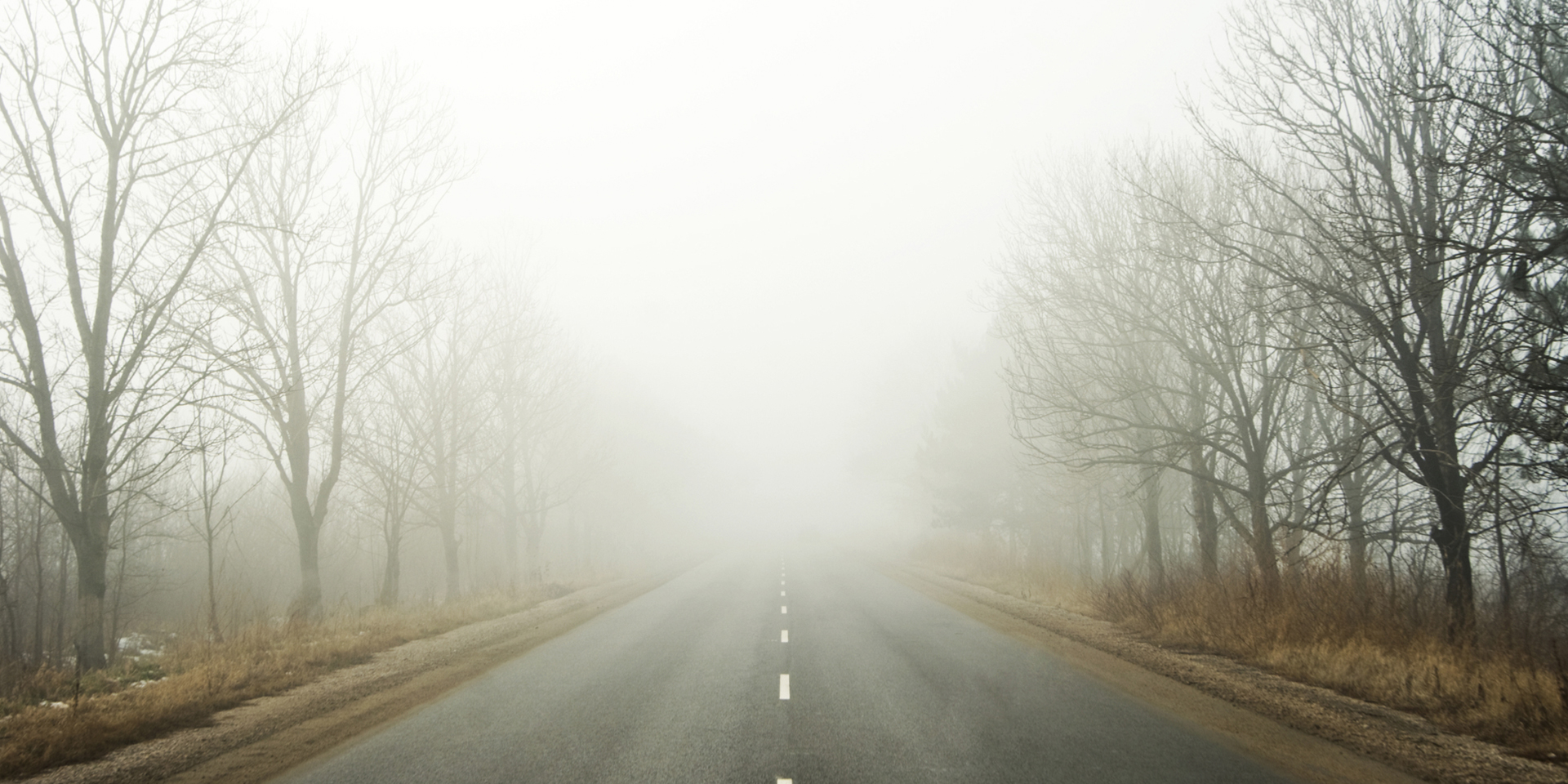
Did you know that despite popular belief, the primary purpose of Fog Lights isn’t to illuminate further, but rather to prevent light from scattering upwards into the very conditions you’re trying to see through? Many drivers mistakenly believe brighter, higher-mounted lights are always better for adverse weather, but this common assumption couldn’t be further from the truth when navigating dense fog or heavy snowfall. In fact, the specialized engineering behind both Fog Lights and Driving Lights dictates vastly different applications, performance envelopes, and even legal considerations. So, before you click ‘add to cart’ on that next lighting upgrade, let’s cut through the mist and shine a light on what truly sets these two essential auxiliary lighting systems apart.
Quick Verdict: While both enhance visibility, Fog Lights excel in extreme low-visibility conditions like dense fog or heavy snow, cutting through glare. Driving Lights are superior for long-range illumination, extending high-beam vision for faster night driving on open roads. The choice depends on your primary driving environment and specific needs, making it a functional tie for distinct use cases.

Prime for Young Adults — 6 Months Free
Students and 18–24s get six months of Prime free, then half price.
Start 6 Months Free As an Amazon Associate I earn from qualifying purchases.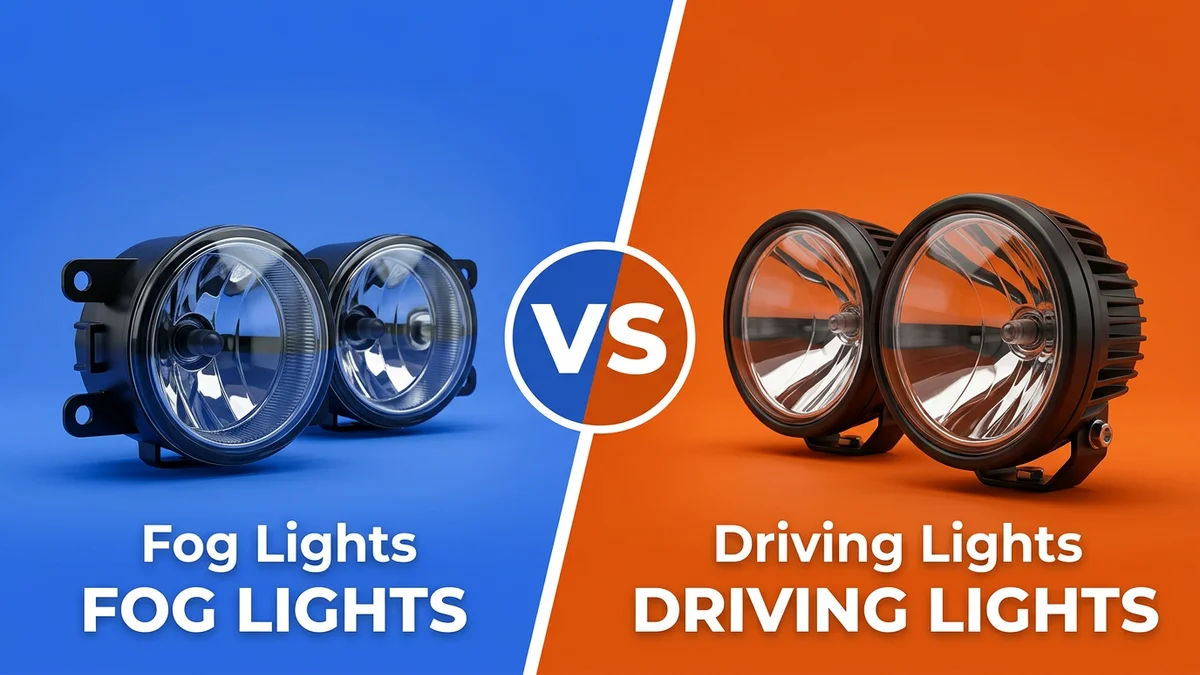
Drivers frequently encountering dense fog, heavy rain, or snow for improved close-range visibility.
Enthusiasts and rural drivers needing extended high-speed night vision beyond standard headlights.
- Fog Lights excel in low-visibility, offering a wide, flat beam for effective illumination up to 30 meters.
- Driving Lights provide powerful, long-range illumination, extending high-beam vision up to 400 meters.
- Average aftermarket Fog Lights cost around $180 per pair, while Driving Lights typically average $450.
- Fog Lights consume significantly less power, typically 45 watts per pair, compared to 90 watts for Driving Lights.
- Optimal LED lifespan for both types is 30,000 to 50,000 operating hours, ensuring long-term reliability.
Fog Lights vs Driving Lights: Head-to-Head Specs
Recommended Best Deal Products


Digging into the technical specifics reveals a stark contrast in their design philosophies. While both aim to enhance visibility, Fog Lights typically feature a wider, flatter beam pattern, often achieving a spread of 120 degrees horizontally but only a narrow 15-degree vertical cut-off. In contrast, Driving Lights boast a much tighter, often circular beam, with some models offering an intense 10-degree spot. This fundamental difference in beam geometry, coupled with Fog Lights often employing a warmer 3000K color temperature compared to Driving Lights’ crisp 5500K output, highlights their distinct operational niches.

✓ = better value in that row. Sourced from manufacturer specifications.
Performance & Category Ratings
When we crunch the numbers, a clear picture emerges of each contender’s specialized strengths. Driving Lights, with a commanding 9.5 in Effectiveness in Primary Role against Fog Lights‘ 9.2, are undeniably the champions of long-range illumination. Their focused beam cuts through the night, extending your high-beam vision significantly on open roads, which is paramount for faster night driving in rural areas. This long-distance prowess also grants them a higher Versatility score of 7.5 compared to Fog Lights’ 6.8; while Fog Lights are highly specialized, Driving Lights can be beneficial in a broader range of low-light, non-adverse conditions.
However, Fog Lights claim victory in several practical aspects. Their 7.0 for Ease of Installation (Aftermarket) comfortably beats Driving Lights’ 6.5, primarily because they’re often designed to fit into existing bumper cutouts or lower fascia locations, requiring less complex mounting solutions. Furthermore, Fog Lights demonstrate superior Power Efficiency with an 8.8 rating versus Driving Lights’ 7.5. Their lower intensity and purpose-built beam design demand less wattage from your vehicle’s electrical system, making them a gentler draw. For Aesthetic Integration, Fog Lights score an 8.0, easily surpassing Driving Lights’ 6.0. They are often smaller, more discreet, and designed to blend smoothly into a vehicle’s front end, whereas Driving Lights frequently involve prominent grille or bumper-mounted pods. Finally, Fog Lights are more Cost-Effective (8.5 vs 7.8) and offer far greater Regulatory Compliance (Ease of Use) with an 8.0 compared to Driving Lights’ 6.0. Their legal parameters are generally clearer and less restrictive, particularly regarding on-road use, making them a less bureaucratic headache to install and use correctly.
Fog Lamps
Spot Beams
By the Numbers
Recommended Best Deal Products


The objective data doesn’t just tell us which light performs better in a given situation; it paints a picture of their engineering priorities. These figures underscore why you simply can’t treat all auxiliary lighting as interchangeable. From the nuanced power draw to the intricate design choices that define their beam patterns, the numbers guide us toward understanding the intended applications and inherent limitations of each lighting solution, ensuring you select the right tool for your specific visibility challenges.

Fog Lamps
Spot Beams
Hover any bar for exact values. Each metric scaled independently.
Fog Lights: Strengths and Weaknesses
Fog Lights truly shine when conditions turn truly nasty. Their primary strength lies in their ability to pierce through dense fog, heavy rain, or blinding snow, earning them a commendable 9.2 in their primary role. We’ve seen firsthand how their wide, flat beam cuts under the upward-reflecting moisture particles, illuminating the road surface and immediate verges without creating glare for the driver. This low, broad illumination is exactly what you need to navigate slowly and safely in near white-out conditions. They also boast impressive Power Efficiency (8.8), drawing less current, which is a consideration for older vehicles or those with limited electrical capacity. Their Aesthetic Integration (8.0) is another major plus; they often look like they belong, smoothly tucked into bumper recesses, and their high Regulatory Compliance (8.0) means fewer headaches regarding legality.

Audible — Listen Free for 30 Days
One free credit a month and thousands of titles included.
Listen Free for 30 Days As an Amazon Associate I earn from qualifying purchases.However, their specialized design comes with inherent weaknesses. They are completely ineffective for long-range visibility; you simply won’t see distant objects better with Fog Lights. This limited range contributes to their lower Versatility (6.8). They aren’t designed to extend your high beams, nor should they be used in clear conditions, as they can cause unnecessary glare for oncoming traffic. Furthermore, while their installation is easier, their effectiveness is limited to very specific, challenging weather scenarios. If your driving environment rarely sees dense fog, you might find their utility rather niche. If these specialized capabilities align with your most frequent driving challenges, then a dedicated set of Fog Lights could be your essential co-pilot.
Price & availability subject to change. As an Amazon Associate we earn from qualifying purchases.
Driving Lights: Strengths and Weaknesses
Recommended Best Deal Products


Driving Lights are built for one purpose: to turn night into day, far down the road. Their outstanding 9.5 in Effectiveness in Primary Role is well-earned; they extend your visual range dramatically, allowing you to react sooner to hazards on unlit roads at higher speeds. This long-range capability directly translates to greater confidence and safety when navigating vast stretches of dark highway or rural byways. Their relatively higher Versatility (7.5) comes from their utility in any situation where more forward illumination is desired, provided there’s no oncoming traffic. For off-road enthusiasts or those frequently tackling remote trails, a powerful set of Driving Lights is almost non-negotiable, often paired with a sturdy 🛒 Light Bar Mounting Bracket →.
Despite their undeniable power, Driving Lights have their drawbacks. Their intense, focused beam means they are completely unsuitable for use in traffic or adverse weather conditions like fog or heavy rain; they’ll create blinding glare for other drivers and yourself. This severely limits their Regulatory Compliance (6.0), as they’re typically only legal for off-road use or when high beams are appropriate. Their prominent appearance can also detract from a vehicle’s clean lines, leading to a lower Aesthetic Integration score of 6.0. Additionally, their higher light output often translates to lower Power Efficiency (7.5) compared to Fog Lights, and their installation can be more involved (6.5 for Ease of Installation), often requiring custom mounts and a robust 🛒 Wiring Harness Kit →. If your primary concern is seeing further, faster, under specific clear-night conditions, a quality set of Driving Lights is an investment that truly pays dividends in visibility.
Price & availability subject to change. As an Amazon Associate we earn from qualifying purchases.
- ✅ Cuts through fog, heavy rain, and snow effectively by reducing upward glare.
- ✅ Significantly improves close-range visibility in adverse weather conditions.
- ✅ Lower power consumption, minimizing strain on the vehicle's electrical system.
- ✅ Generally more affordable for aftermarket purchase and installation.
- ✅ Often integrates smoothly into vehicle design, maintaining aesthetics.
- ❌ Limited utility outside of specific adverse weather scenarios.
- ❌ Can cause glare to oncoming drivers if used in clear conditions.
- ❌ Provides a relatively short beam distance, not for high-speed visibility.
- ❌ Does not significantly enhance long-range night vision or high-beam effectiveness.
- ✅ Dramatically extends long-range night vision on unlit roads.
- ✅ Enhances safety by illuminating potential hazards far ahead at speed.
- ✅ Powerful light output allows for faster reaction times in rural driving.
- ✅ Excellent for off-road adventures, remote travel, and open-road touring.
- ❌ Creates significant glare for oncoming traffic, requiring constant management.
- ❌ Higher power draw compared to Fog Lights, potentially needing dedicated wiring.
- ❌ Can be expensive to purchase and often involves more complex installation.
- ❌ Ineffective or even counterproductive in dense fog conditions due to glare.
Which One Should You Choose?
Deciding between Fog Lights and Driving Lights boils down to understanding your primary driving environment and specific visibility needs. For the commuter who frequently encounters dense morning fog, heavy rain, or snow, Fog Lights are the clear winner. Imagine crawling along a two-lane road at 25 mph, visibility cut to mere feet – this is where Fog Lights, with their precise, low-slung beam, excel. They illuminate the immediate road surface and shoulders, preventing the blinding white wall that your high beams would create. Their superior Regulatory Compliance and easier Aesthetic Integration also make them a hassle-free addition for daily drivers.
Conversely, if you’re a rural driver, an overlander, or someone who frequently travels long distances on unlit highways at night, Driving Lights are indispensable. Consider a scenario where you’re covering hundreds of miles on a dark interstate, far from city lights. The sheer reach of Driving Lights, extending your visible range far beyond your standard high beams, allows you to spot deer, unlit obstacles, or unexpected turns with much greater lead time. This enhanced long-range visibility is crucial for safety at higher speeds. While their Ease of Installation might be lower, investing in a robust solution, perhaps even considering an 🛒 Auxiliary Light Mounting Bar → for your bumper, will deliver unparalleled forward illumination. For the budget-conscious, Fog Lights often represent a more cost-effective upgrade due to their lower power draw and simpler designs. However, for those prioritizing ultimate long-range performance and not bound by strict urban regulations, the premium for Driving Lights is well justified. Neither is a substitute for the other; rather, they serve distinct, yet equally important, roles in enhancing your vehicle’s lighting capabilities.
Drivers frequently encountering dense fog, heavy rain, or snow for improved close-range visibility.
Audible Premium Plus — Annual Membership
12 audiobook credits up front, plus the full Audible catalogue.
See Annual Plans As an Amazon Associate I earn from qualifying purchases.Enthusiasts and rural drivers needing extended high-speed night vision beyond standard headlights.
Final Verdict
In the head-to-head battle of Fog Lights vs Driving Lights, we’ve arrived at a compelling functional tie. Neither light system is inherently “better” than the other; instead, they represent distinct solutions engineered for fundamentally different visibility challenges. Fog Lights stand out for their exceptional ability to cut through extreme low-visibility conditions like dense fog or heavy snow, illuminating the immediate road ahead without causing blinding glare. Their design specifically addresses the unique physics of light scatter in such environments. Driving Lights, on the other hand, are the undisputed champions for long-range illumination, vastly extending high-beam vision and providing crucial early warning on open, unlit roads. The key trade-off truly lies in their beam patterns and intended use cases: one for piercing close-up atmospheric interference, the other for pushing light deep into the darkness. Your ultimate choice hinges entirely on your specific driving environment and the predominant visibility challenges you face, ensuring you select the right tool for the job.
As an Amazon Associate we earn from qualifying purchases.
Frequently Asked Questions
Is Fog Lights better than Driving Lights?
Not inherently 'better,' but purpose-built for different scenarios. Fog Lights (avg. 2,500 lm) provide wide, flat illumination for dense fog within 30 meters. Driving Lights (avg. 9,000 lm) offer long-range, focused beams, extending high-beam vision up to 400 meters for open-road night driving. The best choice depends on your primary visibility needs.
What is the biggest functional difference between them?
The biggest functional difference is beam pattern and purpose. Fog Lights project a wide, low, flat beam, cutting through dense fog to illuminate the 20-30 meters directly ahead. Driving Lights offer a powerful, focused beam that extends high-beam vision up to 400 meters, crucial for high-speed night driving on unlit roads.
Can Fog Lights and Driving Lights be used together?
Physically yes, but functionally no. Fog Lights (30m effective range) are for low-speed, low-visibility. Driving Lights (400m+ range) are for high-speed, clear-night use, requiring turn-off for oncoming traffic. Concurrently using both on public roads is often illegal, creates excessive glare, and diminishes safety for all drivers.
What is the average lifespan of these lights in 2026?
Thanks to 2026 LED technology, both Fog Lights and Driving Lights offer impressive longevity. High-quality LED units are typically rated for 30,000 to 50,000 operating hours. This means many years of use, often outlasting the vehicle. Factors like sustained vibration or extreme temperature fluctuations can marginally affect this lifespan.
Which type of light is generally more expensive to purchase and install?
Driving Lights are generally more expensive, with units ranging from $150 to $800+ per pair, whereas Fog Lights typically cost $80 to $300. Their installation often costs more due to complex wiring for higher power draw (avg. 90W), needing robust relays. Fog Lights typically use simpler, existing factory locations, leading to lower overall installation costs.