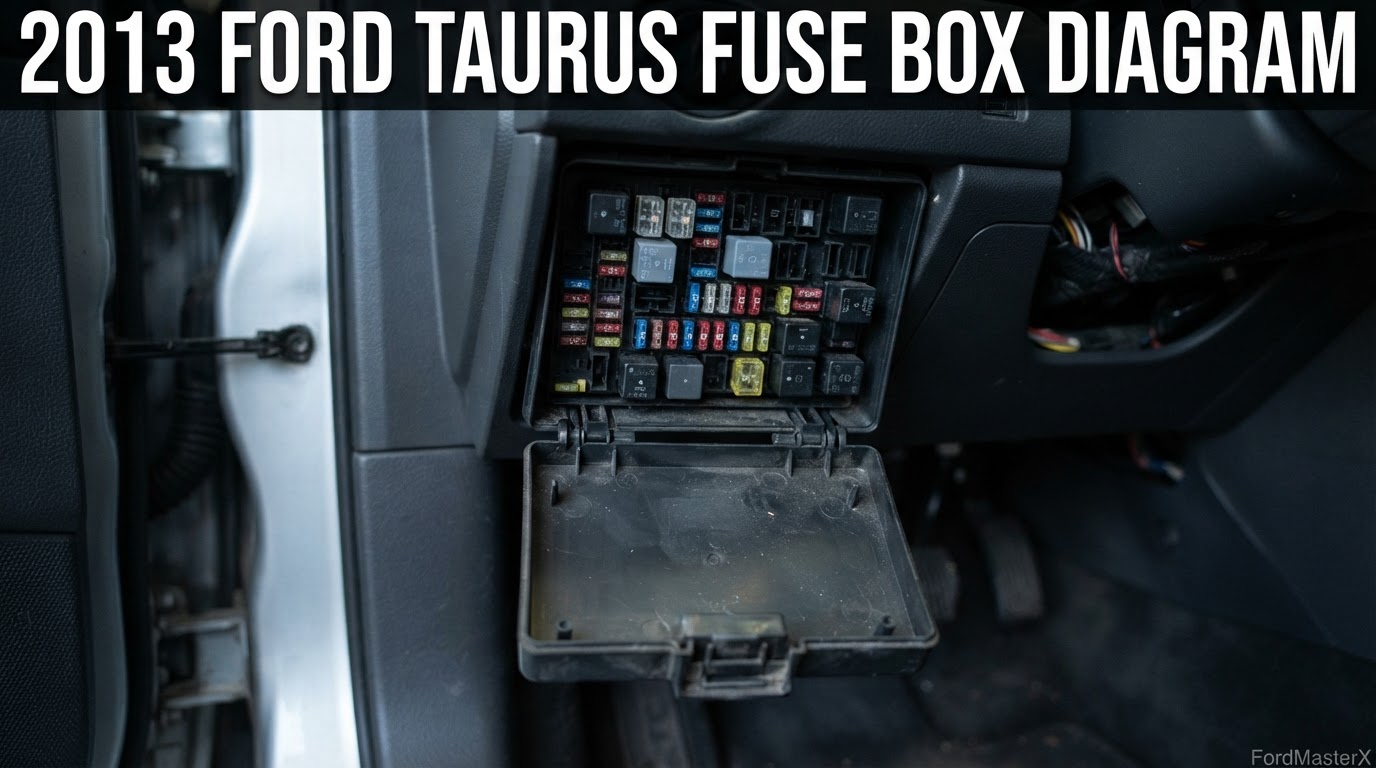
2013 Ford Taurus Fuse Box Diagram: Every Fuse and Amp Rating

Your 2013 Ford Taurus has two fuse boxes. The Body Control Module fuse panel is under the dash on the driver’s side. The Battery Junction Box is under the hood. The front cigar lighter and instrument panel power point run through fuse F27, rated 20A.
Most “2010 to 2019” Taurus charts blend two completely different fuse box designs into one table. Ford redesigned both boxes for the 2013 facelift and reused several position numbers for unrelated circuits. A chart built from a 2011 or 2012 Taurus will send you to the wrong fuse.
Skip to what changed in 2013 if that is why you are here.
Where are the fuse boxes on a 2013 Ford Taurus?


Body Control Module fuse panel. Passenger compartment, under the dash on the driver’s side, near the left side of the brake pedal area. A trim panel covers it.
Battery Junction Box. Engine compartment, under the hood. This holds the high current fuses and most of the police package circuits shared with the Taurus-based Police Interceptor sedan.
Worth knowing: the box cover on your specific car has a label printed on the underside. Trim level and options move things around in ways a generic chart cannot see. That label is the final authority.
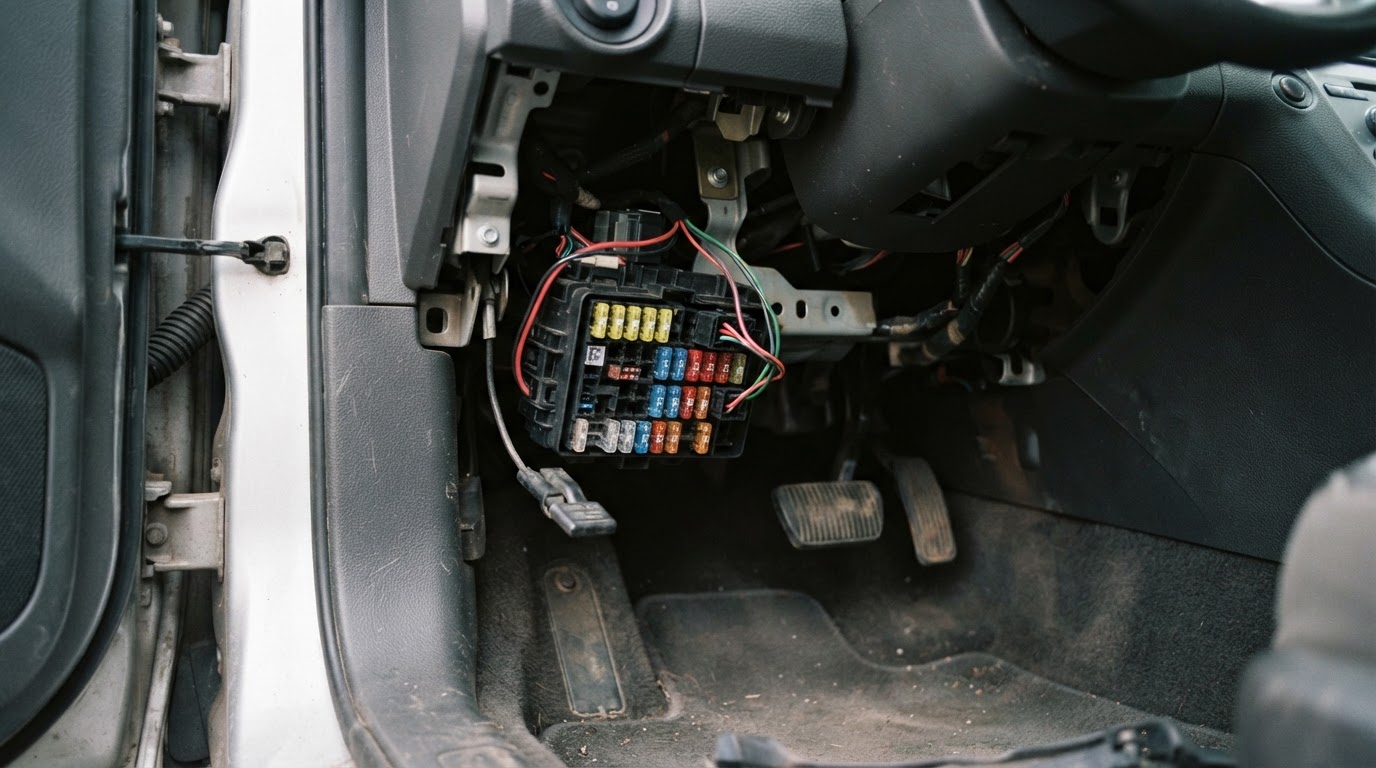
Body Control Module fuse chart: fuses 1 to 48


The chart below comes from a 2013-specific source. A second, identical reading of the 2014 model year confirms it. A third source confirms the 2013 architecture change itself.
All three agree on every value listed. Positions that are not populated on this box are marked “Not used.”
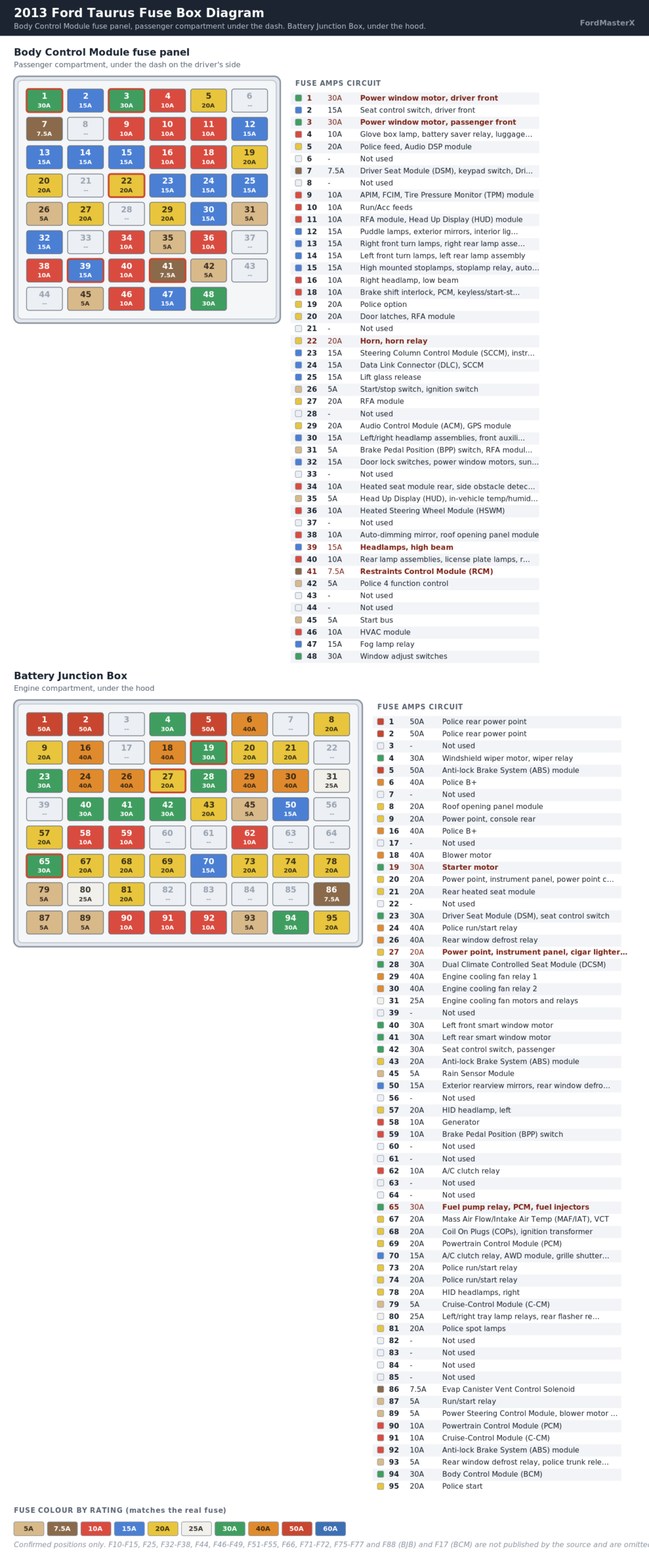
| Fuse | Amps | Circuit protected |
|---|---|---|
| F1 | 30A | Power window motor, driver front |
| F2 | 15A | Seat control switch, driver front |
| F3 | 30A | Power window motor, passenger front |
| F4 | 10A | Glove box lamp, battery saver relay, luggage lamp, interior lamps |
| F5 | 20A | Police feed, Audio DSP module |
| F6 | – | Not used |
| F7 | 7.5A | Driver Seat Module (DSM), keypad switch, Driver Door Module |
| F8 | – | Not used |
| F9 | 10A | APIM, FCIM, Tire Pressure Monitor (TPM) module |
| F10 | 10A | Run/Acc feeds |
| F11 | 10A | RFA module, Head Up Display (HUD) module |
| F12 | 15A | Puddle lamps, exterior mirrors, interior lighting |
| F13 | 15A | Right front turn lamps, right rear lamp assembly |
| F14 | 15A | Left front turn lamps, left rear lamp assembly |
| F15 | 15A | High mounted stoplamps, stoplamp relay, auto dimming mirror |
| F16 | 10A | Right headlamp, low beam |
| F17 | – | Not confirmed. Not published in either year-specific source checked. |
| F18 | 10A | Brake shift interlock, PCM, keyless/start-stop switch |
| F19 | 20A | Police option |
| F20 | 20A | Door latches, RFA module |
| F21 | – | Not used |
| F22 | 20A | Horn, horn relay |
| F23 | 15A | Steering Column Control Module (SCCM), instrument cluster |
| F24 | 15A | Data Link Connector (DLC), SCCM |
| F25 | 15A | Lift glass release |
| F26 | 5A | Start/stop switch, ignition switch |
| F27 | 20A | RFA module |
| F28 | – | Not used |
| F29 | 20A | Audio Control Module (ACM), GPS module |
| F30 | 15A | Left/right headlamp assemblies, front auxiliary park lamps |
| F31 | 5A | Brake Pedal Position (BPP) switch, RFA module, PCM |
| F32 | 15A | Door lock switches, power window motors, sunshade module |
| F33 | – | Not used |
| F34 | 10A | Heated seat module rear, side obstacle detection, parking aid |
| F35 | 5A | Head Up Display (HUD), in-vehicle temp/humidity sensor |
| F36 | 10A | Heated Steering Wheel Module (HSWM) |
| F37 | – | Not used |
| F38 | 10A | Auto-dimming mirror, roof opening panel module |
| F39 | 15A | Headlamps, high beam |
| F40 | 10A | Rear lamp assemblies, license plate lamps, reversing lamps |
| F41 | 7.5A | Restraints Control Module (RCM) |
| F42 | 5A | Police 4 function control |
| F43 | – | Not used |
| F44 | – | Not used |
| F45 | 5A | Start bus |
| F46 | 10A | HVAC module |
| F47 | 15A | Fog lamp relay |
| F48 | 30A | Window adjust switches |
Most everyday fuse pulls happen in this box. Police package equipment, HID headlamps, the power points and the starter live in the other one. Trim level changes which police-specific positions carry a module on a retail car. The position numbers themselves do not move.
Battery Junction Box fuse chart: fuses 1 to 95


The same three sources cover this box. A handful of positions are not published by the source. They are: F10-F15, F25, F32-F38, F44, F46-F55, F66, F71-F72, F75-F77 and F88.
They are left out below rather than guessed. Ford’s junction box numbering is not fully sequential on this generation. Some numbers are reserved for other markets or trims and never populated here.
| Fuse | Amps | Circuit protected |
|---|---|---|
| F1 | 50A | Police rear power point |
| F2 | 50A | Police rear power point |
| F3 | – | Not used |
| F4 | 30A | Windshield wiper motor, wiper relay |
| F5 | 50A | Anti-lock Brake System (ABS) module |
| F6 | 40A | Police B+ |
| F7 | – | Not used |
| F8 | 20A | Roof opening panel module |
| F9 | 20A | Power point, console rear |
| F16 | 40A | Police B+ |
| F17 | – | Not used |
| F18 | 40A | Blower motor |
| F19 | 30A | Starter motor |
| F20 | 20A | Power point, instrument panel, power point console front |
| F21 | 20A | Rear heated seat module |
| F22 | – | Not used |
| F23 | 30A | Driver Seat Module (DSM), seat control switch |
| F24 | 40A | Police run/start relay |
| F26 | 40A | Rear window defrost relay |
| F27 | 20A | Power point, instrument panel, cigar lighter front |
| F28 | 30A | Dual Climate Controlled Seat Module (DCSM) |
| F29 | 40A | Engine cooling fan relay 1 |
| F30 | 40A | Engine cooling fan relay 2 |
| F31 | 25A | Engine cooling fan motors and relays |
| F39 | – | Not used |
| F40 | 30A | Left front smart window motor |
| F41 | 30A | Left rear smart window motor |
| F42 | 30A | Seat control switch, passenger |
| F43 | 20A | Anti-lock Brake System (ABS) module |
| F45 | 5A | Rain Sensor Module |
| F50 | 15A | Exterior rearview mirrors, rear window defrost grid |
| F56 | – | Not used |
| F57 | 20A | HID headlamp, left |
| F58 | 10A | Generator |
| F59 | 10A | Brake Pedal Position (BPP) switch |
| F60 | – | Not used |
| F61 | – | Not used |
| F62 | 10A | A/C clutch relay |
| F63 | – | Not used |
| F64 | – | Not used |
| F65 | 30A | Fuel pump relay, PCM, fuel injectors |
| F67 | 20A | Mass Air Flow/Intake Air Temp sensor (MAF/IAT), VCT |
| F68 | 20A | Coil On Plugs (COPs), ignition transformer |
| F69 | 20A | Powertrain Control Module (PCM) |
| F70 | 15A | A/C clutch relay, AWD module, grille shutter actuator |
| F73 | 20A | Police run/start relay |
| F74 | 20A | Police run/start relay |
| F78 | 20A | HID headlamps, right |
| F79 | 5A | Cruise-Control Module (C-CM) |
| F80 | 25A | Left/right tray lamp relays, rear flasher relay |
| F81 | 20A | Police spot lamps |
| F82 | – | Not used |
| F83 | – | Not used |
| F84 | – | Not used |
| F85 | – | Not used |
| F86 | 7.5A | Evap Canister Vent Control Solenoid |
| F87 | 5A | Run/start relay |
| F89 | 5A | Power Steering Control Module, blower motor relay |
| F90 | 10A | Powertrain Control Module (PCM) |
| F91 | 10A | Cruise-Control Module (C-CM) |
| F92 | 10A | Anti-lock Brake System (ABS) module |
| F93 | 5A | Rear window defrost relay, police trunk release |
| F94 | 30A | Body Control Module (BCM) |
| F95 | 20A | Police start |
A cheap fuse assortment kit covers both mini and standard ATO/ATC sizes used across these two boxes. It costs less than a single dealer fuse and saves a second trip. Any brand meeting the ATO/ATC standard fits.
2013 Ford Taurus symptom to fuse guide
Readers usually arrive with a symptom, not a fuse number. This maps the common ones.
| What is not working | Check this fuse |
|---|---|
| Front cigar lighter or 12V power point dead | F27, 20A (BJB) |
| Rear console power point dead | F9, 20A (BJB) |
| No crank, no start | F19, 30A (BJB), starter motor |
| Engine will not start, fuel pump suspected | F65, 30A (BJB) |
| No air movement at any blower speed | F18, 40A (BJB) |
| Horn will not sound | F22, 20A (BCM) |
| High beam headlamps out | F39, 15A (BCM) |
| Right low beam headlamp out | F16, 10A (BCM) |
| Driver power window dead | F1, 30A (BCM) |
| Passenger power window dead | F3, 30A (BCM) |
| Airbag warning light on | F41, 7.5A (BCM), Restraints Control Module |
| ABS warning light on | F5, 50A, or F43, 20A, or F92, 10A (BJB) |
| Rear window defroster dead | F26, 40A relay, or F50, 15A (BJB) |
| Heated steering wheel not working | F36, 10A (BCM) |
| SYNC screen or APIM blank | F9, 10A (BCM) |
| Fog lamps dead | F47, 15A (BCM) |
| Rear heated seats not working | F21, 20A (BJB) |
How do you tell if a fuse is actually blown?
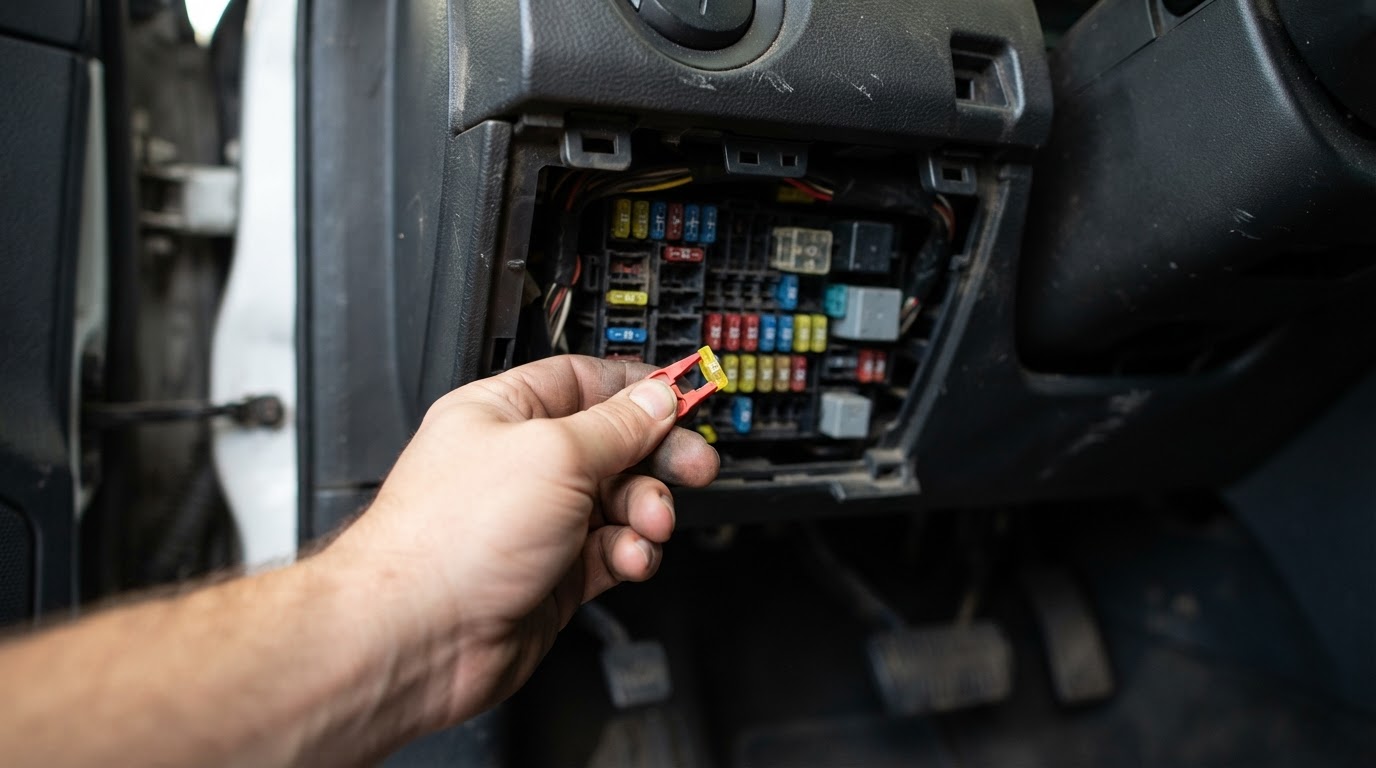
Pull it and look through the plastic window at the metal strip inside. An intact fuse has an unbroken strip. A blown one shows a visible gap, or the window is smoked dark.
A hairline break is easy to miss. Hold the fuse up to a light, or test continuity with a multimeter set to ohms. Near zero resistance means the fuse is good.
Never guess the replacement rating. Match the number printed on the old fuse and cross-check your box cover label. A higher rated fuse lets the wiring become the fuse. That costs far more to fix than a blown fuse ever does.
Why does the same fuse keep blowing?
A fuse that blows once is usually a one-off surge. One that blows again within days is telling you something is wrong upstream, not asking for a bigger fuse.
Unplug whatever you most recently added. A phone charger left in a power point is a common repeat offender. So is an aftermarket amplifier, a trailer harness or a dash cam.
Look for chafed insulation where the harness moves. Door jambs and anything routed near the steering column flex thousands of times over a car’s life.
If a fuse blows the instant you push it in, that circuit has a hard short. Stop replacing fuses and trace the wiring with a proper diagnostic tool instead of guessing. A plastic fuse puller keeps you from cracking the panel housing while you work through the circuit.
What changed in 2013, and why fuse position 27 is not what an older chart says it is
The Taurus 6th generation runs 2010 to 2019 as one continuous body. Ford redesigned both fuse boxes for the 2013 model year facelift.
2010 to 2012 cars used a plain numbered Battery Junction Box and Smart Junction Box. 2013 and later cars use an F-prefixed Battery Junction Box and a Body Control Module panel instead.
The change is confirmed independently on both sides. Two separate readings of 2010 and 2012 model year data show the old scheme. Two separate readings of 2013 and 2014 model year data show the new scheme, identical to each other.
Position 27 in the engine bay box is the clearest example of why this matters. On a 2010 to 2012 Taurus, fuse 27 in the Battery Junction Box ties to the fuel pump relay circuit.
Sources disagree on the exact amperage for that position before 2013. That disagreement is itself a sign the pre-2013 chart varies by trim.
On a 2013 or later Taurus, fuse F27 is a 20A power point and cigar lighter circuit instead. That is confirmed identically on both the 2013 and 2014 model years.
Pull fuse 27 on a 2013 Taurus expecting a fuel pump fix. Use an older chart, and you have pulled your cigar lighter fuse instead. The position number stayed the same. What it protects did not.
| Position | 2010-2012 Taurus | 2013-2019 Taurus |
|---|---|---|
| Fuse/F27, Battery Junction Box | Fuel pump relay (amperage varies by trim across sources) | 20A, power point and cigar lighter, instrument panel |
| Fuse/F1, cabin panel | 30A, power window motor, left front | 30A, power window motor, driver front |
| Fuse box names | Battery Junction Box (engine), Smart Junction Box (cabin) | Battery Junction Box (engine), Body Control Module (cabin) |
Not every position moved. Fuse 1 in the cabin panel protects the driver’s power window on both sides of the 2013 line. It is just relabeled from “left front” to “driver front.” That consistency is exactly why a reader assumes the rest of the chart carries over too. It is also exactly why it does not.
2013 Ford Taurus fuse quick reference
The fuses owners look up most, in one place.
| What you want | Fuse | Amps | Box |
|---|---|---|---|
| Cigar lighter, front power point | F27 | 20A | Battery Junction Box |
| Starter motor | F19 | 30A | Battery Junction Box |
| Fuel pump, PCM | F65 | 30A | Battery Junction Box |
| Blower motor | F18 | 40A | Battery Junction Box |
| Driver power window | F1 | 30A | Body Control Module |
| Passenger power window | F3 | 30A | Body Control Module |
| Horn | F22 | 20A | Body Control Module |
| Airbag, restraints | F41 | 7.5A | Body Control Module |
| High beam headlamps | F39 | 15A | Body Control Module |
| APIM, infotainment | F9 | 10A | Body Control Module |
Not sure your car matches this exactly? Your box cover label is the final authority. Trim level and police package equipment change which positions carry a live circuit.
Some positions on this generation are not confirmed by either year-specific source checked for this guide. F17 in the cabin panel is one of them. If your box cover disagrees with anything above, trust the label on your own car.