

Ford Mustang Dashboard Symbols: When to Stop or Get Service

If the oil-can warning appears while your Mustang’s engine is running, pull over as soon as you can do so safely and switch the engine off. If the coolant-temperature warning appears, stop safely and switch off the vehicle. If the brake warning stays on with the parking brake fully released, pull over safely and arrange assistance. Pull over safely if the check-engine light and wrench are both on while the engine is running. Follow any more specific instruction in your instrument cluster.
Other familiar Ford Mustang dashboard symbols ask for a different response. An engine-outline light that flashes can point to a misfire, while a skidding-car icon that briefly flashes can mean the stability system is doing its job. An oil lamp at ignition-on can be normal before the engine starts. To make the right call, identify the symbol, note what the car was doing when it appeared, and read the complete message beside it.
This guide covers common warnings on U.S.-market 2025–2026 gasoline Mustangs. Exact equipment, graphics, and message wording can vary. Use the manual supplied for your car, particularly for instructions that depend on the model year, package, or type of parking brake. Mustang Mach-E and Mustang GTD use separate manuals.
Mustang warning light response chart
Match the warning to the exact cluster message before choosing a response.
- Pull over safely
Low oil pressure with the engine running or a coolant-temperature warning. Switch the engine off after stopping. Also pull over if the check-engine light and wrench are both on with the engine running.
- Arrange prompt service
Flashing engine outline: avoid hard acceleration and deceleration. Flashing wrench: reduce speed immediately and avoid abrupt speed changes.
- Recognize normal operation
A brief stability-control flash can mean intervention. Ease your inputs. A high-beam indicator can show the lights are selected.
For a brake warning that stays on with the parking brake fully released, pull over safely and arrange assistance. Braking performance may be reduced. Follow the exact cluster message.
Ford Mustang warning lights at a glance
| What you see | What to do first |
|---|---|
| Oil can with engine running | Pull over safely and shut off the engine. Check the oil level only once parked safely. |
| Coolant-temperature warning | Pull over safely and switch off the vehicle. Leave the hot cooling system closed. |
| Brake warning stays on with parking brake released | Pull over safely and arrange assistance. Braking performance may be reduced. |
| Engine outline, steady while running | Read the message and arrange diagnosis. Check for any additional warnings or changes in the way the car runs. |
| Engine outline, flashing while running | Avoid hard acceleration and deceleration. Have the vehicle checked as soon as possible. Pull over safely if the vehicle becomes difficult to control or displays a stop warning. |
| Wrench, especially if flashing | Read the cluster. Ford advises reducing speed immediately if the powertrain warning flashes while driving, avoiding aggressive speed changes and having it checked promptly. |
| Check-engine light and wrench both on with the engine running | Pull over as soon as you can do so safely. Follow the engine-warning procedure in your owner’s manual and arrange prompt service. |
| ABS alone | Have the system checked. A separate brake-system warning or changed pedal behavior calls for greater caution. |
| Tire symbol, steady | Pull over safely as soon as possible to inspect the tires and check pressure. Use the vehicle’s tire label for cold pressures. |
| Tire symbol flashes at startup and then stays on | Check pressure manually and have the monitoring system evaluated. |
| Skidding-car icon briefly flashes in a low-grip situation | The stability or traction system may be intervening. Ease your inputs and adapt to available grip. |
Use the chart as a first-response aid. A specific stop message, a material change in steering or braking, or several warnings appearing together can change how you respond. You can look up the exact graphic in the 2026 Mustang Owner’s Manual, U.S. and Canada edition. Search inside the manual for the cluster wording or the system chapter, since some warnings are explained outside the glossary.
Oil pressure and coolant temperature require a safe stop
Oil-can icon while the engine is running
The oil-can lamp is an engine oil-pressure warning. Ford describes a brief ignition-on illumination and gives a separate instruction for a lamp that comes on with the engine running. In the second case, stop safely, shut down the engine, and check the engine oil level. Park in a safe location and follow the manual’s oil-check procedure. If checking under the hood would put you beside moving traffic, arrange assistance from a safe position.
An acceptable dipstick reading tells you about the amount of oil present under the conditions of the check. It does not establish that the engine is developing the required oil pressure. Ford specifically says that a sufficient level combined with this warning indicates a system malfunction that requires inspection. Report whether you saw the light at idle, under load, on a turn, or after recent service. Do not run the engine to recreate the warning for a video.
An oil-life or maintenance reminder has a separate purpose. Record the exact icon and message rather than telling the shop that an “oil change light” came on. That distinction helps the technician understand the urgency before you describe the rest of the symptoms.
Coolant-temperature warning
A temperature warning is a reason to find a safe stopping point and switch the vehicle off. A hot engine and cooling system need time to cool. Leave the reservoir cap closed while hot and follow the instructions for your year before checking the coolant level or arranging recovery.
A temperature warning may arrive alongside a message or a gauge reading. If you can read those details safely, note whether the warning followed slow traffic, extended idling, or ordinary highway use. A temperature returning to its usual position after shutdown does not identify the underlying cause. Follow Ford’s guidance or have the cause evaluated before continuing. If steam or spilled fluid is present, keep clear of the affected area while obtaining help.
Brake system, electric parking brake, and ABS
The brake lamp can illuminate with the parking brake applied. If a brake warning comes on while driving, confirm whether the parking brake is fully released as soon as you can do so safely. Ford warns that a brake warning remaining on after the parking brake is released can mean the brakes are not working correctly. It can also indicate low brake fluid or a brake system that requires service. Ford warns that driving with this warning can reduce braking performance and lengthen stopping distance. Pull over safely and arrange assistance before continuing.
The electric parking brake can display an indicator during application and a warning when it requires service. Use the accompanying message to distinguish application from a fault, particularly if the lamp keeps flashing unexpectedly. Check the exact message and use the manual section that matches your Mustang’s switch or handle. Do not assume a car is secured on a slope when the parking brake indicates a fault. Consult the specific parking instructions for your transmission.
An ABS-only light identifies a fault in the anti-lock system. Ford explains that conventional braking remains available when the ABS warning is on by itself, provided the brake-system warning is not also illuminated. Anti-lock assistance can be unavailable. If both warnings appear, or the pedal feels different, treat that as a braking concern rather than using the ABS-only guidance. No dashboard icon measures how much braking performance remains.
Check engine and wrench: watch what the light does
The engine-shaped malfunction indicator light is the check-engine light. When it stays amber with the engine running, the onboard diagnostic system has detected an emissions-control malfunction. The shape cannot tell you the failed part. A technician can use stored diagnostic information and the symptoms you observed to narrow down the cause. Record when the lamp appeared and whether it remained on continuously. Clear codes only after the relevant diagnostic information has been gathered and the appropriate repair procedure calls for it.
A flashing check-engine light matters even if it later turns steady. Ford says flashing can indicate an engine misfire. It also warns that increased exhaust temperature can damage the catalytic converter or other components. Avoid heavy acceleration and deceleration and arrange prompt diagnosis. If the vehicle is shaking badly, losing power, or showing a separate stop warning, choose a safe place to stop and arrange assistance. Do not try to reproduce the fault by accelerating hard.
The wrench identifies a powertrain warning. Ford gives specific instructions for a light that flashes while driving: reduce speed immediately, avoid heavy acceleration and deceleration, and have the vehicle checked as soon as possible. Write down any accompanying loss of power or unexpected gear behavior. If the engine outline and wrench are both lit while the engine is running, pull over as soon as you can do so safely. Ford warns that continuing can lead to reduced power or the engine stopping. Once parked safely, consult the engine-warning procedure for your vehicle and arrange prompt service. The combined-warning guidance is covered in the 2026 Mustang Owner’s Manual, U.S. and Canada edition, August 2025 revision, under Starting and Stopping the Engine.
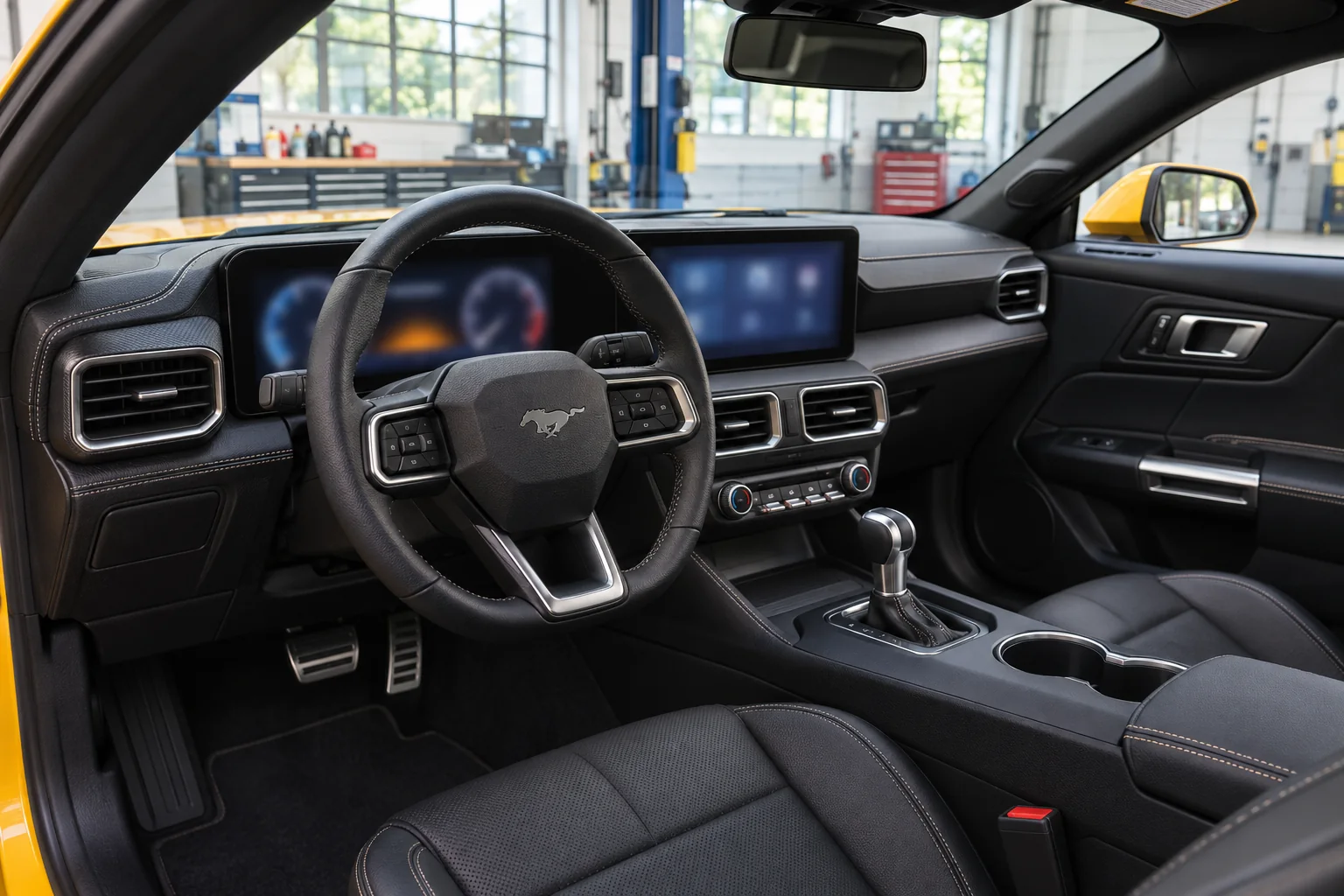
Tire pressure and stability warnings
A steady tire warning can mean one or more tires are significantly underinflated. Pull over safely as soon as possible to check the tires. Look for obvious damage. Check all road tires using a reliable gauge and compare the cold pressures with the vehicle’s tire label at the driver’s door opening. That label applies to the vehicle’s specified setup. The number molded on a tire sidewall is a different measurement and does not replace the vehicle label. Pay attention to any front and rear differences on the placard.
If the tire symbol flashes for approximately a minute at startup and then remains on, Ford describes that sequence as the monitoring system’s malfunction indication. The monitor may be unable to report low pressure correctly. Check the tires manually and arrange diagnosis. A warning after fitting different wheels, installing a spare, or using sealant is worth mentioning to the technician because Ford identifies these situations as relevant to the system. If a tire is visibly damaged or nearly flat, treat that condition immediately and follow the manual’s roadside instructions. If the display separately asks you to service the inflator kit, check what the Service Tire Mobility Kit message refers to before relying on the kit.
A skidding-car icon can flash as stability control or traction control intervenes. Wet pavement, a low-grip surface, or an abrupt request for power can be useful context. Reduce abrupt steering and accelerator inputs and drive to the conditions. If a stability warning stays on, look for a separate OFF indicator or a message explaining whether the system was turned off or requires service. Consult the stability-control chapter for the indicated behavior. Avoid intentionally creating wheelspin to test the light.
Charging, restraints, and everyday indicators
A battery-shaped warning with the engine running concerns the electrical charging system. Record any companion messages and have the system checked promptly. The symbol alone does not establish which component needs replacement. Stop safely if electrical symptoms affect control or visibility, or if the cluster instructs you to stop. A voltage display and the charging warning serve different purposes. Report the indicator and its timing, along with a gauge reading if you captured one safely.
An airbag warning that remains on, flashes, or fails its expected startup check can signal a restraint-system fault. Have the restraint system serviced immediately, even if the warning is intermittent. The passenger airbag status indicator is separate. It reflects the passenger sensing system’s state and should be checked against the occupancy guidance in the manual. If its status does not make sense for the passenger in the seat, consult the manual before continuing with that seating arrangement.
Turn signal arrows and the blue high-beam indicator ordinarily confirm a selected lighting function. Some driver assistance icons likewise tell you that a feature is available, active, switched off, or temporarily unavailable. You still have to drive the car. Use the message to distinguish a selected setting from an unexpected fault. A lit symbol without the exact message can be hard for a second person to identify because several assistance features share visual elements.
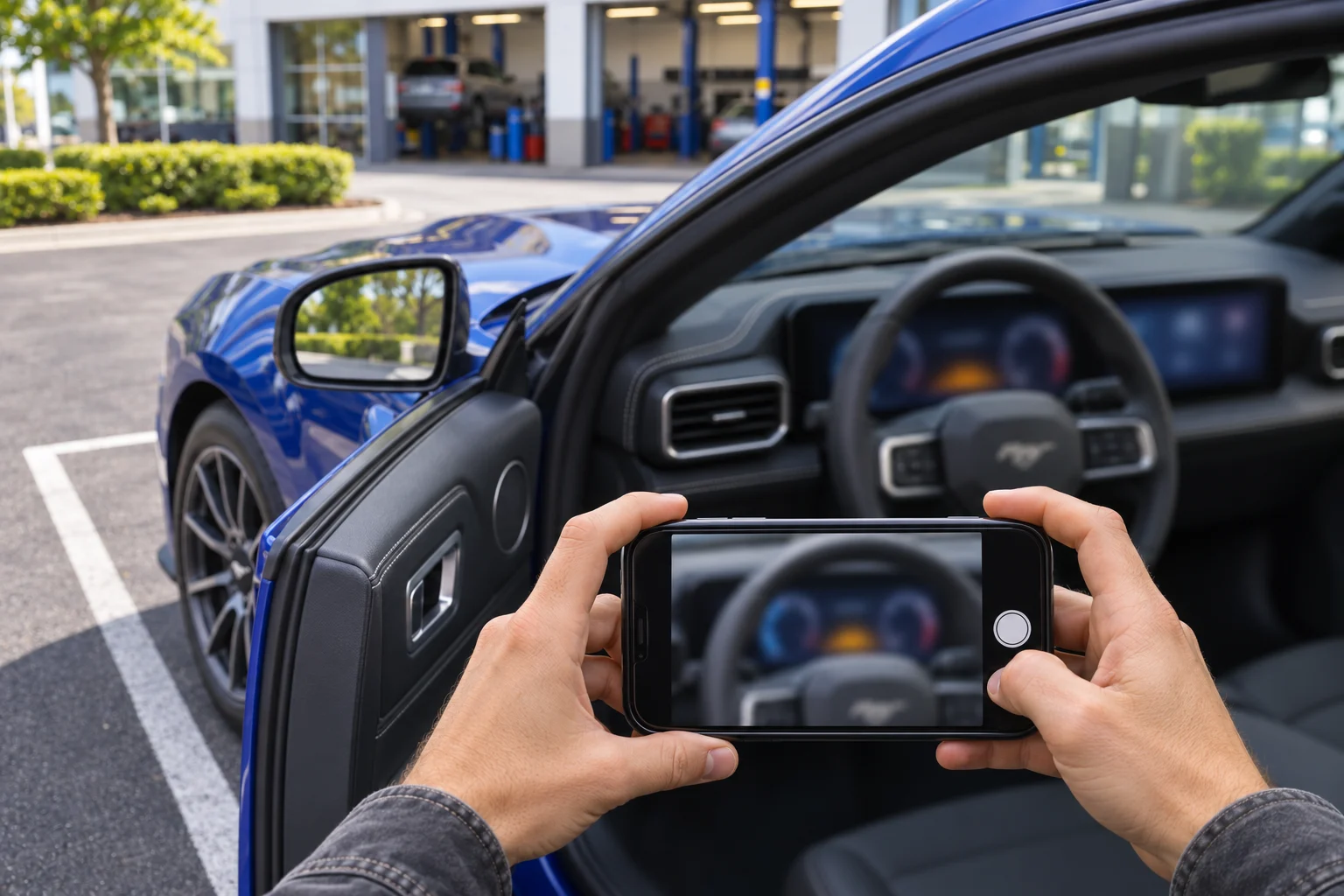
Record the warning after you stop safely
- Note whether the ignition was on, the engine was running, or the car was moving. These conditions matter for both oil and engine warnings.
- Identify the symbol and record the exact cluster message. Include whether it was steady, flashing for a short sequence, or repeatedly flashing.
- Note what happened first. For example, record whether a low tire warning preceded a stability message or whether both showed up together.
- Record the model year and package if known. Mention any recent wheel change, flat tire repair, battery service, or work on the affected system.
- Document changes in braking, steering, engine power, or temperature. Give the service technician the operating conditions instead of guessing a failed part.
- Take a photo only when safely parked. If the message disappears before you can record it, describe it from memory without trying to reproduce a hazardous event.
Ford’s 2025 Mustang Owner’s Manual warning-lamp section and the 2026 manual provide practical starting points. Match your owner’s manual to your car, then search the exact terms shown on the cluster. If different editions display different images or directions, follow the manual supplied with your car and ask Ford to confirm applicability if needed.
Frequently asked questions
Why do several Mustang warning lights appear when I switch the ignition on?
Some lights illuminate as part of normal startup checks. The oil lamp is one example Ford describes. What matters is whether each lamp behaves as its system chapter specifies after the engine starts. Record the light that stays on or returns while driving, then check its specific instructions. If an expected safety-system lamp does not appear at startup, look up the applicable check and arrange service as directed.
Can the car tell me which tire is low?
The display and available detail depend on equipment and operating conditions. Whether or not it names a tire, check each road tire with a gauge after parking safely. A monitor malfunction can reduce the reliability of the displayed information. Do not rely on a clear screen to rule out a visibly damaged tire, and use the vehicle’s pressure label for the specified cold pressures.
What if a warning disappears after I restart the car?
A warning that goes away may still be useful diagnostic evidence. Record what it said and what happened before it went away. For an earlier oil-pressure, overheating, brake, or stop message, follow the instructions for that event before deciding whether to drive. A temporarily clear display by itself does not confirm a repair. Avoid cycling the ignition repeatedly in an effort to erase a warning.
Can I use a Mustang Mach-E warning-light chart for my Mustang GT?
Use the gasoline Mustang manual for a Mustang GT. The Mach-E has its own electric powertrain, charging system, and warning descriptions. Some icons identify shared functions, such as turn signals or seat belts, but similar shapes do not establish that the response is the same. When the model name on a chart is ambiguous, verify the exact vehicle and model year first.