
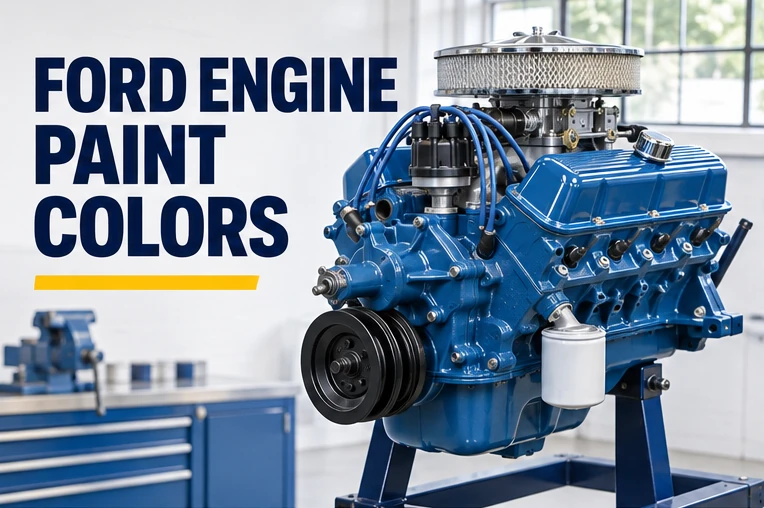
Ford Engine Paint Colors by Era and Component

Ford engine paint colors vary by era and component. The Henry Ford documents a green block on its 1930 Model A. Early 1964–1965 Mustangs used black engine blocks with identifying finishes on parts such as the valve covers. Mustang restoration references identify Ford Corporate Blue as the principal engine color for 1966–1973.
Identify the engine and the part you intend to paint before buying enamel. A listing for Ford Blue, Ford Dark Blue, or Old Ford Blue gives you a product name. For a restoration, compare that product with an original sample or a documented example from the same application. For a driver, choose a finish that fits your goals and use the coating maker’s application instructions.


Ford engine paint colors by era and part
Check the engine application and the component separately. Compare dried samples before painting.
| Application | Block finish documented here | Other components or useful limits |
|---|---|---|
| 1930 Ford Model A in The Henry Ford collection | Green | The documented example has a separately finished black oil-return pipe |
| Early 1964–1965 Mustang six-cylinder | Gloss black | Red on identifying pieces such as the valve cover and air cleaner |
| Early Mustang 260 V8 | Gloss black | Light blue on identifying pieces such as the valve covers and air cleaner |
| Early Mustang 289 four-barrel A-code or D-code | Gloss black | Gold on identifying pieces. Check production details and surviving finish |
| Early Mustang 289 High Performance | Gloss black | Chrome identifying pieces in the restoration reference |
| 1966–1973 first-generation Mustang engines covered by the restoration source | Ford Corporate Blue | Verify the treatment of individual bolt-on parts and any special application |
The green example is documented by The Henry Ford’s transportation curator. The Mustang distinctions come from MotorTrend’s Ford engine paint restoration reference. The chart covers those documented examples. For another Ford engine, use its own application and production details before carrying over the color.
The early Mustang rows explain why two well-restored engine bays can look different with the same basic black block. A gold valve cover or light-blue air cleaner can reflect the hardware and finish specified for a particular engine package. If you are painting the block alone, identify it independently from any cover that may have been changed.
The 1966 change is useful for sorting candidate finishes because it establishes a broad first-generation Mustang transition. For judging or an expensive engine-out restoration, consult the current rules for the class and the period you are restoring. The exact shade and the parts to coat are separate questions.
Ford blue engine paint names and mixing references


| Reference type | Identifier | What it tells you |
|---|---|---|
| Restoration mixing reference | PPG 13358 | A commonly cited match for the Corporate Blue family in first-generation Mustang restoration |
| Dupli-Color engine enamel | DE1601 | Product named Ford Blue |
| Dupli-Color engine enamel | DE1606 | Product named Ford Dark Blue |
| Dupli-Color engine enamel | DE1621 | Product named Old Ford Blue |
| VHT engine enamel | SP134 | Product named Ford Light Blue |
| VHT engine enamel | SP125 | Product named Ford Dark Blue |
| VHT engine enamel | SP153 | Product named Old Ford Blue |
| VHT engine enamel | SP137 | Product named Ford Gray |
Dupli-Color’s engine enamel catalog and VHT’s engine enamel catalog provide their current product names and identifiers. Keep the brand with each number when discussing a match. For example, DE1621 and SP153 are two separate products with the same marketing name.
PPG 13358 is a paint-mixing reference cited by the restoration source. Ask a paint supplier whether it can cross-reference the number in a coating system suitable for your part and application. Bring an original sample if you have one. The reference gives the mixer somewhere to start when you lack a usable example. A dried sample lets you judge the appearance before the whole engine is coated.
The restoration account also discusses historical Corporate Blue shade variation. Lighting, gloss, and the substrate can affect how you perceive a sample. Compare candidates in the same light and under the same conditions. The FordMasterX guide to Old Ford Blue engine paint covers additional shade-selection considerations.
What to document before stripping the engine


Record which engine you actually have
Write down the vehicle’s model year, engine family and displacement, and any known replacement history. Photograph the relevant casting or assembly identification while it is accessible. A vehicle can retain its original body while carrying a donor or service replacement engine. Establish the build you intend to recreate before treating an existing finish as factory evidence.


If the engine is going to a machine shop, tell the shop that color evidence matters before it starts cleaning. A small photographed or preserved sample can keep a useful clue from disappearing. Label the sample with the component, location and date so you can interpret it after parts return from the shop.


Photograph the block and removable parts separately


A block, valve cover, air cleaner, oil pan and accessory bracket can have distinct finishes. Make a short photo record and name the parts. Photograph one view with the components together and close-ups of each finish where possible. Include a neutral color reference in the photos if you have one.
Look for protected areas around removed brackets or fasteners during normal disassembly. If a patch appears to show older paint, note whether there are multiple layers. A brushed-over area or an exposed layer on a replacement cover may tell you about a prior repair. Bring several observations together before treating a patch as decisive.
Separate the body paint code from the engine finish
The exterior code on the certification label helps you identify the vehicle’s factory body paint. A block color is researched from the engine application, historical sources, and physical evidence. Use the Ford exterior paint code chart when the same restoration also needs body paint. Write separate purchase notes for exterior and engine coatings so a supplier can select each system correctly.


How to choose a finish for a restoration or driver
Use the strongest evidence for a judged restoration


Start with the applicable judging guidance and a known original reference for the specific model, engine and build period. Confirm which parts the guidance treats individually. The painted surfaces, gloss and fastener treatment can matter alongside the hue. A written requirement and a well-documented original example give the paint supplier a more precise target than an online color name.
If the car has an early 289 four-barrel engine, first establish which parts carried the gold finish. Then assess candidate gold shades against the best available example. The restoration source discusses variation and uncertainty around early and later gold references. A signed-off test sample is a practical way to handle that uncertainty before painting a large batch of parts.
Choose a stable reference for a driver
A driver restoration often needs a finish you can purchase again for a later repair. Record the brand, product number, lot if visible, and date used. Save a test card with the project records. If a part is replaced later, that card gives you a physical comparison even if a supplier changes its catalog.
If you want Corporate Blue on a 1966 Mustang driver and have no original sample, compare a suitable mixed reference with a readily available engine enamel. Check the shade and gloss after the sample has dried as directed. Then decide which look fits your project and whether the product supports the material and operating conditions of the part.
Identify the goal for a swap or rebuilt engine


A swapped engine can be finished to reflect the donor application or to match the style of the vehicle receiving it. Record which choice you make, particularly if future owners or shops may need to identify the engine. Keep the coating details separate from casting, parts, and service records. A custom blue finish can serve an appearance goal while the physical identification still guides parts purchases.
For a contemporary rebuild, ask the engine builder whether surfaces are cast, machined, coated, or supplied with a specific finish. Match each product to the substrate and component. A general catalog name such as Ford Gray can be useful for purchasing a coating after you decide on the finish. The product name alone supplies little historical evidence about a particular engine.
How to compare paint samples before coating the engine
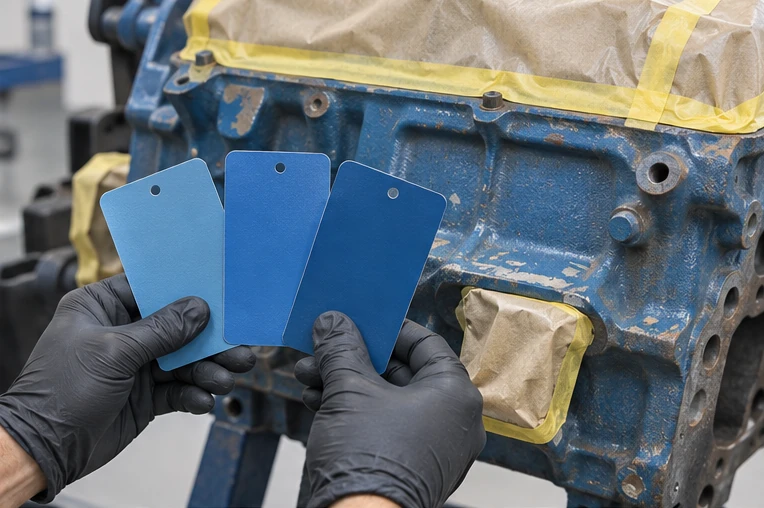
Select two or three credible candidates. Prepare samples according to the coating supplier’s directions and label each one with the product number and the base or primer used. If the shop will apply the final coating, let it prepare the cards in the proposed system so the comparison reflects the job it will actually perform.
Compare the dried samples beside the surviving original finish or reference in the same neutral light. Move both together so they catch the light at similar angles. Gloss and surface texture can change the appearance. Compare the look of the finish from a realistic viewing distance and inspect the details up close.
Before coating the part, review the product instructions for substrate, primer, application conditions and curing. Confirm which surfaces and openings the builder needs left clear, including machined sealing surfaces and identification plates. If the job involves spraying or hazardous coatings, have an appropriately equipped shop handle work you cannot do under the product’s required controls.
Treat exhaust parts as a separate application. Engine enamel and exhaust coatings have different intended uses, and the coating manufacturer identifies which surfaces its product is designed for. Confirm the intended part and application in the technical information before buying. Group the coating work by component so a suitable block finish does not get applied to the wrong surface.
How to plan the finish when several parts are missing
A project bought in boxes may have the block, heads, and accessory parts from different engines. Lay out the parts and list what you can identify before creating a paint order. For a restoration, mark which pieces need documented factory colors and which need replacement before you can determine the final finish. A cover you plan to discard can still preserve a clue, so photograph it first.
When the original air cleaner is missing, identify the style and finish appropriate to the engine before buying a replacement. A later part can bolt on and still change the appearance under the hood. If your project is a driver, you may accept that change. Document the finish you selected so a future replacement does not accidentally introduce another shade or sheen.
For a partial repaint, compare the proposed coating with the old finish where both will be visible. A close color match can still stand out if the fresh surface has a markedly different gloss. Ask the shop to produce a sample with the intended sheen and compare it next to a clean existing part.
Write the final order by component. List the proposed finish for the block, removable covers, and any brackets that are part of the job. Confirm which pieces the machine shop will return cleaned, primed, or bare. That small inventory helps you budget coating and avoids applying one color across pieces you meant to finish individually.
Save the color reference with the build records
Use the Ford engine paint colors chart to narrow the era and finish, then identify the exact engine and the part you intend to coat. Early Mustang blocks and trim pieces may need different treatments, while a Corporate Blue restoration benefits from a physical sample or a documented reference such as PPG 13358. Keep the manufacturer’s name and product number together when comparing modern enamels. If the engine is headed for a shop, agree on a dried sample and the parts to coat before work begins. Save the sample and product record so later touch-ups can follow the same finish.
Frequently asked questions
When did Ford switch Mustangs to Corporate Blue?
The restoration reference places the first-generation Mustang change in 1966 and identifies Corporate Blue through 1973. Confirm the treatment of individual covers and accessories against the engine application you are restoring.
Were early Mustang 289 engine blocks painted gold?
The early Mustang restoration reference identifies black blocks and gold on distinguishing pieces for the A-code and D-code four-barrel 289. Identify the component and the exact engine before selecting the paint. The appearance of the valve covers alone can be misleading.
Which PPG number is commonly used for Corporate Blue?
PPG 13358 is the commonly cited reference in the Mustang restoration source. Ask your supplier to check an equivalent in the coating system you plan to use. Compare a dried sample with original evidence if available.
Is Old Ford Blue the same shade across brands?
Dupli-Color lists DE1621 and VHT lists SP153 under that name. Compare actual dried samples if shade accuracy matters. The product names help you find the options, while the samples let you see how closely they match the reference.
What color was the 1930 Model A engine block?
The Henry Ford documents a green engine block on its 1930 Model A. Use that evidence for the documented application and research the correct year, engine and component for other early Fords.