
Ford Candy Apple Red Paint Code: 2026 Head-to-Head Paint Match Analysis

Finding the correct ford candy apple red paint code is essential for maintaining the integrity of classic Ford, Mercury, and Lincoln restorations. This iconic, deep-toned red has defined the aesthetic of legendary muscle cars for decades. By identifying the exact manufacturer specifications, you ensure color consistency across body panels, touch-ups, and full paint jobs.
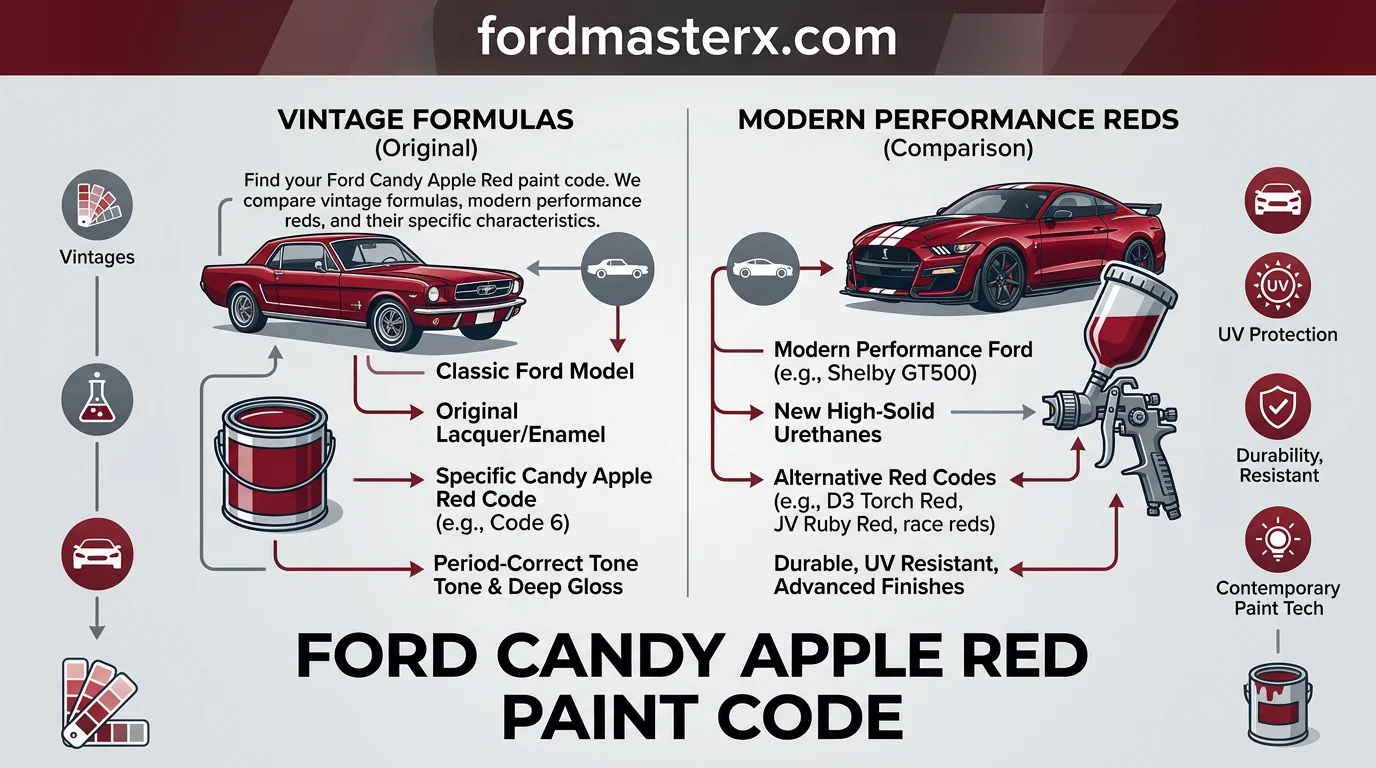
Reference Data for Ford Candy Apple Red Paint Code
How to Read This Chart
The chart above outlines the critical identifiers for the Candy Apple Red color used by Ford during the 1966 production cycle. The “Primary Paint Code” (T) is the character you will typically find on your vehicle’s buck tag or door data plate. The “Engineering ID” (M2008) is the internal Ford document reference. If you are ordering modern automotive paint, the PPG cross-reference number (71528) is often more useful for mixing purposes than the original factory code alone.


Features and Specifications of Ford Candy Apple Red


When selecting a paint system for a classic Ford, you are essentially choosing between single-stage and basecoat/clearcoat systems. Understanding the specifications of the original color helps in determining the “winner” for your specific restoration goals. A single-stage paint (like the 4:1 mix ratio kits commonly found in modern aftermarket support) offers a classic, period-correct look that closely mimics the finish applied in 1966 factories.

✨ Key Advantages and Disadvantages


Advantages
The primary advantage is the historical accuracy of the Candy Apple Red tone. Using code T ensures that if you are doing partial repairs, the color-matching process remains consistent with vintage factory standards.
Disadvantages
Disadvantages include the potential for color drift over 60 years of vehicle aging. Original paint fades or oxidizes, so matching a new “Code T” to 1966-original paint usually requires tinting adjustments by a professional technician.
Comparing Candy Apple Red vs. Signal Flare Red
One of the most common points of confusion for collectors is the distinction between Candy Apple Red (Code T) and Signal Flare Red (Code S). Both were prominent in the 1966 lineup, but they offer significantly different visual profiles. While Candy Apple Red is a deeper, more saturated, and metallic-adjacent shade, Signal Flare Red leans toward a brighter, more orange-leaning spectrum.
🔎 How to Find Your Ford Candy Apple Red Paint Code
To verify that your vehicle originally left the factory in Candy Apple Red, you must locate the data plate. On most 1966 Ford models, this is found on the inside of the driver’s side door. The plate contains a specific “Color” or “Paint” designation. If you see a “T” stamped in that field, your vehicle was factory-sprayed in this iconic shade.
📋 Step-by-Step Guide: Verifying and Ordering
Open the driver’s side door and look for the rectangular metal plate riveted to the door frame. Clean away any dirt or debris that may obscure the text.
Find the section labeled “COLOR” or “PAINT” on the tag. Verify if the letter ‘T’ is present. Note that other codes (like ‘S’ for Signal Flare Red) will be clearly visible if the car is not the original Candy Apple Red.
When ordering from an automotive paint supplier, use the code ‘T’ alongside the year (1966) and the specific model to ensure the chemical formula is tailored correctly for your paint system.
What If the Color Does Not Match?
If you have ordered paint using the correct Ford Candy Apple Red paint code and it still does not match, do not panic. Automotive paint matching is a complex science affected by environmental factors and production variability. Follow these steps if your results are unsatisfactory:
- Check the Batch: Verify if your paint supplier mixed the correct PPG code (71528) or equivalent.
- Evaluate Substrate: Ensure your primer color is neutral; a dark or light grey primer can significantly alter how the red appears once dry.
- Consult a Professional: If you are matching existing paint on an older car, consult a local professional paint shop. They can use a spectrophotometer to scan your existing finish and create a custom-tinted match.
- Professional Cost: Custom matching services typically cost between $100 and $300 for a small, precision-mixed batch.
Ford Candy Apple Red Paint Code Questions Answered
Is Code T the same for all 1966 Ford models?


Yes, code T (M2008) was the standard designation for Candy Apple Red across the 1966 Ford, Mercury, and Lincoln lines. This consistency makes it easier for restorers to source parts and materials.
Can I use modern clearcoat over the single-stage Code T?
You can, but it is rarely recommended to mix systems. If you want the durability of a clearcoat, it is standard practice to use a modern basecoat/clearcoat system rather than clear-coating a single-stage product.
Conclusion
Achieving a professional finish using the Ford Candy Apple Red paint code requires a combination of correct data, quality materials, and proper application techniques. By adhering to the factory-spec code “T” and understanding the differences between vintage paint formulations and modern alternatives, you can successfully restore the vibrant, deep red aesthetic characteristic of the 1966 Ford muscle car era. Always verify your specific vehicle’s door tag to confirm originality before beginning your restoration process.


Key Takeaways
-
✓
Identify your specific Candy Apple Red variant using the vehicle identification plate or trunk lid tag. -
✓
Understand that original lead-based pigments cannot be replicated exactly with modern eco-friendly materials. -
✓
Compare the pros and cons of single-stage versus two-stage clear-coat paint systems. -
✓
Analyze the advantages of modern performance reds when matching vintage panels. -
✓
Utilize the included reference chart to navigate model year specific formula updates through 2026.
❓ Frequently Asked Questions
1
What is the official Ford Candy Apple Red paint code?
Ford used several codes for Candy Apple Red depending on the era and assembly plant, most notably the ‘T’ paint code. Because these formulations evolved, there is no single universal code for all years. You must cross-reference your specific VIN and trim tag against current 2026 color-matching software databases.
2
How does Candy Apple Red compare to modern performance reds?
Vintage Candy Apple Red typically utilizes a deeper, richer pigment profile, while modern performance reds favor high-metallic or tri-coat effects for increased sunlight refraction. The advantage of modern reds is superior UV resistance, while the disadvantage is a potential loss of the classic, deep ‘wet’ look of 60s era paint.
3
Why is the paint code important for restoration?
The paint code is the only way to ensure color consistency across body panels. Using the correct code accounts for the base pigment ratios, which prevents mismatched panels. Understanding the features and limitations of your specific code is essential for achieving a factory-correct show-quality finish.
4
What are the benefits of two-stage application?
The primary advantages of a two-stage application (base coat and clear coat) are increased chemical resistance and a much higher level of gloss retention. Unlike vintage single-stage paints, the clear coat protects the red pigment from oxidation, though the disadvantage is a slightly thicker, more modern aesthetic.
5
How can I get started with matching this paint?
Begin by locating your vehicle’s buck tag or door plate to identify the original paint code. Cross-reference this with a reputable professional paint supplier’s 2026 database. Perform a head-to-head spray-out test on a sample metal panel before committing to painting the entire vehicle body.
6
Is Candy Apple Red a metallic color?
No, it is traditionally a solid (non-metallic) color. It relies on the clear coat for depth rather than metallic flakes.


