
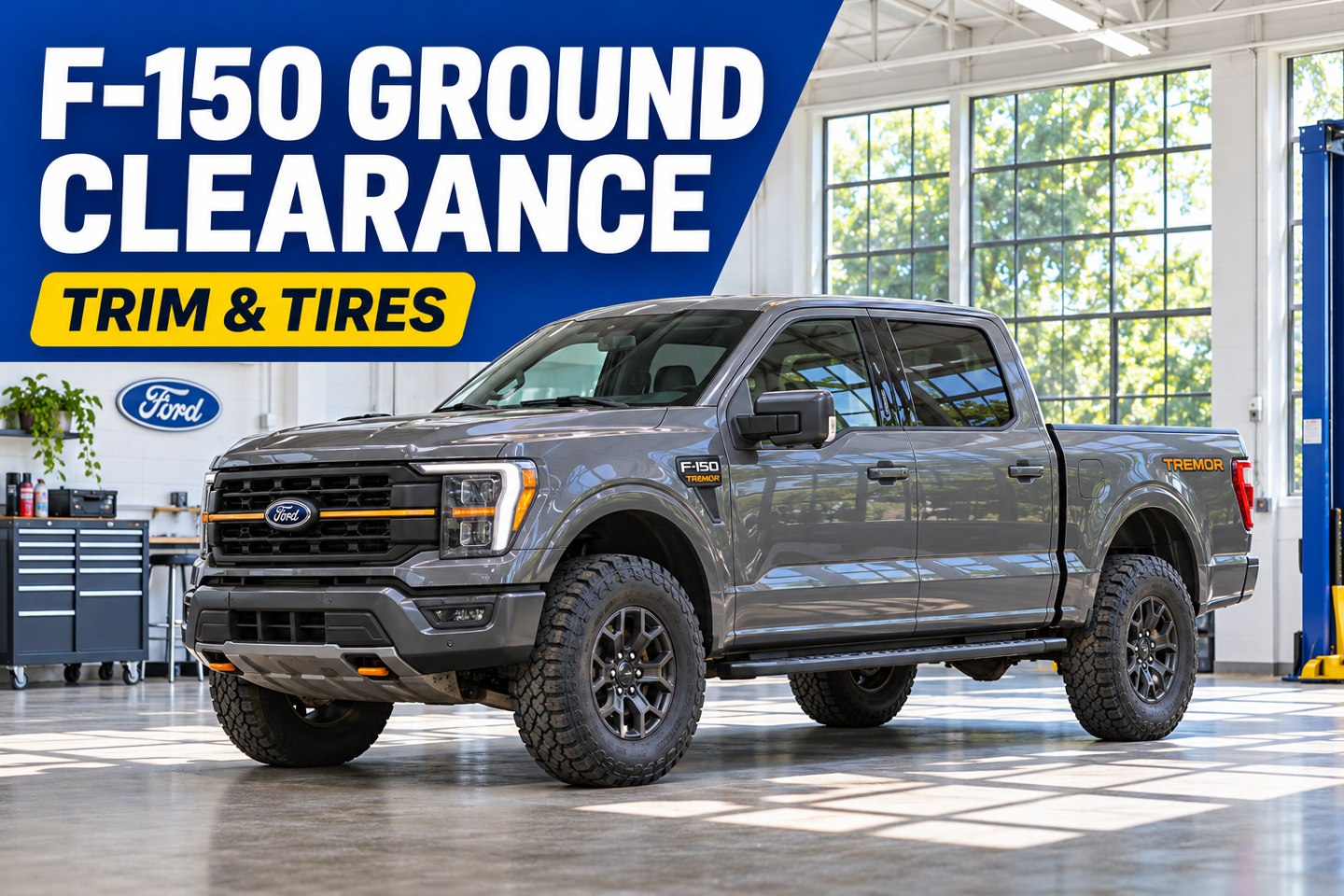
Ford F-150 Ground Clearance Chart for 2024 and 2026

Ford’s 2026 technical specifications list 8.2 inches of ground clearance for the F-150 SuperCrew 4×2 with the 5.5-foot bed and 9.8 inches for the corresponding 4×4. Ford lists 10.7 inches for the 2026 Tremor, and 11.9 or 13.1 inches for the Raptor with the 35- or 37-inch tire setup, respectively. Ford’s consumer page shows 10.9 inches for the Tremor and 12 inches on its Raptor card. The configuration chart below uses the dated technical sheet and identifies the website figures separately.
For a used truck, start with model year, cab, bed, and drivetrain. Use the factory tire configuration when comparing Raptors. For a modified truck or an obstacle with little margin, measure the actual truck. Overall height, clearance beneath the truck, and the angles at which it can approach or leave a slope answer different questions.


Ford F-150 Ground Clearance by Configuration
| Model year | Configuration | Drive or tires | Ground clearance |
|---|---|---|---|
| 2024 | SuperCrew, 5.5-ft bed | 4×2 | 8.2 in |
| 2024 | SuperCrew, 5.5-ft bed | 4×4 | 9.8 in |
| 2024 | Tremor SuperCrew, 5.5-ft bed | 4×4 | 9.4 in |
| 2024 | Raptor SuperCrew | 35-in tires | 12.0 in |
| 2024 | Raptor SuperCrew/Raptor R | 37-in tires | 13.1 in |
| 2026 | Regular Cab, 6.5-ft bed | 4×2 | 8.3 in |
| 2026 | Regular Cab, 6.5-ft bed | 4×4 | 9.8 in |
| 2026 | Regular Cab, 8-ft bed | 4×2 | 8.2 in |
| 2026 | Regular Cab, 8-ft bed | 4×4 | 9.8 in |
| 2026 | SuperCab, 6.5-ft bed | 4×2 | 8.2 in |
| 2026 | SuperCab, 6.5-ft bed | 4×4 | 9.8 in |
| 2026 | SuperCrew, 5.5-ft bed | 4×2 | 8.2 in |
| 2026 | SuperCrew, 5.5-ft bed | 4×4 | 9.8 in |
| 2026 | SuperCrew, 6.5-ft bed | 4×2 | 8.5 in |
| 2026 | SuperCrew, 6.5-ft bed | 4×4 | 8.8 in |
| 2026 | Tremor SuperCrew, 5.5-ft bed | 4×4 | 10.7 in |
| 2026 | Raptor SuperCrew, 5.5-ft bed | 35-in tires | 11.9 in |
| 2026 | Raptor SuperCrew, 5.5-ft bed | 37-in tires | 13.1 in |
The sources are Ford’s 2024 F-150 technical specifications, its 2024 Raptor and Raptor R technical specifications, and its 2026 F-150 technical specifications, revision 1.1. These are selected U.S. factory configurations. The year column matters because even trucks with the same trim badge can have different published dimensions across model years.
Why Ford Lists Two Figures for the 2026 Tremor


The March 31, 2026 technical sheet gives the Tremor SuperCrew column 10.7 inches under ground clearance. The 2026 F-150 model page shows 10.9 inches under minimum running ground clearance for its Tremor card. The website does not explain the difference. The technical table is useful for comparing cab, box, and tire configurations because its columns identify those details together.
Keep both readings attached to their sources if you discuss the truck with a dealer. Ask for the factory tire setup and the specification applicable to the exact build. If the difference would affect whether you can drive over an obstacle, use the measured clearance of the truck in its travel condition and leave room for movement. A two-tenths-of-an-inch discrepancy can be irrelevant in a broad shopping comparison and important when someone is trying to clear a particular obstruction.
Ford’s 2026 Raptor card also gives an overview figure of 12 inches. The technical sheet breaks the Raptor out by 35- and 37-inch tires. It reports 11.9 inches for the 35-inch setup and 13.1 inches for the 37-inch setup. Both technical-sheet numbers belong with their own tire configurations. Treat 12 inches as the consumer-page figure and use the detailed factory table when the exact setup matters.
How Bed Length and Four-Wheel Drive Affect the Lookup


The 2026 short-bed SuperCrew example shows a 1.6-inch difference between the listed 4×2 and 4×4. The 6.5-foot-bed SuperCrew shows a 0.3-inch difference between its own entries. Calculate each difference by subtracting the 4×2 figure from the 4×4 figure in the same row pair. Those numbers illustrate why buying a 4×4 does not establish one specific clearance by itself.
A short bed and a long bed can also pair with different wheelbases, even within the same cab style. Ford lists a 145.4-inch wheelbase for the 2026 SuperCrew with the 5.5-foot bed and 157.2 inches for the 6.5-foot bed in the compared columns. If a used listing omits bed length, the Ford F-150 wheelbase chart can help identify the factory combination. Confirm the truck’s other details before moving from a wheelbase lookup to a ground clearance lookup.
A trim name gives you a starting point. For example, the Tremor and Raptor have named columns in the technical sheet. An ordinary XL or XLT might need to be identified through the cab, bed, and drivetrain columns. Match the entire configuration, especially when a listing gives a generic spec copied from a dealer template. A model-page number beside an “as shown” example can describe a different build from the truck on the lot.

Ground Clearance, Overall Height, and Off-Road Angles
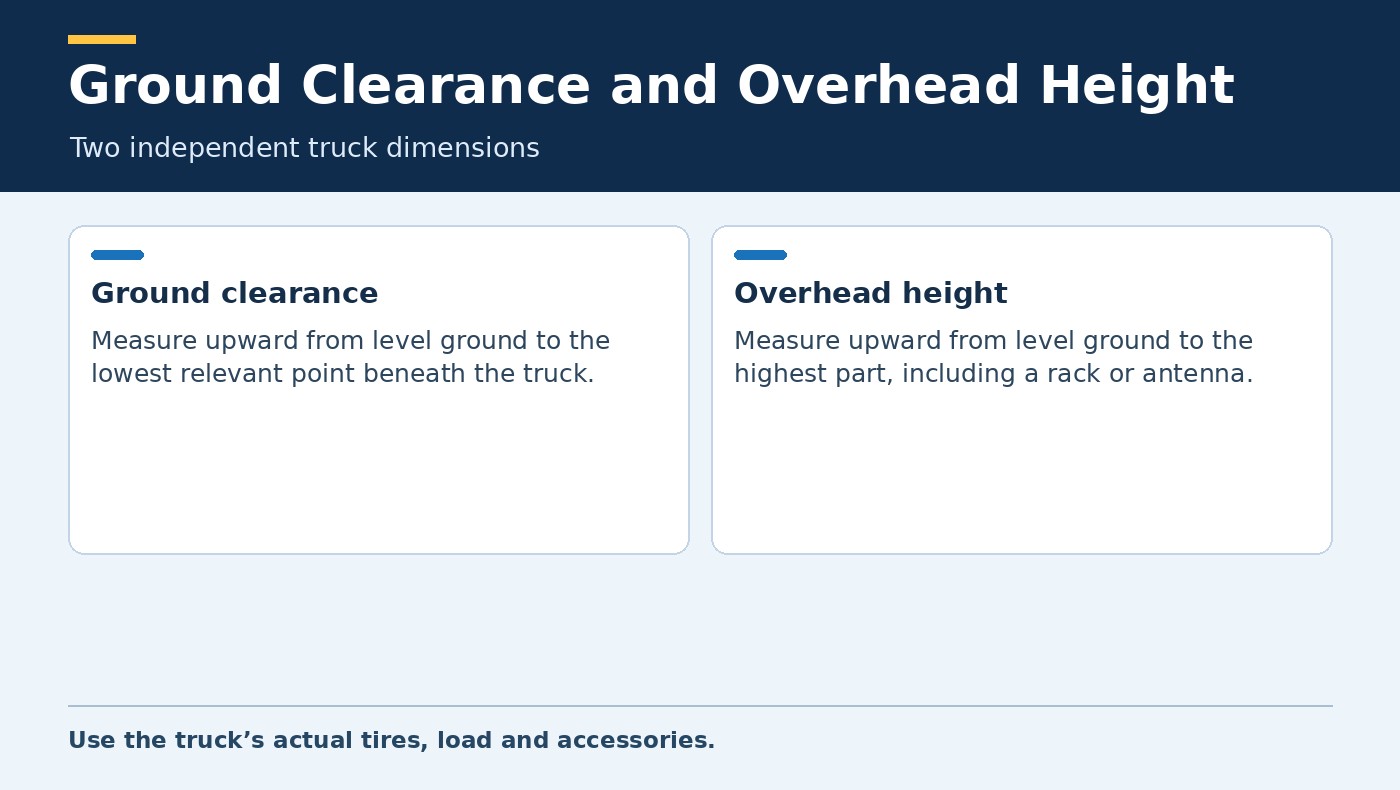
Ground clearance tells you about the available gap below the truck in the measured configuration. It helps with a raised center on a gravel track, loose debris, or a change in grade. To understand what will touch first on your own truck, check where the low point is relative to the obstacle. A receiver, step, or accessory can become the lowest relevant part on the path you need to take.


Overall height tells you whether the top of the truck can pass under an overhead restriction. Ford’s 2026 technical sheet lists a 77.1-inch empty cab height for the 5.5-foot-bed SuperCrew 4×4 example. Its 9.8-inch ground clearance is a separate measurement. For parking or garage decisions, measure to the tallest actual part, including equipment such as a roof rack, antenna mount, or bed-mounted carrier. A sloped garage entrance may change where the truck comes closest to an overhead beam.
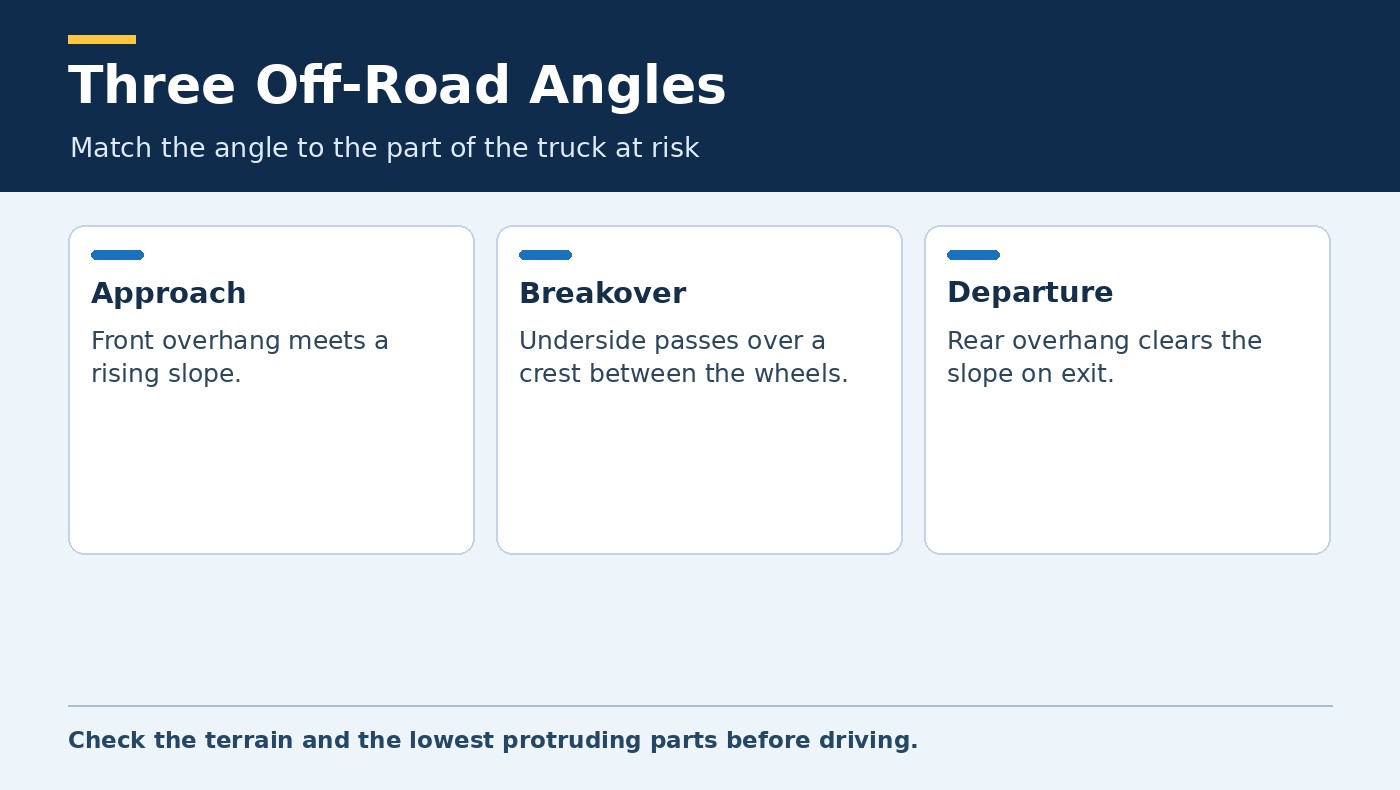
Approach angle relates to the front end meeting a rising slope. Departure angle relates to the rear when the truck leaves that slope. Breakover angle describes how sharply a crest can rise between the wheels before the underside is at risk of touching. Ford’s 2026 sheet gives 25.9 degrees of approach and 19.8 degrees of breakover for the 5.5-foot-bed SuperCrew 4×4 example. The Tremor column lists 27.6 and 21.1 degrees, respectively. These figures describe different parts of the same maneuver.
A floor-mounted obstacle may sit between the tire tracks, where the lowest component matters. On a short, steep ramp, the bumper or hitch can make contact first. A rounded crest can be more difficult for a longer truck even if the underbody gap appears adequate when parked. Use the dimension that corresponds to the shape and location of the obstruction.


How to Measure the Clearance on Your Own F-150
- Park on firm, level pavement. Secure the truck and wait for it to settle. A sloped driveway or uneven shoulder makes it hard to compare measurements across different points.
- Use the intended travel setup. Note the installed tires and pressure, passengers, cargo, and any trailer connection that applies to the trip. Load changes can alter the truck’s stance.
- Identify the low points from outside. Use a light, straightedge, or ruler from a safe position. Consider low components along the intended path, including steps, the hitch, and hardware added by a previous owner. Stay out from under an unsupported vehicle.
- Measure vertically. Record the gap from the ground to each relevant low point. Note which component you measured so the number remains meaningful when you compare it with another truck or a later setup.
- Leave room for movement. The chassis can move as the truck rolls through ruts or across a crest. A stationary clearance close to the obstacle height leaves little room for compression, tire deflection, or an uneven line.
Take photos of the measurement setup if you plan to track changes over time. Park in the same direction and on the same surface when you repeat the check. A change in where a ruler is placed can look like a change in the truck. When comparing before and after photos, align the measurement to the same fixed point and record whether the fuel and cargo conditions changed.
If visibility around the lowest part is poor, ask a tire or suspension shop to inspect the installed truck and explain which component controls the clearance you care about. You can then compare that measured point with driveway geometry or a trail obstacle without assuming the truck still matches its factory dimensions.
How Tires, Lifts, and Accessories Change Real Clearance
A larger tire can increase the distance between the ground and a solid axle, subject to the actual loaded radius of the new tire. As a simple geometric example, replacing a nominal 33-inch tire with a nominal 35-inch tire changes the nominal radius by one inch. That arithmetic is an estimate of the change in radius. The installed tires’ dimensions, pressure, load, and tread can alter the real result. Measure at the part you want to clear after an approved installation.
A suspension change can raise some body or frame points by a different amount from an axle housing. Ask the installer what the kit changes and where the remaining low points will be. A front leveling kit, for example, is often chosen to change stance. It does not establish an across-the-truck increase in measured clearance. A larger wheel diameter by itself also tells you little unless you know the complete tire size mounted on that wheel.
Accessories can change the usable path beneath the truck. A fixed rock slider, skid plate, downward hitch, or bracket may have a lower edge than the area around it. Some parts add protection even when they occupy a little space. Inspect the part and its installation for the obstacle you actually encounter. If you regularly use a ramp to load or park, check the same configuration with the equipment you usually carry.
Three Ways to Use the Clearance Chart
Compare two used pickups with the same badge
Suppose two listings describe a 2026 F-150 XLT with four-wheel drive. One has the 5.5-foot box and the other has the 6.5-foot box. The corresponding SuperCrew 4×4 columns in Ford’s technical sheet give 9.8 and 8.8 inches, respectively. Ask both sellers for the cab, box, and factory tire size. If a seller quotes 9.8 inches for the long-bed truck, ask which source and configuration that figure came from. The right follow-up is to verify the exact vehicle, especially if an aftermarket lift or wheel and tire change makes the original spec less representative.
Check a steep driveway with a receiver installed


Start by looking at the approach from the road and the change in slope near the top. A receiver that hangs below the rear bumper may matter when a truck leaves the ramp. A sharp center crest raises a separate question about the area between the axles. Record the lowest relevant rear part and the lowest part near the center of the truck. If the truck will use that driveway while carrying supplies, check it in that condition. A measurement made on a flat lot helps identify where to look, but leave extra room for changes in pitch at the driveway.
Decide whether a Tremor or a Raptor suits the route
Compare the actual obstacles with the relevant dimensions before choosing a trim. A narrow passage brings width and mirror clearance into the decision. A raised center brings underbody clearance into the decision. A sudden crest gives breakover more weight. Ford’s 2026 chart shows that the Raptor’s 37-inch configuration has higher clearance and a higher breakover figure than its 35-inch configuration, yet the overall height is also higher. Check your parking spot as well as the trail. A truck that fits the trail can still be too tall for a garage door with roof equipment installed.
Keep the Source Beside the Number
A useful record might read “2026 SuperCrew, 5.5-foot box, 4×4, 9.8 inches, Ford technical sheet revision 1.1.” For a measured truck, add the part you measured and the conditions, such as the gap below a receiver with the cargo aboard. If you pass the number to a dealer, installer, or another driver, they can tell what it means and repeat the check. This is especially valuable when comparing two vehicles that wear the same badge.
Frequently Asked Questions
What is the ground clearance of a stock 2026 F-150 4×4?


Ford’s technical sheet lists 9.8 inches for several configurations, including the 5.5-foot-bed SuperCrew 4×4. It lists 8.8 inches for the 6.5-foot-bed SuperCrew 4×4 in the corresponding table. Match the cab and bed before choosing a number. The Tremor and Raptor have their own columns.
Does the 2026 Tremor have more ground clearance than the standard short-bed SuperCrew 4×4?
The two columns in Ford’s March 2026 sheet show 10.7 inches and 9.8 inches, a difference of 0.9 inch. That comparison uses values from the same technical document. Ford’s consumer-page Tremor figure is 10.9 inches, so identify the source if you see a different published comparison.
Which Raptor tire setup has the higher published figure?


Ford’s 2026 technical table gives the 37-inch setup 13.1 inches and the 35-inch setup 11.9 inches. That is a 1.2-inch difference in the published values. Verify the original factory setup on the particular truck if it has had wheels or tires replaced.
Can I use a published clearance number to decide whether a truck fits through a garage?
For the garage opening, use actual overall height. Measure any rack, antenna housing, or other equipment above the cab. Check the opening across the truck’s actual route and consider what happens as the vehicle changes pitch at the threshold. Use ground clearance to assess the gap below the truck on the same route.
Does an empty measurement cover a fully loaded trip?
Measure in the condition you expect to drive. Loads, tire pressures, and installed equipment can affect the practical result. Write down the setup with the measurement so you can compare like with like if you load the truck differently later.