
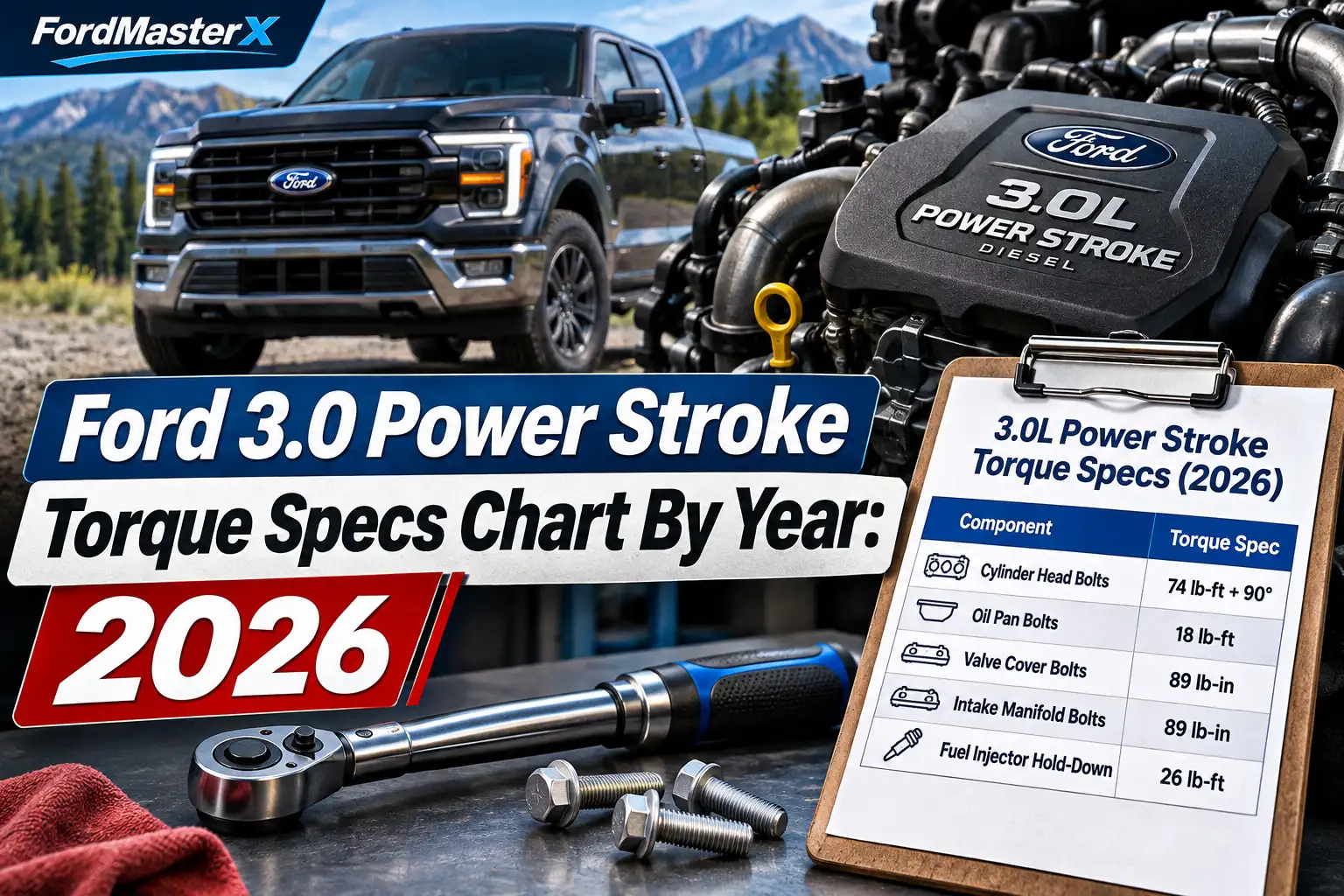
Ford 3.0 Power Stroke Torque Specs Chart By Year: 2026

Ford 3.0 Power Stroke torque specs cover two different measurements: the engine’s 440 lb-ft of peak output at 1,750 rpm and the tightening values for its bolts and service components. The 3.0L diesel also produces 250 hp at 3,250 rpm, according to Ford’s 2021 F-150 technical specifications.
If you’re replacing a cylinder head, assembling the bottom end, or changing the oil, you need a component-specific value, not the engine’s output rating. Below are documented 2020 F-150 3.0L diesel service specifications and the steps required to interpret them.


For a 2018, 2019, or 2021 truck, confirm the relevant procedure in the Ford workshop manual for that model year before tightening critical engine fasteners.
FordMasterX Technical Reference · 2020 Service Procedures
3.0L Power Stroke Torque Specs
2018–2021 F-150 engine family · Tightening values below sourced from 2020 procedures
At 1,750 rpm · Factory rated at 250 hp at 3,250 rpm
Engine Fastener Tightening Stages
Complete each stage in the correct factory bolt order
Cylinder Head Bolts
New bolts required · Both banks use bank-specific order
- Stage 0120 Nm (177 lb-in)
- Stage 0240 Nm (30 lb-ft)
- Stage 0380 Nm (59 lb-ft)
- Stage 04+180° rotation
Final angle is an additional half-turn, not 180 Nm.
Main Bearing Vertical Bolts
Final assembly · Separate bolt groups
- Stage 0140 Nm (30 lb-ft)
- Stage 0290 Nm (66 lb-ft)
- Stage 03+45° rotation
- Stage 04+45° rotation
Follow grouped bolt order and thrust-bearing alignment steps.
Main Bearing Side Bolts
Bolt group 17–24 in 2020 procedure
- Stage 0114 Nm (124 lb-in)
- Stage 02+45° rotation
Do not use the vertical bolt specifications on side bolts.
Connecting Rod Cap Bolts
New bolts required for final assembly
- Stage 0120 Nm (177 lb-in)
- Stage 0230 Nm (22 lb-ft)
- Stage 03+90° rotation
Keep original rod-cap orientation; verify after installation.
| Component | Torque | Note |
|---|---|---|
| Oil pan bolts | 10 Nm · 89 lb-in | Use factory sequence |
| Oil drain plug | 25 Nm · 18 lb-ft | Different from pan bolts |
| Oil filter cap | 25 Nm · 18 lb-ft | New lubricated O-ring |
Reference basis: Ford engine specifications and 2020 F-150 3.0L Power Stroke engine assembly / oil pan procedures. Values shown are not a complete installation procedure.
What Are Ford 3.0 Power Stroke Torque Specs


The quick-reference chart separates engine output from fastener tightening torque. The repair figures are drawn from a 2020 F-150 3.0L Power Stroke service-manual reproduction, including its detailed engine assembly procedure. These are not a substitute for the component’s complete installation instructions.
| Component | Published Output or 2020 Tightening Stages | Equivalent Units | Important Note |
|---|---|---|---|
| Engine peak output | 440 lb-ft at 1,750 rpm | About 597 Nm | Performance rating, not a bolt setting |
| Cylinder head bolts | 20 → 40 → 80 Nm → +180° | 177 lb-in → 30 → 59 lb-ft → angle | New bolts; follow bank-specific pattern |
| Main bearing vertical bolts | 40 → 90 Nm → +45° → +45° | 30 → 66 lb-ft → two angle stages | Final assembly uses separate bolt groups |
| Main bearing side bolts | 14 Nm → +45° | 124 lb-in → angle | Bolts 17–24 in the illustrated procedure |
| Connecting rod cap bolts | 20 → 30 Nm → +90° | 177 lb-in → 22 lb-ft → angle | New bolts for final assembly |
| Oil pan mounting bolts | 10 Nm | 89 lb-in | Follow the pan’s tightening order |
| Oil drain plug | 25 Nm | 18 lb-ft | Different from pan mounting bolts |
| Oil filter cap | 25 Nm | 18 lb-ft | Install a new lubricated O-ring |
| Oil pump mounting bolts | 10 Nm | 89 lb-in | Some bolts require an additional pass |
Applicability: The performance rating applies to the production F-150 3.0L Power Stroke; the component tightening values above are documented specifically in the 2020 service material. They have not been independently established here as identical for every 2018–2021 build. Angle stages and tightening order are essential parts of the specification.
Which F-150 Model Years Use the 3.0L Diesel


Ford offered the 3.0L Power Stroke turbo-diesel V6 in the F-150 for model years 2018 through 2021. It is not the 3.0L EcoBoost gasoline engine found in other Ford models, and it is not the 6.7L Power Stroke diesel used in Super Duty trucks.

Identify your engine using the truck’s original build information, underhood emissions label, or service documentation. Then select the matching model-year and engine section in the workshop manual. Two engines with the same displacement can have entirely different fasteners, materials, and procedures.
Ford’s 3.0L V6 diesel specifications should not be borrowed from a similarly named gasoline engine or another Power Stroke engine. The shared engine name does not establish interchangeable service procedures.
How Do 3.0L Diesel Torque Units and Angles Work


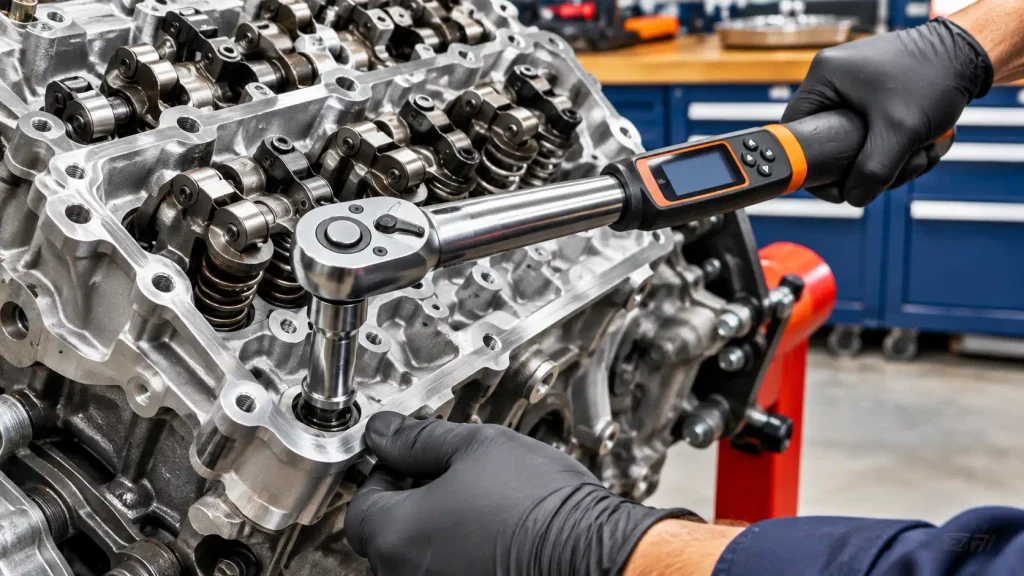
177 lb-in is not 177 lb-ft. Twelve pound-inches equal one pound-foot, so 177 lb-in is approximately 14.8 lb-ft. Mixing those units can severely overtighten a small fastener.


Three notations appear throughout the specifications:
- Nm: Newton-meters, the metric torque unit used in many Ford procedures.
- lb-ft or lb-in: Pound-feet or pound-inches. Check which unit your torque wrench displays.
- +45°, +90°, or +180°: Additional bolt rotation after completing the preceding torque stage. These values are angles, not torque readings.
For example, 80 Nm followed by +180° means first tighten to 80 Nm in the specified order, then rotate the bolt an additional half-turn as directed. It does not mean tighten to 180 Nm.
A calibrated torque wrench handles the initial stages; a suitable torque-angle gauge or angle-capable wrench handles the rotation stages. Use the specified thread condition and lubricant. Torque-to-yield bolts can require replacement because final tightening deliberately produces permanent stretch.
For general truck components outside this diesel engine, FordMasterX also has a Ford F-150 torque specs chart covering common wheel and maintenance fasteners.


What Are 3.0L Power Stroke Head Bolt Torque Stages
The reproduced 2020 3.0L Power Stroke installation procedure gives the following sequence for both left and right cylinder heads. Apply each stage to the bolts in the correct bank-specific tightening order.
| Stage | Setting | Approximate Imperial Equivalent |
|---|---|---|
| 1 | 20 Nm | 177 lb-in |
| 2 | 40 Nm | 30 lb-ft |
| 3 | 80 Nm | 59 lb-ft |
| 4 | Additional 180° | Half-turn after Stage 3 |
Head Bolt Tightening Stages
These are four stages of one procedure, not four alternative values. Do not stop after the 80 Nm pass. The additional 180° rotation is part of the documented installation requirement.
The head tightening-order illustrations differ for the left and right banks. A numerical table cannot communicate the exact bolt positions. Use the corresponding Ford diagram while applying all four stages, rather than improvising a center-outward pattern.
Head Bolt Replacement Requirements


The 2020 procedure explicitly specifies new cylinder head bolts. It also instructs the installer to lightly lubricate the new bolt threads and flanges with clean engine oil. Excessive oil, grease, or anti-seize can change the clamping result and is not an equivalent substitute.
The service instructions also warn that the glow plugs protrude below the cylinder head surface. Protect them when positioning a head. Head-gasket selection involves piston-protrusion measurement, so tightening the bolts is only one part of a correct cylinder head installation.
Cylinder Head Tightening Order


Follow the exact left-bank or right-bank diagram for your engine and perform each torque stage in the numbered order shown. If the diagram or the correct replacement bolts are unavailable, do not proceed based on the torque values alone.
How Are 3.0L Power Stroke Main Bearing Bolts Tightened
The 2020 engine assembly instructions distinguish bearing-bore measurement from final crankshaft assembly. That difference matters: the early measurement procedure tightens the fasteners as a group, while final assembly separates the vertical bolt groups to permit thrust-bearing alignment.
Main Bearing Cap Bolt Stages


For the designated vertical bolts, the tightening stages are:
| Stage | Setting |
|---|---|
| 1 | 40 Nm or 30 lb-ft |
| 2 | 90 Nm or 66 lb-ft |
| 3 | Additional 45° |
| 4 | Another additional 45° |
During the final assembly pass, the documented sequence first applies these stages to bolts 1–6 and 9–14. Next, the crankshaft is moved forward to align the thrust bearings with the cylinder block. The same four stages are then applied to bolts 7–8 and 15–16.
Main Bearing Side Bolt Stages


The side bolts, numbered 17–24 in the 2020 diagram, have a different specification: 14 Nm (124 lb-in), followed by an additional 45°. They are addressed after the designated vertical bolt groups during final assembly.
Do not use the vertical bolt values on the side bolts. The bolt-numbering diagram must be available before starting the procedure.
Crankshaft Assembly Verification
The procedure requires crankshaft end-play measurement after bearing installation and thrust-bearing alignment. It also includes checks for bearing dimensions and selection, which cannot be replaced by a generic torque chart.
Use the engine’s actual service specifications for those measurements. A smooth-turning crankshaft alone does not establish correct bearing clearance or end play.
What Are 3.0L Diesel Connecting Rod Bolt Specs
For the 2020 F-150 3.0L Power Stroke, the connecting rod cap bolt procedure has three tightening stages:
| Stage | Setting | Equivalent |
|---|---|---|
| 1 | 20 Nm | 177 lb-in |
| 2 | 30 Nm | 22 lb-ft |
| 3 | Additional 90° | Quarter-turn after Stage 2 |
The service procedure uses the original rod cap bolts temporarily while checking the connecting rod big-end bore. Those original bolts are discarded after that measurement. New connecting rod cap bolts are required for final assembly.
The rod caps must retain their original orientation and matching positions. After each piston, rod, cap, and bolt set is installed, the 2020 procedure calls for rotating the crankshaft to verify smooth movement.
Do not replace the staged tightening process with a single generic number from another engine. The 6.7 Power Stroke torque specifications describe a different Ford diesel engine and must never be applied to the 3.0L V6.
Which 3.0L Diesel Oil Pan and Filter Torques Apply
The oil pan mounting bolts and the oil drain plug have different torque settings. The documented 2020 oil pan installation procedure specifies 10 Nm (89 lb-in) for the pan fasteners and 25 Nm (18 lb-ft) for the oil filter cap.
| Maintenance Component | 2020 Service Setting | Service Detail |
|---|---|---|
| Oil pan mounting bolts | 10 Nm, 89 lb-in | Use illustrated tightening sequence |
| Oil drain plug | 25 Nm, 18 lb-ft | Do not confuse with pan bolts |
| Oil filter cap | 25 Nm, 18 lb-ft | Fit a new lubricated O-ring |
| Oil pump mounting bolts | 10 Nm, 89 lb-in | Sequence includes a second pass on selected bolts |
Ford’s 2020 oil pan removal instructions also identify the drain plug’s 25 Nm setting.
For oil pan installation, the service material specifies an RTV sealing procedure, including installation within 4 minutes of applying the specified sealant and final pan-bolt tightening within 60 minutes. Follow the actual factory cleaning, sealant application, and tightening diagram; those steps matter as much as the torque number.
The oil pump’s 10 Nm bolts belong to a separate pump installation procedure. It calls for retightening designated bolts, so a single-value chart is not a complete pump installation guide.
When Must 3.0L Power Stroke Bolts Be Replaced
The 2020 service procedures specifically call for new cylinder head bolts and new connecting rod cap bolts for final assembly. Do not assume every other fastener is reusable, or that every bolt should automatically be discarded. Check its individual removal and installation instructions.
For any torque-angle procedure, identify whether Ford requires a replacement bolt, a particular lubricant, a new gasket, or a new seal. The clamping force depends on more than the number shown on the wrench.
Aftermarket head studs and replacement fastener kits may have their own validated tightening requirements. Use the fastener manufacturer’s instructions when specified for that product, not the original factory bolt sequence without confirmation.
Where to Verify 2018 to 2021 F-150 Torque Specifications
Use the Ford workshop service information that matches your truck’s model year, 3.0L Power Stroke engine, and repair operation. Owner manuals generally cover routine maintenance, while full workshop procedures include assembly stages, tightening diagrams, special tools, and replacement requirements.
Before an engine repair, check these details in the relevant procedure:
- Confirm the model year and 3.0L diesel engine application.
- Locate the exact component’s removal and installation procedure.
- Match every torque stage, angle, bolt group, and tightening diagram.
- Confirm whether new bolts, seals, lubricant, or specialized tools are required.
- Follow the related dimensional and post-installation checks.
The tables above provide documented 2020 reference values, not certification that every specification remained unchanged throughout 2018–2021. If a vehicle-specific procedure differs, follow that procedure.
Which 3.0L Power Stroke Torque Values Should You Trust
The Ford 3.0 Power Stroke torque specs begin with 440 lb-ft of engine output at 1,750 rpm, but repair work requires entirely different numbers. The documented 2020 service procedures show why: cylinder head bolts need three torque stages and a final 180° rotation, connecting rod bolts need a final 90° rotation, and main bearing bolts use separate vertical and side-bolt sequences.
For an oil service, distinguish the 25 Nm drain plug from the 10 Nm oil pan mounting bolts. For internal engine assembly, never apply a number without its tightening order, bolt-replacement guidance, and associated measurements. Confirm the exact Ford workshop procedure for your model year before touching a critical fastener. That’s the safest way to turn a specification chart into a reliable repair reference.
What Questions Do 3.0L Diesel Owners Ask About Torque
How Much Torque Does the Ford 3.0 Power Stroke Produce
The factory-rated 3.0L Power Stroke delivers 440 lb-ft at 1,750 rpm and 250 hp at 3,250 rpm. Those are engine performance figures, not bolt-tightening settings. Service fasteners require their own component-specific values.
What Is the 3.0 Power Stroke Cylinder Head Bolt Torque
The documented 2020 procedure uses 20 Nm, 40 Nm, 80 Nm, then an additional 180° rotation in the correct tightening order. It also requires new bolts. Confirm the appropriate left- or right-bank procedure for your model year before installation.
Are 3.0 Power Stroke Head Bolts Reusable
Not under the documented 2020 cylinder head installation procedure. It explicitly calls for new cylinder head bolts lightly lubricated with clean engine oil. Do not reuse the removed bolts unless an applicable, authoritative repair procedure expressly permits it.
What Is the Oil Drain Plug Torque on a 3.0 Power Stroke
The documented 2020 oil drain plug specification is 25 Nm, approximately 18 lb-ft. That differs from the oil pan mounting bolt specification of 10 Nm. Confirm the correct fastener and model-year service instructions before tightening.
Are 2018 and 2021 3.0 Power Stroke Torque Specs the Same
Both model years use the 3.0L Power Stroke engine family, but this reference does not establish that every component fastening procedure is identical across 2018–2021. Verify the specific model-year Ford workshop information, particularly for torque-to-yield bolts and multi-stage engine assembly.