
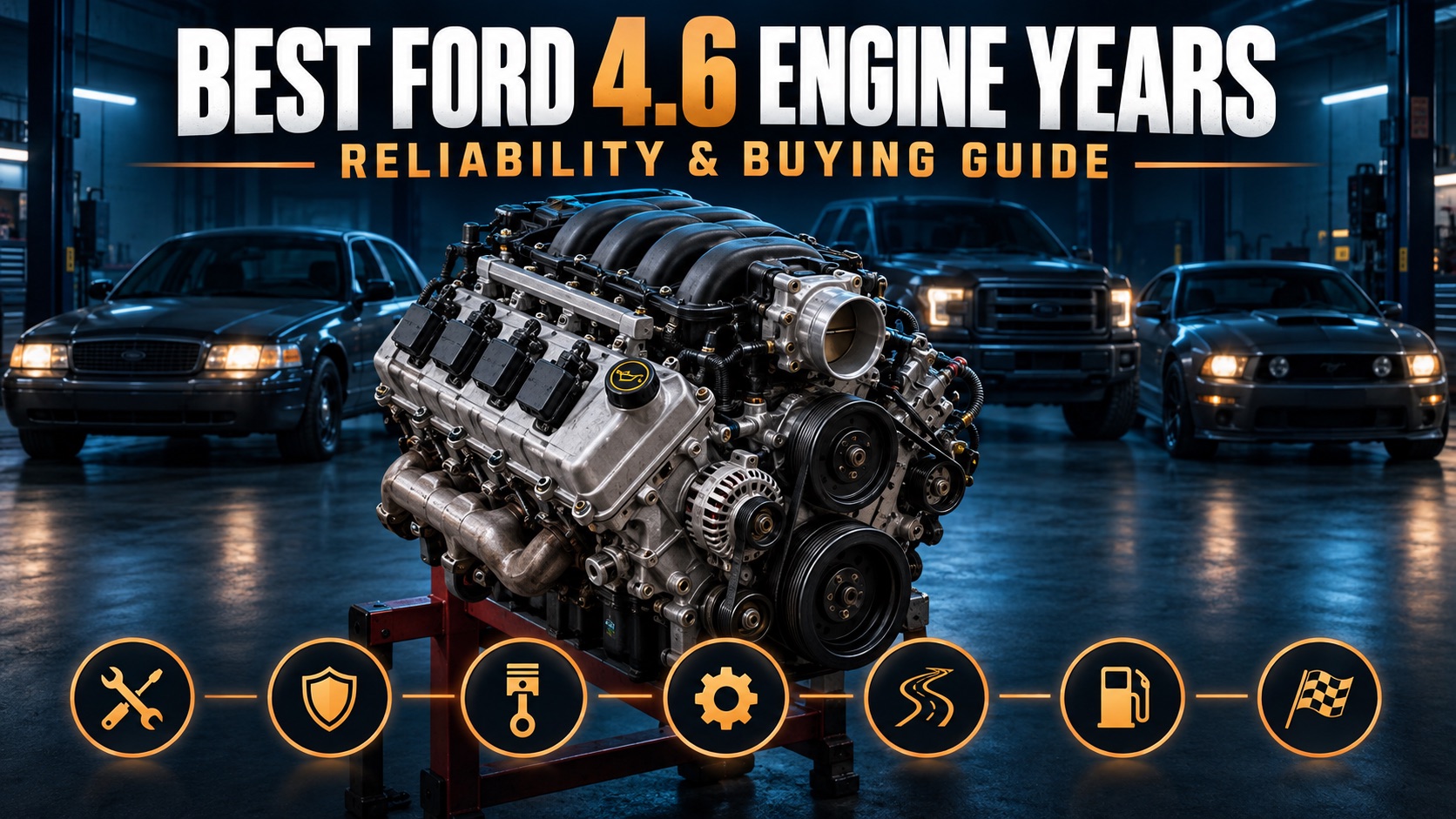
7 Best Ford 4.6 Engine Years 2026 – Reliable Model-Year Picks

The best Ford 4.6 engine years depend on the vehicle, engine version, maintenance history, and how you plan to use it. A clean, documented example is usually a safer purchase than a neglected vehicle from a year with a stronger reputation. This guide ranks seven useful model-year and application combinations, then shows you how to verify the exact engine before buying.
Ford 4.6 Engine Years: Quick Comparison
Recommended Best Deal Products


| Rank | Model year / application | Best for | What to verify |
|---|---|---|---|
| 1 | 2008–2010 Crown Victoria 4.6L | Simple, durable daily-driver layout | Fleet history, intake leaks, cooling system, idle quality |
| 2 | 2009–2010 Mustang GT 4.6L | Performance and enthusiast use | Modifications, oil history, cam-phaser noise, transmission condition |
| 3 | 2007–2008 F-150 4.6L | Light truck work with sensible expectations | Exact engine version, towing history, plug service, timing noise |
| 4 | 2009–2010 F-150 4.6L | Later 4.6L truck availability | VCT noise on 3-valve engines, service records, payload needs |
| 5 | 2006–2008 Explorer 4.6L | Body-on-frame SUV utility | Cooling, timing/VCT noise, transmission behavior, rust |
| 6 | 2005–2008 Mustang GT 4.6L | Value-oriented V8 coupe | Aftermarket tune, hard use, oil consumption, cam-phaser noise |
| 7 | 2004–2006 F-150 4.6L | Budget truck purchase | Plug threads, exhaust leaks, maintenance gaps, frame condition |
These are buying candidates, not a promise that every engine in the range is identical or trouble-free. Ford used the 4.6L across several vehicles and calibrations. Confirm the VIN, emissions label, and service information for the exact vehicle.

Prime for Young Adults — 6 Months Free
Students and 18–24s get six months of Prime free, then half price.
Start 6 Months Free As an Amazon Associate I earn from qualifying purchases.Our 7 Best Ford 4.6 Engine Year and Vehicle Combinations
1. 2008–2010 Ford Crown Victoria 4.6L — Best Overall Used-Car Candidate
The late Crown Victoria pairs the 4.6L V8 with a conventional rear-wheel-drive platform and broad parts availability. It is a practical place to start if your priority is a roomy, uncomplicated used sedan rather than peak horsepower.
- Why we recommend it: mature platform, easy access for many routine repairs, and plentiful service knowledge.
- Best for: daily driving, fleet-style durability, and owners who value serviceability.
- Inspect: evidence of police or taxi duty, cooling-system condition, intake-area leaks, differential noise, and rust.
2. 2009–2010 Ford Mustang GT 4.6L — Best Performance Choice
The late 4.6L Mustang GT delivers the strongest enthusiast appeal in this list. Ford’s 2010 Mustang owner guide identifies the 4.6L V8 and lists its basic specifications, while Ford’s Mustang history notes that the 2011 model brought a new engine lineup.
- Why we recommend it: strong aftermarket support and a chassis designed around performance use.
- Best for: drivers who want a V8 coupe and accept higher inspection standards.
- Inspect: non-stock tuning, track or drag-strip use, cold-start rattle, hot-idle knock, clutch or automatic-transmission behavior, and oil-change history.
3. 2007–2008 Ford F-150 4.6L — Best Balanced Older-Truck Candidate
A clean 2007–2008 F-150 can suit buyers who need light-duty truck utility and do not expect the torque of a modern large-displacement or turbocharged engine. Configuration matters, so check the under-hood label and VIN rather than relying on a seller’s description.
- Why we recommend it: common platform, broad parts support, and useful truck capability at used-market prices.
- Best for: commuting, household hauling, and moderate workloads within the door-jamb ratings.
- Inspect: towing history, spark-plug service, exhaust-manifold leaks, transmission shifts, frame rust, and differential condition.
4. 2009–2010 Ford F-150 4.6L — Best Later-Model Truck Option
Ford’s 2010 F-150 owner guide confirms 4.6L availability in the model line. These trucks can be appealing because they belong to the newer body generation, but equipment and engine versions vary.
- Why we recommend it: later cabin and chassis design while retaining a naturally aspirated 4.6L option.
- Best for: buyers who prioritize truck packaging over maximum tow performance.
- Inspect: hot-idle knock on 3-valve applications, timing-system noise, maintenance documentation, payload sticker, and previous trailer use.
5. 2006–2008 Ford Explorer 4.6L — Best SUV Utility Choice
The 4.6L Explorer combines V8 power with three-row SUV practicality. Ford service literature lists 4.6L Explorer applications in these years, which also means buyers should identify the exact engine and review applicable service information.
- Why we recommend it: useful passenger and cargo layout with traditional SUV towing capability.
- Best for: families seeking an older body-on-frame Ford SUV.
- Inspect: transmission operation, cooling-system health, timing or VCT noise, wheel bearings, rear HVAC, and structural rust.
6. 2005–2008 Ford Mustang GT 4.6L — Best Value V8 Coupe
The earlier S197 Mustang GT made the 4.6L three-valve V8 widely accessible. Ford’s Mustang anniversary material identifies the 2005 GT’s 4.6L V8, while Ford technical service bulletins document diagnostic considerations for some 4.6L three-valve engines.
- Why we recommend it: recognizable styling, strong owner community, and extensive replacement-parts support.
- Best for: an affordable project or weekend car after a thorough pre-purchase inspection.
- Inspect: tune and exhaust modifications, cam-phaser noise, oil level, rear-axle noise, water intrusion, and crash repairs.
7. 2004–2006 Ford F-150 4.6L — Best Budget Truck Candidate
These early eleventh-generation F-150s can be affordable, but age and condition now matter more than the badge on the tailgate. A documented, rust-free truck is preferable to a cheaper example needing engine, transmission, and chassis work at once.
- Why we recommend it: low entry price and familiar truck layout.
- Best for: budget-conscious buyers who can inspect and maintain an older vehicle.
- Inspect: spark-plug thread condition, exhaust leaks, compression consistency, cooling system, frame and cab mounts, and overdue fluids.
2-Valve vs. 3-Valve Ford 4.6: Why It Matters
Recommended Best Deal Products


“Ford 4.6” describes an engine family, not one interchangeable engine. Two-valve and three-valve versions differ in cylinder heads, controls, service procedures, and common inspection points. The three-valve design uses variable cam timing, so oil quality and the diagnosis of cam-phaser or VCT noise deserve particular attention. Ford service bulletins describe diagnostic procedures for hot-idle knock on certain 4.6L three-valve applications; they do not mean every engine will develop the condition.
How to Inspect a Used Ford 4.6 Before Buying
- Start it completely cold. Listen for prolonged timing rattle, knocking, or uneven idle.
- Recheck it fully warm. Some oil-pressure, VCT, and valvetrain symptoms appear only at hot idle.
- Scan all modules. Read stored and pending trouble codes and check readiness monitors.
- Verify oil pressure and condition. Do not treat a clean dipstick as proof of good maintenance.
- Check compression or cylinder balance when symptoms justify it. One weak cylinder can turn a bargain into a major repair.
- Review receipts. Confirm oil intervals, cooling-system work, spark-plug service, and timing repairs.
- Inspect the whole vehicle. Transmission, axle, rust, brakes, tires, and electronics can cost more than the engine.
Official Ford References
Recommended Best Deal Products


- 2010 Ford F-150 Owner Guide
- 2010 Ford Mustang Owner Guide
- Ford TSB 10-18-4: 4.6L 3V hot-idle knock diagnosis
- Ford TSB 06-19-8: 4.6L 3V engine knock guidance
Frequently Asked Questions
What is the best Ford 4.6 engine year?
There is no universally best year across every Ford vehicle. A documented 2008–2010 Crown Victoria is a strong simple-layout candidate, while a 2009–2010 Mustang GT better suits a performance buyer. Condition and service history should decide between individual vehicles.

Audible — Listen Free for 30 Days
One free credit a month and thousands of titles included.
Listen Free for 30 Days As an Amazon Associate I earn from qualifying purchases.Is the Ford 4.6 2-valve or 3-valve better?
The two-valve engine generally appeals to buyers who value simplicity. The three-valve version offers better breathing and performance but adds variable cam timing and related inspection points. Choose based on application and the condition of the specific engine.
How long does a Ford 4.6 engine last?
Mileage alone cannot predict remaining life. Oil-change history, overheating, duty cycle, tune quality, and current mechanical condition are more useful. A pre-purchase inspection is the safest way to judge a high-mileage example.
Do all Ford 4.6 engines have spark-plug problems?
No. Service concerns vary by cylinder-head design, model year, prior repairs, and installation technique. Verify the exact engine and follow Ford’s service procedure rather than applying one internet rule to every 4.6L.
Related FordMasterX Guides
Continue your research with our best Ford Expedition years, F-150 spark-plug guide, and Ford 5.0 Coyote oil-filter guide.
Final Verdict
For a practical used car, start with a well-documented 2008–2010 Crown Victoria. Choose a 2009–2010 Mustang GT when performance matters, and consider an F-150 or Explorer only after confirming the exact engine configuration and workload history. The best Ford 4.6 purchase is the vehicle that passes cold and hot inspections, has credible service records, and fits your actual towing or driving needs.
One Comment