
4WD Ford F-150 Front Suspension Diagram: Every Part by Generation

A 4WD Ford F-150 has used three different front suspension designs since 1980. Twin-Traction Beam (TTB) ran through 1996. Coil-over independent suspension took over in 2004, and its own torque spec changed again in 2015.
Match your truck’s generation first. The three designs do not share parts. Two of them do not even share a torque spec with each other.


I pulled this from Ford’s own 2004 press material, two Wikipedia generation pages, and a TTB technical deep dive. I cross-checked five separate torque-spec tables against each other. Where they disagreed, I flagged it instead of guessing.
Most sites treat 45 years of F-150 front suspension as one part number


Search “F-150 front suspension diagram” and most results show one generic cutaway. They apply it to every year. That is wrong for roughly two thirds of the trucks still on the road.
Ford switched front suspension design twice on the 4×4 F-150. An independent short/long arm (SLA) design on torsion bars replaced the solid TTB axle in 1997. Coil-over shocks then replaced the torsion bars in 2004.
A generic diagram built for a 2015 truck shows parts that do not exist on a 2001 truck. A torque spec from an old thread can be wrong on a 2017 truck by 26 ft-lb. That is on the most safety-critical bolt in the front end, the lower ball joint nut.
That torque change is the number most sites do not carry. It is 111 ft-lb on 2004-2014 trucks, and 85 ft-lb on 2015-2020 trucks. Same bolt, same job, different number.


Where is the front suspension, and what does it look like underneath?


Every 4×4 F-150 front suspension lives behind the front bumper, inside both front wheel wells. It connects each front wheel to the frame. Look from underneath the truck, not inside the cab or engine bay.
On a TTB truck (1980-1996), one long steel beam runs from a frame-rail bracket out to the wheel hub. A second beam does the same from the other side. A U-joint sits at the center where the beam splits to carry the front differential.
On every truck from 1997 on, you instead see two separate control arms per side, stacked one above the other. Each pivots independently at the frame and meets at the steering knuckle. Below the lower arm on a 1997-2003 truck is a torsion bar running back toward the frame.


On a 2004-and-newer truck, that torsion bar is gone. In its place is a coil spring wrapped around a shock absorber, mounted closer to the wheel than before.
Which front suspension does your 4WD F-150 actually have?


Check your truck’s model year against these four ranges before you order a single part.
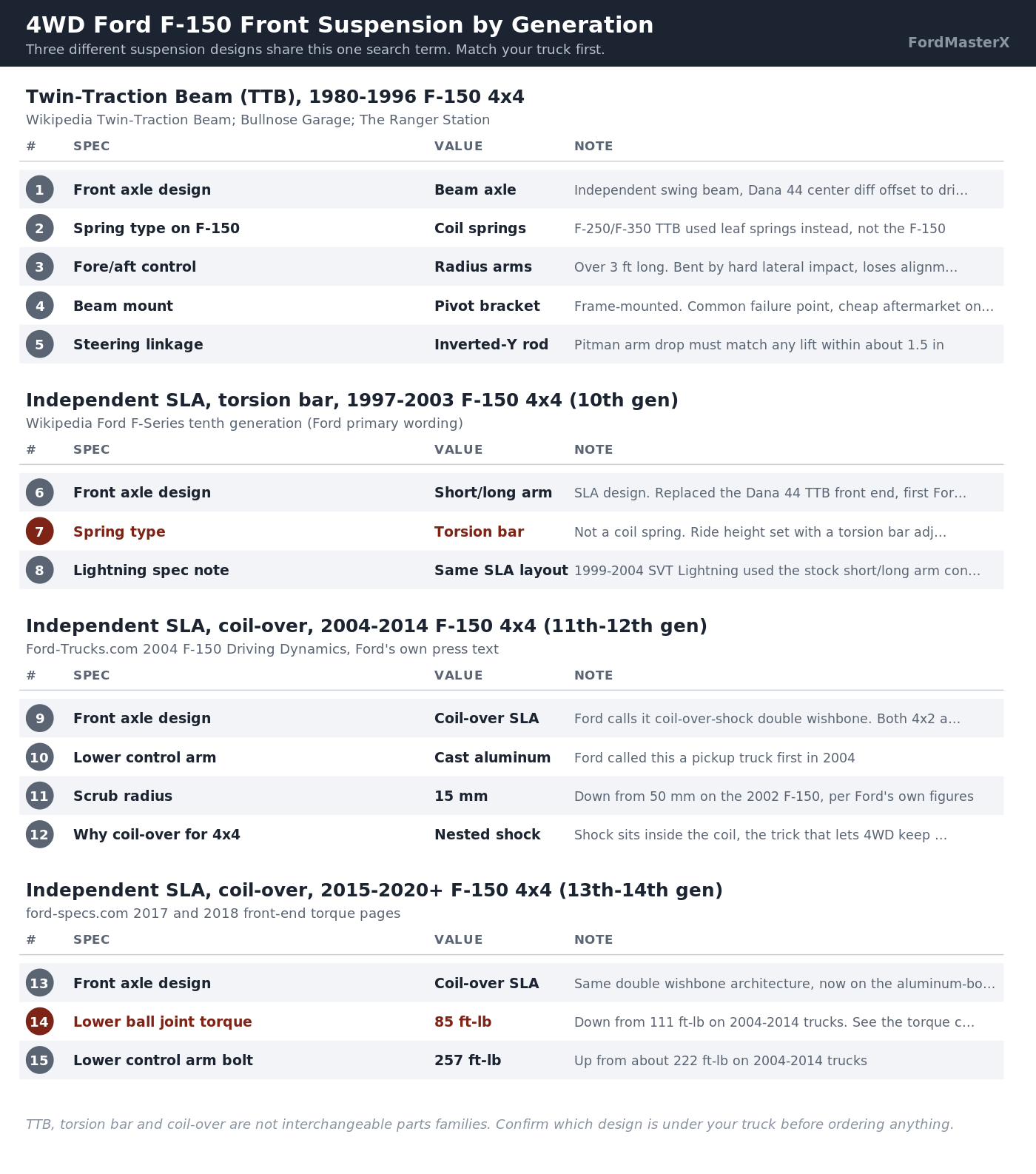
1980-1996, Twin-Traction Beam (TTB). Two independent swing beams pivot on frame-mounted brackets. They share a Dana 44 axle, split at the center by a U-joint. The F-150 used coil springs, with radius arms controlling fore and aft movement.
Heavier F-250 and F-350 trucks used a leaf-spring version of the same beam idea. That variant is not covered here.
1997-2003, independent SLA on torsion bars (10th generation). Ford’s own generation page says this truck retired the twin-beam front end. It calls this the first Ford light truck to do so. Ride height is set with a torsion bar adjuster bolt, not a spring compressor.


The 1999-2004 SVT Lightning used this same short/long arm layout, just recalibrated for the performance truck.
2004-2014, coil-over SLA (11th and 12th generation). Ford’s own 2004 material describes an all-new coil-over-shock, double wishbone front suspension. It covers both 4×2 and 4×4 trucks, with cast aluminum lower control arms, a pickup-truck first.
Mounting the shock inside the coil spring is what let four-wheel-drive models keep a coil spring at all. That packaging had to leave room for the front differential and CV axles that 2WD trucks do not have. Scrub radius dropped from 50mm on the 2002 truck to 15mm, Ford’s own figure for better steering feel.
2015-2020 and later, coil-over SLA, aluminum body (13th and 14th generation). Same double-wishbone layout as 2004, but fastener torques changed. The lower ball joint nut drops from 111 ft-lb to 85 ft-lb. The lower control arm-to-frame bolt rises from about 222 ft-lb to 257 ft-lb.
Two independent model-year torque tables agree on both numbers.
Full data: parts, specs and torque by generation
The chart above covers the component layout. The chart below covers every fastener torque confirmed on at least two independent sources. One figure could not be confirmed, and is flagged rather than guessed.
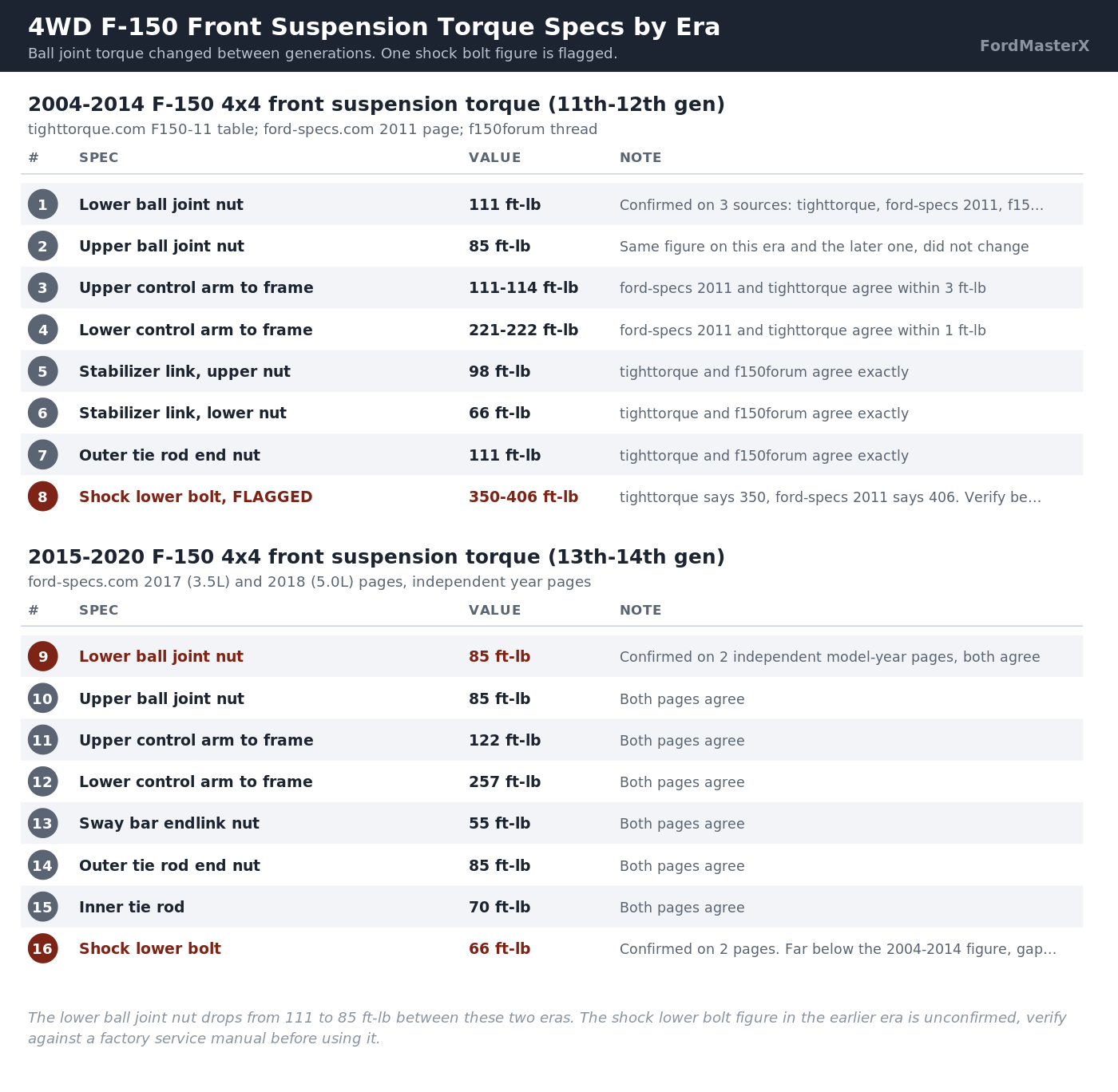
| Fastener | 2004-2014 (11th-12th gen) | 2015-2020 (13th-14th gen) |
|---|---|---|
| Lower ball joint nut | 111 ft-lb (150 Nm) | 85 ft-lb (115 Nm) |
| Upper ball joint nut | 85 ft-lb (115 Nm) | 85 ft-lb (115 Nm) |
| Upper control arm to frame | 111-114 ft-lb (150-155 Nm) | 122 ft-lb (165 Nm) |
| Lower control arm to frame | 221-222 ft-lb (300 Nm) | 257 ft-lb (348 Nm) |
| Stabilizer bar link, upper nut | 98 ft-lb (133 Nm) | 55 ft-lb (sway bar endlink, both nuts) |
| Stabilizer bar link, lower nut | 66 ft-lb (90 Nm) | 55 ft-lb (sway bar endlink, both nuts) |
| Outer tie rod end nut | 111 ft-lb (150 Nm) | 85 ft-lb |
| Inner tie rod | 74 ft-lb (100 Nm), one source only | 70 ft-lb |
| Shock absorber, lower mounting bolt | 350-406 ft-lb, FLAGGED, verify before use | 66 ft-lb, confirmed on 2 pages |
Always torque the ball joint nut first, then advance to the next slot for the cotter pin. Never back off a ball joint nut to line up the pin. If the slots do not align, tighten further until they do.
Looking to level or lift your truck instead of just diagnosing it? See our leveling kit guide for the Ford F-150 or our lift kit guide for the Ford F-150 first. The right kit depends on which suspension design is under your truck.
Symptom to likely cause: what your front end is telling you
| What you notice | Most likely cause | Check this first |
|---|---|---|
| Clunk over bumps, gets louder over time | Worn ball joint, upper or lower | Jack up the frame, grab the tire at 12 and 6 o’clock, rock it for play |
| Clunk only on hard bumps, no steering effect | Worn sway bar end link or bushing | Inspect the link joints and bar bushings by hand with the tire off the ground |
| Front end wanders, steering feels loose | Worn tie rod end or loose ball joint | Check tie rod play with the wheel straight and the truck on the ground |
| Uneven or rapid tire wear, no single clunk | Alignment off, usually from a worn control arm bushing or ball joint | Full alignment check, not just a tire rotation |
| Excessive bouncing, nose-dives under braking | Worn shock absorber or strut, or a sagging spring | Bounce test each corner, it should settle in one cycle |
| Steering wheel vibrates at highway speed | Worn control arm bushing, or an unrelated wheel balance issue | Rule out tire balance and wheel bearing play first |
Need a diagnostic tool that reads live data rather than just a code? Our OBD2 scanner guide for the F-150 covers what works on these trucks. Most symptoms above are mechanical, not electronic, though.
Why do ball joints and control arm bushings fail early on these trucks?
NHTSA complaint records for early independent-suspension F-150s show lower ball joints failing well before 100,000 miles. Among 1997-2001 complaints with a stated mileage, failures cluster between 28,000 and 70,000 miles. Several owners reported a joint found loose during routine service, and a few reported one separating while driving.
On TTB trucks, the recurring failure point is different. Bushings, ball joints and radius arm mounts wear faster than the rest of the suspension. A cheap aftermarket pivot bracket can also bend under a hard impact, throwing off alignment for good.
Across every generation, the common thread is the same. Towing and hauling load the front suspension harder than a car does. A bushing that lasts 150,000 miles on a car can crack from heat and salt sooner on a work truck.
A ball joint press tool kit is worth owning before you start. Pressing a ball joint without the right adapter cups is how people round off the housing. A one-hour job then becomes a trip to the machine shop.
Does a 4WD F-150 get death wobble?
Less often than owners assume. Death wobble, the violent steering-wheel shake that starts at a specific speed, is a solid front axle problem. It needs a track bar connecting the axle to the frame.
Once a track bar’s bushings wear out, the axle can oscillate hard enough to shake the whole truck. Neither TTB nor the independent designs that replaced it use a track bar.
TTB splits the axle at a center U-joint instead. Every F-150 from 1997 on has no solid front axle at all.
If your 4WD F-150 shakes at speed, the cause is almost always a worn ball joint or bad tie rod. That is not death wobble in the strict sense, even if it feels alarming. Super Duty and solid-axle Bronco owners are the ones who actually deal with true death wobble on this site’s lineup.
Where the sources disagree
The two Wikipedia generation pages do not agree on exactly when TTB ended. The Twin-Traction Beam page gives 1980-1997 for F-150/F-250 TTB use. The tenth-generation F-150 page places the independent-suspension redesign at the 1997 model year instead.
Both likely describe the same transition, rounding the boundary year differently. I used 1996 as the last TTB model year and 1997 as the first independent year. That matches the tenth-generation page’s own wording about retiring the twin-beam front end.
The torque tables disagree more sharply on one fastener. For the shock absorber’s lower mounting bolt on 2004-2014 trucks, one source states 350 ft-lb and another states 406 ft-lb. That is a 56 ft-lb gap on one bolt.
Both numbers dwarf every other fastener on the same chart.
I could not find a Ford factory service manual page to settle it. Verify that bolt against a factory manual or a dealer parts counter before you torque it from either number here.
By contrast, the 2015-2020 generation’s shock lower bolt torque, 66 ft-lb, is confirmed cleanly on two independent pages. The gap between that figure and the earlier generation’s disputed one is huge. Two sources agreeing with each other is not proof either one is right.
4WD F-150 front suspension quick reference
| Generation | Years | Design | Spring type |
|---|---|---|---|
| 8th-9th | 1980-1996 | Twin-Traction Beam (TTB) | Coil springs with radius arms |
| 10th | 1997-2003 | Independent short/long arm (SLA) | Torsion bar |
| 11th-12th | 2004-2014 | Independent SLA, double wishbone | Coil-over shock |
| 13th-14th | 2015-2020+ | Independent SLA, double wishbone | Coil-over shock, revised torque specs |
A digital torque wrench rated to at least 250 ft-lb covers every fastener here except the flagged shock bolt. A click wrench alone will not warn you when you have overshot a spec this far outside normal range.
If you only remember one thing from this page, find your truck’s generation first, then pull the matching chart. The three designs above do not share a parts bin. The two newest ones do not even share a torque spec.


