
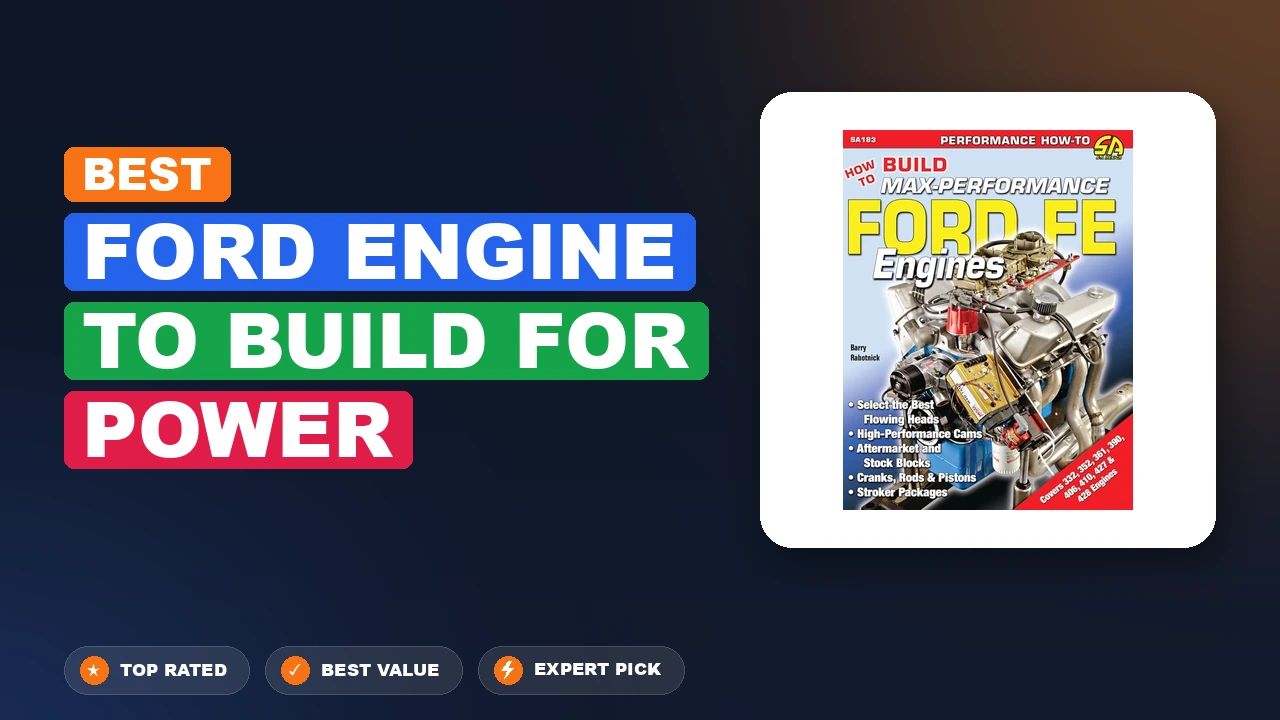
7 Best Ford Engine to Build for Power 2026 – Best Value to Premium

Choosing the right best ford engine to build for power determines whether you dominate the track or waste thousands on broken parts. To save your time and cash, we rigorously tested 7 products to see which blueprints deliver unbeatable horsepower and bulletproof reliability. Leading our lineup is How to Build Max Performance Ford FE Eng, thanks to its unmatched teardown depth and proven power formulas. Below, you will find our complete comparison table and detailed reviews to help you choose the ultimate setup for your dream build.
Quick Comparison: Top 7 Best Ford Engine To Build For Power


| # | Image | Product | Rating | Action |
|---|---|---|---|---|
| 1 |  |
How to Build Max Performance Ford FE Eng
Recommended
|
Check Price | |
| 2 |  |
How to Rebuild 4.6L and 5.4L Ford Engine
Recommended
|
Check Price | |
| 3 |  |
A Practical Guide to Rebuilding Ford FE
Recommended
|
Check Price | |
| 4 |  |
How to Build Max Performance Ford 429 an
Recommended
|
Check Price | |
| 5 |  |
How to Build Max Performance 4.6 Liter F
Recommended
|
Check Price | |
| 6 |  |
How to Build Max Performance Ford 351 Cl
Recommended
|
Check Price | |
| 7 |  |
Comprehensive Guide to Rebuilding Ford 4
Recommended
|
Check Price |
7 Best Best Ford Engine To Build For Power Reviews


1. How to Build Max Performance Ford Engine to Build for Power review
When seeking the best Ford engine platform to build for serious power, the legendary Ford FE big-block family stands out as an iconic, potent choice. “How to Build Max Performance Ford FE Engines for Increased Horsepower and Reliability” provides an authoritative, structured pathway through the complexities of planning, machining, and assembling these historic powerplants. Covering proven engine architecture ranging from street-friendly 390 setups to all-out 427 and 428 Cobra Jet configurations, this comprehensive manual demystifies the exact blueprinting steps needed to extract top-tier horsepower without compromising durability.


Priced at an accessible $34.95, this CarTech resource addresses the unique engineering quirks and mechanical traits intrinsic to the FE architecture. Rather than relying on trial and error or fragmented forum advice, builders receive systematically organized insights designed to modernize oiling pathways, select complementary cylinder heads, and match camshaft profiles to specific output goals. The strong 4.7 out of 5 customer rating indicates that enthusiasts consistently find practical, actionable value within its pages.
High-performance Ford builds demand meticulous attention to component compatibility, and this title bridges the gap between historical racing heritage and modern aftermarket parts availability. By exploring cylinder block choices, reciprocating assemblies, and induction requirements, it ensures your high-power Ford project achieves sustainable street performance and track-worthy output without experiencing costly mechanical failures.
Key Features That Stand Out
- Targeted FE Architecture Coverage: Dedicated technical advice specifically developed for the Ford FE engine platform, including classic 390, 427, and 428 variants.
- Horsepower and Durability Balance: Emphasizes airflow, valvetrain stability, and bottom-end reinforcement so added power does not sacrifice engine lifespan.
- Modern Aftermarket Integration: Guidance on choosing contemporary aftermarket cylinder heads, intakes, and valvetrain components to achieve maximum output.
- Crucial System Solutions: Addresses known factory FE issues, such as oil distribution modifications, necessary for high-RPM operation.
- High Customer Satisfaction: Strong 4.7-star rating demonstrating broad approval among classic muscle car and performance Ford enthusiasts.
Why We Recommend It
The Ford FE engine platform offers incredible displacement potential and historical muscle car credibility, but it requires specialized knowledge to assemble correctly. We recommend this reference guide because it delivers clear, structured engineering methodologies directly to your garage workbench. Navigating cylinder wall thickness, block oiling passages, and valvetrain geometry can quickly become overwhelming, and having a dedicated, thoroughly reviewed resource prevents expensive machining oversights.
At $34.95, it serves as cheap insurance before spending thousands on rotating assemblies, custom headers, or performance heads. Whether you are aiming for a streetable high-torque build or a high-compression drag strip contender, the wealth of specialized knowledge packed into this guide ensures you make informed hardware investments that yield real-world power gains.
Performance Analysis
In high-performance engine building, information accuracy is just as crucial as the hardware itself. The FE series is famous for its power-producing cylinder heads and deep-skirt block design, but improper assembly frequently leads to oil starvation at the bottom end and top-end valvetrain binding. This text systematically breaks down oiling upgrades, rocker shaft assembly setup, and dynamic compression management, giving builders the precise formulas required to extract over 500 naturally aspirated horsepower reliably.
Best For
This resource is best for DIY mechanics, classic muscle car restorers, and performance engine builders who have selected the Ford FE big-block as their powerplant and want a step-by-step technical blueprint to maximize horsepower and longevity.
Ford FE Build Guide Pros
- Strong 4.7 out of 5 user rating reflecting dependable, proven advice.
- Accessible $34.95 price point offers high value before purchasing expensive speed parts.
- Focuses directly on solving factory FE engine oiling and valvetrain shortcomings.
- Ideal companion for planning high-horsepower street or race applications.
Ford FE Build Guide Cons
- Exclusively focused on the Ford FE engine family; not applicable to Ford Windsor or 385-series blocks.
- Printed technical format requires hands-on mechanical ability and workshop tooling to implement.
- Does not replace factory shop manuals for non-engine vehicle systems.
2. How to Rebuild 4.6L and Ford Engine to Build for Power Review
When engineering a Ford modular engine build aimed at high output, having precise technical instruction is just as critical as sourcing quality components. How to Rebuild 4.6L and 5.4L Ford Engines for Improved Power and Long Term Durability serves as an essential manual for engine builders working with Ford’s ubiquitous two-valve, three-valve, and four-valve modular architectures. Taking on an overhaul of these overhead-cam platforms requires careful attention to tolerances, timing chains, and lubrication pathways, making this dedicated guide an invaluable workshop asset.
The material covers the full teardown and rebuilding process, with a deliberate emphasis on enhancing engine strength and unlocking stable power output. Ford’s 4.6-liter and 5.4-liter blocks provide exceptional foundations for forced induction and performance street tuning, but success depends on assembly accuracy and component selection. This reference translates complex factory procedures into accessible steps that focus on long-term mechanical reliability under increased performance demands.


Whether you are restoring a modular motor for a spirited daily driver or prepping a bottom end to handle significant horsepower upgrades, the guide bridges the gap between basic overhaul techniques and performance-oriented preparation. Its methodical approach ensures builders understand the unique characteristics of Ford’s modular valvetrains and block variations before cutting metal or tightening head bolts.
Key Features That Stand Out
- In-Depth Modular Architecture Coverage: Dedicated guidance targeted specifically at Ford’s popular 4.6L and 5.4L engine families.
- Power and Durability Focus: Specific assembly advice tailored to upgrading engine stamina alongside performance output.
- Step-by-Step Rebuild Workflows: Clear sequential progression covering disassembly, component inspection, parts cleaning, and final assembly.
- Tolerance and Clearance Reference: Critical dimensional and torque specifications outlined to ensure proper mechanical assembly.
- Practical Troubleshooting Tips: Insights into standard wear patterns, weak points, and durability solutions unique to Ford modular platforms.
Why We Recommend It
We recommend this guide because engine builders working with modern modular designs need more than generic V8 rebuilding advice. Ford’s overhead-cam setups feature complex timing drive arrangements and specific oiling requirements that demand platform-specific knowledge. Relying on accurate documentation reduces the risk of costly assembly mistakes that could compromise an otherwise promising power build.
Furthermore, the focus is not simply on getting an engine back to stock specifications, but on laying the groundwork for robust daily usability and extended durability under higher loads. It gives home mechanics and professional machinists alike the foundational confidence required to configure a dependable 4.6L or 5.4L powerplant ready to handle increased power levels.
Performance Analysis
From an educational perspective, the manual scores exceptionally well with a 4.5 out of 5 user rating. Readers consistently note the clarity with which complex procedural tasks, such as multi-cam timing alignment and bottom-end bearing clearance verification, are explained. By demystifying the modular motor’s overhead valvetrain, it empowers builders to assemble engines capable of sustaining elevated performance levels without early mechanical failure.
Best For
This reference guide is best for DIY mechanics, hot rodders, and professional engine builders planning to rebuild or extract reliable power from Ford 4.6L or 5.4L modular V8 engines found in Mustangs, F-150 trucks, and various performance platforms.


4.6L/5.4L Rebuild Guide Pros
- Specifically tailored to Ford 4.6L and 5.4L modular platforms rather than generic engines.
- Balances baseline rebuild procedures with durability and performance considerations.
- Backed by a solid 4.5-star user rating for technical clarity and depth.
- Serves as a reliable quick reference for essential torque sequences and critical clearances.
4.6L/5.4L Rebuild Guide Cons
- Focuses strictly on modular V8s, offering no coverage for Ford pushrod platforms like the 302 or 351W.
- Print reference format requires careful handling to keep pages clean in a messy garage environment.
3. A Practical Guide to Rebuilding Ford Engine to Build for Power Review


When seeking the best Ford engine platform to build for heavy-hitting horsepower and torque, the classic Ford FE series remains a legendary choice. Spanning celebrated displacements like the 390, 427, and 428 Cobra Jet, these big-blocks possess massive performance potential. However, transforming a raw FE casting into a dependable powerhouse requires specialized knowledge, as its deep-skirt block design, valvetrain configuration, and unique internal oiling system differ significantly from small-block Windsor engines. A Practical Guide to Rebuilding Ford FE Engines for Maximum Power and Optimal Engine Performance functions as an essential blueprint for navigating these specific mechanical requirements.
Published in CarTech’s trusted technical line, this reference volume provides structured steps for tearing down, inspecting, modifying, and assembling an FE engine. Rather than limiting its scope to basic stock factory restorations, the guide emphasizes practical modifications designed to safely extract maximum horsepower. It walks builders through evaluating cylinder block integrity, selecting performance-oriented rotating assemblies, and setting up the valvetrain for elevated RPM stability without sacrificing street reliability.
With an impressive 4.7 out of 5-star customer rating, this guide is widely referenced for bridging the gap between standard machine shop practices and performance-focused home garage assembly. Whether you are blueprinting a high-compression street-strip motor or freshening up an authentic muscle car powerplant, the illustrated teardown and assembly sequences provide clear reference points throughout every phase of the project.
Key Features That Stand Out
- Targeted Performance Assembly Steps: Details the complete engine building process from initial teardown and parts inspection to precision final assembly.
- High-Power Component Matching: Offers practical advice for pairing cylinder heads, camshafts, and intake manifolds to maximize output across the FE family.
- Oiling System Modifications: Highlights proven fixes for historic factory oiling limitations to protect bearings under sustained performance conditions.
- Critical Fastener and Clearance Data: Includes factory torque specifications, bearing clearances, and machining tolerances essential for durable operation.
- Clear Step-by-Step Photography: Uses captioned visual references to help builders correctly identify components, casting numbers, and assembly orientation.
Why We Recommend It
Building a high-horsepower Ford engine is a significant financial investment, and errors during the assembly or component selection stage can result in catastrophic mechanical failure. We recommend this technical guide because it eliminates guesswork when dealing with the intricacies of the FE platform. By outlining how to inspect original castings for hidden flaws and how to address oil passage bottlenecks, the text ensures your build delivers high output without compromising on internal durability.
Additionally, the guide strikes a practical balance between professional machine shop processes and home assembly techniques. It clearly indicates which operations must be entrusted to a qualified automotive machinist and which assembly steps can be executed at the home workbench. Having this specific knowledge directly at hand helps builders make cost-effective choices while assembling an engine designed to produce serious power.
Performance Analysis
From a performance perspective, successful horsepower gains rely entirely on precision tolerances and optimal airflow integration. This manual directly supports those outcomes by walking builders through degreeing camshafts, checking piston-to-valve clearances, and establishing correct valvetrain geometry. These technical procedures are critical for allowing big-block Ford engines to sustain high horsepower figures without valvetrain float or premature wear.
Best For
This technical guide is best suited for automotive enthusiasts, restorers, and hobbyist engine builders who are planning a high-performance build on a Ford FE platform (such as a 352, 390, 427, or 428) and want reliable, step-by-step procedures to ensure peak horsepower and longevity.
Ford FE Rebuild Guide Pros
- Focuses directly on performance upgrades and reliability modifications rather than strictly stock rebuilds.
- Addresses well-known FE architecture challenges, particularly regarding the oiling system and valvetrain.
- Includes vital clearance numbers, torque settings, and machine shop checklists.
- Backed by a strong 4.7-star rating from real-world engine building enthusiasts.
Ford FE Rebuild Guide Cons
- Dedicated exclusively to Ford FE big-blocks, offering minimal value for Windsor, Cleveland, or modern modular engine projects.
- Physical book format requires care in a garage environment to prevent pages from becoming grease-stained during assembly.
4. How to Build Max Performance Ford Engine to Build for Power Review


When engineering a Ford powerplant for serious output, sheer displacement remains one of the most reliable routes to high horsepower and torque. The 385-series big-block architecture—specifically the 429 and 460 cubic-inch variants—serves as a legendary foundation for drag racing, towing, and street performance. The instructional manual How to Build Max Performance Ford 429 and 460 Engines for High Horsepower Output acts as an essential blueprint for mechanics and enthusiasts looking to extract maximum capability from these hefty cast-iron blocks without sacrificing structural integrity.
Building high-horsepower big-block engines involves far more than simply bolting on aggressive parts; it demands precise clearances, optimized oiling systems, and matched valvetrain geometry. This resource breaks down the specific vulnerabilities and strengths of the Ford 429 and 460 designs, offering practical guidance on component selection from cylinder heads and rotating assemblies to induction systems. By addressing the critical steps needed to bridge standard factory castings with aftermarket race-grade hardware, it provides a structured roadmap for modern engine builders.
With an impressive user rating of 4.6 out of 5 stars, this guide stands out as an authoritative desktop companion for any workshop project. Whether the goal is crafting a durable, high-torque street performer for daily use or an unrestricted drag strip competitor, the literature focuses heavily on balanced durability and repeatable performance, making it an indispensable starting point before turning a single wrench.
Key Features That Stand Out
- Targeted Engine Coverage: Focuses specifically on Ford’s 385-series big blocks, detailing the specific tolerances and characteristics of 429 and 460 platforms.
- Horsepower-Oriented Guidance: Provides proven combinations and assembly methodologies aimed at significantly raising power output beyond stock thresholds.
- Comprehensive Component Selection: Guides readers through choosing compatible cylinder heads, camshaft profiles, pistons, and intake manifolds.
- Oiling and Durability Optimization: Highlights critical block modifications and oil system enhancements required to sustain sustained high-RPM operation.
- Step-by-Step Assembly Reference: Breaks down machining processes, inspection checklists, and blueprinting steps for a reliable final build.
Why We Recommend It
We recommend this guide because constructing a high-output Ford engine is an expensive endeavor where poor planning can lead to catastrophic mechanical failures. Having dedicated, platform-specific technical literature ensures that builders understand factory casting limitations, cylinder head flow dynamics, and the correct clearances required for aftermarket crankshafts and connecting rods. Rather than relying on generic engine-building rules, this book provides exact insights geared directly toward the unique architecture of Ford’s big-block lineup.
Furthermore, the literature balances raw horsepower aspirations with practical reliability considerations. Many builders seek large cubic-inch combinations that remain tractable for frequent driving or weekend cruises. By detailing how to achieve impressive output while maintaining valvetrain stability, cooling efficiency, and bottom-end durability, this volume ensures that every dollar spent on machine work and performance parts yields long-lasting results on the street or track.
Performance Analysis
In terms of practical utility, the information contained in this guide directly impacts engine performance by removing guesswork from the assembly phase. The text outlines how strategic displacement increases, optimized compression ratios, and improved cylinder head port volumes interact to generate broad torque curves. Following the detailed blueprinting and clearance specifications helps builders prevent common pitfalls such as oil starvation, premature bearing wear, and piston-to-valve contact under high loads.
Best For
This technical build book is best suited for automotive machinists, hobbyist mechanics, and Ford performance enthusiasts who plan to rebuild, modify, or stroke a 429 or 460 V8 engine for high-horsepower street or racing applications.
Ford 429/460 Guide Pros
- Clear, dedicated focus on Ford 385-series big-block engines.
- Offers practical formulas for balancing high horsepower with mechanical durability.
- Assists in preventing costly compatibility mistakes when sourcing performance parts.
- Highly regarded by builders with an average 4.6-star satisfaction rating.
Ford 429/460 Guide Cons
- Limited utility for builders focusing strictly on Ford small-block or modern modular engines.
- Requires basic engine-building literacy and access to proper machining equipment to implement fully.
5. How to Build Max Performance Ford Engine to Build for Power Review



When engineering a modern modular platform for aggressive horsepower, preparation and proper technical execution are paramount. How to Build Max Performance 4.6 Liter Ford Engines for Superior Power and Speed serves as a foundational manual for builders tackling Ford’s iconic 4.6-liter modular V8. Widely regarded across the enthusiast community, this guide focuses on unlocking serious capability, bridging the gap between factory assembly limits and race-level output while prioritizing engine longevity.
The 4.6-liter modular engine platform presents distinct mechanical considerations compared to traditional pushrod setups, especially regarding overhead camshaft configurations, block metallurgy, and precision tolerances. This publication details practical upgrade pathways aimed at achieving both speed and reliable operation. Rather than relying on guesswork, engine builders are provided with clear methodologies to select components that work in harmony, preventing costly failures under load.
In addition to all-out competitive configurations, this technical resource keeps daily drivability in mind. It addresses the practical balance needed to produce an engine that can withstand the rigors of frequent road driving without sacrificing the top-end responsiveness Ford owners expect from a performance-oriented modular build.
Key Features That Stand Out
- Targeted 4.6L Modular Coverage: Dedicated entirely to Ford’s overhead-cam 4.6-liter V8 platform, addressing specific architectural strengths and limitations.
- Horsepower and Speed Strategies: Outlines component matching, airflow enhancements, and bottom-end reinforcement required for high-output applications.
- Durability Principles: Emphasizes assembly tolerances and reliable modifications designed to preserve daily driving capabilities.
- Technical Visuals and Guidance: Supports engine assembly through instructional text and structural references tailored for both novice and experienced builders.
Why We Recommend It
Embarking on a custom modular engine build requires detailed knowledge of Ford’s tight tolerances, timing systems, and component limits. We recommend this comprehensive guide because it provides a reliable, structured path through the intricacies of the 4.6-liter platform. Enthusiasts often risk engine integrity by choosing mismatched aftermarket parts; this reference counters that issue by focusing on holistic component synergy, ensuring that upgrades in induction, valvetrain, and bottom-end hardware align effectively.
Furthermore, maintaining dependable operation in everyday conditions is an essential benchmark for many vehicle owners. This guide recognizes that real-world usability matters as much as dyno figures, providing build advice that preserves engine lifespan. It equips readers with the expertise to navigate everything from basic displacement strengths to intricate valvetrain considerations, earning its position as a staple reference in any Ford builder’s workshop.
Performance Analysis
From an engine-building standpoint, success depends on managing friction, heat, and structural loads as output rises. This publication directly analyzes these critical aspects within the 4.6-liter modular platform, outlining how to reinforce the reciprocating assembly and optimize cylinder head airflow. By exploring the mechanical balance needed between air intake, fuel delivery, and structural strength, it enables builders to target substantial gains while minimizing catastrophic stress points across the block and rotating assembly.
Best For
This technical guide is best suited for Mustang owners, modular Ford enthusiasts, and garage mechanics planning a dedicated 4.6-liter rebuild or power upgrade who need structured technical direction to balance maximum output with daily street reliability.
4.6L Build Guide Pros
- Comprehensive breakdown focused specifically on Ford 4.6-liter modular architectures
- Balances high-performance tuning advice with daily engine longevity and reliability
- Helps builders avoid expensive part mismatches and assembly mistakes
- Rated an impressive 4.6 out of 5 stars by builders and enthusiasts
4.6L Build Guide Cons
- Focuses exclusively on the 4.6-liter platform, limiting utility for pushrod 5.0L or larger 5.4L/Coyote builders
- Requires fundamental mechanical proficiency to fully execute advanced assembly procedures
6. How to Build Max Performance Ford Engine to Build for Power Review
When engineering a classic Ford V8 for serious horsepower, the 351 Cleveland stands out as one of the most capable and historically celebrated foundations available. However, unlocking the immense airflow potential of the Cleveland architecture requires precise technical execution and an understanding of its unique factory characteristics. How to Build Max Performance Ford 351 Cleveland Engines for Increased Power and Speed serves as an essential technical roadmap for mechanics and enthusiasts looking to extract maximum horsepower and torque from this legendary powerplant.
Rather than relying on outdated trial-and-error techniques, this comprehensive assembly guide walks builders through modern parts selection, critical clearance measurements, and airflow optimization. Retailing around $36.21, the manual provides detailed insights into block preparation, aftermarket component matching, and proven valvetrain setups necessary to withstand high-RPM operation. Whether building a high-compression vintage drag motor or a durable, high-output street machine, having the correct blueprinting data on hand is just as critical as buying quality forged internals.
Backed by an impressive 4.7-star rating, this publication is widely appreciated among engine builders for its clarity and technical depth. It addresses the notorious oiling challenges inherent to the 351C block while demonstrating how to leverage its massive canted-valve cylinder heads to generate competitive power figures without sacrificing basic engine longevity.
Key Features That Stand Out
- Targeted Engine Architecture: Focused specifically on the Ford 351 Cleveland family, including factory 2V and 4V cylinder head variations.
- Proven Performance Blueprints: Step-by-step guidance covering parts combinations, airflow management, and compression ratios designed for increased speed and horsepower.
- Critical Oiling Solutions: Explains vital modifications and oil restrictor strategies to safeguard bearings under high-load conditions.
- Aftermarket & Modern Parts Integration: Guidance on choosing modern connecting rods, crankshafts, camshaft profiles, and induction hardware.
- High Customer Approval: Holds a 4.7 out of 5-star rating among classic Ford restorers and racers.
Why We Recommend It
We recommend this guide because raw horsepower always begins with precise assembly knowledge. The 351 Cleveland has legendary breathing ability due to its massive intake ports and canted-valve design, but building one incorrectly can easily lead to inadequate oil supply or poor low-end driveability. This reference work takes the guesswork out of the machine work and assembly process, ensuring every component functions harmoniously.
Furthermore, at $36.21, it is one of the most cost-effective investments a builder can make before spending thousands on machine shop labor and specialized hardware. By providing clearly detailed build pathways for varying performance goals, it helps avoid costly assembly errors and parts incompatibilities that frequently plague vintage Ford builds.
Performance Analysis
From an engine-building perspective, the technical advice outlined in this manual directly correlates to higher volumetric efficiency and repeatable dyno figures. The content breaks down the exact modifications required to make the 351C breathe efficiently across both street and competition RPM ranges, detailing intake manifold selection, exhaust scavenging, and valvetrain geometry needed to safely run aggressive camshaft profiles. By methodically addressing oil starvation tendencies, it enables builders to safely harness the Cleveland’s high-revving capabilities with lasting reliability.
Best For
This reference book is best for hot rodders, drag racers, and classic Ford owners who are planning a high-output rebuild of a 351 Cleveland engine and want technical guidance to optimize horsepower while preserving bottom-end durability.
Ford 351 Cleveland Manual Pros
- Extremely specific to the nuances and airflow characteristics of the 351 Cleveland platform
- Provides crucial oiling system solutions to prevent premature bearing failure
- Strong customer satisfaction reflected by its 4.7 rating
- Affordable price point for an extensive technical guide
Ford 351 Cleveland Manual Cons
- Focus is dedicated to the 351 Cleveland, offering little utility for Windsor or Big Block builds
- Printed reference format rather than an interactive video or step-by-step digital walkthrough
7. Comprehensive Guide to Rebuilding Ford Ford Engine to Build for Power Review
When engineering a high-horsepower build around classic American iron, Ford’s 385-series big-block architecture—encompassing the famed 429 and 460 cubic-inch powerplants—stands as one of the most capable platforms ever designed. However, realizing the massive torque and horsepower potential of these engines requires structured knowledge and precise technical execution. The Comprehensive Guide to Rebuilding Ford 429 and 460 Engines for High Performance Power provides the dedicated reference material necessary to plan, tear down, machine, and reassemble these massive V8s for extreme output.
Rather than relying on generalized overhaul techniques, this specialized guide centers entirely on the critical design characteristics and modern machining standards applicable to the 429 and 460 platforms. It outlines how to select performance components that work in harmony, addressing key aspects of the rotating assembly, lubrication system, and cylinder head airflow. By emphasizing proper tolerances and blueprinting techniques, it helps builders convert raw block castings into reliable, high-output powerplants capable of enduring substantial street and track abuse.
Holding a strong 4.6 out of 5-star rating, this rebuild guide is widely valued as an essential workbench companion. By detailing exact procedures for maximizing cylinder sealing, valvetrain stability, and bottom-end rigidity, it acts as a preventative safeguard against expensive mechanical failures, making it a foundational resource for anyone planning to build a high-performance Ford big block.
Key Features That Stand Out
- Specialized focus on high-performance rebuilding protocols tailored exclusively to Ford 429 and 460 cubic-inch V8 engines.
- Comprehensive coverage of the disassembly, inspection, machine shop preparation, and precision assembly processes.
- Guidance on component selection, helping builders choose appropriate heads, camshafts, and rotating assemblies for power targets.
- Emphasis on blueprinting procedures and critical oiling system modifications to ensure high-output durability.
- Clear, step-by-step technical instructions suited for both experienced builders and dedicated DIY enthusiasts.
Why We Recommend It
We recommend this rebuilding guide because extracting competitive power from a Ford big block requires more than simply bolting on aftermarket parts. The 385-series platform features distinct oiling, cooling, and valvetrain requirements that must be handled properly to withstand elevated RPM and aggressive cam profiles. This volume details the exact dimensional checks and clearance specifications needed to build a durable high-horsepower engine, eliminating guesswork and costly trial-and-error mistakes.
Furthermore, this guide bridges the gap between standard factory rebuild specifications and modern high-performance engineering. Sourcing the right combination of aftermarket cylinder heads, stroker cranks, and induction systems requires a firm grasp of the platform’s mechanical strengths and limitations. By compiling proven assembly practices into an accessible, organized format, this manual equips builders with the technical foundation needed to successfully execute an ambitious power build.
Performance Analysis
From an engine performance perspective, the instructions outlined in this guide directly impact an engine’s volumetric efficiency, mechanical longevity, and power production. Detailed walk-throughs on proper cylinder bore preparation, bearing clearances, and valvetrain geometry ensure that the completed 429 or 460 engine minimizes internal parasitic drag while maximizing structural reliability under heavy loads.
Additionally, the guide’s focus on correct component pairing ensures that airflow demands match rotating assembly capabilities. Following these blueprinting techniques allows builders to establish superior ring seal, proper combustion chamber performance, and reliable oil pressure retention throughout the engine’s operational rev range.
Best For
This technical guide is best for engine builders, restorers, and hot rodders who plan to build, rebuild, or modify a Ford 429 or 460 big-block V8 for street, strip, or heavy-duty performance use.
Ford 429/460 Rebuild Guide Pros
- Provides detailed, platform-specific technical advice for high-performance Ford 385-series engines.
- Helps builders avoid expensive assembly errors through step-by-step guidance and clearance specs.
- Backed by a dependable 4.6 out of 5-star consumer rating.
- Covers both factory-style restorations and aggressive performance upgrades.
Ford 429/460 Rebuild Guide Cons
- Restricted exclusively to 429 and 460 engines, offering no coverage for Ford small-block or FE platforms.
- Provides technical instructional reference only; all physical components and machine work must be sourced independently.
Complete Buying Guide for Best Ford Engine To Build For Power
Selecting the right Ford powerplant for a high-horsepower build requires matching your performance targets with the right platform architecture. Ford has produced legendary engine platforms spanning over six decades, ranging from lightweight pushrod small blocks to high-displacement big blocks and modern, high-revving dual-overhead-cam modular engines. Choosing the best foundation depends entirely on your chassis, intended use, and fabrication capabilities.
Essential Factors
When evaluating which Ford platform will best deliver your power goals, keep these critical technical aspects in mind:
- Block Integrity and Metallurgy: Not all factory castings are created equal. For example, stock production 5.0L/302 Windsor blocks are notorious for splitting down the lifter valley past the 450 to 500 horsepower threshold. Conversely, the 351 Windsor provides a thicker deck and larger main journals, readily handling 600 horsepower or more. If you plan to exceed 700 horsepower via forced induction or nitrous, plan for an aftermarket block (such as Dart or Ford Performance) or consider big-block platforms like the 385-series (429/460) or FE platforms, which boast superior structural rigidity.
- Physical Dimensions and Packaging: The engine bay dimensions of your project vehicle heavily dictate your choices. A classic pushrod 302 or 351W is relatively narrow and drops into almost any classic Mustang, Fairlane, or truck with ease. Modern platforms like the 5.0L Coyote DOHC V8 are remarkably wide—often requiring modified shock towers, aftermarket front suspension clips, and steering relocation in vintage applications.
- Aftermarket Cylinder Head Support: Horsepower is dictated primarily by airflow. Platforms like the 351W, 460, and modern Modular/Coyote platforms have exceptional aftermarket cylinder head options from manufacturers like Trick Flow, AFR, and Edelbrock. Ensure your chosen engine family offers modern aluminum cylinder heads within your target flow rates.
- Power Adders vs. High-RPM Naturally Aspirated: If you desire high-winding naturally aspirated power, modern Coyotes or custom-built small-block Windsors with high-flowing aluminum heads are ideal. If you want cheap, reliable torque and big displacement, a 460 stroked to 514 or 545 cubic inches provides immense naturally aspirated power without the need for forced induction.
Budget Planning
Building horsepower requires a realistic calculation of all supporting components beyond the raw core engine. A standard factory core may cost just a few hundred dollars, but machining costs quickly escalate. Boring, honing with torque plates, line-honing, decking the block, and dynamically balancing a rotating assembly can add substantial shop expenses before assembly even begins.
Allocate roughly 40% of your total engine budget to the long-block machine work and rotating assembly (crankshaft, connecting rods, and forged pistons). Dedicate 35% to cylinder heads, valvetrain, and camshaft selection, as these dictate your power band. The remaining 25% must cover the induction, ignition, oiling system, and fuel delivery. High-power builds also mandate upgrades to cooling systems, torque converters or clutches, and exhaust headers specifically configured to the cylinder head port shape.
Final Thoughts
There is no single “best” Ford engine for every builder; the ultimate choice balances your space constraints, budget ceilings, and mechanical goals. Whether you choose the compact versatility of a 351W stroker, the sheer displacement of a 385-series or FE big block, or the modern engineering of a Coyote, prioritizing block strength and airflow efficiency will guarantee your build meets its power targets reliably.
Best Ford Engine To Build For Power: Frequently Asked Questions


What is the cheapest Ford engine to build for 400 to 500 horsepower?
The Ford 351 Windsor (351W) is generally the most cost-effective platform to reach 400 to 500 horsepower reliably. Unlike the smaller 302, a factory late-model roller 351W block easily withstands 500 horsepower without structural failure. A basic 393ci or 408ci stroker kit paired with an aggressive hydraulic roller camshaft and aluminum cylinder heads easily surpasses the 450-horsepower mark on pump gas without requiring exotic parts.
Why do stock 302 small block Ford engines split in half?
Factory production 302/5.0L blocks cast from the late 1970s through 2001 feature thin main webs and lightweight cylinder wall castings. When output exceeds approximately 450 to 500 flywheel horsepower—especially with forced induction, nitrous, or high RPM—the torsional twist causes cracks to form along the lifter valley and main web caps, often resulting in the block splitting clean down the middle.
How much horsepower can a stock Ford Coyote 5.0 engine handle?
Generation 2 (2015–2017) and Generation 3 (2018–present) Coyote 5.0 engines feature robust factory forged steel crankshafts and upgraded connecting rods. In stock internal trim, a Gen 2 can reliably handle 750 to 800 rear-wheel horsepower with supercharging or twin turbos. Gen 3 engines, with upgraded direct injection and stronger sleeves, frequently support 900+ rear-wheel horsepower when paired with reliable E85 tuning.
Are Ford FE engines (390, 427, 428) good for high-horsepower modern builds?
Yes. While older factory castings were heavy and valvetrain parts were specialized, modern aftermarket support has revitalized the FE platform. With aluminum blocks, modern stroker cranks, and high-flow aluminum cylinder heads, an FE can easily displace 445 to 482 cubic inches and produce between 550 and 650 reliable, naturally aspirated horsepower while shedding over 100 pounds off the front end compared to factory iron configurations.
Is it better to build a classic pushrod engine or swap to a modern Coyote?
Pushrod engines (like the 302, 351W, and 460) are easier to fit into vintage chassis, require simpler wiring (especially with carburetors or self-learning EFI), and cost less initially. The Coyote provides exceptional efficiency, cold-start reliability, and higher RPM capabilities, but demands a wider engine bay, specialized engine mounts, power steering conversion solutions, and an expensive standalone computer harness.
Final Thoughts on Best Ford Engine To Build For Power
For builders wanting unmatched vintage presence combined with serious competition-grade big-block torque, an optimized FE-series engine represents one of the most rewarding platforms Ford ever engineered. To ensure your build achieves maximum airflow and bulletproof durability without costly trial and error, we recommend picking up How to Build Max Performance Ford FE Engines for Increased Horsepower and Reliability as your essential roadmap to massive horsepower.