
Ford 2012 F150 5.0 Belt Diagram: 2026 Proper Routing & Maintenance

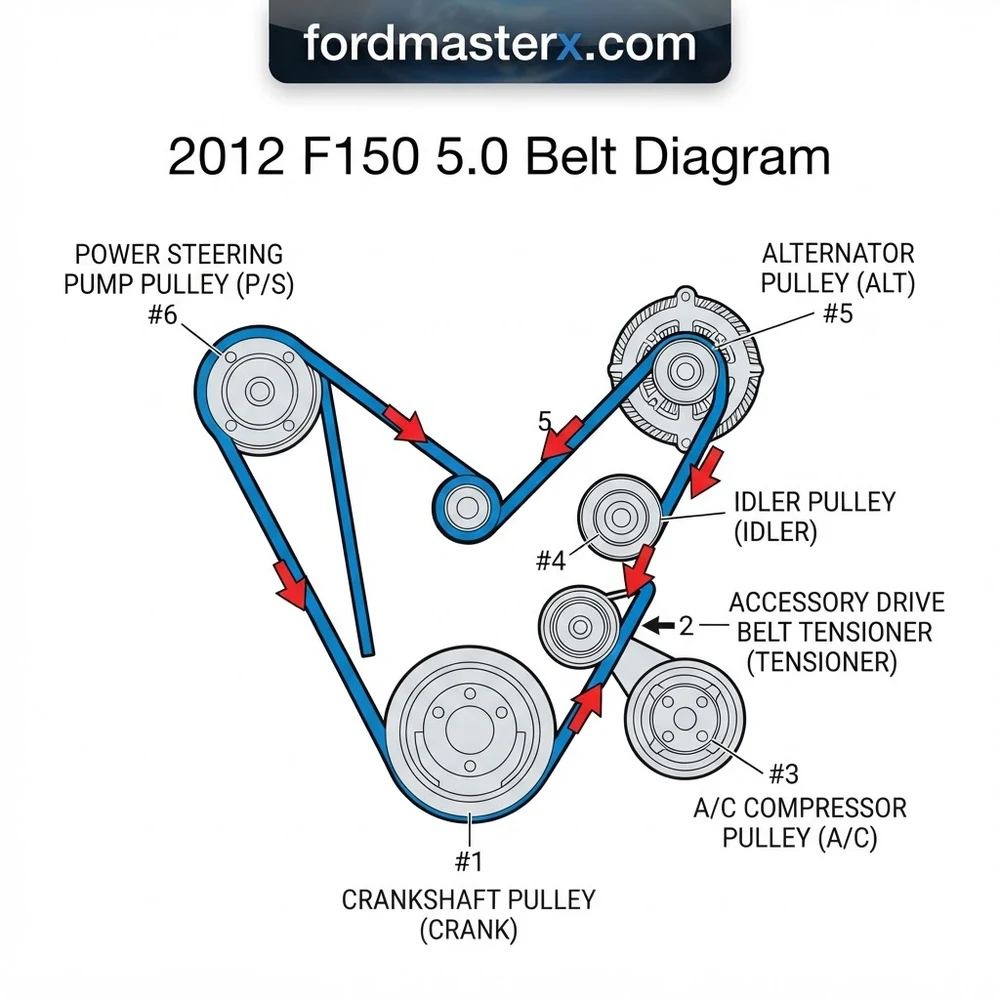
The 2012 Ford F-150 5.0L Coyote engine utilizes a single serpentine belt system. The routing path winds around the crankshaft, A/C compressor, water pump, alternator, and power steering pump. Always verify the belt is seated centrally in the idler pulley grooves to prevent premature wear and misalignment issues during engine operation.
📌 Key Takeaways
- Standard OEM replacement part number is Motorcraft JK6-1188 or equivalent 6-rib belt.
- The belt tensioner features a 15mm hex bolt head for pivoting to release tension.
- Ensure the belt ribbing is fully seated in all pulley grooves before applying final tension.
- Common failure point is the plastic idler pulley bearing seizing or the tensioner spring weakening.
- Seek professional assistance if the tensioner bolt is seized to avoid damaging the timing cover.
The 2012 Ford F-150 equipped with the 5.0L Coyote V8 engine utilizes a complex accessory drive system requiring a high-precision serpentine belt path to maintain optimal alternator, water pump, and A/C compressor function. Whether you are performing routine preventative maintenance or addressing a catastrophic belt failure, understanding the specific routing requirements is essential. The belt serves as the backbone of your engine’s accessory synchronization; improper routing or using the incorrect belt size can lead to premature component bearing failure or sudden accessory loss. This guide provides the technical data, pulley configurations, and procedural requirements necessary to service the 5.0L belt drive system in accordance with OEM specifications.
Decoding the 2012 F150 5.0 Belt Diagram and Engine Layout

The 5.0L Coyote engine in the 2012 F-150 utilizes a single, long serpentine belt to drive all front-end accessory drive (FEAD) components. Unlike older modular engines, the Coyote architecture places high demands on the belt tensioner to maintain consistent deck engagement across multiple grooved and smooth pulleys. The 2012 F150 5.0 belt diagram illustrates a routing path that snakes through the crankshaft pulley, water pump, A/C compressor, power steering pump (if applicable to your specific build), and the alternator.

The Role of the Belt Tensioner

The belt tensioner on the 5.0L Coyote is a spring-loaded pivot assembly designed to exert constant pressure on the belt’s back side. This tensioner is the most common point of failure in the FEAD system. If your belt shows signs of uneven wear or “jumping” during cold starts, the tensioner’s internal clock spring may have lost its calibrated tension. Always ensure the tensioner is fully retracted before attempting to slide the belt over the final pulley to prevent damage to the tensioner pivot bushing.
Analyzing Idler Pulley Placement


The diagram highlights two or more idler pulleys depending on your vehicle’s specific options (such as heavy-duty alternator or auxiliary cooling packages). These idlers are not meant to drive accessories but are critical for optimizing the wrap angle—or “deck engagement”—on the driven pulleys. If an idler pulley bearing exhibits any radial play or noise during rotation, it must be replaced immediately. A seized idler pulley will generate enough friction to melt the internal cords of the serpentine belt, resulting in an immediate roadside failure.
Note the rib side versus the smooth side of the belt. The diagram clearly dictates which side contacts the grooved pulleys (alternator, crankshaft) and which side rides on the smooth pulleys (water pump, tensioner, idlers). Incorrect orientation will result in accessory slippage and accelerated belt degradation.
Recommended 2012 F150 5.0 Belt Part Numbers and Specs
Selecting the correct belt is paramount. Many aftermarket belts claim to fit the 5.0L Coyote, but variations in effective length can cause the tensioner to operate outside of its optimal range. For a 2012 F-150 with a 5.0L engine, always prioritize OEM specifications or high-grade EPDM (Ethylene Propylene Diene Monomer) belts, which offer superior heat resistance compared to traditional rubber belts.
| Component | OEM Part / Spec | Notes |
|---|---|---|
| Serpentine Belt | JK6-1188 (or 6PK-3015) | EPDM material recommended |
| Belt Tensioner | BL3Z-6B209-A | Includes mounting bracket |
| Idler Pulley | BR3Z-8678-A | Single bolt mounting |
Identifying Correct Belt Size
The standard length for the 5.0L Coyote serpentine belt is approximately 1188mm to 1195mm, depending on manufacturer specifications for EPDM shrinkage. Using a belt that is too long will cause the tensioner to bottom out against its internal stop, while a belt that is too short will put excessive strain on the alternator and water pump shaft bearings. When purchasing, check the packaging for the “6PK” designation, which indicates a six-ribbed profile designed specifically for the Coyote pulley grooves.
Always cross-reference the VIN-specific parts catalog. While the 5.0L architecture remained consistent through 2012, auxiliary accessory packages (like snow plow prep or dual alternators) may alter the belt routing path and length requirements.
How to Use the 2012 F150 5.0 Belt Diagram for Routing


Before performing a belt swap, ensure the engine is completely cool to avoid thermal expansion interference. You will require a 15mm or 16mm serpentine belt tool to actuate the tensioner.
Removal and Installation Protocol


1. Document Current Routing: Even if you have the 2012 F150 5.0 belt diagram handy, take a reference photo of the current belt orientation, specifically noting the interaction with the A/C compressor and alternator.
2. Relieve Tension: Locate the tensioner pulley nut. Using a serpentine belt tool or a long-handled 15mm wrench, rotate the tensioner assembly clockwise (this varies slightly by exact sub-model; observe the spring travel).
3. Belt Extraction: Once the tensioner is fully retracted, slide the belt off the most accessible smooth idler pulley. Gently release the tensioner to its resting position. Remove the belt from the remaining pulleys.
4. Inspect Pulleys: With the belt removed, rotate each pulley by hand. You are looking for grinding, clicking, or lateral play. Any pulley showing resistance should be serviced before the new belt is installed.
5. Routing the New Belt: Start from the crankshaft pulley at the bottom and work upward. Follow the routing path shown in the diagram, keeping the belt seated within the grooves of the alternator and power steering pump.
6. Final Tensioner Engagement: Leave the belt off a smooth idler pulley as the final step. Rotate the tensioner again using your belt tool, slide the belt over the final idler, and slowly release the tensioner to apply force.
7. Verify Alignment: Inspect every pulley rib to ensure the belt is centered. A “mis-groove” of even one rib will cause the belt to shred within minutes of operation.
Keep your fingers clear of the tensioner pivot point during operation. The internal spring is under high compression and can cause severe injury if it slips during the installation process.
Tensioner Maintenance and Proper Belt Adjustment
The service life of your serpentine belt is fundamentally tied to the health of the belt tensioner. On the 2012 5.0L Coyote, the tensioner is not merely a static pivot; it is a dynamic component that fluctuates with engine RPM and accessory loads.


Monitoring Tensioner Degradation
Technicians recommend inspecting the tensioner during every oil change. Look for “belt flutter,” which occurs when the tensioner cannot effectively dampen the oscillations of the belt path. If you observe the tensioner assembly vibrating excessively while the engine idles, the internal hydraulic or spring damper has failed. Operating the engine with a failing tensioner will lead to inconsistent accessory performance—most notably dimming headlights (alternator lag) or fluctuating A/C cooling efficiency.


Idler Pulley Bearing Longevity


Idler pulleys are often neglected until they fail, yet they are high-speed components that spin at several times the speed of the crankshaft. Modern diagnostics involve using an automotive stethoscope to listen for bearing growl at the idler pulley housing. If a bearing fails, it will typically overheat and seize, leading to an immediate snap of the serpentine belt. If you are exceeding 100,000 miles, it is standard professional practice to replace both the idler pulleys and the belt tensioner assembly as a complete kit to ensure future reliability.
2012 F150 5.0 Belt Diagram Questions Answered
Can I reuse my old serpentine belt if it looks visually fine?
It is not recommended. Serpentine belts, specifically the EPDM compounds used in the 2012 5.0L Coyote, undergo chemical degradation over time. Even if the rubber appears intact, the internal aramid or polyester cords lose their structural integrity. For a vehicle with this level of towing and hauling capability, an unexpected belt failure is a significant liability.
What are the symptoms of a misaligned belt?
A misaligned belt will typically present with a rhythmic chirping noise, most prominent at idle. If you notice “rib jumping” on the pulley, the belt may be misaligned by one or more grooves. This will cause the edges of the belt to fray rapidly. Inspect the pulleys for debris or foreign objects that may have knocked the belt off its track.


Is the 2012 F150 5.0 belt diagram the same for all cab configurations?
Yes. The 5.0L Coyote engine architecture is consistent across the F-150 chassis for the 2012 model year. Whether you have the Regular Cab, SuperCab, or SuperCrew, the FEAD (Front End Accessory Drive) remains identical, assuming the factory accessory options (like the A/C and alternator) are present.
How do I know if I have the correct belt tension?
Modern automatic tensioners on the Coyote engine are designed to provide the correct tension automatically. There is no manual adjustment nut or screw. If the belt is loose, it is either the incorrect length, or the tensioner spring has reached its end-of-life and requires replacement. Do not attempt to use “belt dressing” or external tightening methods; these will only damage the accessory pulley coatings.
Step-by-Step Guide to Understanding the 2012 F150 5.0 Belt Diagram
Identify – Locate the belt tensioner assembly equipped with a 15mm hex nut head.
Locate – Use the routing diagram to map the path around the crankshaft, water pump, and accessories.
Reference – Clear the area of tools and ensure the belt ribbing matches the pulley grooves.
Connect/Route – Apply clockwise force to the tensioner bolt, route the belt, and release tension slowly.
Verify – Check all pulleys to ensure the belt is perfectly centered and not hanging off any edges.
Troubleshoot – Start the engine briefly; if squealing occurs, re-seat the belt on the pulleys immediately.