P0299 Code Ford F150: Causes Diagnosis and Fix Guide 2026

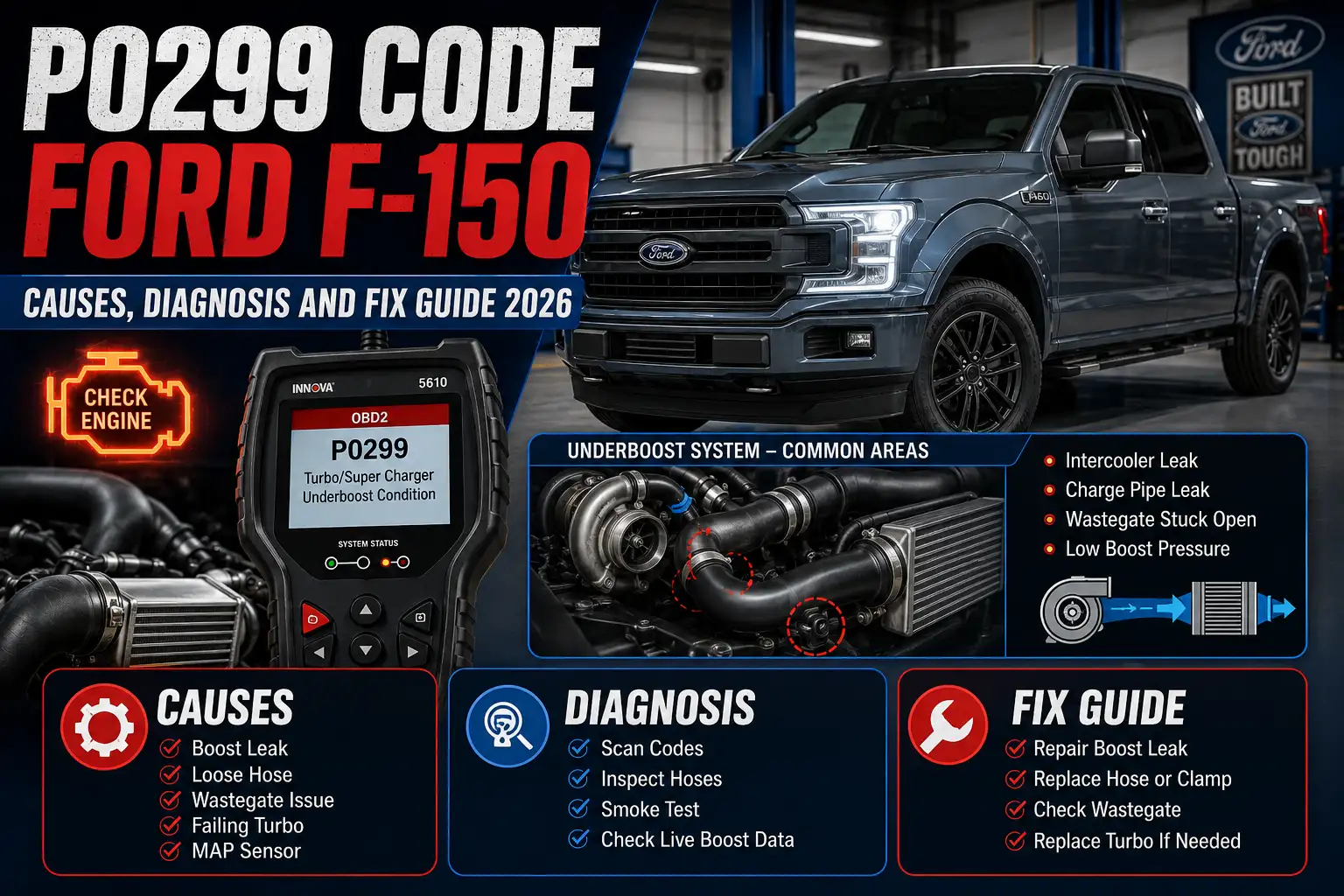
The P0299 code on a Ford F150 means the PCM detected a turbocharger underboost condition. In simple terms, your EcoBoost engine produced less boost pressure than the powertrain control module expected under the operating conditions.
P0299 does not automatically mean the turbocharger is bad. A leaking charge pipe, failed bypass valve, wastegate problem, restricted turbo inlet, sensor issue, or damaged turbo can all produce underboost.

Prime for Young Adults — 6 Months Free
Students and 18–24s get six months of Prime free, then half price.
Start 6 Months Free As an Amazon Associate I earn from qualifying purchases.
The smartest diagnosis starts with the code data and inexpensive external checks before moving toward turbo replacement.
Follow this order before replacing expensive parts. P0299 confirms an underboost condition, but the failed component still has to be identified.
Save Codes and Freeze Frame
Record P0299, related DTCs, RPM, load, temperature, and available boost data before clearing the PCM.
Always start hereIdentify Engine and Build Date
Confirm model year, engine, trim, and build date so Ford service bulletins can be matched correctly.
Year changes the diagnosisInspect the Complete Air Path
Check turbo inlet pipes, charge hoses, clamps, intercooler connections, and visible restrictions or damage.
Hissing usually points herePressure Test for Boost Leaks
Use the correct smoke or pressure-test procedure to find leaks that may only open when the system is under boost.
Fix confirmed leaks firstCheck Wastegate Operation
Inspect the actuator, linkage, mounting hardware, and control system for separation, looseness, or failed movement.
Key check on affected 2021 2.7LCompare Pressure Sensor Data
Review requested versus actual boost and inspect MAP-related wiring or connectors if readings look implausible.
Verify data before replacing sensorsInspect the Turbocharger Last
Check for compressor damage, binding, excessive shaft looseness, housing contact, abnormal noise, or confirmed oil leakage.

Audible — Listen Free for 30 Days
One free credit a month and thousands of titles included.
Listen Free for 30 Days As an Amazon Associate I earn from qualifying purchases.Repair the Confirmed Cause
Clear the code only after the diagnosed leak, wastegate fault, sensor issue, restriction, or turbo failure is repaired.
Retest under the same conditionsWhat Does P0299 Mean on a Ford F150
Ford identifies P0299 as Turbocharger or Supercharger A Underboost Condition. The PCM monitors the difference between desired boost and actual boost while the engine is operating under load.
Ford’s gasoline OBD monitor documentation for earlier EcoBoost applications shows P0299 monitoring desired versus actual boost continuously. In those strategies, a difference of about 4 psi for 5 seconds can satisfy the underboost malfunction threshold when the required monitor conditions are met.
That threshold should not be treated as a universal specification for every F-150 model year. Ford changes diagnostic strategies across engines and generations.
| Item | P0299 Information |
|---|---|
| DTC | P0299 |
| Ford Definition | Turbocharger or Supercharger A Underboost Condition |
| System | Turbocharger and boost control |
| Common Result | Reduced boost and weak acceleration |
| Confirms Bad Turbo | No |
| First Move | Save scan data and inspect for related faults |
The code tells you that boost production did not meet the PCM’s target. It does not tell you which component caused the loss.
6 Symptoms That Narrow Down P0299 Causes
Your F-150’s symptoms can help determine which P0299 branch deserves attention first.
Low Power Under Acceleration
Loss of acceleration is one of the clearest P0299 symptoms. The truck may feel normal at light throttle but become weak when passing, climbing a grade, or requesting more boost.
Ford has documented reduced-engine-power conditions with P0299 on specific F-150 EcoBoost and PowerBoost applications.
If your main complaint is poor acceleration, our guide to Ford F150 EcoBoost no power when accelerating covers other faults that can produce similar symptoms.
Hissing Under Boost
A hiss or rushing-air sound that becomes stronger with throttle should move the charge-air system near the top of your checklist.
Audible Premium Plus — Annual Membership
12 audiobook credits up front, plus the full Audible catalogue.
See Annual Plans As an Amazon Associate I earn from qualifying purchases.Compressed air travels from the turbochargers through charge plumbing and the charge air cooler before reaching the engine. A split connection, loose clamp, damaged pipe, or leaking valve can release that air before it reaches the intake.
The PCM then sees less pressure than it expected and may set P0299.
Wastegate Area Rattle
A wastegate regulates how much exhaust energy drives the turbocharger. If the wastegate cannot close correctly, exhaust gas can bypass the turbine and limit boost.
A mechanical linkage problem deserves special attention on some trucks. Ford SSM 49960 states that certain 2021 F-150 trucks with the 2.7L EcoBoost can experience loss of power and P0299 when the upper linkage lever separates from the wastegate control actuator because of a missing jam nut. Ford specifically states that an actuator kit can be serviced without replacing the entire turbocharger assembly in this condition.
A rattle alone does not prove that the turbo is defective. Inspect the control system first.
Smoke From the Exhaust
Smoke combined with P0299 changes the diagnostic priority.
Underboost by itself can come from an external air leak. Smoke accompanied by oil loss, abnormal turbo noise, or evidence of compressor-side oil leakage raises concern about mechanical turbo damage.
Ford’s 2021 PowerBoost bulletin specifically describes possible right-turbo turbine shaft damage, a binding impeller, or oil leakage from the compressor wheel on affected trucks.
Abnormal Turbo Noise
Whining, scraping, or contact noise from the turbo area deserves inspection, especially when it appears together with weak boost.
Ford’s TSB 22-2198 directs technicians working on applicable 2021-2022 Raptor and Tremor trucks to inspect whether the compressor wheel is damaged, whether the shaft turns freely, whether it is loose in the housing, and whether the wheel has contacted the housing.
Noise without physical inspection is not enough reason to order a turbocharger.
Highway Stumble in Humid Weather
Early 3.5L EcoBoost owners need one historical distinction.
Ford TSB 12-10-19 covered certain 2011-2012 F-150 trucks with the 3.5L GTDI EcoBoost that could stumble or misfire after extended highway driving in humid or damp conditions. P0299 was one of the codes that could accompany the condition.
However, Ford later superseded TSB 12-10-19 with TSB 13-3-3. The superseding bulletin updated the issue and service procedure and focused on the humid-weather stumble and misfire condition.
So an early EcoBoost with P0299 should not automatically be diagnosed using an old bulletin simply because the code appears.
P0299 Causes by F150 Engine and Year
The correct P0299 path changes with the engine and model year. Ford’s own service communications show why a generic “replace the turbo” diagnosis is unreliable.
| F-150 Application | Documented P0299 Concern | Diagnostic Priority |
|---|---|---|
| 2011-2012 3.5L EcoBoost | Historical humid-weather stumble condition where P0299 could accompany misfire codes | Check symptoms and related codes before assuming turbo failure |
| 2021 2.7L EcoBoost | Wastegate actuator upper linkage lever may separate due to missing jam nut | Inspect wastegate actuator linkage |
| 2021-2022 Raptor and Tremor 3.5L | Air deflector interference can restrict turbo inlet and contribute to turbo damage | Inspect inlet path and turbo condition |
| 2021 3.5L PowerBoost built on or before Sep. 30, 2021 | Restricted right air-cleaner outlet pipe can contribute to right turbo damage | Inspect right inlet pipe and turbo |
| Other EcoBoost F-150s | No single P0299 part failure applies to every year | Follow standard leak, control, sensor, and turbo diagnosis |
Ford’s 2021 2.7L EcoBoost SSM 49960 is especially useful because it warns against replacing the entire turbo when the serviceable wastegate actuator linkage is the actual fault.
For 2021 F-150 PowerBoost trucks built on or before September 30, 2021, TSB 24-2257 identifies a restriction in the right air-cleaner outlet pipe as a condition that can lead to P0299, reduced power, and right-turbo damage.
For 2021-2022 F-150 Raptor and Tremor models with the 3.5L EcoBoost, Ford TSB 22-2198 identifies upper radiator air-deflector fit and possible interference with the engine air-cleaner fresh-air inlet as a condition associated with reduced power and P0299.
The year, engine, trim, and build date therefore matter before you buy any parts.
If You Hear Hissing Check Boost Leaks First
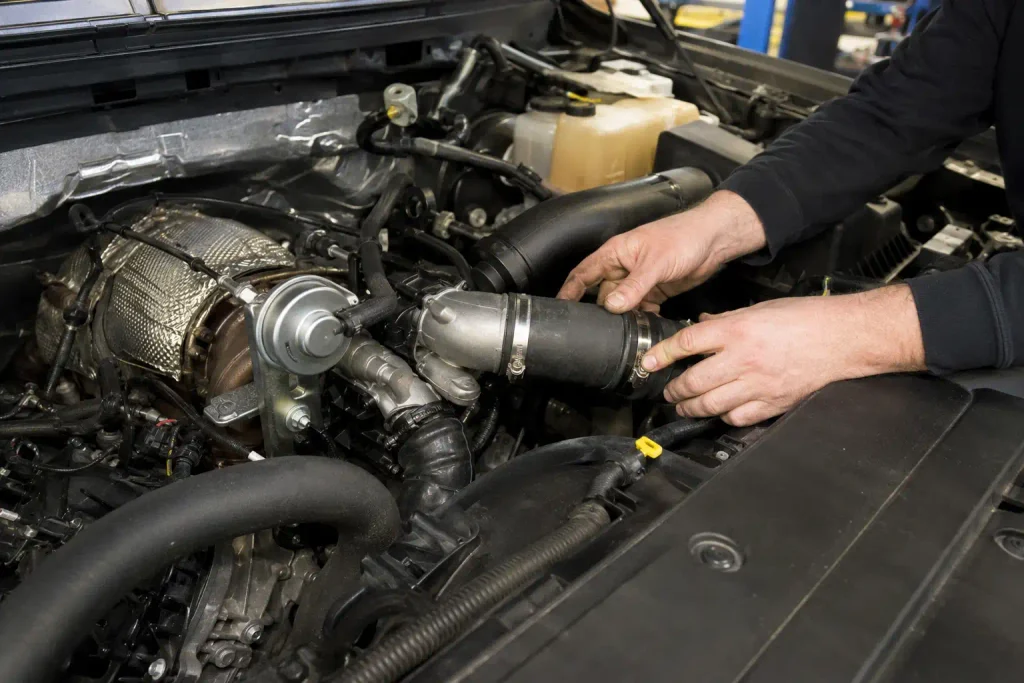
If your F-150 hisses or whooshes during acceleration, inspect the pressurized intake system before condemning the turbochargers.
Start with a cold engine and visually inspect the accessible charge-air plumbing. Look for connections that have moved, damaged clamps, cracked hoses or pipes, oily residue concentrated around a joint, and physical damage around the charge air cooler.
Oil film inside EcoBoost charge plumbing can occur during normal crankcase ventilation operation, so oil by itself does not prove a leak. A wet area combined with a loose joint, split hose, or confirmed pressure loss is more useful evidence.
Next, inspect the compressor bypass or blow-off valve system applicable to your engine. A valve that cannot seal can release boost instead of keeping pressurized air in the intake tract.
Ford’s diagnostic information for P0299 has historically included checking turbo control tubing for restrictions, cracks, and incorrect connections.
Do not apply arbitrary shop-air pressure to the complete intake system. Use the Ford service procedure for your exact engine or a purpose-built smoke or pressure tester operated within the equipment manufacturer’s limits.
If the charge system holds pressure, move to the wastegate branch.
If Boost Plumbing Passes Test the Wastegate
If you cannot find a charge-air leak, check whether the wastegate system can keep the turbocharger in its boost-producing range.
The wastegate controls exhaust flow around the turbine. A wastegate that remains too far open reduces turbine speed and can leave actual boost below the PCM’s requested boost.
Inspect the visible actuator linkage for disconnected parts, excessive looseness, damaged hardware, or movement that clearly does not correspond to actuator operation.
The 2021 2.7L EcoBoost deserves a specific check. Ford SSM 49960 says the wastegate control actuator upper linkage lever can separate because of a missing jam nut. Ford released separate right and left actuator service kits and stated that complete turbo replacement is unnecessary for that condition.
That service message demonstrates why P0299 should be diagnosed by condition rather than by expensive-part guessing.
If the linkage appears intact, a capable scan tool becomes valuable. Compare boost commands, pressure data, and available actuator information according to the Ford service procedure for your engine.
If Hardware Looks Good Check Sensors and Airflow
If the hoses, charge-air cooler, bypass system, and wastegate do not reveal a problem, inspect the information the PCM uses to judge boost.
Ford’s earlier EcoBoost OBD monitoring strategy relies on boost-related sensor and actuator inputs while checking for an underboost condition. A bad signal can therefore complicate diagnosis even when the turbo hardware appears normal.
Check connectors for water intrusion, loose pins, damaged wiring, or contamination before replacing a sensor.
On a 3.5L EcoBoost, our 3.5 EcoBoost MAP sensor location guide can help identify the sensor locations before inspection.
Do not judge a sensor from one random live-data number. Compare related pressure readings under the correct operating conditions and use Ford’s diagnostic procedure for the exact model year.
Airflow restrictions matter too. A blocked or deformed inlet can reduce the amount of air available to the compressor even when the pressurized side does not leak.
Ford’s 2021 PowerBoost and 2021-2022 Raptor and Tremor bulletins provide real examples where restrictions on the turbo inlet side were associated with P0299 and turbo damage.
When Does P0299 Actually Mean Turbo Failure
A P0299 code justifies turbo replacement only after diagnosis shows that the turbocharger itself cannot do its job.
Evidence becomes much stronger when you find physical compressor damage, a shaft that binds, excessive looseness, wheel-to-housing contact, abnormal mechanical noise, or oil leakage that Ford’s inspection procedure identifies as a turbo fault.
TSB 22-2198 tells technicians to inspect the compressor wheels, verify that the turbine shaft spins freely, check for looseness, and look for contact between the compressor wheel and housing before applying the bulletin’s turbo-replacement procedure.
TSB 24-2257 gives another concrete example. On affected 2021 PowerBoost trucks, Ford describes a right turbocharger turbine shaft that may be broken, a binding impeller, or oil leakage from the compressor wheel in conjunction with the restricted inlet condition.
If you want to understand how age and service affect these units, see our guide to 3.5 EcoBoost turbo lifespan.
P0299 alone does not prove any of those physical defects.
| Evidence | What It Suggests |
|---|---|
| P0299 only | Underboost is confirmed, cause is not |
| Charge leak found | Repair leak before turbo diagnosis |
| Wastegate linkage fault | Repair control problem first |
| Restricted turbo inlet | Correct restriction and inspect turbo |
| Incorrect sensor data | Diagnose sensor or circuit |
| Compressor damage or binding shaft | Mechanical turbo failure becomes likely |
The expensive repair belongs at the end of the diagnostic process.
How to Diagnose Ford F150 P0299 in 7 Steps
Diagnose P0299 from the least invasive checks toward the expensive components. That sequence reduces unnecessary parts replacement.
1. Save the Scan Data
Scan all modules before clearing codes.
Record P0299, related powertrain codes, freeze-frame information, engine speed, load, temperatures, and any useful boost-related data captured when the fault occurred.
Related codes can completely change the diagnosis.
2. Identify Your Exact F150
Confirm the model year, engine, trim, and build date.
A 2021 2.7L EcoBoost, a 2021 PowerBoost, and a 2022 Raptor can all show P0299 for different documented reasons.
Check for applicable Ford service messages before using a generic diagnostic path.
3. Inspect the Air Path
Check the intake from the air cleaner toward the turbocharger and the charge-air system from the turbo outlet toward the throttle body.
Look for restrictions, damaged tubing, loose connections, split hoses, and displaced clamps.
4. Test for Charge Leaks
If visual inspection does not expose the problem, test the charge-air system using the correct Ford procedure or appropriate diagnostic equipment.
A leak that only opens under boost may be difficult to find while the engine is sitting still.
5. Check Wastegate Operation
Inspect the actuator, linkage, control hoses where applicable, and related hardware.
If you have a 2021 2.7L EcoBoost, specifically inspect for the linkage separation described in Ford SSM 49960.
6. Compare Sensor Data
Use scan data to compare the PCM’s requested boost with the pressure the system actually produces.
Inspect MAP and other relevant pressure-sensor circuits if readings are implausible or inconsistent with operating conditions.
7. Inspect the Turbocharger
Move to mechanical turbo inspection only after the air path, wastegate controls, and sensor inputs have been checked.
Look for the physical defects specified in the service information for your engine. If the compressor wheel is damaged, the shaft binds, or the assembly fails Ford’s mechanical inspection, turbo replacement may be justified.
| Diagnostic Finding | Best Next Move |
|---|---|
| Charge hose or connection leaks | Repair leak and retest |
| Bypass valve fails inspection | Repair or replace failed valve |
| Wastegate linkage disconnected | Repair applicable actuator or linkage |
| Turbo inlet restricted | Correct restriction and inspect turbo |
| Pressure reading is implausible | Diagnose sensor and wiring |
| Turbo has physical damage | Repair or replace turbo as required |
| No fault found | Continue Ford pinpoint diagnosis |
This process turns P0299 from a guess into a testable sequence.
Can You Drive an F150 With P0299
Whether you should keep driving depends on the symptoms accompanying P0299.
Mild Underboost Only
If the truck has only a check engine light and mild loss of boost with no smoke, overheating, oil-pressure warning, or mechanical turbo noise, move diagnosis to the top of your repair list and avoid demanding operation until you know the cause.
P0299 can reduce available power, which matters when merging, passing, or towing.
Severe Power Loss
If acceleration becomes unpredictable or the truck displays reduced engine power, avoid towing and other high-load driving.
Ford’s bulletins for affected 2021 EcoBoost and PowerBoost applications specifically document reduced-power conditions with P0299.
Smoke or Mechanical Turbo Noise
If P0299 comes with heavy smoke, rapidly increasing oil consumption, scraping or grinding from a turbo, or obvious compressor damage, stop treating the problem as a routine boost leak.
Continuing to load a mechanically damaged turbo can create a larger repair.
There is no responsible universal answer such as “P0299 is safe for another 500 miles.” The cause and symptoms determine the risk.
Which P0299 Fix Fits Your F150
There is no single P0299 repair that fits every Ford F-150.
If a charge-air leak is confirmed, repair the hose, pipe, clamp, cooler connection, or other leaking component and verify that requested boost returns.
If the bypass system cannot seal, repair the failed valve or related control problem.
If the wastegate linkage or actuator fails inspection, repair that system according to the engine-specific Ford procedure. On the affected 2021 2.7L, Ford explicitly provides actuator kits instead of requiring an entire turbo assembly.
If the turbo inlet is restricted, correct the restriction and inspect the compressor for resulting damage. This is especially relevant to the specific trucks covered by TSB 22-2198 and TSB 24-2257.
If sensor data is wrong, diagnose the sensor, wiring, connectors, and related circuits before touching the turbo.
If mechanical turbo inspection fails, replacement becomes justified.
That decision order is much safer for your wallet than treating P0299 as a turbo replacement code.
Fix the Underboost Cause Before Replacing Parts
The P0299 code Ford F150 diagnosis starts with one fact: the PCM detected underboost, not a specific failed part.
Save the scan data, identify the exact EcoBoost engine and model year, check applicable Ford service information, inspect the complete air path, test for charge leaks, verify wastegate operation, and compare pressure data.
Only move toward turbo replacement when the external systems pass and physical inspection supports mechanical turbo failure.
If replacement does become necessary, our breakdown of 3.5 EcoBoost turbo replacement cost covers what goes into the repair.
5 Common Ford F150 P0299 Questions
Does P0299 Mean My F150 Turbo Is Bad
No. P0299 means the PCM detected less boost than expected, but the code does not identify the failed component. Charge-air leaks, wastegate faults, inlet restrictions, sensor problems, and mechanical turbo damage can all lead to an underboost condition.
Can a Boost Leak Cause P0299 on an F150
Yes. A leak between the turbocharger and engine can prevent the intake system from reaching the boost pressure requested by the PCM. Inspect charge pipes, connections, clamps, the charge air cooler, and applicable bypass components before assuming the turbocharger has failed.
Can a Wastegate Cause Ford F150 P0299
Yes. A wastegate that remains open or cannot be controlled correctly can limit turbo speed and boost. Ford SSM 49960 documents a real P0299 wastegate-actuator linkage problem on certain 2021 F-150 trucks with the 2.7L EcoBoost.
Can I Clear P0299 and Keep Driving
You can erase the code with a scan tool, but clearing it does not repair the underboost condition. Save the freeze-frame and related DTC information first because those records can show the operating conditions present when the PCM detected the fault.
How Much Does Ford F150 P0299 Cost to Fix
The cost depends completely on the confirmed failure. A loose connection or serviceable actuator problem is a very different repair from a mechanically damaged turbocharger, so diagnosing the fault before requesting prices is essential. If the turbo is confirmed bad, use the linked FordMasterX turbo replacement cost guide to plan the larger repair.