Ford G1 Paint Code Color: Model Year Guide 2026

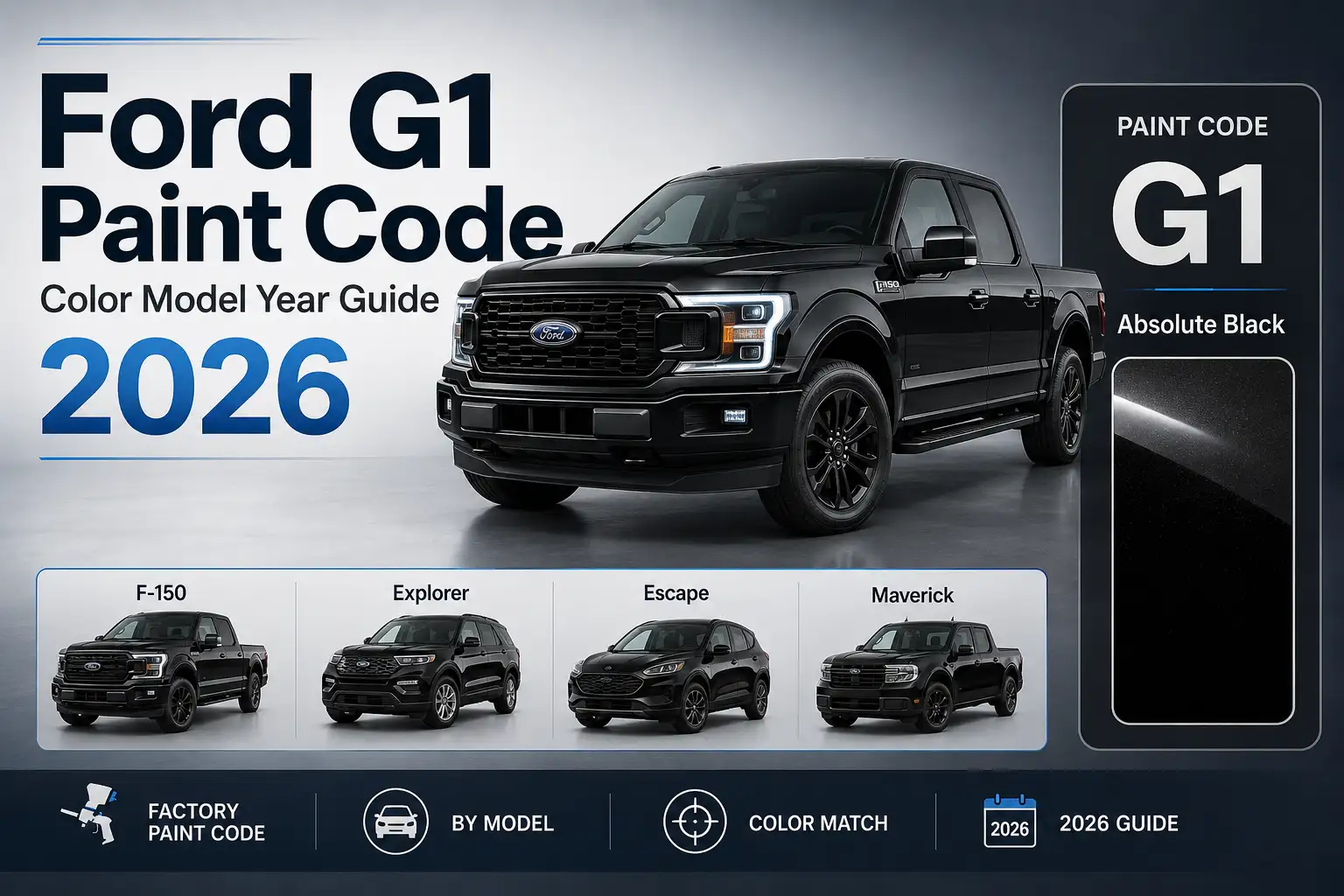
Ford G1 paint code identifies a factory black finish commonly called Shadow Black. Ford also uses the name Absolute Black for G1 in some model and accessory references, so the two-character G1 code is more useful than the marketing name when matching paint.
Ford has used G1 across Mustangs, F-150s, Explorers, Super Duty trucks, Rangers, Broncos, Bronco Sports, Mavericks, and other applications. Availability varies by model year, so confirm the code on your own Ford before ordering touch-up paint or refinishing materials.

Prime for Young Adults — 6 Months Free
Students and 18–24s get six months of Prime free, then half price.
Start 6 Months Free As an Amazon Associate I earn from qualifying purchases.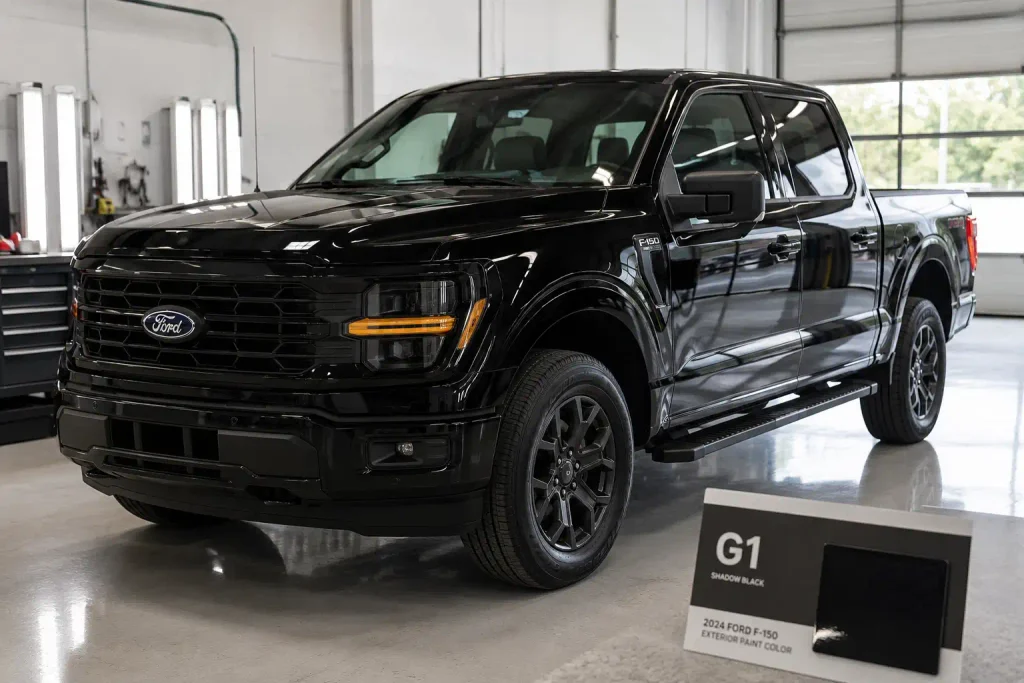
This guide explains what G1 means, where Ford used it, how Shadow Black and Absolute Black relate, and how to verify your paint before a repair.
Ford G1 Paint Code Quick Identification Guide
Use the factory paint code first, then confirm your Ford model and model year before ordering paint.
G1 is commonly identified by Ford as Shadow Black. Some Ford references use the name Absolute Black for documented G1 applications.
Shadow Black Absolute Black M7343 Cross Reference| Ford Color | Paint Code | Same as G1 |
|---|---|---|
| Shadow Black | G1 | Yes |
| Absolute Black | G1 in documented applications | Yes by code |
| Black | UA | No |
| Agate Black | UM | No |
| Tuxedo Black | UH on relevant applications | No |
What Ford G1 Paint Code Actually Means
Recommended Best Deal Products


The basic G1 identification is straightforward.
| Specification | Ford G1 Details |
|---|---|
| Paint code | G1 |
| Common Ford color name | Shadow Black |
| Alternate Ford-used name | Absolute Black |
| Manufacturer cross-reference | M7343 |
| General color family | Black |
| Metallic designation | Not identified as metallic in Ford Mustang order guides |
| Repair system | Basecoat and clearcoat applications are used for Ford color-matched accessories |
Ford’s Mustang documentation repeatedly identifies Shadow Black with order code G1. The 2026 Mustang order guide still lists G1 as Shadow Black, showing that this code remains in use more than a decade after its mid-2010s introduction.
The M7343 cross-reference also appears in Mustang paint databases for G1 Shadow Black. It is useful when working with automotive paint suppliers, although you should still give the supplier your Ford model, model year, and G1 code.
Ford does not mark G1 as a metallic color in Mustang order guides that specifically identify other finishes as metallic. That matters because you should not substitute another Ford black simply because its appearance is similar.
For a broader lookup of factory colors beyond G1, the Ford paint code chart covers other Ford exterior codes and color families.
The next question is where Ford actually used G1.

Audible — Listen Free for 30 Days
One free credit a month and thousands of titles included.
Listen Free for 30 Days As an Amazon Associate I earn from qualifying purchases.Which Ford Models Use G1 Shadow Black
G1 has appeared across several Ford product lines, but the marketing name and available years are not identical for every model.
The table below focuses on applications that can be supported by Ford documents, Ford-linked order information, or automotive paint compatibility data.
| Ford Model | Verified G1 Applications | Name Used in Source | Paint Code |
|---|---|---|---|
| Mustang | Appears throughout 2016 to 2026 era | Shadow Black | G1 |
| F-150 | 2016 to 2017 verified | Shadow Black | G1 |
| Explorer | 2016 verified | Absolute Black | G1 |
| Super Duty F-250, F-350 and F-450 | 2017 verified | Shadow Black | G1 |
| Ranger | 2023 and 2025 verified | Shadow Black | G1 |
| Bronco Sport | 2022 verified | Shadow Black | G1 |
| Maverick | 2022 to 2026 Ford accessory applications | Absolute Black | G1 |
Ford Mustang G1 Paint Years
The Mustang gives us one of the clearest G1 histories.
Ford documentation confirms Shadow Black G1 for 2016, and subsequent order information verifies it in 2018, 2020, 2022, 2023, 2024, and 2026 model-year documentation.
That evidence shows G1 remained a recurring Mustang black through both the S550 and S650 eras.
Ford F-150 G1 Paint Years
The 2016 F-150 was offered in Shadow Black G1. A contemporary vehicle order confirmation lists Shadow Black with code G1, and a 2017 application guide confirms Shadow Black G1 for 2016 and 2017 F-150 applications.
Do not assume that every later black F-150 is G1. Ford has also used codes such as UM for Agate Black, which makes the door-label check essential.
Ford Explorer G1 Paint
A 2016 Ford color compatibility document identifies the Explorer’s G1 exterior color as Absolute Black rather than Shadow Black.
This is a good example of why the code matters more than the marketing name. If your Explorer label says G1, tell the paint supplier G1 and the exact model year instead of requesting generic black paint.
Ford Super Duty G1 Paint
Ford’s 2017 Super Duty order information lists Shadow Black G1 for F-250, F-350, and F-450 pickups.
Audible Premium Plus — Annual Membership
12 audiobook credits up front, plus the full Audible catalogue.
See Annual Plans As an Amazon Associate I earn from qualifying purchases.Super Duty colors changed over later generations, so do not use the 2017 identification as a blanket rule for every F-250 or F-350.
Ford Ranger G1 Paint
The Ranger also used Shadow Black G1.
Ford’s 2025 Ranger order guide lists Shadow Black with code G1 across XL, XLT, Lariat, and Raptor configurations. 2023 Ranger ordering information also references Shadow Black G1.
The model and year chart gets you close. Your truck’s own certification label gives you the final answer.
How To Find G1 on Your Ford Label
Recommended Best Deal Products


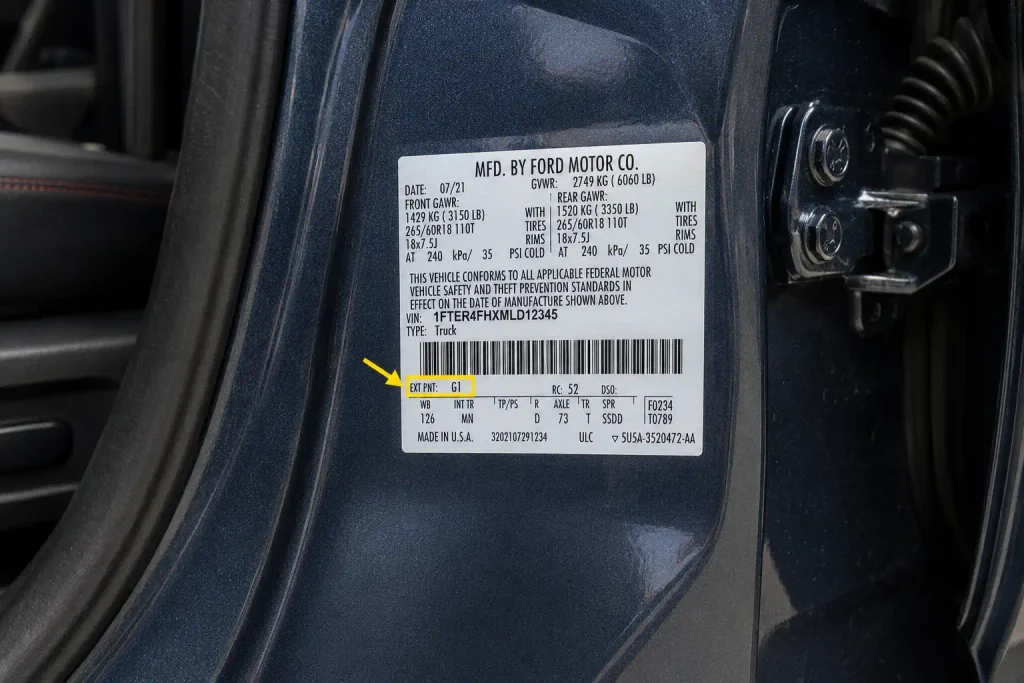
Your Ford’s certification label is the safest place to confirm the factory exterior code before buying paint.
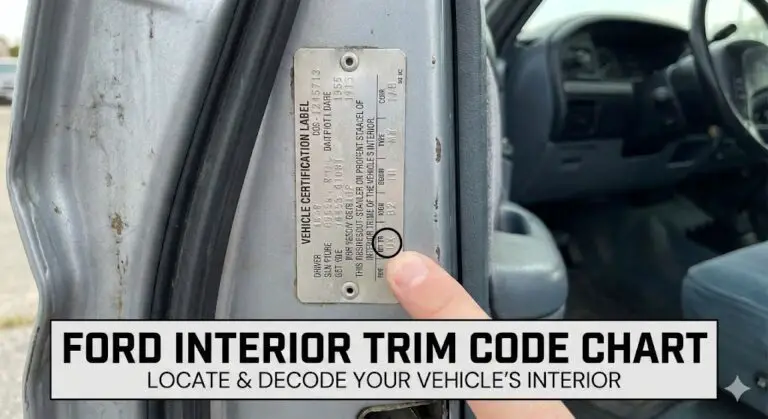
Ford has long included an EXT PNT field on certification labels. Ford owner documentation also shows the certification label on the driver’s-side front door latch pillar for many models.
Use this four-step check.
- Open the driver’s door. Look around the door jamb or latch-pillar area for the certification label.
- Find the exterior paint field. Older Ford labels commonly identify it as
EXT PNT. - Read the code exactly. If the field shows
G1, your exterior paint code is G1. - Confirm the model year before ordering. Give the supplier the G1 code, year, and Ford model so the paint formula can be checked against the correct application.
Ford’s own touch-up products describe colors using the Vehicle Certification Label Paint Code, which confirms that this label is a key reference for matching factory paint.
If your Ford has a factory two-color body treatment or contrasting sections, the Ford two tone paint schemes guide can help explain why more than one exterior color may be involved.
Once you confirm G1, the next issue is the different black names attached to it.
Shadow Black vs Absolute Black and Other Ford Blacks
Shadow Black and Absolute Black can both be associated with Ford code G1. That does not mean every Ford black uses G1.
Ford Mustang and Ranger documentation generally calls G1 Shadow Black. Ford color compatibility information for the 2016 Explorer calls the same code Absolute Black. Ford’s current accessory catalog also sells Maverick color-matched products described as Absolute Black, paint code G1.
The practical comparison looks like this:
| Ford Black Finish | Code | Same as G1 |
|---|---|---|
| Shadow Black | G1 | Yes |
| Absolute Black | G1 in documented applications | Yes by code |
| Black on some earlier Ford models | UA | No |
| Agate Black | UM | No |
| Tuxedo Black | UH on relevant applications | No |
For example, Mustang references show Shadow Black G1 replacing earlier black offerings in the mid-2010s. A different code means a different paint identification even when two black panels look nearly identical from several feet away.
Ford also lists Agate Black under UM on newer applications and accessories, separate from G1.
This is why searching for “Ford black touch-up paint” is not enough. Match the factory code first.
How To Match Ford G1 Touch Up Paint
Recommended Best Deal Products


Once the label confirms G1, use the code as the main reference for your repair paint.
1. Start With Paint Code G1
Tell the supplier that the certification label shows G1.
Do not order based only on a listing that says “Shadow Black” or “Absolute Black.”
2. Give the Exact Ford Model and Year
Provide the year and model with the code.
For example, a 2016 F-150 G1 and a G1 application carrying the Absolute Black name can be cross-checked correctly when the supplier knows the original Ford application.
3. Use a Basecoat and Clearcoat System When Required
Ford’s own color-matched accessory listings describe their painted parts as using basecoat/clearcoat automotive paint.
For a small stone chip, a matched touch-up product may be enough. A bumper, door, bedside, hood, or quarter-panel repair requires a more controlled refinishing process.
4. Test the Paint Before a Large Repair
Apply the mixed paint to a spray-out card or another test surface before committing to a visible body panel.
Factory code matching gets you to the correct formula, but the existing finish may have changed slightly after years of UV exposure, polishing, previous repairs, or environmental wear.
5. Blend Larger Panel Repairs
A fresh G1 formula can look different beside aged paint even when the paint code is correct.
Professional collision repairers may blend color into an adjacent area so the transition is less visible. For a major body repair, code identification is only the first part of getting an acceptable match.
Ford itself tells customers to verify the paint code before ordering non-returnable color-matched accessories.
That same rule makes sense for touch-up and refinishing paint.
4 G1 Paint Matching Mistakes To Avoid
Most Ford G1 paint problems start with identification rather than application.
Matching by Color Name Only
Do not buy paint simply because the container says Shadow Black.
The actual G1 code is the stronger identifier because Ford has used different marketing terminology for the same code.
Assuming Every Black Ford Is G1
Ford has several black paint codes.
G1, UA, UH, and UM should not be treated as interchangeable simply because they all belong to the black color family.
Ignoring the Certification Label
An online color chart is useful for research, but your own Ford’s label should be checked before you buy paint.
If the label does not show G1, do not order G1 solely because your truck looks like another Shadow Black Ford.
Skipping a Paint Test
Do not spray a large hood, bedside, door, or bumper immediately after mixing the paint.
Test the formula first. A test card can reveal an obvious shade or appearance problem before you create a much larger repair job.
These checks reduce the chance of turning a small chip or scratch into a noticeable color mismatch.
How To Confirm Your Ford G1 Paint Code
Use this sequence before buying G1 paint:
- Find the certification label on your Ford.
- Locate the exterior paint or
EXT PNTfield. - Confirm that the code actually reads G1.
- Record your exact model and model year.
- Order by G1 plus model and year, not by the words “black” or “Shadow Black” alone.
- Test the matched paint before repairing a large visible area.
Ford G1 paint code most commonly corresponds to Shadow Black, while Ford also uses Absolute Black terminology for some G1 applications. The code itself is the key detail.
If your label says G1, use that code as the starting point and let the model year resolve any naming differences.
5 Common Ford G1 Paint Code Questions
Is Ford G1 Paint Code Shadow Black?
Yes. Ford order guides identify G1 as Shadow Black on models including the Mustang and Ranger. Ford also uses the Absolute Black name for G1 in some Explorer, Maverick, and accessory references, so both names can appear for the same two-character code.
What Year Did Ford Start Using G1 Shadow Black?
There is no single Ford-wide start year that applies to every model. G1 is documented on 2016 Mustang, F-150, and Explorer applications, while Ford later used the code on models such as Ranger, Bronco Sport, and Maverick-related color-matched accessories.
Is Ford G1 the Same as UA Black?
No. G1 and UA are different Ford paint codes. A vehicle with UA on the factory label should be matched to UA, while a Ford showing G1 should be matched using the G1 formula.
Where Is the G1 Paint Code on a Ford?
Look for the certification label around the driver’s-side door latch pillar or door-jamb area. Ford label examples identify the exterior finish with an EXT PNT field, where a G1-equipped Ford will show the G1 code.
Can I Order Touch Up Paint Using Only G1?
G1 is the most important identifier, but you should also provide the Ford model and model year. Ford itself instructs buyers of color-matched accessories to verify the paint code before ordering, and model/year confirmation gives the paint supplier another check against an incorrect listing.
Ford G1 Paint Code Quick Takeaway
The Ford G1 paint code identifies a black factory finish most commonly named Shadow Black, with Absolute Black used in some Ford references. Ford documentation confirms G1 across several models and model years, but not every black Ford uses this code.
Check the driver’s-side certification label before ordering anything. If the exterior paint field says G1, give the paint supplier G1, your exact Ford model, and the model year.
That simple check is more reliable than choosing paint from a photo, marketing color name, or another black Ford parked beside yours.