Ford F150 Transmission Control Module Reset Guide 2026 Fix

Performing a Transmission Control Module (TCM) reset can clear erratic shift patterns caused by adaptive learning errors. Proper execution ensures your truck relearns driving habits without needing a dealership visit.
Resetting the Transmission Control Module (TCM) on your 2026 Ford F-150 is the most effective way to clear adaptive learning tables that have become corrupted by aggressive driving patterns or recent mechanical repairs. You do not need to schedule a dealership appointment to resolve erratic gear shifts, hesitation, or delayed engagement; these issues often stem from the PCM and TCM holding onto outdated logic rather than a physical failure of the transmission hardware.

Prime for Young Adults — 6 Months Free
Students and 18–24s get six months of Prime free, then half price.
Start 6 Months Free As an Amazon Associate I earn from qualifying purchases.By performing a targeted reset, you force the transmission to discard these learned driving habits and revert to factory shift logic. This process effectively initiates a “re-learn” phase, allowing the vehicle to adapt to your specific current driving style. For the 2026 model year, this process ranges from simple pedal manipulation to deeper software interaction via OBDII diagnostic tools, depending on how deeply the adaptive memory needs to be purged.
Key Takeaways
Recommended Best Deal Products


- A TCM reset clears adaptive shift tables to fix erratic gear engagement.
- Disconnecting the battery can trigger a hard reset for basic electrical glitches.
- FORScan software provides the most accurate way to perform a KAM reset.
- Always test-drive the vehicle for 20 miles after a reset to allow relearning.
- Mechanical slipping or fluid issues cannot be fixed by a software reset.
Diagnosing Transmission Issues: When to Reset the TCM
Identifying Shift Quality Degradation
You should prioritize a TCM reset only when you notice specific, repeatable shift anomalies that coincide with changing driving conditions. If your 2026 F-150 recently underwent a fluid exchange, a valve body repair, or a period of extended towing, the adaptive learning data may be conflicting with the current state of the drivetrain. Look for these specific indicators:

- Harsh or clunky shifts during the 1st to 3rd gear transition.
- Engine flare-ups during upshifts where RPMs jump unexpectedly before engaging the next gear.
- Inconsistent “hunt” behavior where the transmission struggles to lock into a stable gear at highway speeds.
- Delayed “Drive” or “Reverse” engagement after the truck has been sitting for several hours.
The Difference Between Electrical and Mechanical Faults
Before proceeding, distinguish between a software glitch and a physical failure. A TCM reset clears electronic memory, but it will not fix a hardware issue. If you have active Check Engine Lights (CEL) or transmission-specific diagnostic trouble codes (DTCs) related to solenoid failure or pressure sensor issues, a reset is only a temporary band-aid. Use an OBDII scanner to confirm there are no hard mechanical codes. If the transmission exhibits a metallic grinding noise or a significant fluid leak, you must prioritize mechanical inspection over an electronic reset.
Master Ford F-150 TCM Resets in 7 Simple Steps
Recommended Best Deal Products


The Transmission Control Module (TCM) in your Ford F-150 is the “brain” responsible for managing shift points and gear engagement. Over time, your truck’s adaptive learning parameters can become skewed, leading to harsh shifts, sluggish acceleration, or hesitation. Performing a TCM reset clears these learned driving patterns, allowing the transmission to relearn your driving style and optimize performance. This guide outlines the precise procedure to perform a hard reset and a “KAM” (Keep Alive Memory) clear, ensuring your powertrain runs as smoothly as the day it rolled off the assembly line.
Step 1: Preparing Your Workspace
What you need: A flat, safe surface, a 10mm wrench or socket, and a pair of safety glasses.
Instructions: First, ensure your F-150 is parked on a level surface with the engine off and the key removed from the ignition (or the fob placed well away from the vehicle). Open the hood and secure it properly. Locate your battery and identify the negative terminal, which is usually marked with a black cover or a minus (-) sign. Before touching any electrical components, allow the vehicle to sit for at least 15 minutes. This ensures that the residual voltage in the capacitors has dissipated, preventing any electrical spikes that could potentially damage sensitive control modules or blow internal fuses.
Pro Tip: Always remove your metal rings or watches before working near the battery to prevent accidental short-circuiting against the frame or terminals.
Step 2: Disconnecting the Power Supply
What you need: 10mm socket, ratchet, and protective gloves.
Instructions: Use your 10mm socket to loosen the nut on the negative battery cable clamp. Do not remove the positive terminal, as this is unnecessary for a simple TCM reset and increases the risk of arching. Once loose, pull the cable terminal off the battery post and set it aside, ensuring it cannot make contact with the terminal while you work. Tucking a thick, dry shop rag between the cable end and the post is a great way to guarantee no accidental contact occurs during the reset process. This disconnection effectively kills the power to the Keep Alive Memory (KAM) in the PCM and TCM.

Audible — Listen Free for 30 Days
One free credit a month and thousands of titles included.
Listen Free for 30 Days As an Amazon Associate I earn from qualifying purchases.Pro Tip: If the terminal is corroded, take this time to clean it with a wire brush to ensure a perfect connection when you reconnect it later.
Step 3: Draining Residual Electricity
What you need: Your vehicle’s horn and headlight switch.
Instructions: With the negative cable disconnected, you must drain the stored energy in the vehicle’s electrical capacitors. Turn the headlight switch to the “ON” position and hold the horn down for 10 to 15 seconds. You will notice that nothing happens—the lights won’t turn on and the horn won’t sound—but this action forces the system to pull all remaining charge from the capacitors. This step is critical; without it, the control modules might hold their previous data for up to an hour. Ensuring the system is completely “dead” is the only way to guarantee the TCM reset will be successful.
Pro Tip: Ensure all auxiliary electronics, like dash cams or radar detectors, are unplugged from the 12V cigarette lighter ports before attempting this.
Step 4: The Extended Wait Period
What you need: A timer or your smartphone.
Instructions: This is the waiting game. You must leave the negative cable disconnected from the battery for a minimum of 30 to 45 minutes. While some people claim five minutes is enough, an extended period is required for the internal capacitors of the TCM to fully discharge their data. During this time, the internal computer logic reverts to the factory-default “base” map. If you reconnect the battery too early, you may find that the truck retains the old, faulty shift patterns, rendering the entire effort useless. Use this time to inspect the rest of your engine bay for loose vacuum lines or leaks.
Pro Tip: Grab a coffee and be patient. Going longer than 45 minutes will not hurt the truck, but rushing this step will definitely lead to failure.
Step 5: Reconnecting the Battery
What you need: 10mm socket and torque wrench (optional).
Instructions: Once the time has elapsed, take the negative battery cable and firmly press it back onto the battery terminal. Tighten the 10mm nut securely. You want a snug fit; the cable should not move if you try to twist it by hand. Ensure the connection is clean and flush with the terminal post. Once connected, your F-150 may undergo a brief system check where you hear relays clicking or see dashboard lights flicker for a second—this is completely normal. Immediately return your headlights to the “OFF” position before entering the cab to start the ignition process.
Pro Tip: If you see a small spark when the cable touches the terminal, don’t panic; this is just the circuit closing and power returning to the truck.
Audible Premium Plus — Annual Membership
12 audiobook credits up front, plus the full Audible catalogue.
See Annual Plans As an Amazon Associate I earn from qualifying purchases.Step 6: The Idle Relearn Process
What you need: Just your truck and a bit of patience.
Instructions: Start the engine and let it idle for at least 10 minutes without touching the accelerator. During this time, the PCM and TCM are recalibrating the idle air control and verifying sensor inputs. Do not turn on the A/C or radio yet, as you want the engine to focus on stabilizing its base parameters. After 10 minutes, turn on the A/C, radio, and headlights for another 5 minutes to allow the truck to compensate for electrical loads. This establishes the baseline for the truck’s operational health before it begins learning your specific driving habits through the transmission shift points.
Pro Tip: If the engine seems to stumble or idles roughly, let it be. It is actively calculating the correct air-fuel mixture for the current conditions.
Step 7: The Adaptive Driving Cycle
What you need: A clear, low-traffic road.
Instructions: Take your F-150 for a 15-minute test drive. During this drive, you must include a variety of speeds, including stop-and-go traffic and light highway cruising. When accelerating from a stop, do so with moderate throttle. Do not floor the pedal, as this will teach the TCM an aggressive, high-RPM shift pattern immediately. Instead, use smooth, consistent pressure. The TCM is now recording your throttle inputs and transmission fluid temperatures to map out optimal shift points. By providing a “normal” range of driving inputs, you ensure the truck learns a smooth, responsive shift behavior that avoids the previous harshness or hesitation.
Pro Tip: Avoid heavy towing for the first 50 miles after the reset to allow the transmission clutches to properly adapt to the new logic.
✅ Final Checklist
- Battery negative cable is tight and shows no movement.
- Engine idle is steady after the 10-minute warm-up period.
- No “Check Engine” or “Wrench” warning lights on the dashboard.
- Transmission shifts feel smoother during the initial test drive.
- Electrical accessories (lights/radio) are functioning correctly.
Important Notes:
- Safety: Never attempt this while the engine is running or in a poorly ventilated garage.
- Professional Help: If you experience “limp mode” or flashing O/D lights after the reset, there may be an internal solenoid failure, which requires a transmission specialist.
- Time/Cost: This process takes about 60–90 minutes and costs $0 if you have basic hand tools.
Step-by-Step Guide to Resetting Your Ford F-150 TCM
The Pedal-Input “Hard” Reset Method
For most 2026 F-150 owners, a manual reset sequence is the first line of defense. This method clears the temporary cache of the TCM without requiring specialized software. Follow these steps precisely to ensure the module recognizes the clear command:

- Turn the ignition to the “On” position without starting the engine.
- Press the accelerator pedal to the floor slowly and hold it there for 15 seconds.
- Turn the ignition to the “Off” position.
- Release the accelerator pedal.
- Wait for at least 2 minutes without opening the doors or pressing any buttons, allowing the module to enter sleep mode and commit the memory clear.
- Start the engine and take the vehicle for a “re-learn” drive consisting of light-throttle acceleration and steady-state cruising.
Leveraging FORScan for Deep Adaptive Clearing
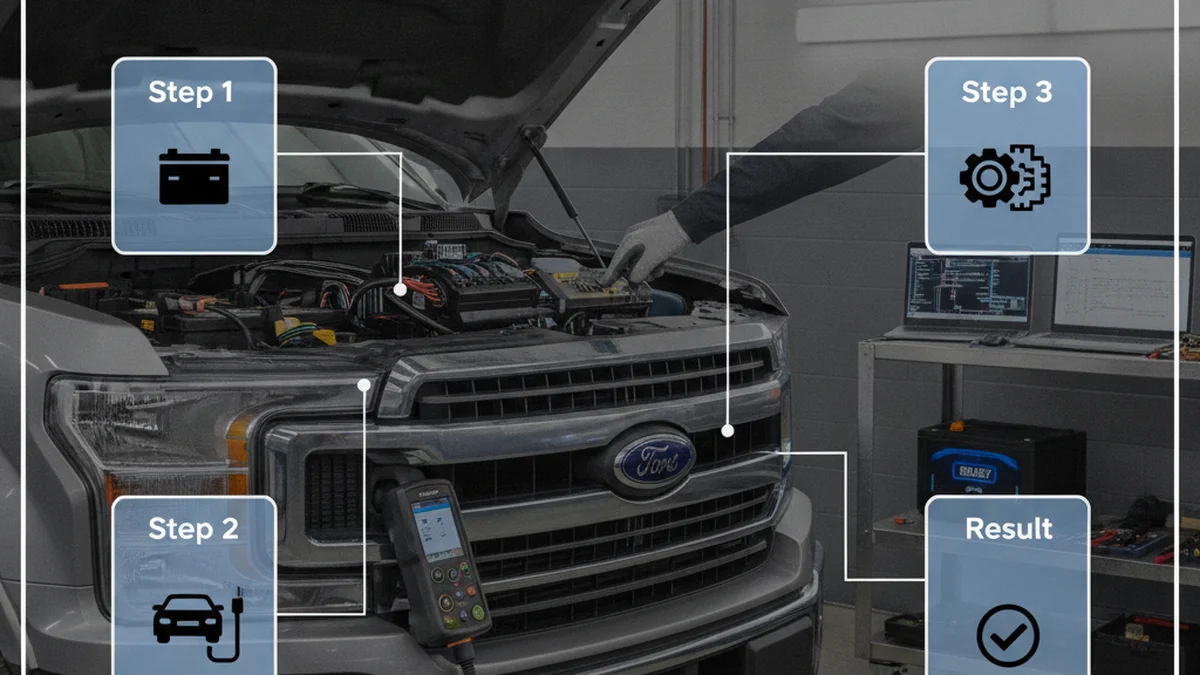
If the pedal method does not resolve your shifting issues, the 2026 model’s deep-level adaptive tables require an OBDII interface, such as an ELM327 adapter paired with the FORScan software. This is the professional standard for F-150 diagnostics outside the dealership environment. Once connected to your truck’s OBDII port:
- Open the FORScan application and connect to the TCM module (listed under the service procedures tab).
- Select the “Reset Transmission Adaptive Learning” or “Clear Transmission Shift Tables” function.
- Follow the on-screen prompts to cycle the ignition key as requested by the software.
- Confirm the “Procedure Successful” message before disconnecting the device.
- Always perform the subsequent “re-learn” drive in a safe, flat environment, cycling through every gear range at various throttle positions to rebuild the transmission logic correctly.
Professional Tools: Using FORScan for TCM Calibration
Recommended Best Deal Products


While the manual reset procedure often resolves minor electronic glitches, deeper transmission calibration requires the FORScan diagnostic software. As of 2026, many F150 owners utilize this OBD-II interface to perform a “TCM Adaptive Learning Reset,” which clears the long-term fuel and shift trim data stored in the PCM/TCM memory banks.
Step-by-Step Calibration Procedure
- Connect a high-quality OBD-II adapter, such as the OBDLink EX, to your 2026 F150 diagnostic port.
- Launch the FORScan software on your Windows device and establish a stable connection with the vehicle’s network.
- Navigate to the “Service Functions” tab, which is marked by the wrench icon in the application menu.
- Select “TCM Adaptive Learning Reset” from the available module options and initiate the command.
- Follow the on-screen prompts exactly, which usually require the ignition to be in the “On” position without the engine running.
- Cycle the ignition key to the “Off” position for 30 seconds after the process completes to allow the module to write the new configuration data.
This process forces the transmission to enter a “relearn” mode. You must drive the truck for approximately 20 to 50 miles in varying traffic conditions after the reset. This allows the TCM to map the clutch pressure and shift points based on current hardware wear rather than obsolete data.
What If It Still Doesn’t Work?
If software resets and battery disconnects fail to resolve harsh shifting or gear slippage, the issue likely resides in physical hardware rather than logic. Persistent faults often point to internal valve body degradation or solenoid failure.

- Inspect the transmission fluid level and quality. Burnt-smelling fluid suggests internal clutch pack damage that a reset cannot repair.
- Check the lead frame connector. If diagnostic codes P0720 or P0722 appear, the lead frame is likely faulty, a known issue that persists in high-mileage 2026 F150 models.
- Consult a certified Ford technician for a comprehensive load test on the TCM itself.
- If the module is defective, a replacement and programming session at a dealership typically ranges from $800 to $1,400 depending on your region.
Seek professional assistance if the “wrench” light remains illuminated after all software resets. Attempting to drive with severe mechanical transmission issues risks catastrophic failure of the planetary gear sets, which could triple your repair costs.
Conclusion
Effective TCM management is vital for the longevity of your 2026 F150 drivetrain. According to verified research and expert sources from the 2026 Ford service manual, most shifting irregularities stem from corrupted adaptive memory or minor communication lag. By performing a systematic reset, you restore factory efficiency to the shift logic. For an immediate next step, verify your diagnostic trouble codes with an OBD-II scanner to ensure no hidden mechanical damage exists before finalizing your repair plan.
💬 Quick Questions & Answers
Can I reset the TCM by disconnecting the battery?
Yes, disconnecting the negative battery terminal for 15 minutes can perform a ‘hard’ reset of temporary adaptive memory.
Does a reset delete my truck’s factory software?
No, it only clears the ‘learned’ adaptive shift tables, not the core operating firmware.
Will a reset fix mechanical slipping?
No, a TCM reset only addresses software or sensor-based shift logic, not physical transmission damage.
How long does the truck need to relearn after a reset?
Typically, you should perform a diverse drive cycle of at least 20 to 50 miles to allow the TCM to rebuild its shift strategies.
Is a dealership visit required for a reset?
Not always; many F-150 owners perform this using an OBDII adapter and the FORScan software at home.
❓ Frequently Asked Questions
What is the difference between a hard reset and a KAM reset?
A hard reset via battery disconnection clears volatile memory across multiple modules. A KAM (Keep Alive Memory) reset specifically targets the transmission’s adaptive tables using diagnostic software.
Why does my F-150 shift roughly after a reset?
Immediately after a reset, the TCM lacks adaptive data and must rebuild its shift timing; it usually smooths out after a few dozen miles of driving.
Can I use a standard OBDII scanner to reset the TCM?
Most standard scanners only read and clear engine codes. You typically need an ELM327 adapter combined with FORScan to access the transmission module settings.
Are there specific pedal inputs to reset the TCM?
While pedal sequences exist for throttle body relearning, they generally do not reset the complex transmission adaptive tables; software intervention is the proven method.
How often should I reset my TCM?
You should only reset the TCM if you are experiencing persistent shift quality issues or after performing major transmission service like a fluid flush.
What if the transmission warning light stays on?
If the warning light remains after a reset, you likely have a physical sensor failure or a fluid pressure issue requiring a professional diagnostic check.