
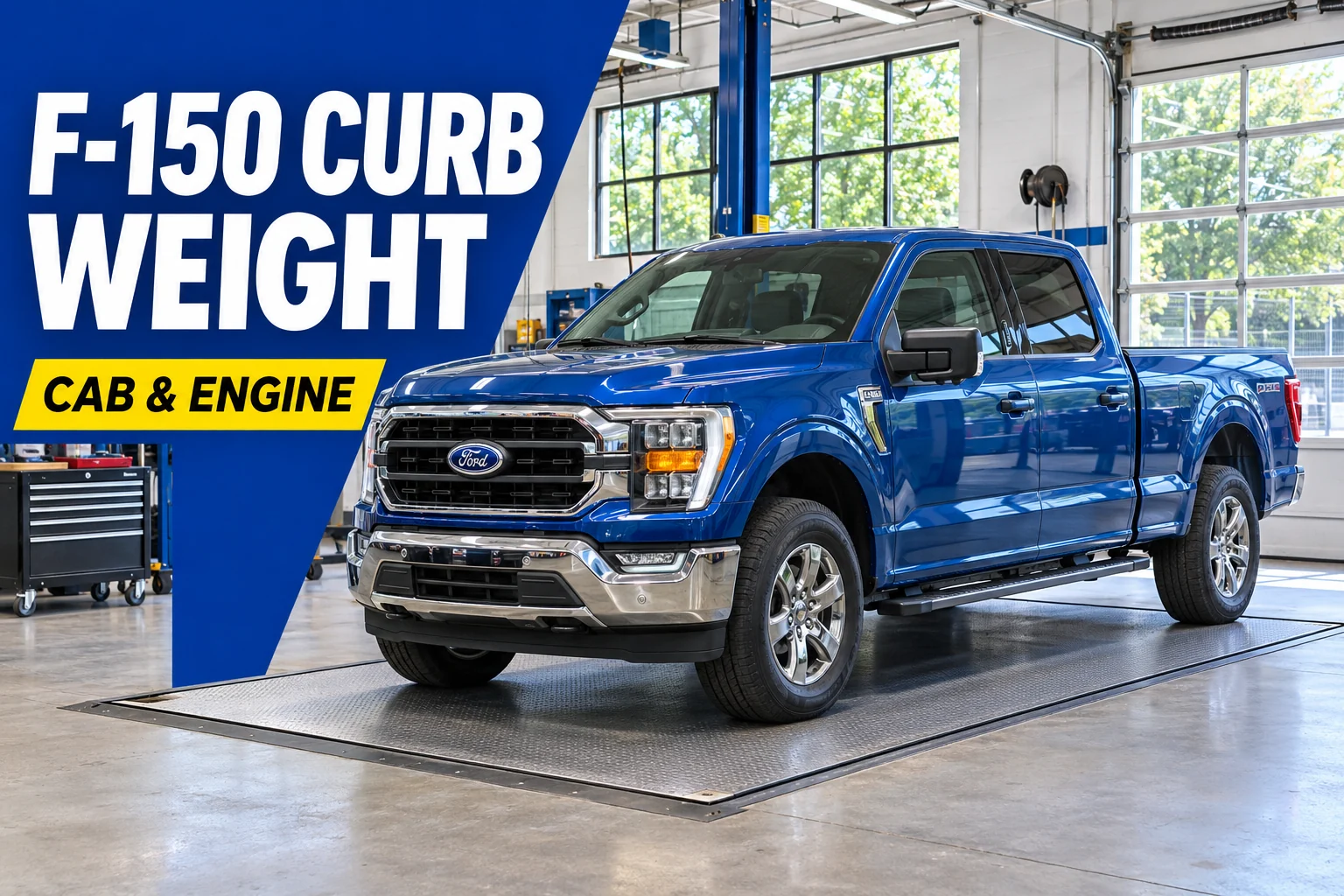
Ford F-150 Curb Weight Chart by Cab, Engine, and Drivetrain

Ford lists a 2021 F-150 Regular Cab 4×2 with the 3.3L V6 and the 6.5-foot bed at 4,021 lb. A 2021 F-150 SuperCrew 4×4 with the 3.5L PowerBoost hybrid and the 6.5-foot bed comes in at 5,540 lb in the same Ford specification sheet. The 1,519-lb spread compares two different configurations. Use the chart to match your model year, cab, bed or wheelbase, engine, and drivetrain before using a published figure.
This guide compares selected 2014 and 2021 U.S. F-150 base curb weights that Ford published with enough detail to identify the truck. It also shows how to check the weight of a particular used or modified truck when the factory figure cannot answer your question. Each value is in pounds.


Ford F-150 Curb Weight Chart
| Model year | Cab | Bed or wheelbase | Engine | 4×2 | 4×4 |
|---|---|---|---|---|---|
| 2014 | Regular Cab | 126-in. wheelbase | 5.0L V8 | 4,791 | 5,033 |
| 2014 | Regular Cab | 145-in. wheelbase | 5.0L V8 | 4,901 | 5,130 |
| 2014 | SuperCab | 145-in. wheelbase | 5.0L V8 | 5,169 | 5,461 |
| 2014 | SuperCrew | 145-in. wheelbase | 5.0L V8 | 5,254 | 5,586 |
| 2014 | SuperCrew | 157-in. wheelbase | 5.0L V8 | 5,345 | 5,716 |
| 2021 | Regular Cab | 6.5-ft bed | 3.3L V6 | 4,021 | 4,275 |
| 2021 | Regular Cab | 6.5-ft bed | 5.0L V8 | 4,300 | 4,564 |
| 2021 | Regular Cab | 8.0-ft bed | 5.0L V8 | 4,396 | 4,650 |
| 2021 | SuperCab | 6.5-ft bed | 5.0L V8 | 4,554 | 4,810 |
| 2021 | SuperCrew | 5.5-ft bed | 5.0L V8 | 4,661 | 4,912 |
| 2021 | SuperCrew | 5.5-ft bed | 3.5L EcoBoost V6 | 4,696 | 4,948 |
| 2021 | SuperCrew | 5.5-ft bed | 3.5L PowerBoost hybrid | 5,260 | 5,517 |
| 2021 | SuperCrew | 6.5-ft bed | 3.5L PowerBoost hybrid | 5,228 | 5,540 |
Factory base weights from Ford’s technical specifications. Use a scale for the weight of your particular truck.
The 2014 figures come from the base curb weight rows of Ford’s 2014 F-150 technical specifications. The 2021 figures use Ford’s 2021 F-150 technical specifications. The chart follows each source’s identifying dimension: wheelbase for the 2014 rows and bed length for the 2021 rows. The figures describe published base configurations, with equipment differences possible on individual trucks.
What Ford Includes in Base Curb Weight


In Ford’s RV and Trailer Towing Guide, base curb weight includes standard equipment and a full fuel tank. Passengers, cargo, and optional equipment sit outside that base definition. The figure gives you a reference for comparing configurations under a common definition.
Think about what a previous owner can change without changing the truck’s model name. A camper shell, bed drawer system, steel bumper, winch, or permanent toolbox all travel with the truck. They count in its actual scale weight. The same principle applies to ordinary removable gear, such as recovery equipment or tools. When you want a repeatable empty-truck reading, decide which items are permanently installed and which should come out before weighing.
The published figure can still be useful before you buy a truck. It tells you how much Ford reported for the relevant base configuration and helps you identify whether a seller’s estimate even refers to the correct truck. Once you need the actual weight for transport, equipment selection, or load planning, weigh the vehicle in the condition that matters for that decision. Record fuel level and the equipment carried alongside the reading.
How Much Do Cab, Bed, and Drivetrain Change the Number?

Compare the two drivetrains within one row
The 2021 5.0L Regular Cab with a 6.5-foot bed is listed at 4,300 lb in 4×2 and 4,564 lb in 4×4, a 264-lb difference between the published configurations. The corresponding SuperCrew 5.0L with a 5.5-foot bed shows 4,661 lb and 4,912 lb, a 251-lb difference. These calculations subtract the 4×2 figure from the 4×4 figure in each row. Use the exact comparison that matches the truck instead of adding a universal 4×4 allowance.
The same approach works for the 2014 table. On the 5.0L SuperCrew with the 145-inch wheelbase, Ford lists 5,254 lb in 4×2 and 5,586 lb in 4×4. That is a 332-lb difference for that pair. It illustrates why a 4×4 correction borrowed from a different generation or body can give the wrong estimate.
Match the cab and the bed independently

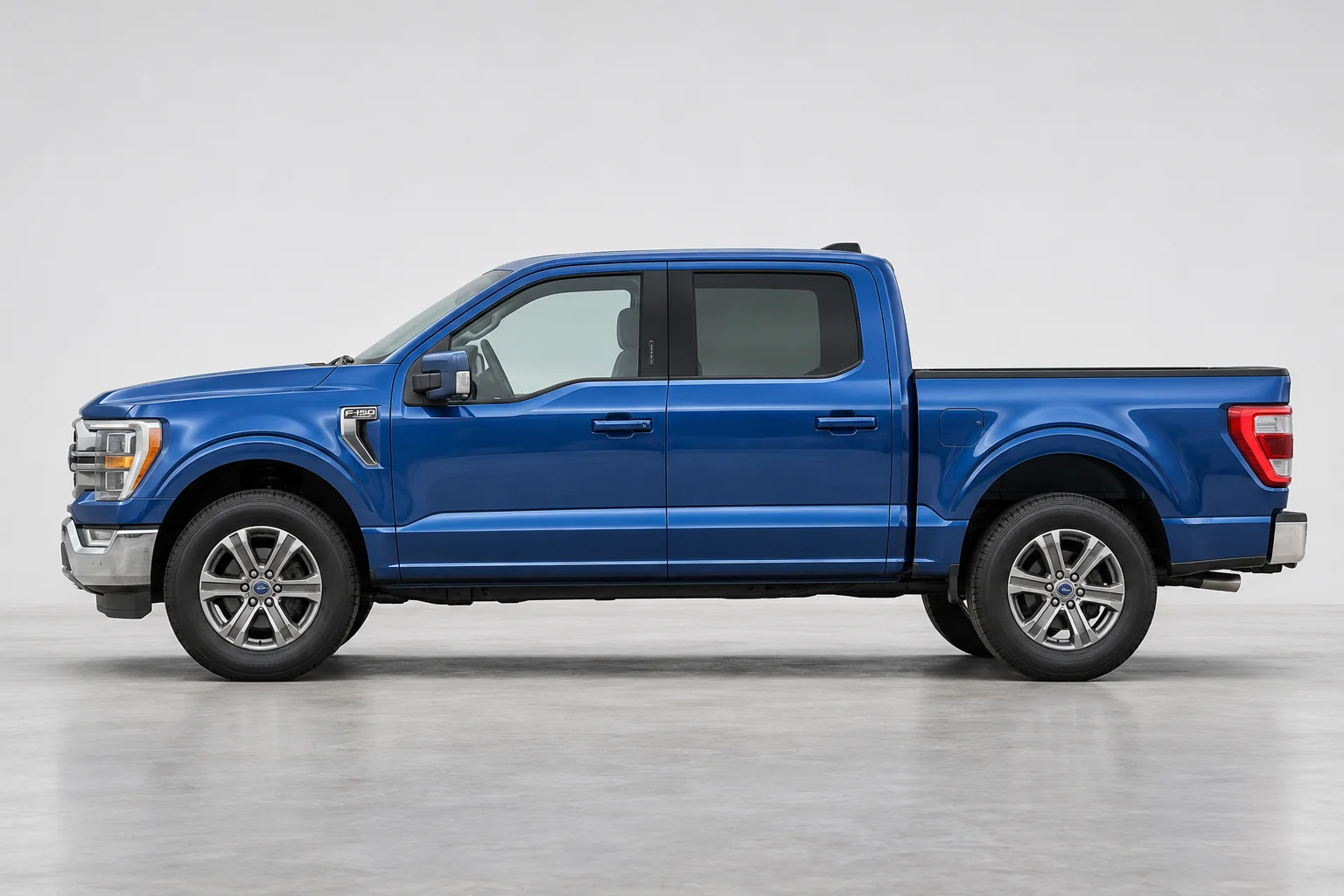
The cab describes passenger space and the bed describes the cargo box. Both affect which row you read. Two SuperCrew trucks can have different bed lengths, and a bed length alone cannot identify the cab. When the table uses wheelbase, use the distance between the centers of the front and rear axles. A measurement of the whole truck from bumper to bumper answers a different question.


Ford’s 2021 5.0L Regular Cab figures show what happens when you change bed length in a close comparison. The 4×2 entry rises from 4,300 lb for the 6.5-foot bed to 4,396 lb for the 8.0-foot bed, a 96-lb difference in the published figures. Compare the engine and drivetrain at the same time. A different truck that happens to have the longer bed may also carry other differences that prevent a simple bed-only estimate.


For 2014, compare the V8 SuperCab and SuperCrew rows at 145 inches with the same drivetrain. The 4×2 SuperCrew is listed at 5,254 lb and the 4×2 SuperCab at 5,169 lb, an 85-lb difference in two Ford configurations with the same wheelbase. Equal wheelbase is enough to align the columns for that comparison. You still need the cab to locate the exact figure.
Confirm EcoBoost and PowerBoost by name
Both of these 2021 powertrains have a 3.5L V6 designation. The sales listing or registration may stop at that displacement, but the curb-weight rows differ. In the 2021 SuperCrew 4×4 with a 5.5-foot bed, Ford lists 4,948 lb for the 3.5L EcoBoost and 5,517 lb for the PowerBoost hybrid. Subtracting the first from the second gives 569 lb between those base configurations. That calculation compares two whole trucks in Ford’s table. It cannot isolate the weight of a battery, engine, or individual component.
For used listings, ask for a build record or original window sticker if the engine branding is unclear. If you use a Ford dealer to identify the configuration, give the VIN and ask for the powertrain and original cab and box combination. Check any equipment added after delivery separately. A build record describes the factory configuration, which may no longer match everything on a particular truck.


How to Find the Weight of Your F-150
- Confirm the model year. Start with the VIN and vehicle records. A truck purchased late in one calendar year can belong to the next model year.
- Identify the cab and bed or wheelbase. Use the factory configuration records where possible. If you measure, match the dimension named by the table. Record the exact value before selecting a column.
- Confirm the engine and drivetrain. Find the complete engine name and whether the truck is 4×2 or 4×4. Two similar badges or listings with the same displacement can lead to different rows.
- Read the matching Ford table. Find the section headed base curb weight in the source for that year. Check every row label and column heading. A dash or blank leaves you without a usable published figure for that cell.
- Weigh the truck if you need a vehicle-specific result. Document fuel level, occupants, cargo, and installed accessories. Use the same condition if you reweigh the truck later to measure a change.
An owner comparing two trucks for purchase should record both configurations side by side. That makes it easier to see whether a weight difference accompanies a change in engine, four-wheel drive, or body. A person arranging a flatbed or transport has a different decision. Tell the operator about installed equipment and use the measured vehicle weight if a capacity decision depends on it.
For a model year outside this chart, start with the applicable Ford technical specifications or ask a Ford dealer for the configuration-specific base figure. A model-wide sales page may provide tow ratings or dimensions without a base curb weight table. Those fields cannot fill the missing weight entry. The source should identify the correct year and configuration before the number goes into your records.
Curb Weight, GVWR, and Payload
| Term | What the figure represents | Where to look |
|---|---|---|
| Base curb weight | Ford’s reference for the truck with standard equipment and a full fuel tank | Model-year technical specs or a Ford dealer |
| Actual scale weight | What the truck and everything aboard weigh at the time | A suitable vehicle scale |
| GVWR | The maximum loaded vehicle weight specified for the truck | Safety Compliance Certification Label |
| GAWR | The front or rear axle weight rating | Certification label and applicable Ford documentation |
| Occupant and cargo limit | The combined limit printed for that particular truck | Tire and Loading Information label |
A base weight chart is useful for comparing trucks. Load decisions depend on the specific vehicle’s labels and the weight it will carry. Read the occupant-and-cargo statement and certification label before loading. Include people, tools, and added equipment in the load assessment. When towing, include the actual tongue or pin weight the trailer puts on the truck. Use Ford’s towing and weight guidance and the applicable model-year manual to check the truck, axle, hitch, and trailer limits.
For a simple illustration, a truck with a hypothetical 7,000-lb GVWR and a measured 5,300-lb weight has a 1,700-lb difference below GVWR in that condition. If four people and cargo add 800 lb, the arithmetic difference below GVWR falls to 900 lb. These are teaching numbers. A separate front or rear axle limit, the labeled occupant and cargo capacity, or another applicable rating can call for a lower load. An axle-by-axle weighing of the truck as loaded can identify a problem that a whole-vehicle number hides.
Watch for double counting when you start with a scale ticket. If the driver or permanently installed equipment was on the truck when it was weighed, that weight already appears in the ticket. Add only the load that was still missing from the weighing condition when you do the comparison. If you use a sticker limit as your starting point, follow the applicable instructions for accounting for installed equipment and added loads.
When a Scale Reading Is More Useful Than the Chart
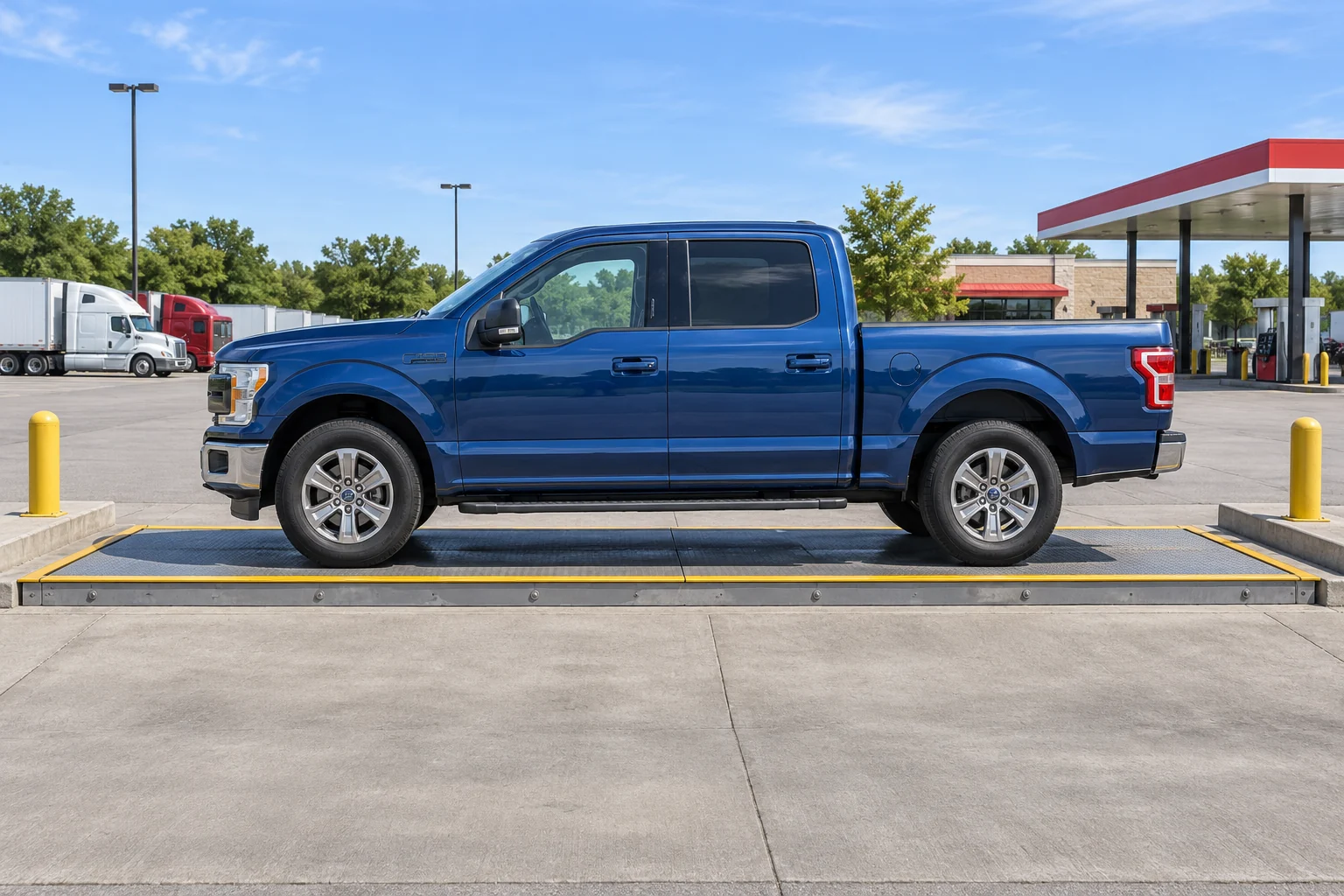
Use a scale when your truck has unknown options, extensive modifications, or a permanent load. The weight of a contractor’s truck can differ from a factory reference even after the driver clears out removable gear. A lifted truck may have larger wheels and tires, changed suspension components, and added protection. A vehicle carrying a slide-in camper has additional weight that needs to be checked against its equipment and axle ratings in the intended travel condition.
First decide whether you want an empty-truck baseline, the regular work setup, or the planned loaded combination. A ticket for the empty truck cannot show the axle loads after a camper or trailer is attached. If the question involves actual travel loads, measure the relevant loaded setup and compare the readings with the applicable ratings. Preserve the date and setup on the scale ticket so you can reproduce the measurement.
A scale also helps when a brochure-derived estimate and a dealer listing seem inconsistent. Before assuming either source is wrong, compare the names of the weight fields. The dealer listing might give GVWR, the chart might give base curb weight, and a scale ticket might show a truck carrying equipment. They can all describe the same truck in different terms or conditions.
Two Examples of How to Use the Chart
You are comparing two used listings. One listing says “2021 F-150 5.0 4WD” and gives a weight, while a second listing describes a SuperCab. Ask both sellers for the cab and bed. If the first truck is the 6.5-foot-bed Regular Cab and the second is the 6.5-foot-bed SuperCab, the matching 4×4 references are 4,564 lb and 4,810 lb, respectively. The 246-lb difference comes from the two matching Ford entries. This is a comparison of the published configurations. A bed liner, hitch, or dealer-installed equipment could change the measured difference between the actual trucks.
Your paperwork gives the wheelbase but your Ford table uses bed size. Start with the cab and model year, then check the Ford F-150 wheelbase chart to identify which box goes with that combination. Once you have both fields, return to the appropriate Ford weight table and select the engine and drivetrain. Writing down all the inputs makes the lookup repeatable. It also helps you pass a traceable estimate to a commercial transport company, repair shop, or prospective buyer. If the two sources use different dimensions or one listing omits a field, get the underlying configuration before assigning a number.
Frequently Asked Questions
How much does a Ford F-150 weigh empty?


It depends on the model year and configuration. In the 2021 sheet, the selected 3.3L Regular Cab 4×2 is listed at 4,021 lb and the 6.5-foot-bed PowerBoost SuperCrew 4×4 at 5,540 lb. Use the configuration matching your truck. For a specific empty-truck measurement, put the truck on a suitable scale and document its fuel and equipment condition.
Does the weight on the driver’s door label tell me curb weight?
Check the label heading. The certification label provides ratings such as GVWR and axle ratings. The tire and loading label gives the combined occupant and cargo limit. Use a matching Ford specification for base curb weight or a scale for your truck’s actual weight.
Do all F-150 SuperCrew trucks have the same curb weight?


The SuperCrew cab is only one lookup field. The engine, drivetrain, bed, model year, and equipment matter. For example, the 2021 short-bed 4×4 SuperCrew figures differ between the EcoBoost and PowerBoost configurations even when both engines are described as 3.5L V6s.
Can I get an exact curb weight from the VIN alone?
The VIN helps identify the truck and lets Ford or a dealer look up factory records. It cannot describe later modifications or what is carried in the truck today. Use build information to select the matching base specification, and weigh the truck when you need its actual weight.