Ford 4.6 Triton Firing Order and Cylinder Diagram Explained 2026

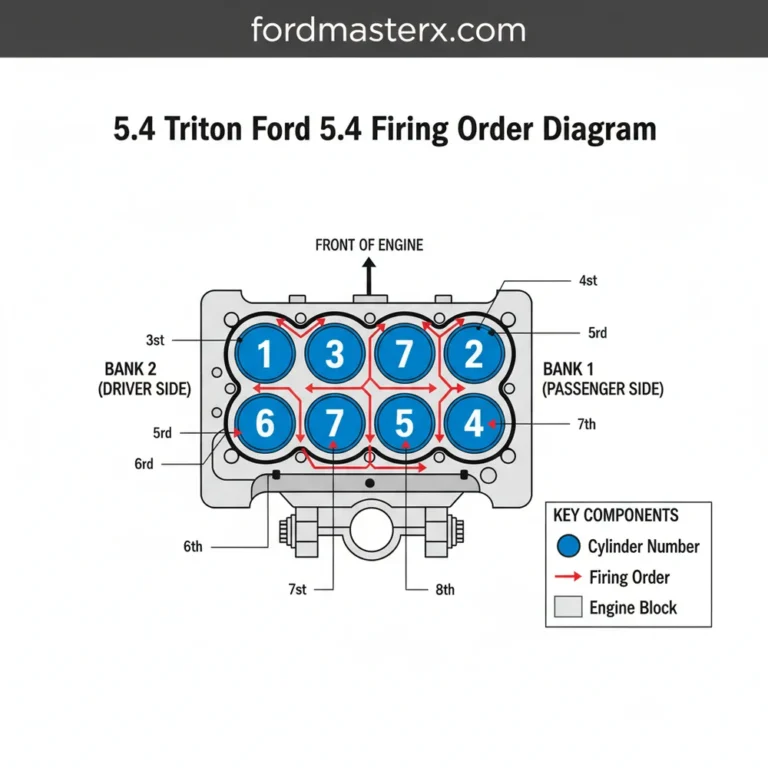
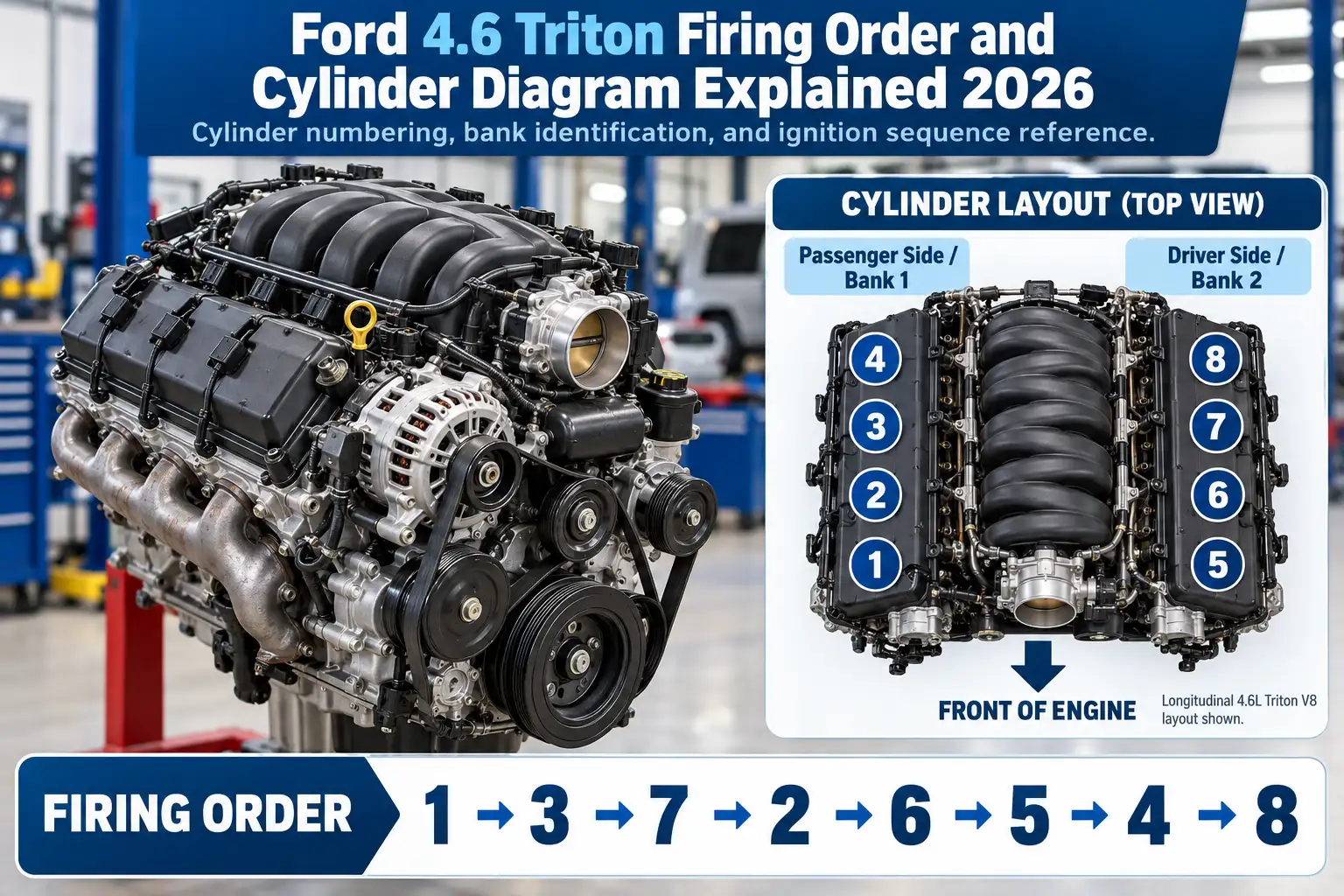
The Ford 4.6 Triton firing order is 1-3-7-2-6-5-4-8. On a longitudinal Ford F-150 4.6L V8, cylinders 1 through 4 run from front to rear on the passenger side, while cylinders 5 through 8 run from front to rear on the driver side.
Ford documents that sequence for both 2-valve and 3-valve F-150 configurations. Before checking a misfire or reconnecting plug wires, determine whether your engine has coil packs or individual coils.
Longitudinal Ford F-150 engine • Top-down reference
- 1st1
- 2nd3
- 3rd7
- 4th2
- 5th6
- 6th5
- 7th4
- 8th8
What Is the Ford 4.6 Triton Firing Order
Recommended Best Deal Products


The eight cylinders fire in this sequence:
1 → 3 → 7 → 2 → 6 → 5 → 4 → 8
Ford lists this order in its 2002 F-150 Owner’s Guide, page 301. The same sequence appears for both 4.6L versions in the 2009 and 2010 F-150 specifications.
Firing order is not cylinder numbering. Firing order describes the sequence of combustion events. Cylinder numbering identifies each cylinder’s physical position. Neither one, by itself, tells you which tower on an older coil pack should connect to a particular spark plug.
Use the cylinder map to locate components correctly.
What to Confirm Before Using a 4.6L Diagram
This layout applies to the longitudinal Ford F-150 4.6L Modular V8. Confirm the model year before using it.
You should also check three details:
- Engine identity: Confirm that the truck has the 4.6L V8, not a 5.4L or another engine.
- Viewing direction: Identify the radiator at the front and firewall at the rear. Driver and passenger sides are named as if you are seated in the truck facing forward.
- Ignition hardware: Look for plug wires leading from coil packs or individual coils positioned over the spark plugs.
Make these visual checks with the engine off and cool.
Step 1 Locate Cylinder One on Your Ford 4.6L
Cylinder 1 is the front cylinder on the passenger-side bank. In a US-market F-150, that is the right-hand side of the truck when viewed from the driver’s seat, not necessarily the right side of your view while standing at the front bumper.
- Stand at the front of the truck and find the radiator and accessory-drive end of the engine.
- Locate the passenger-side cylinder bank. The cylinder closest to the radiator on that bank is number 1.
The next cylinders behind it, moving toward the firewall, are 2, 3, and 4. Across the engine, cylinder 5 is the front cylinder on the driver side.
If you need a broader reference for nearby engine components, the Ford 4.6 Triton engine diagram covers the engine’s major systems. For cylinder identification, use the numbered map below.
Step 2 Map Both Ford 4.6L Cylinder Banks
Ford numbers each bank from front to rear. Bank 1 contains cylinder 1; Bank 2 is opposite.
Ford F-150 4.6L V8 cylinder-numbering diagram:
| Passenger Side · Bank 1 | Driver Side · Bank 2 |
|---|---|
| 4 · Rear, near firewall | 8 · Rear, near firewall |
| 3 | 7 |
| 2 | 6 |
| 1 · Front, near radiator | 5 · Front, near radiator |
Top-down reference for a longitudinal F-150 engine. The bottom row is closest to the radiator. This is a cylinder-position map, not a coil-pack wiring diagram.
Passenger Side Cylinders
The passenger bank contains cylinders 1, 2, 3, and 4. Number 1 is at the front; number 4 is nearest the firewall. A cylinder 3 misfire points to the third cylinder back on this bank.
Driver Side Cylinders
The driver bank contains cylinders 5, 6, 7, and 8. Number 5 is at the front; number 8 is nearest the firewall. Cylinder 7 is third from the front.
Always distinguish cylinder position from firing sequence.
Step 3 Check 2V and 3V Engine Variants
The documented Ford 4.6L 2V and 3V engines use the same 1-3-7-2-6-5-4-8 firing order. Valve count does not change the cylinder numbering shown above.
Ford’s 2009 F-150 Owner’s Guide, page 397, lists both variants side by side. It also identifies both as coil-on-plug engines.
| F-150 Reference | 4.6L Configuration | Firing Order | Documented Ignition |
|---|---|---|---|
| 1997 | SOHC 4.6L V8 | 1-3-7-2-6-5-4-8 | EDIS coil packs and plug wires |
| 2002 | 4.6L V8 | 1-3-7-2-6-5-4-8 | Coil on plug |
| 2009 | 4.6L 2V and 3V | 1-3-7-2-6-5-4-8 | Coil on plug |
| 2010 | 4.6L 2V and 3V | 1-3-7-2-6-5-4-8 | Coil on plug |
These are verified example years, not a complete ignition-fitment chart. Check your truck before following a wiring diagram.
The 2009 Ford manual also lists different spark plug gaps: 0.052–0.056 inch for the 4.6L 2V and 0.039–0.043 inch for the 4.6L 3V. Those gap specifications do not change the firing order. Use engine-specific plug specifications.
Step 4 Identify Ford 4.6L Coil Pack or COP Ignition
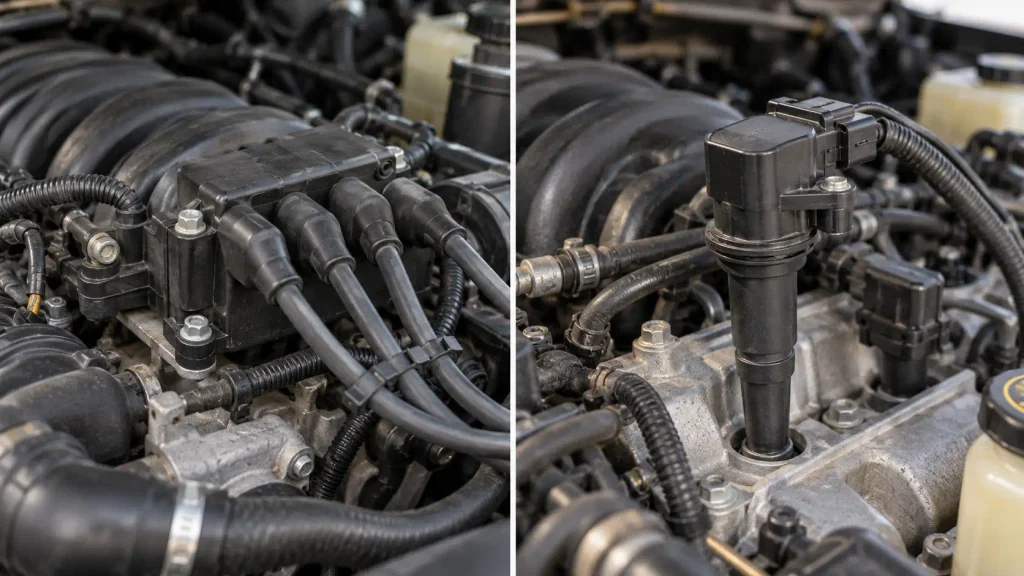
The ignition hardware changes how spark reaches each plug. Identify it before touching wiring.
Coil Pack Ignition
The 1997 F-150 4.6L used an electronic distributorless ignition system, or EDIS, with coil packs and spark plug wires. The wires carry high voltage to the plugs.
The 1997 F-150 ignition-system service description identifies these components. Use the correct coil-terminal drawing to trace its wires.
Do not connect wires to coil-pack towers in simple firing-order sequence. Tower position and paired-coil connections must match the installed ignition system. For additional model-specific context, FordMasterX also has a 1997 F-150 4.6 firing order guide.
Coil on Plug Ignition
Ford’s 2002 F-150 manual lists coil-on-plug ignition for the 4.6L V8, as do the 2009 and 2010 manuals. With this system, each spark plug has its own coil, so there is no conventional coil-pack-to-plug wire routing to arrange.
Match the trouble code to a cylinder, then inspect its coil connector, boot, and plug using the proper procedure. Choose replacement parts by engine and model year, not firing order alone.
Neither ignition configuration should be tested by pulling live wires or touching exposed ignition connections while the engine is running.
How Ford 4.6L Misfire Codes Identify Cylinders
A cylinder-specific misfire code points to a physical cylinder number, not its position in the firing sequence. For example, P0302 means a misfire was detected on cylinder 2, which is second from the front on the passenger-side bank. P0307 identifies cylinder 7, third from the front on the driver side.
Ford’s OBD misfire-monitor documentation identifies these standard codes:
| Diagnostic Code | Meaning |
|---|---|
| P0300 | Random or multiple-cylinder misfire detected |
| P0301–P0304 | Misfire detected on cylinder 1, 2, 3, or 4 respectively |
| P0305–P0308 | Misfire detected on cylinder 5, 6, 7, or 8 respectively |
Use the code and map to locate the fault. Causes can include a plug, coil, injector, air leak, or mechanical problem. A P030x code alone does not prove the ignition coil is faulty.
Record stored codes and freeze-frame data before clearing anything. Diagnose the affected cylinder systematically. If a plug needs replacement, compare engine-specific options in our Ford 4.6 spark plug buying guide. If the check-engine light is flashing, avoid hard acceleration and arrange prompt service; Ford warns that severe misfiring can damage the catalytic converter.
4 Ford 4.6L Firing Order Mistakes to Avoid
Reversing the Engine Banks
The passenger bank is on the vehicle’s right, not necessarily the diagram’s right. Check orientation before locating cylinder 1.
Confusing Sequence With Position
Cylinder 7 fires third but sits third from the front on the driver bank. For P0307, use physical cylinder numbering.
Assuming Every Truck Uses Plug Wires
A 1997 coil-pack diagram does not route wiring on a 2002 or 2009 coil-on-plug truck. Inspect the actual hardware.
Replacing Parts From Codes Alone
A P030x code identifies a misfiring cylinder, not a failed part. Test before replacing coils or injectors.
3 Checks Before Working on Ford 4.6L Ignition Parts
Before removing a plug, coil, or wire, complete these checks:
- Verify the engine. Confirm the model year and that the truck has a 4.6L V8. Check whether you have a 2V or 3V version when selecting service specifications.
- Identify the cylinder and ignition type. Find the radiator-facing end, locate the correct bank, and determine whether you are working with coil packs and wires or individual coils.
- Use the matching service procedure. Check the factory wiring reference, plug specification, and required safety steps for the exact engine. Leave advanced electrical or mechanical testing to a qualified technician if you lack the tools or procedure.
These checks make the firing-order diagram useful without guessing at replacement parts.
Use the Correct Ford 4.6L Firing Order
The Ford 4.6 Triton firing order is 1-3-7-2-6-5-4-8, and the longitudinal F-150 cylinder layout places 1–4 on the passenger side and 5–8 on the driver side, numbered front to rear. Both 2V and 3V configurations in Ford’s documented F-150 specifications share that sequence.
The important distinction is the ignition system. An early coil-pack truck has spark plug wires that require the correct terminal routing, while a coil-on-plug truck places an individual coil over each plug. The firing-order numbers do not replace either service diagram.
Before diagnosing a misfire or servicing ignition components, identify the cylinder, verify the exact model-year configuration, and follow Ford’s corresponding repair instructions.
Ford 4.6L Triton Firing Order FAQs
What Is the Firing Order on a Ford 4.6 Triton?
The Ford 4.6L Triton or Modular V8 fires in the order 1-3-7-2-6-5-4-8. Ford documents this order for the 4.6L F-150 engine in the 2002 owner’s guide and for both 2V and 3V versions in the 2009 and 2010 manuals. The numbers describe combustion sequence, not coil terminals.
Where Is Cylinder One on a Ford 4.6 V8?
Cylinder 1 sits at the front of the passenger-side bank on a longitudinal Ford F-150 4.6L V8. Cylinders 2, 3, and 4 follow it toward the firewall. On the driver side, cylinders 5 through 8 also run front to rear, beginning with cylinder 5 nearest the radiator.
Do Ford 4.6L 2V and 3V Engines Have the Same Firing Order?
Yes. The 2009 and 2010 Ford F-150 owner manuals list 1-3-7-2-6-5-4-8 for both 4.6L 2V and 3V engines. Their spark plug specifications differ, however, so use the correct engine-specific maintenance information rather than assuming that identical firing orders mean identical parts or service settings.
Does a Ford 4.6L Have Coil Packs or Coil on Plug?
It depends on the specific application and model year. The 1997 F-150 4.6L service reference shows distributorless coil-pack ignition with spark plug wires, while Ford’s 2002, 2009, and 2010 F-150 manuals identify coil-on-plug systems. Check the components installed on your engine before using a wiring or replacement guide.
Is the Ford 4.6 Firing Order the Same as the 5.4 Triton?
Yes. Ford’s 2009 F-150 engine-data table lists 1-3-7-2-6-5-4-8 for the 4.6L 2V, 4.6L 3V, and 5.4L V8 engines. Cylinder location and ignition-component details should still be checked against the specific engine. See the separate Ford 5.4 Triton firing order diagram when working on a 5.4L truck.