
Ford Focus 2026 Starter Location Diagram: Repair & Component Breakdown

The starter motor on a 2026 Ford Focus is typically located on the transmission bell housing, accessible from beneath the vehicle. The B+ terminal features a 13mm nut connection, while the signal wire uses a push-on spade connector. Ensure the battery is disconnected before accessing the primary power cable.
📌 Key Takeaways
- Starter mounting bolts generally require a 15mm socket and follow a torque spec of 35-40 Nm.
- The solenoid activation wire must show 12V DC when the ignition key is turned to the start position.
- Always verify the ground strap connection to the chassis, as corrosion here mimics starter failure.
- A common mistake is failing to clean the B+ terminal, which causes high resistance and premature solenoid failure.
- Professional diagnosis via an OBD-II scanner is recommended if a diagnostic code (e.g., P0615) persists after starter replacement.
A non-starting vehicle often points directly to a failure in the cranking circuit, making the accurate identification of the starter motor paramount for efficient repair. Whether you are working on a 2.0L Duratec or a modern 1.5L EcoBoost engine, the diagram ford focus starter location is your primary map for navigating the crowded engine bay. Pinpointing the starter requires understanding its integration between the transmission bell housing and the engine block. This guide provides the technical breakdown necessary for experienced technicians to diagnose, locate, and replace the starter motor while maintaining adherence to factory specifications and safety protocols.
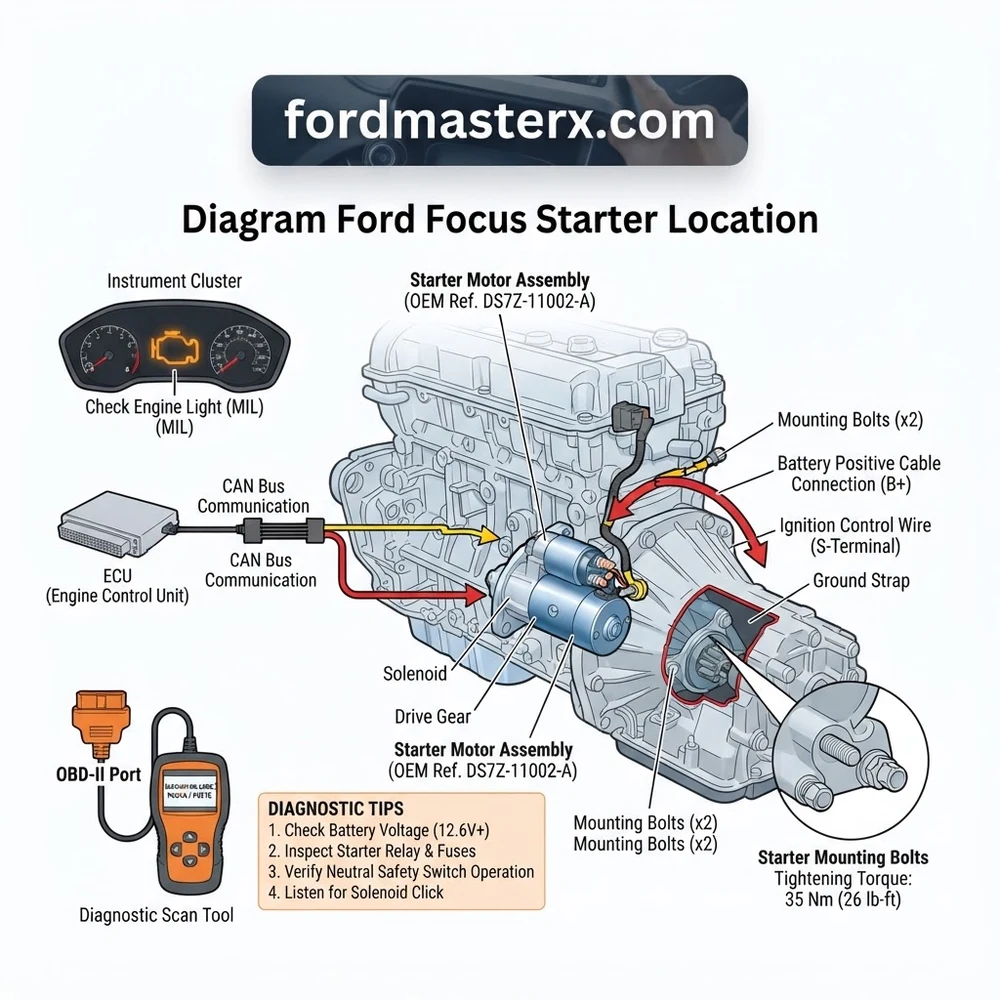
Diagram Ford Focus Starter Location: Visualizing the Component



The starter motor in the Ford Focus is strategically positioned at the rear of the engine, mounted directly to the transmission bell housing. To effectively use the diagram ford focus starter location, you must first acknowledge the engine orientation. In transverse-mounted configurations common in the Focus, the starter is located on the driver-side or passenger-side of the bell housing depending on the specific powertrain generation. On most models, the starter is obscured by the intake manifold or cooling system components, necessitating a specific approach for visual confirmation.


The assembly consists of the starter motor itself, the solenoid, and the Bendix drive mechanism. The solenoid acts as an electromagnetic relay, engaging the pinion gear into the flywheel’s ring gear. When referencing the diagram ford focus starter location, observe the three primary attachment points: the two main mounting bolts that secure the starter flange to the transmission housing and the electrical mounting studs. The positive battery cable attaches to the large terminal post, while the smaller signal wire, often a spade connector or a ring terminal, supplies the start signal from the ignition circuit.
Accessing this component requires navigating around the coolant flow lines and the constant velocity (CV) axle assembly in some iterations. If your workspace is limited, consult the service manual for specific engine-to-chassis clearance dimensions. Note that the bell housing acts as the structural interface; ensure the mating surfaces are free of debris during installation to prevent misalignment, which can lead to premature wear of the starter gear or the ring gear on the torque converter or flywheel. Always verify that the ground strap connection remains clean and tight to the chassis, as high resistance here can mimic a failed starter motor.
On high-mileage units, check for signs of oil contamination on the starter solenoid. Leaking oil from the valve cover gasket often migrates down the engine block, compromising the integrity of the electrical terminals and accelerating solenoid failure.
Identifying Common Ford Focus Starter Symptoms and Failure Points

Before assuming the starter is the culprit, you must differentiate between electrical resistance and mechanical failure. A no-start condition can often be misdiagnosed; using the diagram ford focus starter location as a reference, you can perform targeted testing. The following table delineates common failure modes associated with the starting system.
| Symptom | Primary Suspect | Diagnostic Action |
|---|---|---|
| Single loud click | Solenoid or Pinion | Check Bendix drive engagement |
| Rapid clicking noise | Low Battery/Voltage Drop | Load test battery and check cables |
| No sound/Silence | Ignition Switch/ECU Signal | Verify signal at solenoid terminal |
| Slow crank (drag) | Internal Bushing Wear | Check starter amperage draw |
Mechanical failures often involve the Bendix drive, where the internal clutch mechanism fails to disengage or engage properly. Electrical failures, however, are frequently external. Verify the state of the negative terminal connection at the chassis; a corroded ground is a frequent cause of intermittent starting. If the starter engages but does not crank the engine, consider if the timing chain has skipped, causing an engine lock-up, though this is a less common catastrophic scenario compared to simple solenoid failure.
Diagnostic Steps for Ford Focus Starting System Problems
Systematic diagnosis prevents unnecessary part replacement. Start by utilizing your OBD-II scanner to verify if any diagnostic code is present that points to the ECU or the immobilizer system. If the check engine light is illuminated, cross-reference the stored codes; some immobilizer errors will prevent the ECU from sending the activation signal to the starter solenoid, even if the starter itself is functional.
1. Verify System Voltage: Using a high-impedance multimeter, measure voltage at the battery terminals during an attempted crank. Voltage should not drop below 10.5V.
2. Signal Verification: Locate the signal wire on the solenoid using the diagram ford focus starter location. Check for 12V ignition signal when the key is turned to the start position.
3. Resistance Testing: Measure resistance from the starter housing to the engine block. High resistance indicates an insufficient ground, which is often misinterpreted as a faulty starter motor.
4. Relay Check: Inspect the starter relay in the Power Distribution Box. If the relay does not click, check the signal path from the ignition switch through the safety neutral switch or clutch safety switch.
5. Direct Bypass: Briefly jump the main terminal to the signal terminal with a remote starter switch to confirm if the motor spins. If it spins during the bypass but not via the ignition, the issue lies in the control circuit.
Always disconnect the battery negative terminal before attempting to remove the starter. Failure to do so creates a significant short-circuit risk when handling the main positive B-terminal cable.
Safe Access Methods for Removing the Ford Focus Starter
Removing the starter from a Ford Focus often requires precision due to the tight clearances between the transmission bell housing and the intake manifold. Depending on the engine model—whether you are working on a naturally aspirated Duratec or the more compact EcoBoost—you may find it necessary to remove secondary components like the air intake box or even the battery tray to gain overhead access.
Once you have identified the location using the diagram ford focus starter location, clear any coolant flow hoses that obstruct your workspace. Be cautious with these lines, as they become brittle over time. When unbolting the starter, notice the torque spec required for reassembly. Over-torquing the mounting bolts can damage the aluminum threads in the bell housing, while under-torquing can lead to vibration that causes misalignment with the engine flexplate or flywheel.
If you encounter resistance while withdrawing the unit, ensure the starter is not caught on the wiring harness or an oil pressure sensor. Maneuver the starter slowly, rotating the assembly to find the path of least resistance through the bay. When installing the replacement, apply a thin layer of dielectric grease to the electrical terminals to prevent future corrosion. Finally, perform a final visual check to ensure no wires are pinched between the starter flange and the transmission housing. Failure to properly route these cables can lead to insulation chafing, potential short circuits, and subsequent ECU damage.
Standard starter mounting bolt torque is typically 35-40 Nm (26-30 lb-ft). Always consult your specific service manual to confirm the torque spec for your engine year and variant.
Diagram Ford Focus Starter Location Questions Answered
Does a bad starter trigger a diagnostic code?
Generally, no. The starter is a high-amperage mechanical component that the ECU does not directly monitor for internal faults. However, if the solenoid circuit is open or if an immobilizer issue is preventing the start, the ECU may store a related diagnostic code in the immobilizer or body control module.
Can I reach the starter from the top of the engine bay?


Accessing the starter from the top is possible on most Ford Focus models, provided the air intake box and battery tray are removed. In some lower-clearance engine configurations, reaching the bottom bolt may require access from below the vehicle, necessitating the use of a jack and jack stands for safety.


Is it necessary to remove the intake manifold to replace the starter?
For most standard engine setups, removing the intake manifold is unnecessary. However, if your specific model has a secondary coolant flow component or an accessory bracket blocking the bolt path, you may need to relocate those items rather than fully removing the intake manifold.
How does the starter relate to oil pressure sensor location?
In certain engines, the oil pressure sensor is located in the vicinity of the starter motor near the rear main seal area. Be careful when working on the starter not to inadvertently damage the sensor or its electrical connector, as this will lead to oil leaks or erroneous dashboard warning lights.
Step-by-Step Guide to Understanding the Diagram Ford Focus Starter Location
Identify – Locate the starter motor assembly on the rear side of the engine near the transmission bell housing.
Locate – Ensure the vehicle is safely lifted on jack stands and identify the B+ cable and signal wire.
Reference – Use the diagram to confirm the orientation of the mounting bracket to avoid improper alignment.
Connect/Route – Secure the B+ cable to the stud, ensuring no contact with the engine block to prevent short circuits.
Verify – Torque mounting bolts to factory specifications and check for continuity with a multimeter.
Troubleshoot – Check for a check engine light or diagnostic code using an OBD-II scanner if the vehicle fails to crank.
{
“@context”: “https://schema.org”,
“@type”: “FAQPage”,
“mainEntity”: [
{
“@type”: “Question”,
“name”: “What does the diagram ford focus starter location show?”,
“acceptedAnswer”: {
“@type”: “Answer”,
“text”: “The diagram displays the exact physical orientation of the starter motor relative to the transmission housing and engine block. It highlights the primary 12V B+ power terminal, the smaller solenoid trigger wire, and the specific mounting bolt locations required for removal and bench testing procedures.”
}
},
{
“@type”: “Question”,
“name”: “How do I read the diagram ford focus starter location?”,
“acceptedAnswer”: {
“@type”: “Answer”,
“text”: “Orient the diagram based on the bell housing seam. Identify the starter solenoid as the cylindrical attachment on top of the motor body. Match the color-coded electrical leadsu2014usually red for B+ and violet/yellow for the signalu2014to ensure your harness is routed correctly away from hot exhaust manifolds.”
}
},
{
“@type”: “Question”,
“name”: “What are the main components in diagram ford focus starter location?”,
“acceptedAnswer”: {
“@type”: “Answer”,
“text”: “The primary components include the starter solenoid, the B+ positive cable stud, the S-terminal signal input, the mounting flange with two bolt holes, and the drive gear (pinion). The diagram also illustrates the proximity to the flywheel ring gear and the necessary clearance for tool access.”
}
},
{
“@type”: “Question”,
“name”: “What are common problems with diagram ford focus starter location?”,
“acceptedAnswer”: {
“@type”: “Answer”,
“text”: “Users often report ‘no-start’ conditions caused by a faulty starter relay or a triggered check engine light due to a P0615 diagnostic code. If the engine clicks but does not crank, verify the voltage at the solenoid signal wire before assuming the internal starter motor is dead.”
}
},
{
“@type”: “Question”,
“name”: “Can I use diagram ford focus starter location for DIY repair?”,
“acceptedAnswer”: {
“@type”: “Answer”,
“text”: “Yes, the diagram is essential for DIY repair as it ensures the correct orientation of the starter during installation. Follow standard safety protocols by disconnecting the negative battery terminal to prevent shorting the B+ post against the transmission housing, which could damage the ECU or blow main fuses.”
}
},
{
“@type”: “Question”,
“name”: “What tools do I need for diagram ford focus starter location?”,
“acceptedAnswer”: {
“@type”: “Answer”,
“text”: “You will need a 3/8-inch drive ratchet, 13mm socket for the power cable, 15mm deep-well socket for mounting bolts, a multimeter for testing voltage drops, and a wire brush to clean electrical terminals. An OBD-II scan tool is also useful to clear any lingering diagnostic codes.”
}
}
]
}