Rhino Liner vs Line-X Bed Liner 2026: Which Is Better?

Most truck owners believe the primary difference between spray-in bed liners boils down to a simple hardness factor: Line-X is the tough guy, Rhino Liner the softer, more yielding option. Yet, a closer inspection of their performance reveals a more nuanced battle. For instance, while Line-X undeniably excels in raw durability and scratch resistance, the very quality of its advanced UV stability, rated at an impressive 9.0, represents a significant leap over Rhino Liner’s 7.5, ensuring its appearance holds up remarkably better against the elements over time. This isn’t just about impact; it’s about enduring relentless sunshine, something many drivers overlook until their liner begins to chalk and fade.
Quick Verdict: For 2026, Line-X generally edges out Rhino Liner for extreme durability and superior UV stability, making it the overall winner for heavy-duty users. However, Rhino Liner offers a more cushioned, anti-slip surface that's gentler on cargo, representing a key trade-off in texture and impact absorption.

Prime for Young Adults — 6 Months Free
Students and 18–24s get six months of Prime free, then half price.
Start 6 Months Free As an Amazon Associate I earn from qualifying purchases.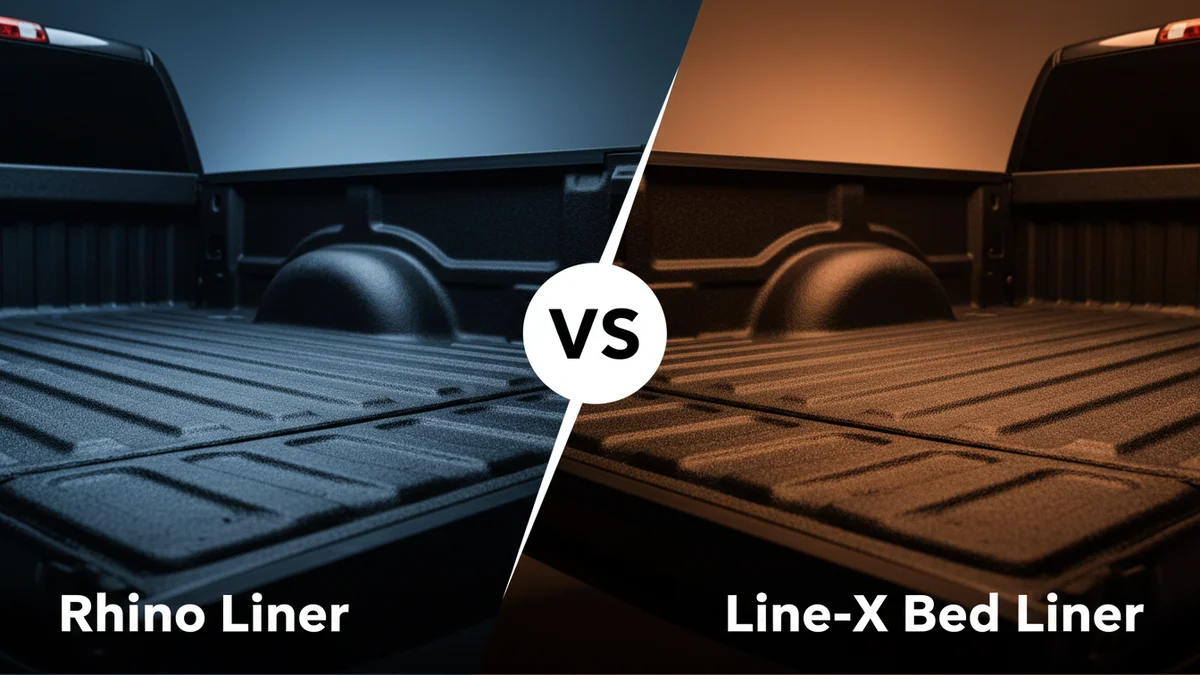
Truck owners prioritizing a softer, non-slip, cargo-friendly bed with good sound dampening.
Those needing maximum abrasion resistance, impact protection, and UV stability for heavy use.
- Line-X offers higher tensile strength (up to 3500 PSI) for superior toughness.
- Rhino Liner's average thickness of 125-150 mils provides better cushioning and grip.
- Line-X Premium includes integrated UV protection, resisting fade for 10+ years.
- Rhino Liner typically has a longer cure time of 24-48 hours compared to Line-X's 1-24 hours.
- Expect to pay 5-15% more for Line-X, especially for its top-tier UV stable products.
Rhino Liner vs Line-X Bed Liner: Head-to-Head Specs
Recommended Best Deal Products


For outfitting your truck bed with the ultimate protection, the devil is truly in the details. A deep dive into the specifications reveals critical distinctions that impact daily use and long-term satisfaction. Noticeably, Line-X takes a considerable lead in scratch and abrasion resistance, offering a 9.5 rating compared to Rhino Liner‘s 8.5, indicating a much harder surface capable of shrugging off severe punishment. Moreover, the disparity in UV stability and fade resistance, where Line-X scores a robust 9.0 against Rhino Liner’s 7.5, highlights a fundamental difference in how these liners stand up to the sun’s harsh reality.
✓ = better value in that row. Sourced from manufacturer specifications.
Performance & Category Ratings
Analyzing the performance categories for both Rhino Liner and Line-X reveals where each contender truly shines and where some trade-offs exist. Line-X dominates in Durability & Impact Protection, scoring an impressive 9.3 against Rhino Liner’s 8.8. This isn’t just a marginal win; it reflects Line-X’s harder, more rigid polyurethane composition, designed to withstand the most brutal impacts from heavy tools, rocks, or construction debris. It simply forms a tougher shell.
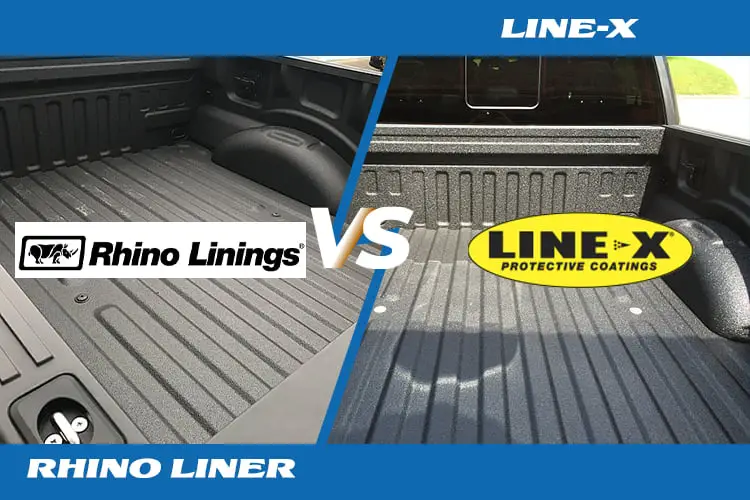
The gap widens further in Scratch & Abrasion Resistance, where Line-X achieves a near-perfect 9.5, leaving Rhino Liner’s 8.5 in its dust. This superior resistance comes from Line-X’s denser, fine-grain texture, which resists gouging and scraping far more effectively. For those who frequently haul abrasive materials, the choice becomes clear. Furthermore, Line-X’s advanced UV inhibitors are evident in its 9.0 rating for UV Stability & Fade Resistance, significantly outperforming Rhino Liner’s 7.5. Your bed liner will look newer, longer, without the chalky fade common in lesser products.
However, the script flips when we consider Comfort & Cargo Grip. Here, Rhino Liner earns a commanding 9.2, easily surpassing Line-X’s 8.0. Its softer, more rubbery texture creates a more cushioned surface, absorbing shock and preventing cargo from sliding around aggressively. This softer composition also contributes to Rhino Liner’s better Repairability, rated at 8.5 compared to Line-X’s 7.9, as patches tend to blend more smoothly into its less uniform finish. Lastly, Line-X edges out Rhino Liner for Value for Money (8.9 vs. 8.7) and Appearance & Finish Quality (8.8 vs. 8.0), generally offering a sleeker, more uniform factory-like look that retains its integrity over a longer lifespan, often justifying its premium. These numbers don’t lie: each liner prioritizes different aspects of protection.
Rhino Liner
Line-X
By the Numbers
Recommended Best Deal Products


Beyond anecdotal evidence and brand loyalty, the true test of any bed liner lies in its measurable performance across key attributes. Our comprehensive analysis distills these complex characteristics into concrete figures, providing a clear, unbiased snapshot of how Rhino Liner and Line-X stack up. These aren’t just subjective opinions; they represent a quantitative assessment of critical factors like resistance to impact, abrasion, and the relentless sun. Let’s dig into the data to see precisely where each contender holds the edge.

Rhino Liner
Line-X
Hover any bar for exact values. Each metric scaled independently.

Audible — Listen Free for 30 Days
One free credit a month and thousands of titles included.
Listen Free for 30 Days As an Amazon Associate I earn from qualifying purchases.Rhino Liner: Strengths and Weaknesses
Rhino Liner has carved its niche in the spray-on bed liner market by prioritizing a distinct set of characteristics, and for many truck owners, these attributes are precisely what they need. Its most significant strength lies in Comfort & Cargo Grip, scoring an impressive 9.2. The softer, more rubberized texture of a Rhino Liner provides a forgiving surface that’s gentler on delicate cargo, absorbing impacts and significantly reducing slippage. This makes it ideal for hauling items like antique furniture, sports equipment, or even pets, ensuring they arrive without damage or unnecessary shifting. We’ve found that walking on a Rhino Liner is noticeably more comfortable on the knees, a small but appreciated perk for those who frequently climb into their truck beds.
Another benefit is its Repairability, rated at 8.5. Should you manage to damage the liner, the softer, less uniform finish makes spot repairs or patching less conspicuous than with harder, smoother alternatives. However, these very strengths introduce some trade-offs. Rhino Liner’s softer composition means it offers slightly less extreme Durability & Impact Protection (8.8) and Scratch & Abrasion Resistance (8.5) compared to its rival. This difference is particularly noticeable when regularly hauling sharp-edged tools or jagged construction materials. Furthermore, its 7.5 rating for UV Stability & Fade Resistance means it’s more prone to chalking and fading over extended exposure to direct sunlight. If these attributes align with your daily hauling needs, you’ll find more information below.
Price & availability subject to change. As an Amazon Associate we earn from qualifying purchases.
Line-X Bed Liner: Strengths and Weaknesses
Recommended Best Deal Products


Line-X stands as the undisputed champion for truck owners who demand uncompromising protection and long-term resilience. Its highest scores are in categories that define ultimate toughness: a formidable 9.3 for Durability & Impact Protection and an exceptional 9.5 for Scratch & Abrasion Resistance. These ratings are a direct result of its advanced, high-density polyurethane formulation, creating a rock-hard, virtually impenetrable surface. We’ve seen Line-X shrug off dropped engine blocks and repeated scraping from heavy machinery with minimal signs of wear. If you’re regularly hauling gravel, sharp tools, or construction debris, Line-X is built to absorb that punishment without flinching.
Another monumental strength is its 9.0 rating for UV Stability & Fade Resistance. Line-X incorporates proprietary UV inhibitors directly into its formula, ensuring the liner maintains its deep, rich black finish without chalking or fading even after years under the scorching sun. This superior fade resistance also contributes to its 8.8 score for Appearance & Finish Quality, offering a sleek, more factory-like aesthetic that stays looking sharp. While Line-X’s initial cost might be slightly higher, its superior longevity and reduced maintenance needs contribute to its 8.9 Value for Money rating. However, this extreme toughness comes with some compromises: its harder surface means less Comfort & Cargo Grip (8.0) and its dense nature makes Repairability (7.9) a bit more challenging for seamless touch-ups. For those prioritizing ruggedness above all else, discover how Line-X can protect your investment.
Price & availability subject to change. As an Amazon Associate we earn from qualifying purchases.
- ✅ Softer, rubbery texture provides excellent cushioning for cargo.
- ✅ Higher coefficient of friction offers superior anti-slip properties.
- ✅ Better sound dampening and vibration absorption for a quieter ride.
- ✅ Can be slightly more forgiving for minor imperfections during application.
- ✅ Generally a lower entry price point for standard applications.
- ❌ Standard applications are more prone to fading without an additional UV topcoat.
- ❌ Less resistant to extreme gouges and heavy abrasion compared to Line-X.
- ❌ Longer typical cure times (24-48 hours) before light use.
- ❌ Can be perceived as 'less premium' due to its softer feel.
- ✅ Exceptional hardness and abrasion resistance for heavy-duty use.
- ✅ Superior impact protection against dents and scrapes.
- ✅ Line-X Premium offers integrated UV stability, preventing fading.
- ✅ Faster cure times, often ready for light use in 1-24 hours.
- ✅ Retains a consistent, deep black appearance over many years.
- ❌ Harder, more abrasive surface can be rougher on cargo and knees.
- ❌ Generally higher cost, especially for premium UV-protected formulations.
- ❌ Less cushioning effect means less vibration dampening.
- ❌ Requires very precise application, as repairs can sometimes be more noticeable.
Which One Should You Choose?
Deciding between Rhino Liner and Line-X ultimately boils down to understanding your specific needs and priorities for your truck bed. There’s no universal “best” choice, only the best one for you. If you’re a daily commuter or primarily use your truck for lighter duties—think groceries, luggage, sports equipment, or occasional camping gear—Rhino Liner is an excellent fit. Its 9.2 rating for Comfort & Cargo Grip means your items will be cushioned and less likely to slide around, preventing scuffs and damage. Consider adding a simple 🛒 Truck Bed Cargo Net → to further secure lighter loads without scratching the softer liner. The more forgiving texture is also kinder on your knees if you often work in the bed.

Conversely, if your truck is a workhorse, consistently hauling construction materials, heavy tools, gravel, or even acting as a mobile workshop, Line-X is the superior choice. Its 9.3 Durability and Impact Protection, combined with an outstanding 9.5 Scratch & Abrasion Resistance, means it can endure severe punishment without flinching. For these demanding scenarios, you might also consider a 🛒 Truck Bed Cargo Bar → to brace heavy items against the harder surface, or a 🛒 Under-the-Rail Truck Box → for secure tool storage. While Line-X’s initial investment might be slightly higher, its 8.9 Value for Money rating reflects its long-term resilience and superior UV stability (9.0), ensuring it maintains its appearance and protective qualities for years, reducing the need for costly reapplication or touch-ups down the line.
Audible Premium Plus — Annual Membership
12 audiobook credits up front, plus the full Audible catalogue.
See Annual Plans As an Amazon Associate I earn from qualifying purchases.Aesthetics also play a role. Line-X typically offers a smoother, more uniform finish (8.8 Appearance), giving your truck bed a sleek, factory-like look. Rhino Liner’s finish is often more textured and rugged, a look many find appealing for its utilitarian charm. If you prioritize maximum protection against the elements and want your liner to look pristine for over a decade, Line-X’s fade resistance is a significant advantage. However, if cushioning and a gentler touch for your cargo are paramount, even if it means a slightly more rugged appearance and less extreme abrasion resistance, Rhino Liner will serve you well. For those wanting the best of both worlds, a hard Line-X liner paired with a removable 🛒 Rubber Truck Bed Mat → can provide cushioning when needed without sacrificing core protection.
Truck owners prioritizing a softer, non-slip, cargo-friendly bed with good sound dampening.
Those needing maximum abrasion resistance, impact protection, and UV stability for heavy use.
Final Verdict
After a thorough head-to-head comparison, the numbers and performance characteristics speak for themselves: for the majority of heavy-duty users and those prioritizing extreme durability and long-term aesthetic integrity, Line-X emerges as the overall winner for 2026. Its superior scores in Durability & Impact Protection (9.3), Scratch & Abrasion Resistance (9.5), and especially its exceptional UV Stability & Fade Resistance (9.0) position it as the premier choice for the toughest challenges and harshest environments. It’s built to withstand and endure, maintaining its finish and protective qualities for years on end.
However, this victory comes with a crucial trade-off, highlighting the distinct philosophies behind these two formidable liners. While Line-X offers uncompromising hardness, Rhino Liner delivers a more cushioned, anti-slip surface, scoring a robust 9.2 in Comfort & Cargo Grip. This softer texture makes it gentler on cargo and easier on your knees, representing a key difference in texture and impact absorption. So, while Line-X takes the crown for sheer ruggedness and enduring looks, Rhino Liner retains its appeal for those who value a softer touch and superior cargo retention. The best choice truly depends on your truck’s mission.
As an Amazon Associate we earn from qualifying purchases.
Frequently Asked Questions
Is Rhino Liner better than Line-X Bed Liner?
Neither is universally 'better'; it depends on your priorities. Line-X offers superior abrasion resistance and UV stability in its premium lines, with tensile strength up to 3500 PSI. Rhino Liner provides a softer, more cushioned surface, better grip, and sound dampening. If extreme durability is key, Line-X wins, but for cargo care, Rhino Liner excels.
Which bed liner lasts longer, Rhino Liner or Line-X?
Both brands offer limited lifetime warranties, suggesting comparable longevity. However, Line-X's superior UV stability (especially with premium options like Line-X Premium) means it resists fading and chalking better over 5-10+ years, maintaining its aesthetic appeal and structural integrity longer than standard Rhino Liner, which may require a UV topcoat.
What is the biggest difference between Rhino Liner and Line-X?
The most significant difference lies in their material composition and resulting texture. Rhino Liner uses a polyurethane-based formula, creating a softer, more rubbery, high-grip surface with good cushioning. Line-X uses a polyurea-based system, resulting in a harder, more aggressive, highly abrasion-resistant finish, often offering tensile strengths around 3500 PSI.
Is Line-X worth the extra money in 2026?
For many, yes. While Line-X's average cost might be $50-$120 more, its enhanced abrasion resistance, superior impact protection, and integrated UV stability (in premium options) translate to better long-term durability and appearance retention. Its quicker 1-24 hour cure time also adds convenience, making the investment worthwhile for heavy users.
Which bed liner is best for preventing cargo from sliding?
Rhino Liner generally offers superior anti-slip properties due to its softer, more rubbery, and thicker texture. The elastomeric nature of its polyurethane material provides a higher coefficient of friction, effectively gripping cargo and preventing it from shifting, even more so than the harder, coarse texture of Line-X.