
Ford Truck Payload Capacity Chart By Year (2026 Updated)

Quick Answer
Ford truck payload capacities vary significantly by model, spanning from approximately 1,500 lbs for light-duty F-150s to over 7,800 lbs for F-350/F-450 Super Duty configurations. The most critical factor is the vehicle’s specific GVWR minus its individual curb weight. Because factory-installed options, trims, and cab configurations alter these figures, the only definitive payload rating for your specific vehicle is located on the Tire and Loading Information door jamb sticker.
Do you know exactly how much weight your Ford truck is legally allowed to carry? While many owners rely on general brochures or online marketing charts, these sources often fail to account for specific trim levels, installed engines, and factory-added accessories. The truth is that payload capacity varies significantly from one specific vehicle to the next, even within the same model year and trim. In this guide, we provide the 2026 updated payload capacity data and, more importantly, explain how to identify the precise, VIN-specific limit for your truck using the factory door jamb certification label.
This reference covers Ford F-Series and Ranger models (2020–2026). Values provided are base estimates; actual capacities vary by engine, drivetrain, and cab/bed configuration. Always prioritize the VIN-specific door sticker over generic industry charts. Last reviewed: August 2026.
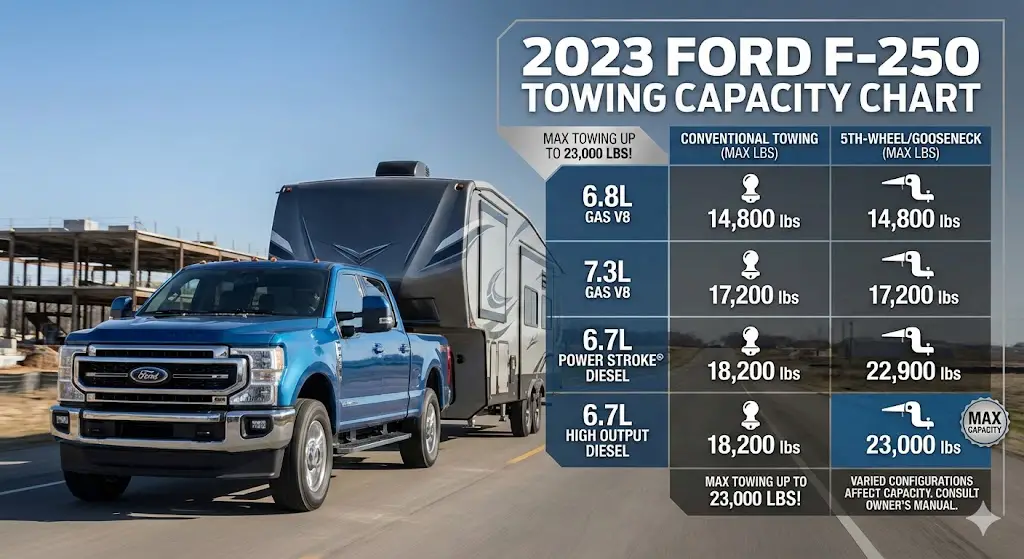
Ford Truck Payload Capacity Chart: Comprehensive Data Overview


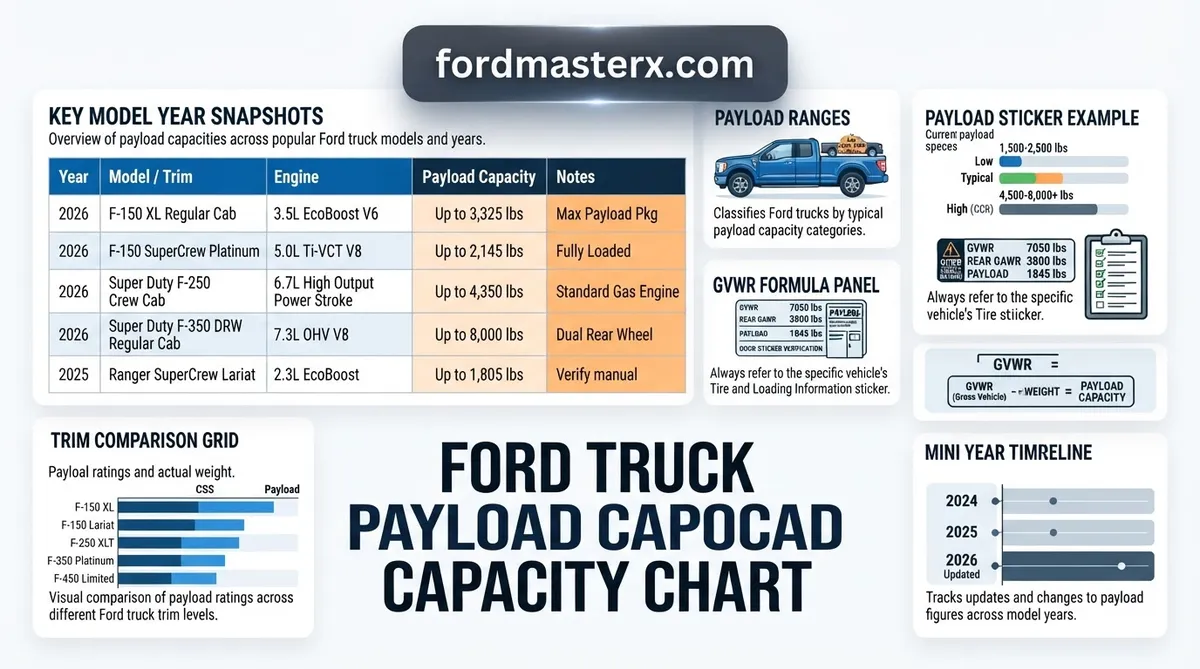
The following table outlines the approximate payload ranges for recent Ford trucks. Note that “Base” values reflect entry-level configurations, while “Max” values often require specialized heavy-duty payload packages.


📤 Share Image
| Model | Engine | Payload Range (lbs) | Notes |
|---|---|---|---|
| Ranger | 2.3L/2.7L EcoBoost | 1,300 – 1,800 | Varies by SuperCab/CrewCab |
| F-150 | 3.5L PowerBoost / 5.0L V8 | 1,500 – 3,300 | Max requires specific towing package |
| F-250 Super Duty | 6.7L Power Stroke / 7.3L Gas | 3,000 – 4,500 | Significant drop with diesel weight |
| F-350 Super Duty | 6.7L HO Power Stroke | 4,000 – 8,000 | Higher with DRW (Dual Rear Wheel) |
How to Interpret These Payload Values
Payload capacity is the maximum weight a truck can safely carry, including passengers, cargo in the bed, and the weight of any trailer tongue resting on the hitch. As the table shows, there is a massive delta between an entry-level trim and a fully kitted-out luxury version of the same truck. Luxury features like moonroofs, heated power seats, and premium sound systems add hundreds of pounds of “curb weight,” which subtracts directly from your payload capacity.
Understanding Base Models vs. Fully Loaded Trims


Consider an F-150 XL compared to an F-150 Platinum. The XL is a “stripper” model with minimal interior weight, allowing for higher available payload. The Platinum, conversely, is loaded with heavy electronics and comfort-oriented gear. Even if both trucks share the same engine and suspension, the Platinum will have a lower legal payload capacity on the door sticker.
How to Find Your Specific Ford Truck Payload Capacity
Open the driver-side door. On the door jamb, you will find a yellow and white sticker labeled “Tire and Loading Information.” This is your definitive source of truth.
Look for the line that says: “The combined weight of occupants and cargo should never exceed XXXX kg or XXXX lbs.” That number is the total remaining payload for your specific vehicle configuration.
Why Brochures Differ from Physical Stickers
Marketing brochures often list the “best-in-class” payload numbers, which are based on a stripped-down, regular cab, 2WD vehicle. These numbers do not reflect real-world trucks found on dealer lots. When you add a heavier engine (like a diesel V8), 4WD systems, or a crew cab, the curb weight increases, and the payload sticker on that specific vehicle is adjusted downward at the factory to maintain safety compliance.
What Factors Reduce Your Ford Truck Payload Capacity?
Every modification to your truck that adds weight reduces its ability to carry cargo. It is critical to account for these items before loading up for a trip.
- Aftermarket Accessories: Installing a heavy steel bed liner, toolboxes, tonneau covers, or aftermarket bumpers can consume 200–500 lbs of your payload capacity instantly.
- Trim Levels & Packages: Sunroofs, power running boards, and heavy-duty towing packages add physical weight to the chassis, lowering the rated payload.
- Passenger & Cargo Weight: The total payload includes the weight of all occupants, personal gear, and even the fuel in the tank (in some measurement methodologies).
- Trailer Tongue Weight: If you are towing a travel trailer, 10-15% of that trailer’s total weight rests on the truck’s hitch, which counts directly against your remaining payload.
Exceeding your truck’s payload capacity can cause premature wear on suspension components, put excessive stress on brakes, and potentially void your manufacturer warranty. Always stay within the limits specified on your door jamb sticker.
Ford Truck Payload vs. Towing Capacity: Key Differences
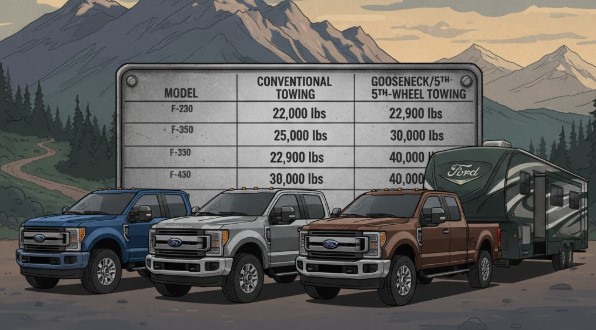
One of the most frequent mistakes owners make is confusing towing capacity with payload capacity. While towing capacity refers to the weight the engine and frame can pull, payload capacity defines what the truck’s suspension and frame can physically hold.
Calculating Tongue Weight and Payload
You might have a truck rated to tow 12,000 lbs, but if your remaining payload is only 1,500 lbs, you cannot safely tow a trailer with 2,000 lbs of tongue weight. Payload is almost always the “limiting factor” that prevents you from reaching your maximum towing potential.
The Role of GAWR (Gross Axle Weight Rating)
The Gross Axle Weight Rating (GAWR) defines the maximum load each axle can handle. Your payload is also constrained by the weight distribution; even if your total payload is within limits, putting too much weight behind the rear axle can exceed the rear GAWR, leading to unstable handling and tire failure.
Industry Data Breakdown
The Payload Formula
Standard Tongue Weight Ratio
Ford Truck Payload Capacity Questions Answered
Q: Does adding helper springs increase my payload capacity?
A: No. While helper springs or air bags may help level the truck and improve handling under load, they do not change the legal Gross Vehicle Weight Rating (GVWR) established by Ford. You are still limited by the door jamb sticker.
Q: Where do I find the payload sticker on older Ford trucks?
A: Ford began using the standardized “Tire and Loading Information” yellow sticker for most F-Series trucks in the mid-2000s. If your truck is older, you may need to consult the owner’s manual and subtract the truck’s weight at a CAT scale from the GVWR listed on the VIN plate.
Q: Can I use a different tire to increase payload?
A: Tire upgrades can improve the “load range” of the contact point, but the chassis and suspension remain the bottleneck. Never exceed the GVWR of your vehicle.
If you frequently carry heavy loads, take your truck (loaded as you would for a trip) to a local public scale. This will give you your exact real-world weight, allowing you to see exactly how much payload you truly have left.
To ensure the safety and longevity of your vehicle, always use your specific door jamb sticker for the exact payload limit rather than general internet data. Remember that factory options and aftermarket accessories subtract directly from your maximum capacity, and payload includes all passengers, gear, and trailer tongue weight. Check your driver-side door jamb today to confirm your truck’s safe operating limits before your next haul.


{
“@context”: “https://schema.org”,
“@type”: “FAQPage”,
“mainEntity”: [
{
“@type”: “Question”,
“name”: “Is payload the same as towing capacity?”,
“acceptedAnswer”: {
“@type”: “Answer”,
“text”: “No. Payload capacity is the maximum weight you can carry inside the truck (including passengers, cargo, and tongue weight), while towing capacity is the maximum weight the truck can pull behind it. A truck can have a high towing capacity but a low payload capacity if the trailer tongue weight consumes the available payload rating.”
}
},
{
“@type”: “Question”,
“name”: “Why is my payload sticker lower than the truck brochure?”,
“acceptedAnswer”: {
“@type”: “Answer”,
“text”: “Brochures list maximum capacities for base-model trucks with the fewest options. In reality, every factory-installed featureu2014such as a sunroof, leather seats, 4×4 transfer case, or extended cabu2014adds weight to the vehicle. This additional ‘curb weight’ is subtracted from the GVWR, resulting in a lower payload capacity on your specific truck compared to the advertised maximum.”
}
},
{
“@type”: “Question”,
“name”: “Does my truck’s aftermarket equipment reduce payload?”,
“acceptedAnswer”: {
“@type”: “Answer”,
“text”: “Yes, absolutely. Any weight added to the truck after it leaves the factoryu2014including aftermarket bumpers, winches, toolboxes, tonneau covers, or slide-in campersu2014becomes part of the truck’s curb weight. Because the GVWR remains fixed, every pound of aftermarket equipment directly reduces the amount of weight you can legally carry in the bed or cab.”
}
},
{
“@type”: “Question”,
“name”: “Where do I find the official payload for my specific truck?”,
“acceptedAnswer”: {
“@type”: “Answer”,
“text”: “The most accurate rating is found on the ‘Tire and Loading Information’ yellow-and-white sticker located on the driver-side door jamb. This sticker is specific to your truck’s VIN and includes the weight of all factory-installed options. Do not rely on owner’s manuals or general charts for your individual vehicle’s limit.”
}
},
{
“@type”: “Question”,
“name”: “Can I increase my payload capacity by upgrading springs or tires?”,
“acceptedAnswer”: {
“@type”: “Answer”,
“text”: “While upgrading suspension components like airbags or helper springs can help the truck sit level under load and improve handling, they do not increase the vehicle’s official payload capacity or GVWR. These are fixed ratings established by Ford engineers based on the entire chassis, braking system, and frame design. You are still legally and mechanically bound by the manufacturer’s door-sticker rating.”
}
}
]
}
{
“@context”: “https://schema.org”,
“@type”: “Article”,
“headline”: “Ford Truck Payload Capacity Chart By Year (2026 Updated)”,
“description”: “View our detailed Ford truck payload capacity chart for model years 2015-2026. Learn how trims, engines, and configurations affect your truck’s real-world hauling limits.”,
“dateModified”: “2026-08-24”,
“author”: {
“@type”: “Person”,
“name”: “Content King Editorial Team”
},
“about”: [
{
“@type”: “Thing”,
“name”: “ford truck payload capacity chart”
},
{
“@type”: “PropertyValue”,
“name”: “payload capacity”
}
],
“mainEntity”: {
“@type”: “Dataset”,
“name”: “Ford Truck Payload Capacity Chart By Year (2026 Updated) data table”,
“description”: “This chart covers Ford F-150, F-250, and F-350/F-450 Super Duty model years 2015 through 2026. Data represents maximum potential ratings per manufacturer specifications. Actual capacity is unique to every individual VIN based on factory equipment, including engine, drivetrain, bed length, and trim level. Always cross-reference the Tire and Loading Information sticker located on the driver-side door frame for your vehicleu2019s exact legal limit.”,
“variableMeasured”: “payload capacity”,
“temporalCoverage”: “2026”
}
}