
Ford P1000 Code No Start: Readiness Monitor Versus Fault Logic Explained

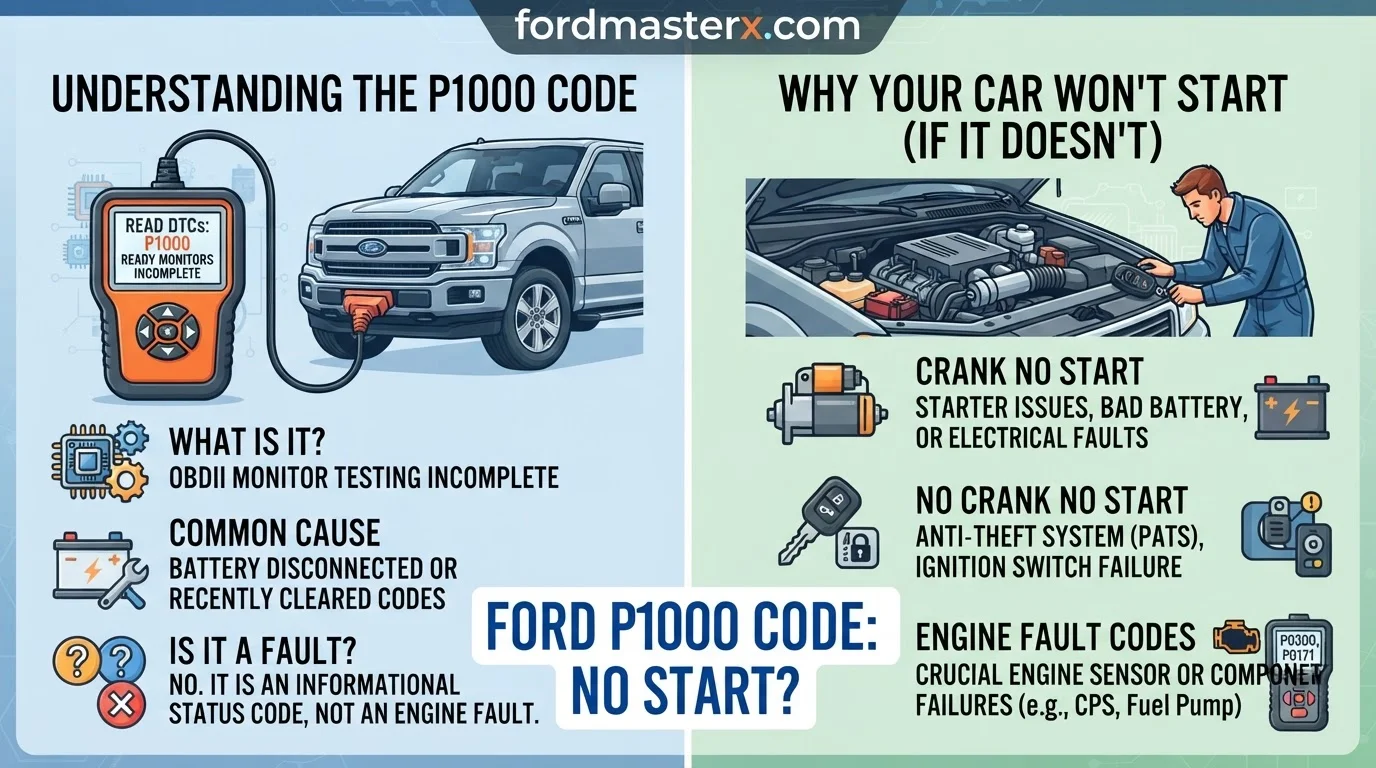
The Ford P1000 code is not a mechanical failure and does not cause a “no start” condition; it indicates that the OBDII system has not completed its self-diagnostic readiness tests. If your vehicle will not start, the P1000 code is a red herring caused by a cleared memory or battery disconnect. This guide helps you distinguish between readiness status and genuine electrical or mechanical starting faults.
Ford P1000 Code No Start Main Reference Chart
How to Read This Chart
This reference chart distinguishes between informational status codes and actual hardware failure codes. The “Code Type” column identifies the code series: P1000 is unique to Ford as a system-readiness indicator, while P0XXX represents standard industry-wide fault codes triggered by mechanical or electrical failures.


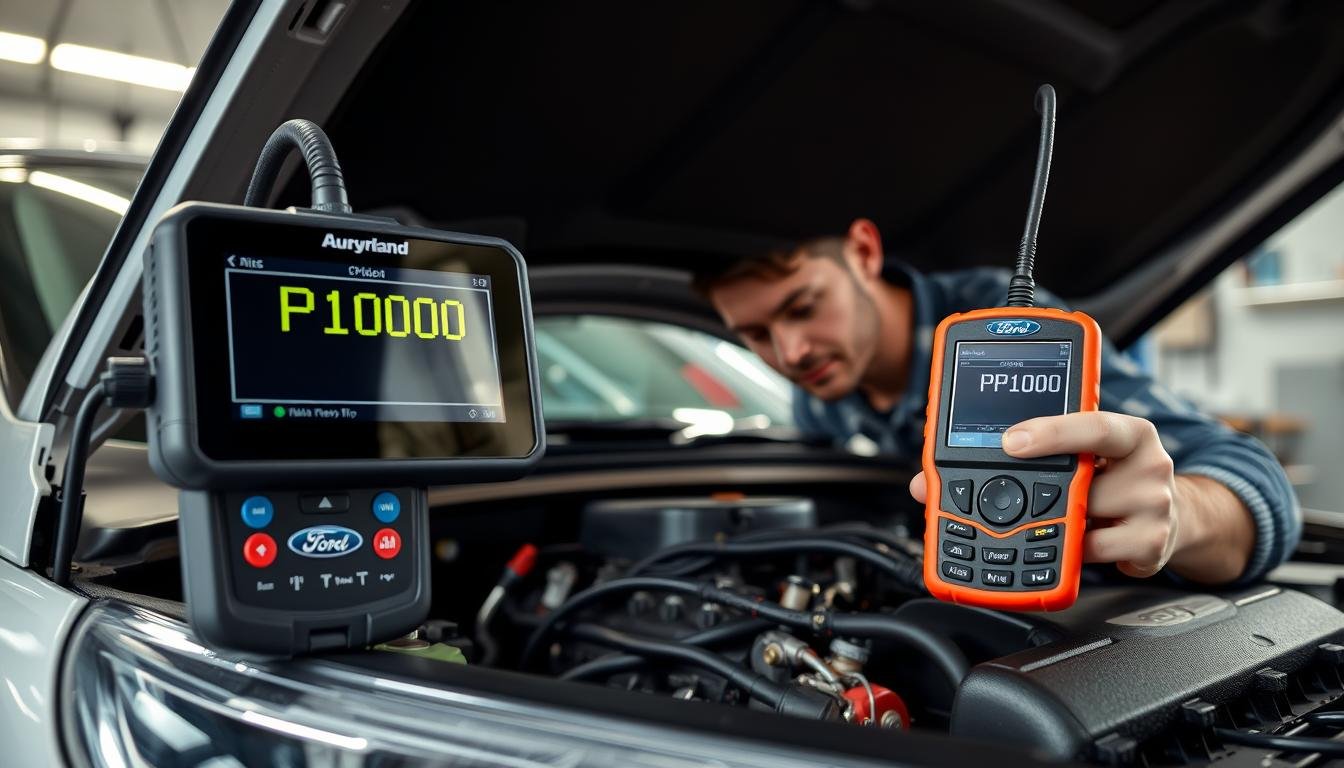
The “System Impact” column highlights why confusion often arises regarding “no start” conditions. Because P1000 is merely a marker indicating that the PCM memory was recently cleared—usually via battery disconnection or a scan tool reset—it does not imply a mechanical breakdown. It simply means the vehicle’s self-testing monitors are incomplete.

If you encounter a no-start condition while the P1000 code is present, look for additional P0XXX codes in your scanner data. The P1000 code itself is an informational status, not a cause for the engine failing to crank or turn over. If no P0XXX codes are present, the no-start issue is likely caused by an unrelated mechanical or electrical fault, not the readiness state of the PCM.
The code P1000 is an informational readiness indicator, not a diagnostic trouble code identifying a broken part. When this code appears, the vehicle’s Powertrain Control Module (PCM) is simply reporting that it has not yet completed its series of self-tests. This occurs most frequently after a battery has been disconnected or the memory has been wiped by a scan tool.
There is a common misconception that P1000 signifies a mechanical failure preventing the engine from starting. This is categorically false. The P1000 code is essentially a “system pending” signal and will not, by itself, cause a no-start condition. If your vehicle fails to start, the root cause lies elsewhere.
For vehicles experiencing a no-start, technicians check for active P0XXX series codes. These codes identify specific hardware failures such as a faulty fuel pump, ignition failure, or sensor malfunction. When you see P1000 alongside other fault codes, prioritize the hardware faults first, as these are the components responsible for the vehicle’s operational failure.
Do not attempt to “clear” the P1000 code to resolve a no-start problem. Clearing the code will only reset the monitor timer, forcing the system to start the readiness process from the beginning. Focus your diagnostic efforts on identifying active mechanical or electrical faults that actually prevent the engine from firing correctly.
Understanding the OBDII Readiness Monitor Process


| Test Phase | Operational Requirement | Purpose |
|---|---|---|
| Cold Start | Engine cool, idle 2-5 mins | O2 sensor/Catalyst verification |
| City Driving | Stop-and-go, varied RPM | EGR and Evap leak testing |
| Highway Cruise | Steady 55+ MPH for 10 mins | Fuel trim and purge efficiency |
How to Read This Chart


This table outlines the sequential stages the Powertrain Control Module (PCM) follows to validate vehicle systems. The “Test Phase” column indicates the driving environment needed, while “Operational Requirement” identifies the specific conditions the PCM looks for during its diagnostic cycle.
The “Purpose” column explains which emissions components are being evaluated during those maneuvers. This applies to most Ford vehicles equipped with OBDII systems manufactured after 1996. Note that failure to meet these specific thresholds will cause the P1000 code to persist.


How the PCM Monitors System Health
The PCM acts as the central brain of your Ford, continuously auditing the performance of emissions-related hardware. Every time the battery is disconnected or the memory is cleared, the PCM loses its stored performance data. It must then reset its internal “readiness monitors” to ensure the vehicle is operating within strict environmental guidelines.
The P1000 code is essentially a status flag, not a malfunction. It signals that the PCM has not yet finished its self-diagnostic routine. Because the system requires a specific set of operating conditions to test each component, short trips or erratic driving may prevent these monitors from setting correctly.
During the monitoring process, the PCM looks for specific feedback from sensors like the Heated Oxygen (HO2) sensors, the Exhaust Gas Recirculation (EGR) valve, and the catalytic converter. It monitors these parts during various phases, starting from a cold engine soak through to a sustained highway cruise.


Why Emissions Testing Requires Complete Readiness


Emissions testing stations use OBDII scan tools to query the status of these internal monitors. If the P1000 code is present, it tells the inspector that the computer lacks sufficient data to confirm the vehicle’s emissions integrity. Essentially, the “jury is still out” on whether the car is polluting excessively.
It is vital to understand that P1000 is merely a byproduct of the PCM’s reset state. It is not the source of a no-start condition or any other engine performance issue. It simply means the computer is still in its learning phase, waiting for the necessary data to confirm that all systems meet federal compliance.
Once all required self-tests have successfully passed under normal driving conditions, the PCM will automatically clear the P1000 code. You do not need to manually delete it with a scan tool; in fact, doing so will only restart the monitor process and prolong the state of non-readiness for your next inspection.
The P1000 code is a Ford-specific notification that the OBDII drive cycle is incomplete. Other manufacturers use different proprietary codes for the same status, but the underlying requirement for a varied, multi-stage drive cycle remains universal for all modern vehicles.
Common Triggers for the Ford P1000 Readiness Code
The P1000 code is not a traditional fault code indicating a specific mechanical failure. Instead, it is an informational status code signaling that the Powertrain Control Module (PCM) has not yet completed its self-diagnostic tests. This code exists specifically because the PCM’s non-volatile memory was recently cleared or reset, wiping out the “readiness” status of its internal emissions monitors.
When the PCM memory is wiped, the vehicle loses its long-term fuel trim data, oxygen sensor history, and catalyst efficiency records. Without this stored data, the PCM must restart the entire monitoring process from scratch. Until the vehicle completes a specific drive cycle that satisfies the internal logic requirements for all monitors, the P1000 code will remain present to alert technicians or inspectors.
Battery Disconnect and Memory Loss
The most frequent cause of a P1000 code is a loss of power to the PCM. When the battery is disconnected for service, dies completely, or is replaced, the voltage supply to the PCM’s Keep-Alive Memory (KAM) is interrupted. This causes the computer to dump its learned data and revert to factory base-map settings.
Beyond simple battery replacement, other scenarios that lead to this memory loss include:
- Removing the PCM fuse or relay for an extended duration.
- Performing an electrical repair that requires a total vehicle power-down.
- Using a low-quality memory saver tool that failed to maintain constant voltage.
- Experiencing a parasitic battery drain that dropped system voltage below critical thresholds.
In these instances, the vehicle acts as if it has just left the assembly line. Because the PCM has no reference for how the engine is currently performing under real-world conditions, it cannot confirm that emissions systems are functioning correctly, thus triggering the P1000 status.
Scan Tool Usage and PCM Resetting


Modern diagnostic scan tools provide the ability to clear Diagnostic Trouble Codes (DTCs). While this is a necessary step when fixing a vehicle, the “Clear Codes” or “Reset” function does more than just erase a P0XXX error code. It forces a global reset of the PCM, which inherently clears all stored readiness monitors and resets the P1000 indicator.
Mechanics often see this code immediately after a diagnostic session. Even if you were only trying to clear a minor code related to a one-time glitch, the act of resetting the system removes the evidence that the car has passed its internal emissions checks. This effectively forces the vehicle into an “incomplete” state, regardless of whether the mechanical components are actually healthy.
Consequently, if you use a scan tool to attempt to “fix” a warning light, you are simultaneously creating a P1000 code. This is why attempting to clear codes right before an emissions test usually results in a failure; the testing equipment detects the P1000 code and identifies that the vehicle’s diagnostic system has not had sufficient time or mileage to verify its own health.
Executing a Proper Drive Cycle to Clear the Code


| Drive Phase | Requirements | Duration |
|---|---|---|
| Cold Start | Soak time 8+ hours; Engine temp below 86°F | Immediate |
| City/Stop-and-Go | Variable speeds 25–45 mph; Idle time included | 15–20 minutes |
| Highway Cruise | Steady speed 55–65 mph; Minimal throttle | 15–20 minutes |
How to Read This Chart
The table above outlines the specific operating conditions required to reset the Ford P1000 readiness monitor. The “Drive Phase” column categorizes the engine states needed to complete various internal diagnostic tests.
The “Requirements” column lists the environmental and mechanical triggers, such as the mandatory “cold soak” where the vehicle must sit for eight hours. The “Duration” provides the minimum time needed for the Powertrain Control Module (PCM) to verify system integrity.
These requirements apply broadly to most Ford OBDII-compliant vehicles manufactured after 1996. While specific software versions may vary slightly, these parameters provide the baseline for satisfying the monitors that generate a P1000 code.
The Ford OBDII Drive Cycle Requirements
The P1000 code signifies that the vehicle’s diagnostic monitors have not completed their self-tests. Because these tests rely on live sensor data, driving the vehicle is the only way to satisfy these requirements. You cannot clear the code simply by idling in a driveway; the PCM requires varying engine loads and speeds.
A standard drive cycle begins with a cold start after the vehicle has been parked for at least eight hours. This allows the coolant and intake air temperature sensors to reach an ambient baseline. Once started, allow the engine to idle for two minutes before beginning your drive.
Next, perform a mix of city driving, including several stops and acceleration events up to 45 mph. Follow this with a steady highway cruise at approximately 55 to 65 mph for at least 15 minutes. Consistent throttle input is vital here to let the Oxygen (O2) and Catalyst monitors lock in their data.
Avoid heavy acceleration or sudden braking during the steady cruise phase, as these actions interrupt the diagnostic sampling process. By completing this combined sequence, you provide the PCM with the necessary inputs to evaluate every emissions-related component, eventually clearing the P1000 status.
Why Clearing the Code with a Scan Tool Fails
Many vehicle owners attempt to bypass the P1000 code by using an OBDII scan tool to “clear” or “erase” the trouble codes. While this removes the P1000 from the display screen, it is counterproductive because it resets the entire readiness monitor suite back to “not ready.”
When you trigger a manual reset via a scanner, you essentially force the computer to “forget” the previous test results. The PCM interprets this command as a system wipe and reinstates the P1000 code immediately. It does not fix the underlying lack of data; it merely hides the symptoms while forcing a restart of the diagnostic timer.
Forcing a clear also erases critical Freeze Frame data, which could have helped identify why the monitors were failing to set in the first place. Instead of using a scan tool, you must rely on the vehicle’s natural drive cycle. Driving normally under varied conditions is the only authentic path to clearing the P1000 and achieving emissions readiness.
📋
Step-by-Step Drive Cycle
Let the vehicle sit for 8 hours. Start the engine and let it idle for 120 seconds to establish initial sensor calibration.
Drive for 15 minutes at speeds varying between 25 and 45 mph. Perform at least 5 stops to allow the sensors to cycle.
Maintain 55-65 mph for 15-20 minutes. Avoid erratic throttle movements to keep the catalyst monitors stable.
Distinguishing P1000 from Fault Codes (P0XXX)
How to Read This Chart
This table differentiates between the P1000 informational status and standard P0XXX trouble codes. The “Feature” column lists the criteria for evaluation, while the “P1000” and “P0XXX” columns show how each type of code behaves. The P1000 code specifically monitors the vehicle’s readiness state rather than the physical integrity of components.
When you see P1000, it is not a diagnosis of a mechanical failure. Conversely, P0XXX codes represent specific failures detected by the OBD-II system. This chart applies to all Ford vehicles utilizing standard OBD-II protocols, regardless of engine or drivetrain configuration.
Seeing a diagnostic code on your scanner often triggers immediate anxiety, but it is vital to understand that P1000 is strictly an informational message. It is not an indicator of a broken engine component or a mechanical failure. Instead, it informs you that the vehicle’s self-diagnostic monitors have not yet completed their evaluation process.
When you clear codes or disconnect your battery, the engine control module (ECM) wipes its stored data. The P1000 code essentially says, “I am still learning and haven’t finished my homework.” It is a normal temporary state that occurs after the power supply to the computer is interrupted.
P1000 vs P1111: Completed Testing Status
Once your Ford has completed all required self-tests, the P1000 code will clear automatically. In many Ford models, you will see it replaced by the P1111 code. The P1111 code is the “system ready” status, confirming that all monitors passed and the engine management system is fully calibrated for emissions testing.
If you have P1000, you are simply in the middle of a reset. If you have P1111, your system is fully verified. Neither of these codes indicates a need for repairs, nor do they reflect a “no start” condition caused by a malfunctioning part. They are status reports generated by the computer’s logic.
When to Worry About Other Engine Codes
You should only be concerned if your scanner displays P0XXX codes alongside the P1000 status. A P0XXX code points to a specific, active failure, such as a faulty O2 sensor, an ignition misfire, or a failing component. If you see these codes, your engine is signaling a genuine mechanical issue.
For example, if your Check Engine Light is illuminated and you see both a P1000 and a P0300 (Random/Multiple Cylinder Misfire), the P1000 is irrelevant to the problem. You should prioritize fixing the P0300, as the P1000 is simply present because the computer was reset during your troubleshooting process.
Do not mistake “Not Ready” status for “Failure.” If your car is suffering from a no-start condition but the only code present is P1000, the issue is likely not related to the computer’s emission monitors. Instead, focus your diagnosis on fuel pressure, starter function, or battery voltage, as these are independent of the OBD-II readiness cycle.
Professional Tips for Emissions Compliance and Readiness
The presence of a P1000 code on your Ford indicates that the On-Board Diagnostic (OBDII) system has not yet completed its required self-tests. It is critical to understand that this code is an informational status report rather than a hardware error. It signals that your vehicle’s computer lacks sufficient data to report on the health of emissions components.
Because P1000 is not a fault code, it does not signify a failed part. You should avoid replacing sensors, catalytic converters, or other emissions components based solely on this code. Replacing functional hardware will not clear the P1000 status, as the computer requires specific operating conditions—not new parts—to complete the readiness monitors.
Avoiding Unnecessary Component Replacement
Many vehicle owners mistakenly assume that any code stored in the computer requires a mechanical repair. When you see P1000, do not visit a repair shop for diagnostics or parts replacement. This code is triggered by recent battery disconnection, clearing existing codes, or a dead battery that reset the computer’s memory.
If you replace parts like the oxygen sensor or the mass airflow sensor while a P1000 code is present, you are essentially “fixing” a vehicle that may not be broken. The P1000 status will remain until the vehicle undergoes a proper drive cycle. Always focus on driving the vehicle through the manufacturer’s specified routine before considering any hardware intervention.
How to Check Readiness Monitor Status
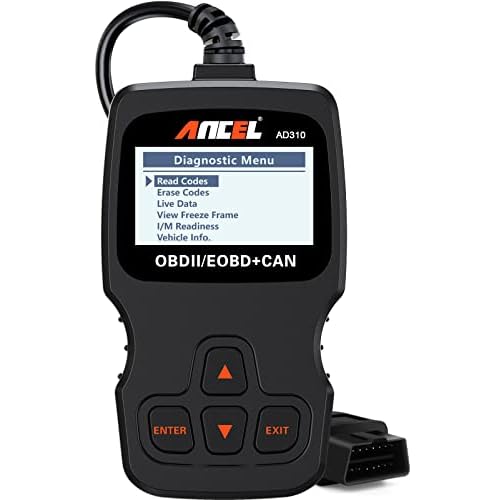
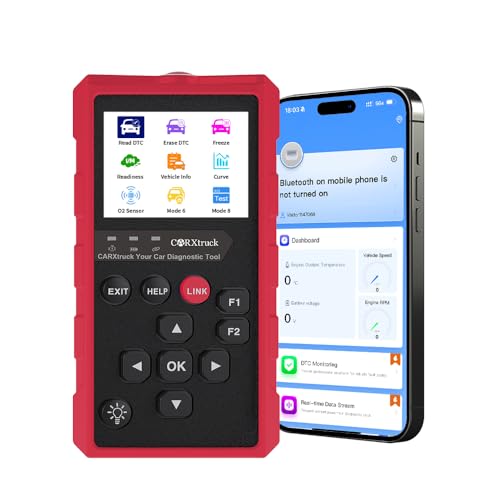
You do not need to go to an official emissions testing station just to see if your vehicle is ready. You can verify the status of your emissions monitors at home using an inexpensive OBDII dongle. These devices are widely available for roughly $20 and connect to your smartphone via Bluetooth to provide real-time diagnostic data.
After plugging the dongle into the OBDII port under your dashboard, open the corresponding app on your phone. Look for a section labeled “I/M Readiness” or “Monitor Status.” The app will display a list of systems, such as the Catalyst, Evaporative System, and EGR. If the monitors show as “Ready” or “Complete,” the P1000 code will typically clear on its own.
Before heading to a testing facility, ensure that all required monitors are marked as complete. While the P1000 code itself will not cause an automatic failure, the unfinished monitors it represents certainly will. By checking the status before your appointment, you ensure your time and money are spent efficiently, avoiding the frustration of a rejected inspection report due to an incomplete drive cycle.
Key Takeaways
-
✓
Distinguish between a P1000 readiness status and actual engine fault codes (P0XXX) that cause no-start conditions. -
✓
Understand that the P1000 indicates incomplete emissions monitors, not a mechanical or electrical failure preventing ignition. -
✓
Follow a specific Ford drive cycle to transition monitors from ‘not ready’ to ‘ready’ for inspection compliance. -
✓
Identify the pros and cons of clearing codes via scan tools versus natural driving cycles. -
✓
Recognize the advantages of maintaining OEM-spec sensors to prevent recurring readiness monitor delays.
❓ Frequently Asked Questions
1
What is the Ford P1000 code?
The P1000 code is an OBDII system status indicator used by Ford vehicles. It means that the onboard computer’s self-diagnostic tests have not yet finished gathering enough data to confirm the emission control systems are functioning correctly. It is a status report, not a mechanical failure code.
2
How does the OBDII readiness monitor work?
The OBDII system continuously monitors engine and emissions components. When the battery is disconnected or codes are cleared, these monitors reset to ‘not ready.’ The vehicle must be driven through specific conditions—including cold starts and highway cruising—to verify every component passes its internal self-test.
3
Why is the P1000 code important for emissions?
Emissions testing facilities require all monitors to be in a ‘ready’ state to ensure your vehicle is not polluting beyond legal limits. If the P1000 code is present, the testing equipment sees that the diagnostic cycle is incomplete and will automatically reject the vehicle, regardless of actual emissions.
4
What are the benefits of clearing the P1000 code?
Clearing the code manually isn’t possible; it clears itself once the monitors finish. The advantage of allowing it to clear naturally is ensuring your engine management system is fully verified by the factory software, providing peace of mind that no hidden faults exist within the emission hardware.
5
How can I get started with clearing the P1000?
Start by checking for other hard fault codes using an OBDII scanner. If none exist, perform a manufacturer-recommended drive cycle, which typically involves a cold start, varied city speeds, and steady highway cruising for 15–20 minutes. Check your scan tool’s ‘I/M Readiness’ menu to track progress.
6
Why does my car have a P1000 code?
Explain that it occurs when the PCM has been reset, typically due to battery disconnect or a recent code clearing.