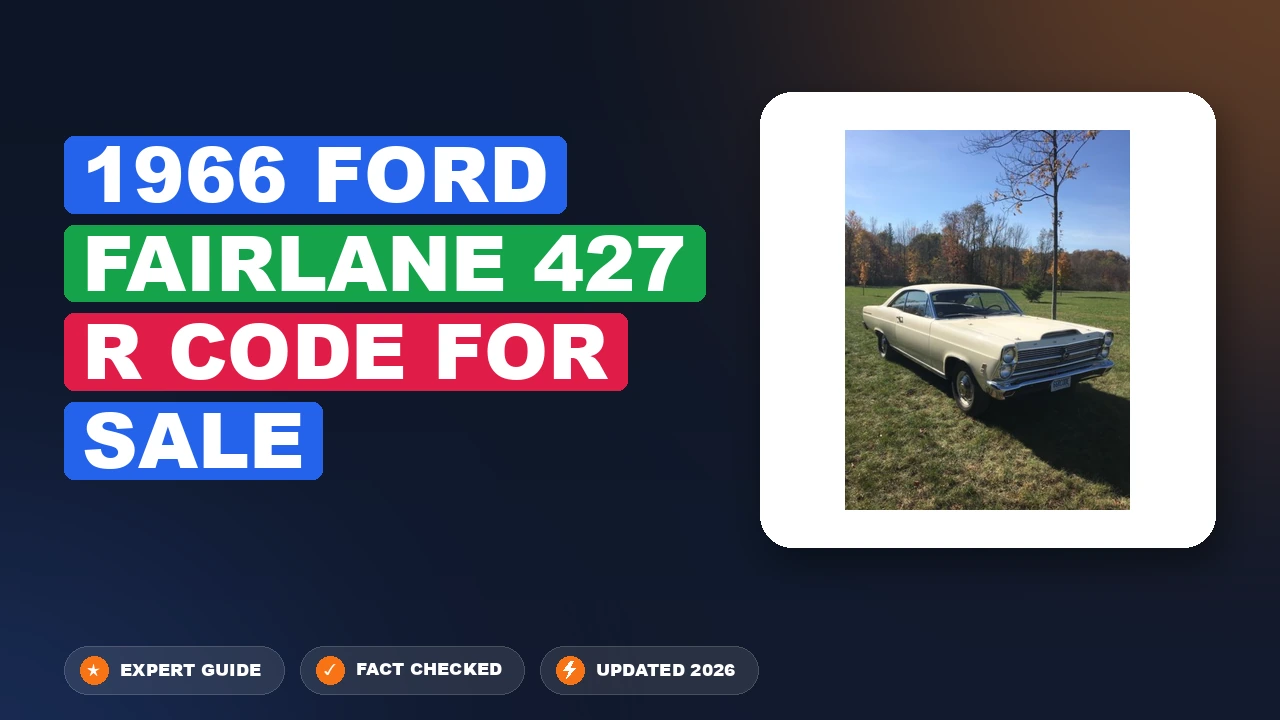
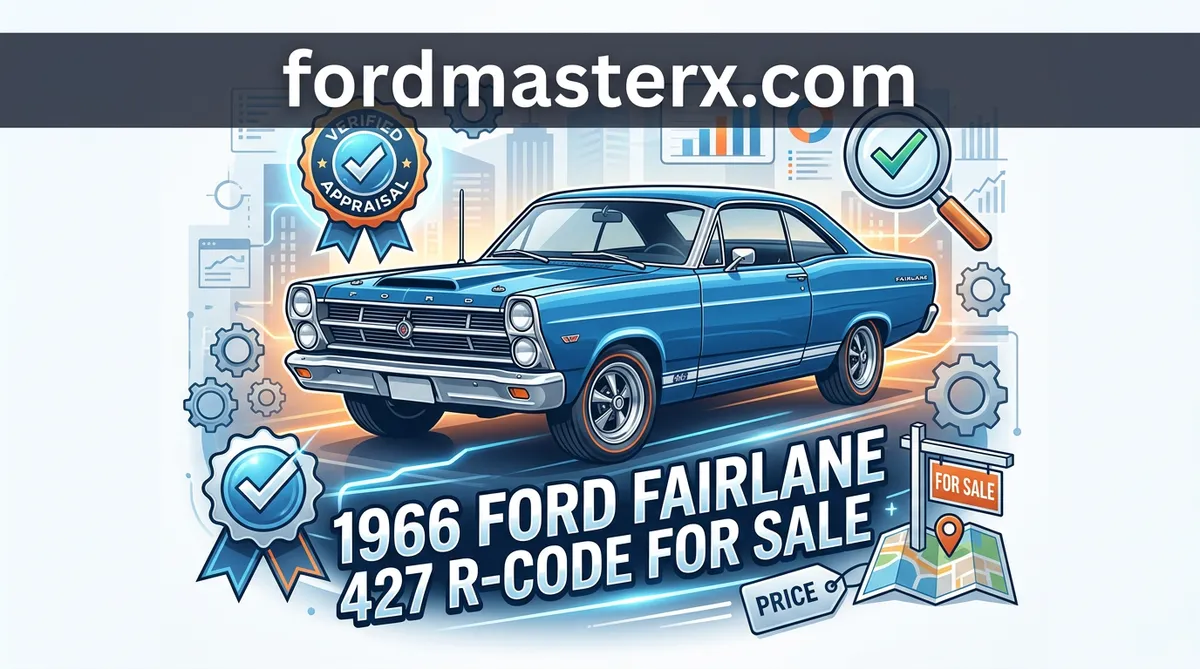
1966 Ford Fairlane 427 R-Code for Sale: Verified Appraisal

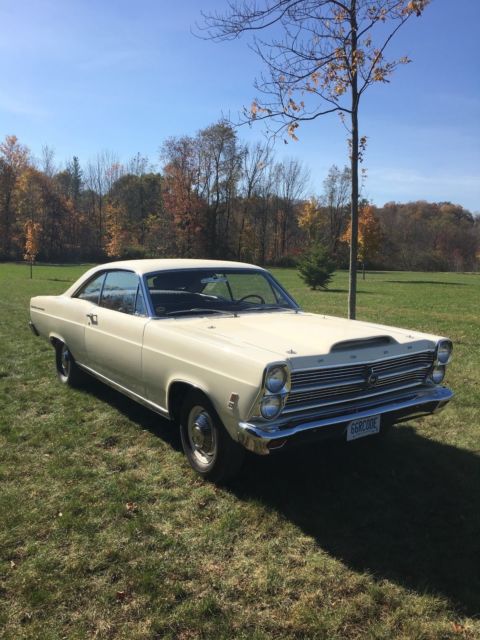
The 1966 Ford Fairlane 427 R-Code is the holy grail for Blue Oval muscle car collectors, representing a brief, violent moment in factory racing history. With extreme rarity comes extreme risk, as the market is flooded with high-end clones and misidentified street performance builds. This guide provides the forensic tools and expert knowledge needed to identify a legitimate R-Code and make a secure investment.

The Legacy of the 1966 Ford Fairlane 427 R-Code for Sale
📤 Share Image
The FE-Series Engine Heritage
At the heart of the 1966 Ford Fairlane 427 R-Code lies the legendary Ford FE-series engine. The 427 cubic-inch V8 was not merely an engine; it was a race-bred powerplant designed to dominate. Unlike the standard 390 GT, which served the general public, the 427 R-Code utilized the “side-oiler” block. This design improved oil flow to the main bearings under sustained high-RPM racing conditions, a critical requirement for endurance and drag racing applications. The FE engine family, known for its deep-skirt block design, provided the structural rigidity necessary to handle the immense torque generated by dual-quad carburation.

NASCAR Homologation Origins
The “R-Code” designation is synonymous with homologation. Ford manufactured these vehicles specifically to satisfy the requirements for NASCAR and NHRA competition. These were not luxury items. They were stripped-down, performance-first machines that omitted creature comforts like power steering or air conditioning in favor of weight reduction and track readiness. When you examine a 1966 Ford Fairlane 427 R-Code for sale, you are looking at a factory-produced weapon that was intended to be taken straight to the strip.
Comparing the GT vs. the R-Code
It is vital for any collector to distinguish between the Fairlane GT and the R-Code. The GT was a trim level available to the public, usually featuring the 390 V8. While a respectable performer, it was a street car. The R-Code, by contrast, featured the high-compression 427, heavy-duty cooling, and a reinforced suspension system. The R-Code wasn’t about upholstery or trim; it was about internal component strength.
Authenticating a 1966 Ford Fairlane 427 R-Code for Sale
📋
Authentication Procedures
The Vehicle Identification Number (VIN) must contain the ‘R’ engine code. This digit represents the specific 427 engine option. Cross-reference this with the door data plate to ensure the scheduled production date and paint/trim codes align with the R-Code production cycle.
Authentic 427 FE engines feature specific casting numbers. Look for “C6AE-R” or “C6AE-U” markings on the side of the engine block. A genuine side-oiler will have the oil gallery passages relocated, a feature that distinguishes it from lesser FE blocks.
The intake manifold should be the correct medium-riser dual-quad unit, fitted with the original-style Holley carburetors. Examine the linkage setup and fuel lines; high-quality, professional restorations will use period-correct hardware, while clones often use mismatched or modern generic parts.
Technical Specifications and Performance Information
Understanding the raw capability of these machines requires a clear look at their factory configuration. Below is a comparison of the legendary 427 against more common engine options of the era.
Drivetrain and Chassis Requirements
The R-Code was almost exclusively mated to a heavy-duty Toploader 4-speed manual transmission. The rear end was the bulletproof 9-inch unit, often equipped with limited-slip differentials to handle the massive torque loads. When evaluating a vehicle for sale, ensure the transmission housing bears the correct casting marks for the 427-spec units, as many lower-tier transmissions will fail under the stresses that these engines were designed to produce.
By The Numbers
Cubic Inches Displacement
Factory Rated Horsepower
Avoiding Market Pitfalls with 1966 Ford Fairlane 427s
Common Clone and Tribute Red Flags
The market for muscle cars is rife with “tributes” or “clones.” These are often standard Fairlanes that have had 427 badges and engine swaps installed to mimic an R-Code. A telltale sign is the VIN; if the car lacks the ‘R’ code in the chassis number, it is not a factory R-Code. Furthermore, scrutinize the vehicle’s history. A genuine R-Code will typically have a paper trail—racing logs, original purchase invoices, or documented ownership transfers that can be verified through trusted registries.

Audible — Listen Free for 30 Days
One free credit a month and thousands of titles included.
Listen Free for 30 Days As an Amazon Associate I earn from qualifying purchases.Distinguishing S-Code Street Performance from R-Code
Collectors often confuse the street-performance “S-code” (usually representing 390 high-performance configurations) with the race-bred “R-code.” While both are Ford products, their engineering philosophies are diametrically opposed. The S-code was designed for the highway; the R-code was designed for the win light. Do not accept a seller’s claim that a 427-equipped S-code car is an R-Code—it is fundamentally a different class of vehicle.
Beware of “numbers-matching” claims without physical verification. Many engines have been restamped to look factory-correct. Always have an independent appraiser verify that the date codes on the block, transmission, and rear end fall within the correct production window for the car’s VIN.
Reliable Appraisal and Final Purchase Guidance
The value of a legitimate 1966 Ford Fairlane 427 R-Code is substantial, making the cost of a professional appraisal a necessary investment. A qualified appraiser understands the nuances of FE engine production and the assembly plant standards of the mid-60s. They provide an objective, expert-level assessment that protects your capital. Never rely solely on a seller’s assurance; independent verification is the standard for high-value collector cars.
✅ Why Authenticity Matters
- Ensures investment appreciation
- Validates historical significance
- Confirms engineering integrity
- Provides peace of mind
❌ Investment Risks
- High-end clone misrepresentation
- Unverifiable engine internals
- Restamped block fraud
- Documentation inconsistencies
Always request clear photos of the engine block casting numbers and the VIN tag before traveling to view a car. These are the two most critical data points; if a seller is reluctant to provide them, consider it a major red flag.
Securing a 1966 Ford Fairlane 427 R-Code is an achievement for any serious collector. By focusing on the VIN, verifying the engine block’s “side-oiler” provenance, and relying on professional appraisal, you ensure your purchase is based on fact rather than speculation. Always verify that the ‘R’ designation is present, inspect the casting numbers for accuracy, and maintain a focus on provenance documentation. Before signing the bill of sale, ensure you have an independent expert conduct a full visual and historical inspection to confirm you are acquiring a genuine piece of Ford’s racing heritage.
1966 Ford Fairlane 427 R-code for Sale: Frequently Asked Questions
How many 1966 Fairlane R-Codes were produced?
While exact factory records are often subject to debate due to Ford’s internal manufacturing processes for competition cars, historians and marque experts generally agree that between 57 and 60 units of the 1966 Fairlane 427 R-Code were built. Because these were intended primarily for drag racing, very few exist today in their original, numbers-matching configuration, making them extremely rare in the collector market.
Are these cars street-legal?
Yes, the 1966 Ford Fairlane 427 R-Code was manufactured as a factory production vehicle, meaning they left the assembly line as street-legal automobiles. However, because they were designed for competition, they are incredibly loud, have stiff racing suspensions, and are prone to overheating in modern traffic. Most owners today drive them sparingly, primarily for exhibition and show purposes rather than as daily drivers.
What is the difference between an R-Code and a standard 427?
The ‘R-Code’ designation specifically denotes a factory-installed 427 cubic-inch V8 engine, typically featuring the ‘Side Oiler’ block design and dual four-barrel carburetors. While other Fairlanes could be ordered with various V8 options, the R-Code was a specialized high-performance engine package built with heavy-duty internal components specifically for drag racing. Standard 427s may refer to engines installed in other Ford platforms, but the R-Code Fairlane is a unique, competition-bred factory build.
How do I spot a fake R-Code Fairlane?
The most common way to spot a fake is to check the VIN; if the fifth character is not an ‘R’, it is not a factory-built 427 car. Furthermore, authentic R-Codes feature specific chassis reinforcements and factory-welded engine mounts that are difficult and expensive to replicate perfectly. Always compare the body tag and the VIN against a verified Marti Report to ensure the vehicle matches its original build sheet.
Should I purchase an R-Code for investment purposes?
Purchasing a genuine R-Code Fairlane is a significant investment that requires expert verification. When authenticated, these vehicles are considered blue-chip assets in the muscle car world, often appreciating steadily. However, buying a clone masquerading as an original is a financial risk. Always hire a professional appraiser who specializes in 1960s Ford performance vehicles to provide a formal report before committing to a purchase.
Audible Premium Plus — Annual Membership
12 audiobook credits up front, plus the full Audible catalogue.
See Annual Plans As an Amazon Associate I earn from qualifying purchases.