Ford Remote Start Not Working? An Expert Diagnostic Guide to Troubleshooting Key Fob, FordPass, and Module Lockouts

The remote start system (RSC) integrated into modern Ford vehicles, whether activated via the key fob or the FordPass mobile application, is a complex subsystem governed by the Powertrain Control Module (PCM) and the Body Control Module (BCM). When the remote start function fails, it is rarely due to simple breakage.
Instead, the system is designed to trigger a hard lockout, indicating that a critical prerequisite condition has not been met, often as a safety or security precaution. Understanding the diagnostic logic requires classifying the failure based on the activation source: Radio Frequency (RF) communication (key fob) or cellular communication (FordPass app via the Telematics Control Unit or TCU).
The Crucial Role of Remote Start System Prerequisites
Ford’s remote start system functions under a set of stringent interlocks. These mandatory conditions must be verified by the vehicle’s central computers before the starter sequence is authorized. Failure to meet even one of these conditions results in an immediate rejection of the command. For a successful operation, the system confirms not only the correct command input but also the vehicle’s safe operating environment, ensuring the vehicle is stationary and secure.
The Essential Activation Sequence Review
Before engaging in advanced diagnostics, it is essential to confirm the correct operational protocol, which often varies slightly based on the vehicle model and key fob type (integrated keyhead versus Intelligent Access). Generally, the process requires two specific actions in quick succession: first, the user must press the lock button on the key fob to secure the car doors, and second, the dedicated remote start button (often marked with a $2\times$ symbol and a circular arrow) must be pushed two times.
If the command is successful, the vehicle’s exterior lamps will typically flash twice. The engine will run for a duration dependent on the programming (usually 5, 10, or 15 minutes). The run time can be extended up to a maximum duration of 35 minutes by repeating the Lock/Start sequence while the vehicle is already running. A clear indicator of failure during this sequence is the sounding of the horn, unless the “quiet start” feature is enabled in the information display.
Ford Remote Start Diagnostics
Is your F-150, Explorer, or Escape refusing to start? Use this interactive data guide to identify the culprit, from the Battery Management System (BMS) to simple key fob failures.
Why Did It Fail?
Analysis of common service requests indicates that nearly half of all remote start failures are related to the Key Fob battery or signal, rather than a mechanical engine fault.
The Voltage Cut-Off
Ford’s Battery Management System (BMS) aggressively protects starting power. As your main car battery degrades or loses charge, remote start is the first feature to be disabled.
Diagnostic Decision Tree
Fix Engine Issue.
Check Hood/Doors.
Change CR2032.
Horn Chirp Decoder
The car often tells you exactly what is wrong via the horn. Listen closely when you attempt the start sequence.
| Chirps | Meaning |
|---|---|
| No Chirp | Ignition On or Key Fob Dead |
| 1 Chirp | Door/Hood Open or Low Fuel |
| 2 Chirps | Brake Pressed or Key in Ignition |
| 3 Chirps | Remote Start Disabled by Admin |
The Hard Limit
Maximum remote starts allowed in one hour.
Cycle Ignition ON/OFF to reset.
© 2025 FordMasterX Infographics. Data sourced from manufacturer owner manuals.
The Basic Prerequisite Checklist and Initial Feedback
When the remote start command is issued and fails, the first steps involve validating the state of the vehicle itself. These mechanical and electrical prerequisites act as fundamental safety interlocks programmed into the BCM.
Critical Conditions That Prevent Ignition (The Mandatory Lockouts)
A remote start failure is frequently attributable to one of the following eight mandatory conditions not being met. These lockouts are intentionally enforced by the vehicle’s safety logic:
- Ignition Status: The vehicle’s ignition must be completely off.
- Transmission Position: The transmission selector must be securely engaged in Park (P).
- Physical Closures: The hood must be completely closed, and all doors and the trunk/liftgate must be fully latched.
- Alarm Status: The vehicle’s integrated alarm system cannot be active or triggered.
- Feature Disablement: The remote start feature must not have been manually disabled via the vehicle’s settings menu.
- Battery Voltage: The primary vehicle battery voltage must be sufficient; if the voltage is too low, the system will disable remote start functionality to preserve power for manual ignition.
- Diagnostic Trouble Codes: The presence of an active “Service Engine Soon” light indicates a fault that is severe enough to prevent remote, unsupervised operation.
Interpreting Key Fob LED Status: The Blinking Red Alert
Analyzing the feedback mechanism on the key fob is critical for determining the nature of the fault. The LED status offers immediate diagnostic information, separating signal communication failures from vehicle-side lockouts.
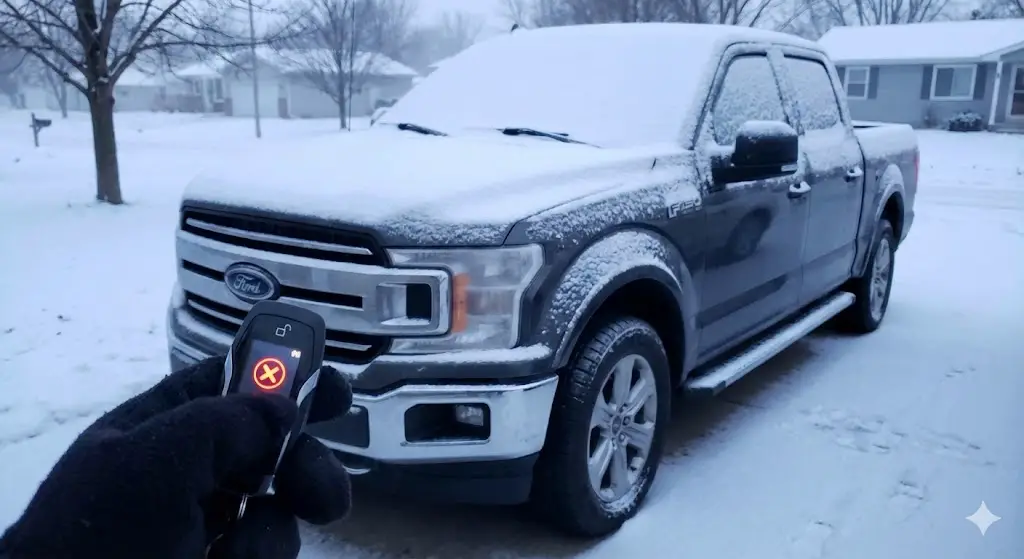
A Blinking Red light on the key fob is one of the most significant diagnostic clues. This status confirms that the key fob successfully transmitted the remote start signal and that the vehicle’s receiver (often part of the BCM) acknowledged the signal. However, the subsequent blinking red indicates that the vehicle’s internal logic ultimately rejected the command because a safety prerequisite (like an open door or a stored fault code) was detected. If the LED fails to light up entirely, the problem is often the fob battery or distance. If the LED blinks red, the problem lies within the vehicle’s electronics.
The following table provides a breakdown of the remote control feedback status:
Key Fob LED Status Diagnostic
| LED Status | Indication | Significance |
| Solid Green | Remote Start/Extension Successful | Command accepted; system active. |
| Solid Red | Remote Stop Successful; Vehicle Off | Command accepted; engine stopped. |
| Blinking Red | Remote Start or Stop Failed | Vehicle received the signal but denied the request due to a lockout condition. |
| Blinking Green | Awaiting Status Update | RF signal delay; system is waiting for success/failure confirmation. |
Hardware Lockouts and Sensor Failures (Cost-Effective Fixes)
If the key fob indicates a “Blinking Red” failure, attention must shift to specific hardware components known to trigger hard lockouts, particularly the safety interlocks.
3.1 The Hidden Culprit: The Hood Ajar Switch/Sensor Failure
Among the most commonly overlooked sources of remote start failure is the hood ajar sensor, often referred to as the hood pin sensor. This sensor is a non-critical component in normal vehicle operation but serves as a mandatory safety interlock for remote start. Its primary purpose is to prevent the engine from starting remotely while a mechanic or owner is actively working under the hood.
If this sensor fails, becomes corroded, or falls out of alignment, it can perpetually report an “open hood” status to the BCM, regardless of whether the hood is physically closed. Because the BCM strictly enforces the “hood closed” prerequisite, the remote start command will be rejected every time. For advanced users, employing a diagnostic tool with live data logging capabilities (such as FORScan) to read the hood-ajar sensor’s real-time input is the definitive method to confirm this fault. Given that the hood pin sensor is relatively inexpensive, with OEM parts ranging from $18.00 to $25.00, diagnosing and replacing this component is a high-probability, low-cost repair path.
3.2 Key Fob Communication and Reprogramming Reset
If the key fob is unresponsive or fails to produce any LED indication, the primary suspect is a dead key fob battery or a communication error between the fob and the vehicle. After replacing the fob battery, if the remote start remains non-functional, a key fob reprogramming procedure may resolve any electronic communication issues or conflicting settings (such as MyKey restrictions).
The programming procedure generally follows a sequence that forces the vehicle into a learning mode:
- Close all vehicle doors, then open only the driver’s side door, and press the UNLOCK button on the door.
- Turn the ignition from OFF to RUN eight times within a ten-second interval, ensuring the eighth turn ends in the RUN position. This swift cycling is necessary to enter the programming mode.
- Successful entry into programming mode is confirmed when the door locks cycle (lock and unlock) several times. If the doors do not cycle, the procedure must be restarted, often requiring faster key turns.
- Within eight seconds of the locks cycling, press any button on the key fob to be programmed. The doors will cycle again, confirming the fob has been successfully reset for keyless entry functions.
- If multiple key fobs require programming, repeat the button press for each remote within the same eight-second interval.
- Turn the ignition off to exit programming mode.
It is important to ensure that the key being used does not have restriction settings applied that might interfere with remote operation. If the key has conflicting settings, learn How to Program Your Ford MyKey and Clear Restrictions to rule out software limitations imposed by the vehicle.
Electronic Control Module (ECM) and Diagnostic Trouble Codes (DTCs)
One of the most elusive causes of Ford remote start failure stems from the vehicle’s internal protection protocols reacting to stored Diagnostic Trouble Codes (DTCs). This issue extends beyond simple visible faults and often requires specialized diagnostic tools.
4.1 DTCs That Block Remote Start: Going Beyond the Dash Light
The vehicle’s powertrain and body control modules are designed with sophisticated fail-safes. The system operates under the principle that if any electronic fault exists within a critical subsystem, the ability to operate the vehicle without a human operator present (i.e., remote start) must be disabled.
A critical discovery for advanced diagnosis is that stored, pending, or Continuous Memory Diagnostic Trouble Codes (CMDTCs) in modules like the PCM, BCM, or Instrument Panel Cluster (IPC) can prevent remote start even if the standard “Service Engine Soon” or “Check Engine” light is not illuminated on the dashboard. These codes may be low-priority communication errors or transient sensor faults (e.g., an unplugged accessory like running boards, as documented in one case), yet they are still interpreted by the PCM as a system integrity issue.
The resolution pathway is clear: the underlying fault causing the code must be addressed, and then the stored codes must be cleared from the memory of the affected module. Numerous community reports confirm that remote start functionality is instantly restored after codes are successfully addressed and cleared. This requires advanced diagnostic software, such as dealer-level tools or platforms like FORScan, capable of running deep module-specific self-tests to locate these hidden codes that standard OBD-II readers miss.
4.2 BCM Communication Failures and Capacitor Discharge Reset
The Body Control Module (BCM) is the central nerve center responsible for controlling locks, lights, and interfacing with safety interlocks like the remote start system. Internal communications faults within the BCM, sometimes indicated by general communication codes like U1000, can disrupt the remote start command pathway. Before escalating to expensive BCM repair or replacement, a simple reset procedure can often resolve temporary communication glitches.
The BCM hard reset procedure involves discharging the residual electrical charge retained in the module’s capacitors:
- Turn the ignition off and ensure all accessories are shut down.
- Disconnect the negative (black) battery terminal from the vehicle battery.
- Disconnect the positive (red) battery terminal.
- Carefully touch the disconnected positive and negative battery cables together for a few seconds (ensuring neither cable touches the battery posts during this step). This action safely drains any temporary charge stored in the BCM capacitors, forcing a system reset.
- Reconnect the positive terminal, followed by the negative terminal.
If this temporary reset fails, persistent BCM faults often indicate internal hardware failure, requiring repair or replacement, which is typically complex. If this temporary reset fails, you may need a deeper dive into Diagnosing and Clearing Ford Body Control Module (BCM) Fault Codes to uncover permanent network errors.
FordPass and TCU-Specific Connectivity Issues
When remote start fails specifically when initiated through the FordPass mobile application, the diagnosis must focus on the cellular communication pathway controlled by the Telematics Control Unit (TCU).
5.1 The TSB Two-Start Rule: A Software Lockout (FordPass/Lincoln Way)
A critical software limitation often misdiagnosed as a hardware failure is detailed in Ford Technical Service Bulletin (TSB) MC-10176123-0001. This TSB specifically applies to a wide range of 2012–2020 Ford and Lincoln vehicles equipped with a TCU.
The vehicle’s cellular system is programmed to only allow two remote start requests using the MyFord Mobile/FordPass/Lincoln Way mobile applications before imposing a temporary software lockout. After the third command is received without an intervening “vehicle drive event” (i.e., starting the car manually and driving it), the mobile app will display a “Vehicle Failed To Start” message. The system will remain locked until the vehicle is physically started and driven, which resets the remote start counter, allowing the mobile app to function again. This mechanism is designed to prevent excessive cellular traffic or unauthorized stationary idling.
5.2 Troubleshooting TCU Communication Faults (Connectivity Loss)
If the FordPass app consistently fails to connect, start the vehicle, or update its status, it often signifies an internal communications fault or a freeze within the TCU module itself. Since the TCU requires constant power to maintain cellular connectivity, a simple ignition cycle often does not fully reset the unit, leading to persistent connectivity loss.
The high-value, no-cost DIY solution is the fuse pull technique. By locating and removing the specific fuse that powers the TCU for approximately five minutes, the unit is forced into a complete power cycle. This hardware reset can clear temporary communications faults, restoring cellular functionality without requiring expensive dealer diagnostics or replacement. Users have reported that this simple procedure resolved issues for which dealerships had quoted thousands of dollars for unnecessary component replacement.
5.3 TCU Replacement Cost and Programmed Module Installation (PMI)
When the TCU fails internally and cannot be resolved by a fuse pull or software updates, replacement becomes necessary. While a used OEM TCU part may be obtainable for around $160.00, the professional installed cost can be significantly higher, often reaching the $800 to $1,500 range, with dealer quotes sometimes exceeding $1,200.
This discrepancy is due to the necessity of Programmed Module Installation (PMI). Unlike simple electronic swaps, the TCU contains vehicle-specific configuration data, including the VIN and software calibrations. A new TCU cannot simply be “plopped” into the vehicle; it must be calibrated by a technician who can perform a PMI, transferring the necessary data from the old module (or using “as-built data” if the old module is inoperable) to the new one. Attempting a DIY replacement without this specialized programming will introduce a cascade of new, potentially severe, communication errors.
Comparative Repair Costs and Professional Diagnosis Thresholds
Understanding the potential costs associated with different failure points allows the owner to choose the most economically viable diagnostic route, prioritizing DIY fixes for high-probability, low-cost components.
6.1 Cost Matrix: DIY vs. Professional Repair
The following matrix compares the typical component costs for DIY repair versus the full professional repair cost (including parts, labor, and dealer diagnostic fees) for the most common remote start failure points.
Estimated Repair Costs for Common Ford Remote Start Issues
| Component/Issue | DIY Part Cost Estimate | Professional (Dealer/Shop) Repair Estimate (Parts + Labor) | Primary Symptom |
| Hood Pin Sensor Replacement | $18 – $25 | $100 – $200 | Blinking Red Fob, system reports hood ajar. |
| Stored DTC Clearing (BCM/PCM) | $0 (via owned diagnostic tool) | $150 – $300 (Diagnostic Fee) | Sudden failure, no visible dash light. |
| Aftermarket Remote Start Installation (Comparison) | $150 – $500 (Kit only) | $349 – $450 (Basic installed system) | N/A (Standard for adding functionality). |
| TCU Replacement (FordPass Failure) | $160 (Used OEM Part) | $800 – $1,500 (Dealer required PMI) | Persistent FordPass connectivity loss. |
6.2 When to Escalate to a Ford Dealer or Specialist
While many remote start failures can be resolved through simple resets or inexpensive sensor replacements, there is a clear threshold when professional diagnosis becomes mandatory. If the remote start failure is accompanied by an illuminated Service Engine Soon light, the underlying powertrain fault must be addressed before the remote function will be restored.
Similarly, complex, persistent communication errors—typically indicated by U-codes (e.g., U1000) or network topology faults—require specialized diagnostic tools and expertise to trace the fault back to a specific module or wiring harness failure. These issues often relate to critical network components that directly impact vehicle safety systems, demanding professional intervention. To investigate vehicle-specific issues, learn more about Everything You Need to Know About Ford Technical Service Bulletins (TSBs), as these documents provide crucial diagnostic pathways that may supersede generic troubleshooting steps.
Conclusion
The failure of a Ford remote start system is seldom a sign of mechanical breakdown but rather an electronic lockout imposed by the vehicle’s central control modules. Diagnosis should follow a structured, hierarchical pathway, beginning with zero-cost visual and procedural checks. The highest probability of a swift, low-cost resolution lies in verifying the core prerequisites, particularly the hood ajar sensor status, and addressing common software lockouts.
For key fob users, the Blinking Red light is a directive to check vehicle sensors and hidden Diagnostic Trouble Codes (DTCs). For FordPass users, understanding and applying the TCU fuse pull reset and recognizing the two-start TSB limitation are crucial steps that can often preempt unnecessary and costly dealership repair quotes for module replacement.
Frequently Asked Questions (FAQs)
Q: What does the blinking red light on my key fob mean?
A: A blinking red light on your key fob indicates that the key fob successfully transmitted the remote start command, but the vehicle’s control modules refused the request. This points toward a vehicle-side lockout, usually due to an open door, open hood, low battery voltage, or a stored Diagnostic Trouble Code (DTC) in a key control module.
Q: My remote start fails only when using the FordPass app. Why?
A: This is most commonly due to a specific software lockout enforced by the Telematics Control Unit (TCU). Ford limits the number of remote start attempts to two via the FordPass or MyFord Mobile apps before requiring a “vehicle drive event” to reset the counter. If this is not the cause, the TCU may require a hard reset by pulling its fuse for five minutes.
Q: Can I extend my remote start run time indefinitely?
A: No. While the run time can be extended by repeating the lock/start sequence, Ford vehicles have a fixed maximum total duration, typically 35 minutes, after which the vehicle must be physically started to reset the timer.
Q: Where can I search for official Ford Technical Service Bulletins (TSBs)?
A: Technical Service Bulletins are available directly through the Ford Support Technical Service Information page. TSBs are important supplements to a vehicle’s repair manual and often address recurring electronic or software faults, such as the two-start rule affecting FordPass connectivity.
Q: How much does it cost to install an aftermarket remote starter?
A: The cost for a basic aftermarket remote start system kit alone typically ranges between $150 and $500. However, professional installation by a certified 12-volt automotive electrician, including the necessary hardware and labor, typically ranges from $349 to $450 for a standard, short-range system.