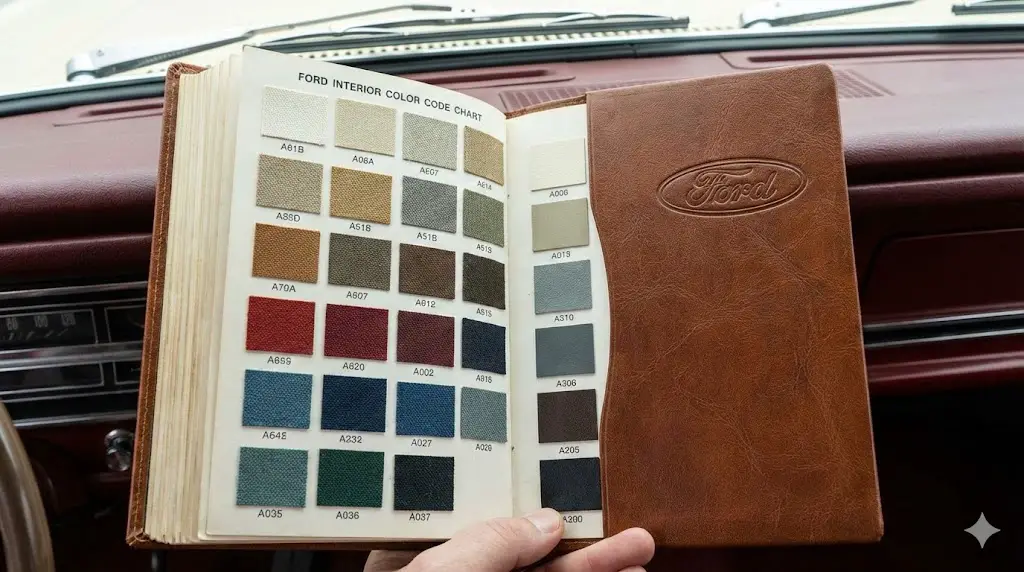
Ford Interior Color Code Chart: Locate & Decode Your INT TR (Expert Guide)

The process of accurately matching or sourcing replacement interior components for a Ford vehicle—whether it involves repairing minor wear on vinyl seats, replacing faded carpeting, or performing a full restoration—begins with one crucial piece of data: the Interior Trim Code. While often colloquially referred to as the “Ford Interior Color Code,” the official terminology used by the manufacturer is the Interior Trim Code, frequently abbreviated on vehicle documentation as INT TR or simply TR.
This alphanumeric designation functions as the vehicle’s primary identifier for all upholstery, plastic components, and soft trim materials, detailing not only the primary color but often the material type (e.g., vinyl, cloth, or leather). Without this exact code, matching repair dyes or factory-correct replacement parts is often an exercise in guesswork, resulting in noticeable variations in shade or texture. The complexity of Ford’s coding lies in its historical variability; the scheme has shifted significantly over the decades, moving from a two-character system defining both material and color in classic cars to a simpler, single-character system for modern vehicles.
Understanding the difference between these schemes is paramount. The short code found on the door jamb is often a family code, defining a general color (such as Flint or Parchment) used across multiple models and materials. However, achieving perfect color fidelity for repair often necessitates cross-referencing this primary code with highly specific, multi-digit numerical dye codes maintained by specialized aftermarket suppliers. These secondary codes, such as 7276 (Med. Dk. Graphite), account for component-specific variations and the impact of material aging, a level of technical specificity that elevates maintenance from simple replacement to factory-level restoration accuracy.
FORD INTERIOR COLOR CODES
The ultimate data-driven guide to decoding your VIN sticker, identifying trim materials, and finding the perfect replacement match.
Why Decode the Code?
Finding the correct replacement seat cover, door panel, or touch-up paint for a Ford vehicle isn’t as simple as guessing “Beige” or “Grey.” Ford uses specific 2-character alphanumeric codes located on the vehicle’s safety label to define the exact material and color palette. Mismatched interiors can devalue a vehicle by up to 15%. This infographic decodes the system.
Step 1: Locate the Sticker
The Safety Compliance Certification Label is your primary data source. It is located on the driver’s side door jamb (B-Pillar). Look for the code under “INT TR” or “TR” (Interior Trim).
*Visual representation of the door jamb sticker.
Step 2: Decode the Syntax
Most modern Ford codes (2000+) use a 2-character format. The first character typically designates the Material (Cloth, Leather, Vinyl), while the second designates the Color.
e.g., Cloth, Leather, Vinyl
e.g., Medium Parchment
Most Common Ford Interior Tones
Based on replacement part data for F-150s, Explorers, and Expeditions (2004-2018), four distinct color families dominate the market. Knowing which “Tan” or “Grey” you have is critical, as they are often visually similar but technically distinct.
Key Color Families
-
Medium Parchment / Camel The classic “Tan”. Extremely common in King Ranch and Lariat trims. Warm, yellow undertone.
-
Medium Light Stone / Flint The “Grey” standard. A cooler, neutral grey widely used in XLT models.
-
Charcoal Black / Ebony Standard for Sport, FX4, and modern Platinum trims. Hides dirt best.
Model Specifics
Certain codes are ubiquitous within specific model lineages. Here are the most frequently searched codes for key Ford trucks.
The Ford Color Palette Matrix
*Colors on screen are approximations. Always verify with OEM swatch.
Evolution of Ford Interior Aesthetics
1990 – 1999
Interiors were bold. “Porno Red”, “Royal Blue”, and Deep Green fabrics were standard options alongside grey. Materials were predominantly velour or heavy cloth.
2000 – 2010
The rise of the “Work Truck”. Colors consolidated to utilitarian “Medium Parchment” (Tan) and “Medium Flint” (Grey). Plastics became harder and more durable.
2011 – Present
Shift towards “Charcoal Black” as the standard. Higher trims introduce specific themes like “King Ranch Java” or “Platinum Ceramic”. Two-tone dashboards become common.
Locating the Ford Interior Trim Code (INT TR): The SCCL Primary Source
For any Ford, Lincoln, or Mercury vehicle, the definitive source of the Interior Trim Code is the manufacturer-affixed certification label.
The Primary Location: The Safety Compliance Certification Label (SCCL)
The official location for the Interior Trim Code is overwhelmingly the Safety Compliance Certification Label (SCCL), which is universally recognized as the door jamb sticker.2 Ford, along with its historical brands Lincoln and Mercury, maintains a consistent practice of affixing this crucial VIN sticker either to the driver's side door or to the driver's side door pillar.3 This placement differs from certain competing manufacturers who may place identification labels in less accessible locations, such as the glove box or spare tire well.
The precise physical location of the SCCL is typically on the door latch post pillar on the driver's side, which is the vertical surface of the body frame that the door latches onto when closed.2 In rare instances, particularly on some older models, the sticker might be found on the interior edge of the driver's front door itself.
Identifying the Code Designation
Once the SCCL is located, the user must identify the specific field containing the interior code. The required code is always labeled specifically as INT TR (Interior Trim) or sometimes abbreviated simply as TR.
This code is one component of a comprehensive set of factory specifications provided on the label, which also includes the Vehicle Identification Number (VIN), the date of manufacture, the exterior paint code (EXT PNT), and various axle and spring codes. The alphanumeric characters listed next to the INT TR designation constitute the official factory trim code needed for parts matching.
The following structure helps visualize the key data fields typically found on the SCCL:
Guide to Finding the Interior Trim Code on Ford Door Jamb Label
| Label Designation | Definition | Location on Label | Typical Format |
| INT TR or TR | Interior Trim/Color Code | Lower section of the SCCL | 1-2 Alphanumeric characters |
| EXT PNT | Exterior Paint Code | Usually near the INT TR field | 2-character code |
| DATE | Date of Manufacture | Upper left of the SCCL | MM/YY |
| AXLE | Axle Ratio Code | Bottom row of the SCCL | Single Letter/Number |
Alternative Identification Methods
Reliance on the physical door jamb sticker can be problematic for older or restored vehicles, where the label may be faded, damaged, or entirely missing due to accident repair or prior modification. For these critical scenarios, authoritative alternatives must be sought.
For vehicles up to five model years old, replacement compliance labels are sometimes available through a Ford Dealer. However, for vehicles older than this period, standard dealer systems may not provide full historical data.2 In such cases, the definitive factory information can be obtained via a Build Sheet or Marti Report (a certified factory options list).
For contemporary models, the dealership can utilize the 17-digit VIN to access the original factory build specifications, which definitively include the INT TR code.6 For a deeper understanding of the primary alphanumeric identifier, consult resources on Understanding Modern Ford Vehicle Identification Number (VIN) Decoders.
Decoding the Code: Understanding Ford's Variable Trim Schemes
Ford has utilized distinct coding philosophies over time. The codes found under the INT TR field must be interpreted based on the vehicle’s era, as a two-character code and a single-character code convey information in fundamentally different ways.
A. Decoding Classic Era Codes (Pre-1980s): Material and Color Intertwined
During the classic and muscle car eras, Ford’s trim codes were highly specific, often consisting of two alphanumeric characters. This system was designed to convey the trim level, material, and color simultaneously.
The Logic of Two-Character Codes
In this scheme, the characters were interdependent:
- Material and Series: The first character or digit often denoted the specific trim level or material composition (e.g., standard, Ranger XLT, Lariat) and whether the seating was all vinyl, or a combination of vinyl and cloth.
- Color: The second character usually specified the primary interior color, such as ‘A’ for Black, ‘B’ for Blue, or ‘T’ for Sand.
This level of detail is critical for high-fidelity restoration. For example, in a 1979 F-Series truck, the code DA specifically denoted "Black all vinyl," whereas the code KA indicated the Lariat trim level with "Black vinyl and black cloth". Similarly, classic Mustangs employed codes that often incorporated two-tone appointments. A 1966 Mustang code of D2 specifies Parchment upholstery with blue trim accents, differentiating it from a solid-color code like 66 for Black. These codes ensure that replacement material matches not only the color but the factory-installed texture and material combination.
B. Decoding Mid-Modern Codes (Approx. 1980s-2000s): Standardized Color Families
As manufacturing processes standardized and interiors became more modular, Ford streamlined the INT TR code to a single alphanumeric character (a letter or a number) typically found on mid-modern vehicles like trucks, SUVs, and standard cars from the late 1990s and early 2000s.
This simplification meant the code defined a general color family rather than a specific material-and-color combination. Common codes such as 2 (Medium Graphite), H (Medium Parchment), and E (Flint) were used consistently across multiple model years (e.g., 1997 through 2008 for the F-Series).
C. Transitioning to Numerical Dye Codes: The Restoration Specialist's Challenge
While the single-character door jamb code identifies the primary color scheme, it is insufficient for precise restoration matching. The door jamb code represents a broad category; for example, the code ‘D’ (Dark Flint, 2003) is a family that encompasses several subtly different shades and material textures used on components like dashboards, door panels, and seat inserts.
To achieve perfect color fidelity, especially when using vinyl dyes or leather repair kits, the owner must cross-reference the short INT TR code with proprietary, multi-digit numerical codes, often four digits long, maintained by specialized automotive upholstery and dye vendors. These numerical codes, like 7276 (Med.
Dk. Graphite) or 7398 (New Med. Parchment), are the true target for specialized color vendors and account for subtle differences between different materials and production runs. For comprehensive guidance on sourcing, refer to specialized guides such as Restoring Your Ford's Interior: Matching Vinyl and Dye Codes.
Master Ford Interior Color Code Charts by Era
To fully address the necessity for accurate identification, the following data tables segment Ford’s coding by era, providing the required context for the codes found on the SCCL.
A. Data Table 1: Vintage Ford Truck Interior Trim Codes (1979 F-Series Example)
This table illustrates the two-character structure used in classic vehicles, where the code explicitly defines the material alongside the color, eliminating ambiguity for restorers seeking factory correctness.
1979 Ford F-Series Truck Interior Trim Scheme Codes
| CODE | Series and Body Type | Color (Primary) | Material Type & Detail |
| AA | F100/350 (81A) | Black and silver | All vinyl |
| AD | F100/350 (81A) | Red | All vinyl |
| AR | F100/350 (81A) | Jade | All vinyl |
| BA | F100/350 (81E, Ranger XLT, Lariat) | Black and silver | All vinyl |
| CB | F100/350 (Ranger XLT) | Blue | Vinyl and blue cloth |
| KA | F100/350 (Ranger Lariat) | Black | Vinyl and black cloth |
| QB | F100/350 (81E Reg/Super Cab) | Blue | Vinyl and blue cloth |
| QT | F100/350 (81E Reg/Super Cab) | Sand | Vinyl and sand cloth |
| SF | F100/350 (Explorer) | Cordovan | All vinyl |
| TT | F100/350 (exc. Explorer) | Sand | Vinyl and sand cloth |
B. Data Table 2: Mid-Modern Ford Truck/SUV Interior Family Codes (1997-2008 Common Codes)
This table represents the common single-character codes used during the transitional period, which defined broad color families across high-volume platforms like the F-150.
Common Single-Character Ford Interior Trim Codes (1997-2008 Examples)
| Model Year Range | INT TR Code | Color Family Name | Associated Material (Typical) | Application Examples |
| 1997-2004 | 2 | Medium Graphite | Cloth/Vinyl | Standard F-Series, Ranger |
| 1997-2005 | X/M | Prairie Tan | Cloth/Pebble Vinyl | F-150, Expedition |
| 1999-2001 | R | Denim Blue | Cloth | F-Series |
| 2000-2003 | H | Medium Parchment | Cloth/Leather | Expedition, Explorer |
| 2002-2007 | E | Flint | Cloth/Leather | Focus, F-150 |
| 2003-2007 | D | Dark Flint | Cloth/Leather | Truck/SUV Premium Trims |
| 2004-2006 | B | Black/Ebony | Cloth/Leather | General Standard Black Interior |
| 2007-2008 | C | Camel/Parchment | Leather | Luxury/Lariat Trims |
C. Data Table 3: Examples of Modern Ford Specific Interior Dye Codes
For the most accurate restoration or repair, the general INT TR code must be refined into a numerical dye code. These four-digit references are critical for matching the precise chemical formulation used for dye application.
Examples of Ford Specific Interior Dye Codes (Post-2000s References)
| Specific Dye Code | Official Ford Color Name | Color Family | Color Shade Insight |
| 7220 | Light Parchment | Tan/Beige | Used for light headliners and pillars |
| 7222 | Dk. Graphite | Gray | Often used for dashboards and floor coverings |
| 7398 | New Med. Parchment | Tan/Beige | Updated formulation of the Parchment family |
| 7441 | Black Ink | Black | A deep, non-metallic black |
| 7530 | Crimson Red | Red | Used primarily in Mustang or performance models |
| 7677 | Dk. Parchment | Tan/Beige | Darker component pieces (e.g., handles) |
| 7731 | Greystone | Gray | A neutral, modern gray tone |
| 8724 | Raven Black | Black | Classic and performance black components |
Advanced Resources and Application: From Code to Color Match
The identification of the INT TR code marks the initial stage of any parts or restoration project; subsequent steps require utilizing this code in conjunction with specialized documentation to ensure material and color accuracy.
Utilizing Third-Party Color Reference Charts for Dyes
The short, one- or two-character INT TR code is a general identifier. For repairs involving vinyl, leather, or plastic dyeing, the code must be cross-referenced with vendor-specific databases to determine the exact numerical dye formula. Companies specializing in automotive upholstery maintain extensive charts that bridge Ford's short trim codes to the corresponding specific dye codes, such as 7677 Dark Parchment.
This level of granularity is vital because interior materials age and fade differently; simply ordering "Medium Graphite" may result in a color mismatch compared to the 20-year-old existing material. This cross-reference process ensures the chosen material or dye perfectly complements the aged components of the vehicle. (Source: Specialized Automotive Dye/Parts Resource ).
The Complementary Nature of Exterior and Interior Codes
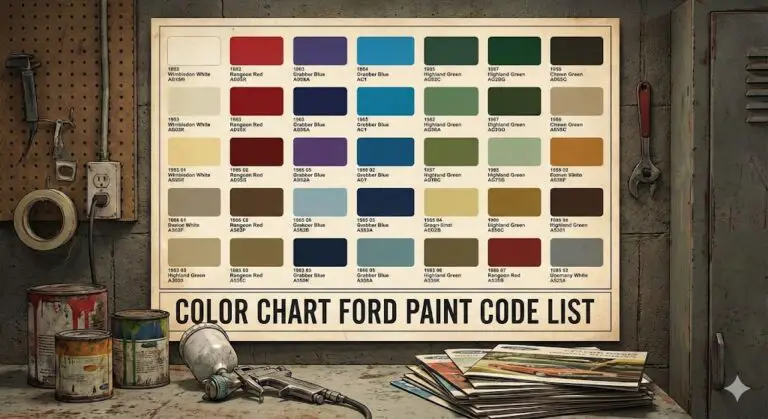
The SCCL is designed as a centralized data repository. The exterior paint code (EXT PNT) is consistently located in close proximity to the INT TR code. Retrieving both codes simultaneously provides a comprehensive record of the vehicle's aesthetic factory specifications, which is essential for insurance claims, bodywork, and complete restorations. For detailed information on the vehicle’s exterior appearance, resources such as Ford Exterior Paint Codes: A Complete Reference Guide should be consulted.
Navigating Missing Documentation and Cross-Manufacturer Confusion
Owners of classic or modified vehicles often find their SCCLs compromised or missing. For older models, official Ford dealer support systems may be limited, leading the manufacturer to recommend contacting customer service for Technical Data Sheets. For definitive archival data on classic Mustangs, Broncos, or F-series trucks, the Marti Report or equivalent Build Sheet provides the full factory record, bypassing any potential errors stemming from previous repairs or faded labels.1 (Source: Historical Automotive Archive/Marti Report reference).
Furthermore, individuals working on multiple vehicle brands must be cautious of practices used by other manufacturers. While Ford standardizes the INT TR location on the driver's door jamb, General Motors (GM) commonly places its interior codes in the glove box or spare tire well, and those codes often follow a different format, potentially ending in the letter "I".
Ford’s consistent door jamb placement across its makes (Ford, Lincoln, Mercury) provides a distinct advantage in ease of access compared to the varied locations used by competitors, but users must adhere strictly to Ford’s specific methodology to avoid code misidentification. (Source: Autowrecking Trim Code Comparison ).
Conclusion: Mastery of Ford Interior Data
Locating and accurately decoding the Ford Interior Trim Code (INT TR) is the foundational requirement for any reliable interior repair or restoration project. The process necessitates moving beyond the simple search term "color code" and embracing the manufacturer’s technical data structure.
The analysis confirms that the code is reliably found under the INT TR designation on the driver's side door jamb SCCL. However, the successful application of this code requires an understanding of Ford’s era-specific logic: distinguishing between the material-and-color-defining two-character codes of the classic era and the broader, color-family single-character codes of the mid-modern era.
Ultimately, the short code is merely the starting point. Factory-level accuracy for restoration, particularly involving color matching, demands that the INT TR code be cross-referenced with specialized vendor charts to identify the specific numerical dye codes. Utilizing the SCCL in conjunction with archival documents (such as Marti Reports for classic vehicles) and specialized aftermarket resources ensures that the final result perfectly replicates the vehicle's original factory specifications.
Frequently Asked Questions (FAQs)
Q: Where exactly is the interior color code located on a Ford?
The Ford interior color code, officially labeled INT TR or TR, is nearly always located on the Safety Compliance Certification Label (SCCL), affixed to the driver's side door jamb (or the door latch post pillar).
Q: Are Ford interior color codes and trim codes the same thing?
Yes. The terms "Interior Color Code," "Upholstery Code," and the official "Interior Trim Code (INT TR)" are functionally synonymous. They all refer to the alphanumeric characters found on the door jamb label that specify the factory interior color and material composition.
Q: How do I find the interior trim code if my door jamb sticker is missing or damaged?
If the door jamb label is damaged, contact a Ford dealership with your Vehicle Identification Number (VIN) for a lookup.6 For classic vehicles (those older than approximately five model years), the definitive factory information can be purchased through a Build Sheet or Marti Report.
Q: What do the two characters in classic Ford trim codes signify?
For classic Fords (such as 1970s trucks), the two-character code is comprehensive: the first character typically denotes the series, trim level, or primary material, and the second character indicates the primary color (e.g., 'CB' signifies a specific trim series using Blue vinyl and Blue cloth).
Q: What is the difference between the door jamb code and the dye code?
The door jamb code (INT TR) identifies the general Color Family (e.g., Flint or Parchment) used across the interior. The specific, multi-digit Dye Code (e.g., 7220 Light Parchment) is a precise numerical reference used by dye and parts vendors for exact color matching on individual components, accounting for material type and potential age differences.