How to Reset the ABS Light on Ford – Step-by-Step Guide 2026

The Anti-lock Braking System (ABS) represents a critical intersection of hydraulic engineering and electronic telemetry in modern Ford vehicles. By modulating brake caliper pressure thousands of times per minute, the ABS prevents wheel lockup during aggressive deceleration, preserving vehicular steering authority. When the ABS warning light illuminates on a Ford dashboard, the vehicle’s internal self-diagnostic protocol has detected a voltage irregularity or mechanical failure within this network.
As a protective measure, the powertrain control module (PCM) disables the anti-lock functionality, though standard hydraulic braking remains operational. Successfully clearing this dashboard warning requires more than a simple scanner reset; it demands a thorough understanding of the root causes, proper recalibration techniques, and occasionally, advanced software intervention.
Understanding the Core Triggers for ABS Light Activation
Before initiating any reset procedure, identifying the mechanical or electronic catalyst is essential. If a physical defect persists, the ABS module will detect the anomaly during its next drive-cycle self-test and immediately trigger the warning light again.
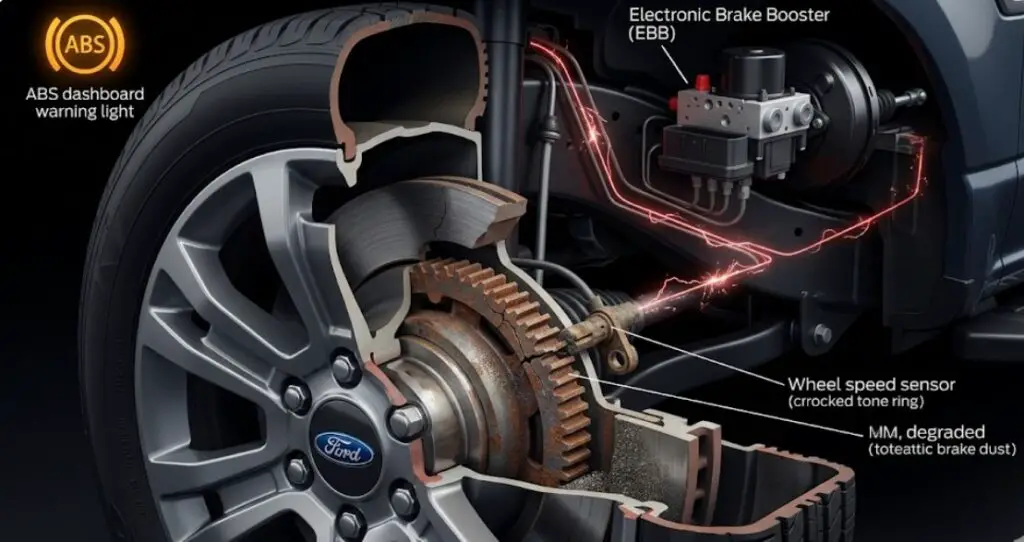
The most frequent culprit across the Ford lineup is wheel speed sensor degradation. Modern Ford architectures utilize a four-channel system with dedicated Hall-effect or variable reluctance sensors at each wheel hub. These sensors continuously monitor a rotating toothed gear known as a tone ring (or reluctor ring).
When a sensor becomes coated in metallic brake dust, or if the tone ring suffers from severe rust and cracks—a documented vulnerability in Ford Escape models—the sensor transmits erratic AC voltage signals to the ABS control module. The module interprets this irregular pulse as an impending wheel lockup, often resulting in a pulsating brake pedal at low speeds followed by an immediate dashboard warning.
Furthermore, catastrophic internal module and hydraulic pump failures are well-documented across specific generations. The 2007 through 2014 Ford F-150 is particularly notorious for an internal short circuit within the ABS module that commands the hydraulic pump motor to run continuously, even when the ignition is turned off.
Similarly, low brake fluid levels resulting from severe brake pad wear or line leaks will trigger a fluid level sensor, illuminating both the ABS and primary red brake warning lights.
Notably, the 2024 and 2025 model years for the Ford F-150, Bronco, Ranger, and Expedition are currently subject to a major safety recall mandated by the(https://www.nhtsa.gov) regarding defective Electronic Brake Boosters (EBB). A gain resistor mismatch within the EBB module can force the vehicle into a fail-safe mode, completely disabling power brake assist while simultaneously illuminating the ABS and Electronic Stability Control lights.
How to Reset ABS Light: Step-by-Step Manual Methods
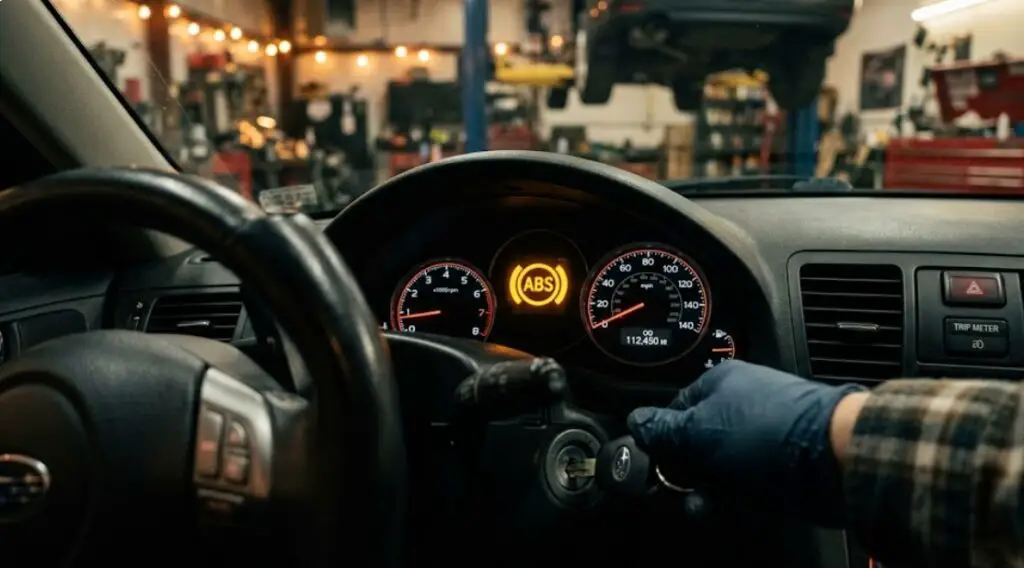
Once a physical repair is completed, such as replacing a severed speed sensor harness or installing a new tone ring, the vehicle’s memory must be cleared. For operators without access to commercial diagnostic scanners, several manual procedures can force the ABS module to reset and recalibrate.
Method 1: The Brake Pedal Recalibration Sequence
For minor communication glitches or transient voltage drops, a manual pedal recalibration can successfully reset the module without tools. The first step involves turning the ignition to the “ON” position without cranking the engine, ensuring all dashboard accessory lights illuminate. Next, the operator must slowly press the brake pedal completely to the floor and release it ten to fifteen consecutive times.
This specific sequence assists the system in releasing minor trapped air pockets within the master cylinder and recalibrates the pedal stroke sensors. Finally, the ignition should be turned off for two minutes before fully starting the engine to verify if the warning light has extinguished.
Method 2: The Battery Disconnect (Hard Reset)
A hard reset forces a complete power drain of the vehicle’s volatile memory. The procedure begins by ensuring the ignition is completely off to prevent electrical surging. Using a wrench, the negative battery terminal must be loosened and completely disconnected from the battery post. The vehicle must remain in this state for twenty to thirty minutes. This waiting period is critical, as it allows all internal capacitors within the ABS control module to discharge entirely.
Once the negative terminal is securely reconnected, the vehicle can be started. It is important to note that while this method clears transient codes, it will also erase radio presets and engine idle learning parameters. If a hard mechanical fault remains, the ABS light will return immediately upon driving.
Method 3: The Ford ABS Self-Test Drive Cycle
In many scenarios, particularly after replacing a faulty wheel speed sensor, the ABS light will remain illuminated immediately upon startup. The Ford ABS module requires dynamic rotational data to verify the repair. The operator must drive the vehicle to an open, safe roadway and accelerate smoothly past 15 miles per hour (24 km/h).
At this precise speed threshold, the ABS module initiates a self-diagnostic ping to all four wheel speed sensors. If the module receives coherent and matching rotational data from all channels, it will automatically clear the active fault code and extinguish the dashboard light.
Advanced Diagnostics and Bleed Procedures Using FORScan
When manual resets fail, or when replacing major hydraulic components, advanced software intervention is mandatory.(https://forscan.org) is a highly specialized diagnostic software utilized extensively by independent Ford technicians and enthusiasts, allowing for dealer-level module programming via an OBD-II adapter.
If a failed ABS module is replaced with a salvage yard or new OEM unit, the vehicle will not recognize the hardware, throwing a VIN mismatch configuration error. Before removing the defective unit, technicians use FORScan to download the specific “As-Built” data file. Once the new module is physically installed, this As-Built data is flashed onto the replacement hardware, correctly configuring the vehicle’s tire size, axle ratio, and powertrain parameters.
Furthermore, if the ABS Hydraulic Control Unit is exposed to air during a replacement, standard manual brake bleeding will not expel the air trapped inside the internal valving. Technicians must navigate to the FORScan “Service Procedures” menu and execute the “ABS Service Bleed” function. This software command forces the hydraulic pump motor to activate and rapidly cycles the internal solenoids, pushing the trapped air out of the ABS block and into the primary brake lines, where it can then be manually bled at the wheel calipers.
Common Ford ABS Diagnostic Trouble Codes (C-Codes)
When an ABS light remains stubbornly illuminated, connecting an advanced OBD-II scanner will reveal specific Chassis codes (C-codes) that pinpoint the exact failure. The following table outlines the most prevalent Ford ABS fault codes to assist in precise diagnostic isolation.
| Diagnostic Trouble Code (DTC) | Official Ford System Definition | Common Diagnostic Action |
| C0031 | Left Front Wheel Speed Sensor | Indicates a circuit short to ground or a wrong mounting position. Inspect the wiring harness for abrasion. |
| C0034 | Right Front Wheel Speed Sensor | Signal contains too many transitions. Typically points to a cracked or missing tooth on the tone ring. |
| C0037 | Left Rear Wheel Speed Sensor | Signal compare failure. Resistance should be verified using a multimeter (expect 900-2000 ohms). |
| C1073 | Pump Motor Control Circuit | Indicates internal failure of the ABS module or pump motor. Prevalent on 2007-2014 F-150 trucks. |
| C1095 | ABS Hydraulic Pump Motor Failure | Points to a blown heavy-duty ABS fuse in the main power distribution box or a burned-out pump motor. |
| B1342 / C1342 | ABS Control Module Malfunction | Represents a catastrophic internal ECU failure. Requires complete module replacement or rebuilding. |
| U0121 | Lost Communication with ABS | A CAN-bus network failure indicating the main computer cannot communicate with the ABS module. |
Visualizing Repair Costs: Sensors vs. Modules
Understanding the financial breakdown of ABS repairs is critical for vehicle owners determining whether to attempt a home repair or seek dealership assistance. Global supply chain shifts and the increasing integration of Advanced Driver Assistance Systems (ADAS) have heavily influenced replacement costs.
| Repair Type | Estimated Parts Cost | Estimated Labor Cost | Total Estimated Cost Range |
| Wheel Speed Sensor Replacement | $31 – $188 | $87 – $128 | $160 – $310 |
| Tone Ring / Hub Assembly | $30 – $250 | $170 – $250 | $200 – $500 |
| ABS Module Rebuild Service | $250 – $300 | DIY / Independent | $250 – $350 |
| New ABS Module (Dealership) | $866 – $1,190 | $152 – $448 | $1,186 – $1,400+ |
Is It Safe to Drive With the ABS Light On?
A dominant concern regarding ABS system failure relates to roadway safety. According to the official Ford Owner manual documentation, an illuminated ABS light indicates that the anti-lock feature is offline, but standard hydraulic braking remains fully functional.
However, NHTSA safety guidelines emphasize the underlying risks. While a vehicle can be safely driven to a repair facility, it loses its ability to prevent wheel lockup during panic stops. This severely reduces the driver’s ability to maintain steering control when evasive maneuvers are required on wet or icy pavement. If the ABS light illuminates simultaneously with the primary red brake light, it signifies a critical loss of hydraulic fluid or pressure, and the vehicle must not be driven under any circumstances.
In-Depth FAQ
Why are both the ABS and “Service AdvanceTrac” lights illuminated simultaneously?
AdvanceTrac is Ford’s proprietary electronic stability control system. This system does not possess its own wheel speed sensors; rather, it relies entirely on the telemetry data provided by the ABS module. Therefore, if a single wheel speed sensor fails or a tone ring cracks, the ABS module goes offline. Because AdvanceTrac is subsequently starved of rotational data, it also fails, triggering both warning lights simultaneously.
Why does my Ford F-150 ABS pump run continuously even when the key is removed?
This is a hallmark symptom of a failed internal relay within the ABS control module, predominantly affecting 2007 through 2014 Ford F-150 models. The module internally shorts to the battery, supplying constant 12-volt power to the pump motor. To prevent rapid battery drain, the primary 60-amp ABS fuse in the under-hood power distribution box must be manually removed until the module can be rebuilt or replaced.
Can low tire pressure or mismatched tires trigger the ABS light?
Yes. The ABS control module relies on identical rotational speeds across all four wheels to maintain system coherency. If a vehicle is driven with a significantly under-inflated tire, or if a spare tire of a different overall diameter is installed, that specific wheel will rotate at a fundamentally different velocity. The ABS module interprets this continuous speed variance as a sensor failure or a permanent loss of traction, thereby triggering the ABS and AdvanceTrac warning lights and logging a C1222 (Speed Wheel Mismatch) trouble code.
Will a basic OBD-II scanner reset an ABS code?
Standard budget OBD-II scanners only read generic Powertrain (P-codes) related to engine emissions. Because the ABS operates on a completely separate network module, clearing an ABS light requires a scanner explicitly marketed with “ABS/SRS functionality” to successfully access and erase Chassis (C-codes).