Ford F-250 Bed Size Chart & Dimensions Guide: The Definitive Resource (1999–2026)

The Ford F-250 Super Duty is not merely a vehicle; it is a foundational implement of North American industry, agriculture, and recreation. Since its divergence from the light-duty F-150 platform in 1999, the Super Duty has defined the parameters of the heavy-duty pickup segment. While horsepower and torque figures often dominate the marketing discourse, the geometry of the cargo box—the bed—remains the single most critical variable for the truck’s utility.
Whether for a fleet manager calculating the cubic yardage of mulch a crew can haul, a contractor determining if a pallet of drywall can sit flat between the wheel wells, or an RVer assessing the center of gravity for a 3,000-pound slide-in camper, the precise dimensions of the F-250 bed are the arbiter of capability.
This comprehensive report provides an exhaustive analysis of Ford F-250 bed sizes across the model’s entire history, with a specific focus on the engineering shifts that occurred during the transition from the steel-bodied “Gen 1-3” eras (1999–2016) to the aluminum-alloy “Alumi-Duty” eras (2017–Present). We will explore not just the static length and width measurements, but the dynamic implications of bed height on fifth-wheel towing, the impact of box depth on cargo volume, and the structural nuances that affect aftermarket fitment.
Ford F-250 Bed Size Chart & Dimensions
The ultimate data-driven guide to choosing between the 6.75′ Standard Bed and the 8′ Long Bed.
Standard Bed
6.75 ft
Long Bed
8.0 ft
Selecting the right bed size for your Ford F-250 Super Duty isn’t just about aesthetics—it defines your truck’s capability. Whether you are hauling 4×8 plywood sheets, fitting a fifth-wheel hitch, or trying to park in a standard garage, the difference between the 6.75-foot Standard Bed and the 8-foot Long Bed is critical. This guide breaks down the exact dimensions, cargo volumes, and payload implications to help you decide.
Core Dimensions: The Tale of the Tape
While the bed length is the obvious differentiator, understanding the floor width and the distance between wheelhouses is vital for contractors. Note that both bed sizes share the same width specs; the gain is purely in longitudinal cargo space.
Linear Dimensions Comparison (Inches)
Standard Bed (6.75′)
- Length (Floor): 81.9″
- Width (Max): 66.9″
- Width (Wheelhouse): 50.5″
- Tailgate Height: 21.1″
Long Bed (8.0′)
- Length (Floor): 98.1″
- Width (Max): 66.9″
- Width (Wheelhouse): 50.5″
- Tailgate Height: 21.1″
Cargo Volume Analysis
For bulk material hauling like mulch, gravel, or debris, cubic footage is king. The Long Bed offers roughly 20% more cargo volume than the Standard Bed. This chart visualizes that dominance.
Volume Efficiency
While the Standard Bed is sufficient for most recreational towing and light duty work, the Long Bed maximizes the F-250’s footprint.
Data Source: Ford Technical Specifications (2024 MY)
Total Cargo Volume (Cu. Ft.)
Cab & Bed Configurations
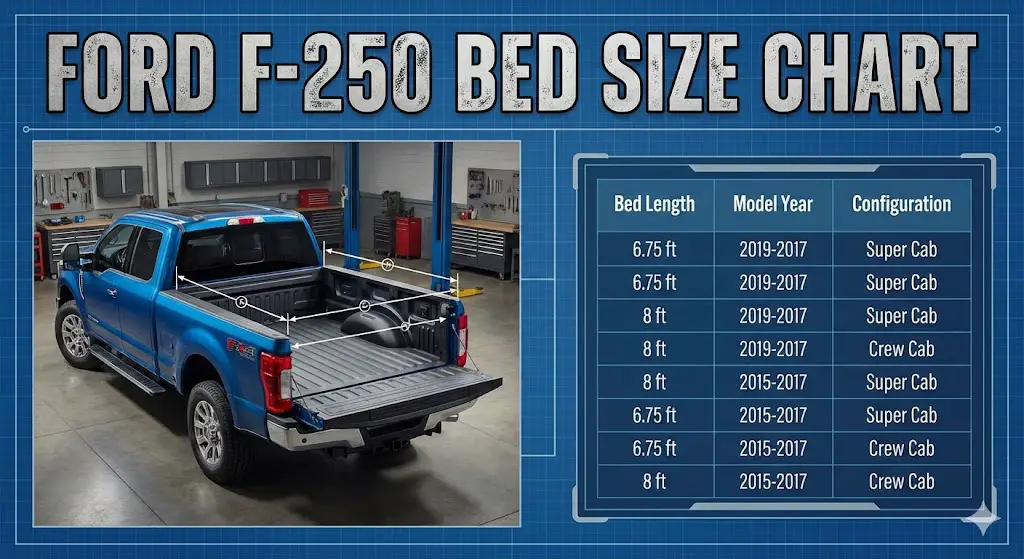
Not every bed size is available with every cab style. Use this matrix to check the availability of your desired configuration.
| Cab Style | Standard Bed (6.75′) | Long Bed (8.0′) | Wheelbase (Inches) |
|---|---|---|---|
| Regular Cab | ✕ | ✓ | 141.6″ |
| SuperCab | ✓ | ✓ | 148.0″ / 164.2″ |
| Crew Cab | ✓ | ✓ | 159.8″ / 176.0″ |
Real-World Versatility Analysis
Choosing a bed size involves trade-offs. The Long Bed excels at hauling but suffers in urban maneuverability. The Standard Bed offers a balanced daily driving experience but limits 5th-wheel towing clearance and bulk hauling.
Versatility Score Comparison
Parking & Maneuverability
The Long Bed adds nearly 17 inches to the wheelbase on Crew Cabs, making standard parking spaces and drive-thrus significantly more difficult to navigate.
5th Wheel / Gooseneck Towing
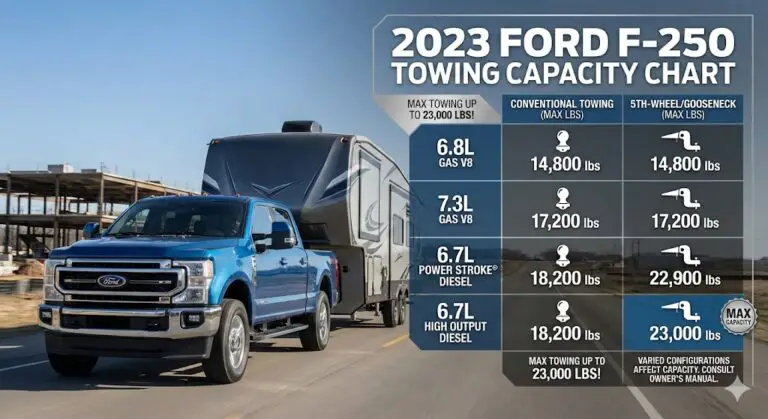
Long Beds are superior for 5th-wheel towing. The extra length allows the trailer nose to clear the cab during tight turns without requiring an expensive sliding hitch.
Resale Value
Long beds generally hold value better in commercial markets, while Standard beds are more desirable in the personal use/family luxury market.
Payload Capacity Dynamics
Heavier trucks have lower payloads because the Gross Vehicle Weight Rating (GVWR) is fixed. A Long Bed truck is physically heavier than a Standard Bed truck (due to more steel/aluminum), which can slightly reduce max payload unless equipped with heavy-duty packages.
Estimated Payload vs. Truck Weight
Comparing approximate payload across engine options (Gas vs Diesel) and Bed Sizes.
Frequently Asked Questions
Can I fit a 4×8 sheet of plywood in the 6.75′ bed?
Yes, the width between wheelhouses is 50.5″, so the sheet lays flat. However, since the bed is only 81.9″ long, the plywood will hang over the edge unless you leave the tailgate down.
Does the bed size affect the towing capacity?
Indirectly. While the engine and axle ratio are the primary factors, the longer wheelbase of the 8′ bed provides better stability for towing heavy trailers, especially in windy conditions.
Which bed size is better for a camper shell?
The 8′ Long Bed is vastly superior for slide-in truck campers due to the center of gravity placement and increased volume for amenities.
The Evolution of the "Standard" Bed
Unlike the half-ton segment, where a 5.5-foot bed has become the suburban norm, the F-250 has steadfastly maintained a 6.75-foot (81.9-inch) bed as its "short" option. This decision is rooted in the physical dimensions of standard construction materials and the wheelbase requirements for heavy towing stability. Understanding this distinction is vital for cross-shopping; a "short bed" F-250 offers significantly more utility volume than a short bed F-150, altering the value proposition for mixed-use buyers.
The Data Landscape
The analysis presented herein synthesizes data from Ford Body Builder Layout Books, technical service bulletins (TSBs), and real-world measurement databases. We address the "Tall Bed" phenomenon of 2017, where increased rail height disrupted the fifth-wheel market , and we dissect the cargo volume gains achieved by deepening the bed floor. This report serves as a singular reference point for verifying compatibility for tonneaus, caps, campers, and gooseneck hitches.
Master Ford F-250 Bed Size Charts (2017–2024)
The current generation of Super Duty trucks represents a radical departure in manufacturing philosophy. The shift to military-grade aluminum alloy in 2017 allowed Ford engineers to redesign the cargo box from the frame up. The primary goal was to increase cargo volume without widening the vehicle's footprint, achieved by deepening the bed and flattening the interior side walls.
2017–2024 Dimensional Specifications
The following data applies to the aluminum-body F-250s. Note that while the front fascia and interior were refreshed in 2020 and 2023, the internal cargo box dimensions have remained structurally consistent to ensure continuity for upfitters.
| Feature | 6.75-Ft Box (Standard/Short) | 8-Ft Box (Long Bed) |
| Cargo Box Volume | 65.4 cu. ft. | 78.5 cu. ft. |
| Inside Length (At Floor) | 81.9 in. | 98.1 in. |
| Inside Length (At Top Rail) | 80.3 in. | 96.4 in. |
| Width (Maximum at Floor) | 66.9 in. | 66.9 in. |
| Width (Between Wheelhouses) | 50.5 in. | 50.5 in. |
| Inside Height (Depth) | 21.1 in. | 21.1 in. |
| Tailgate Opening Width | 60.5 in. | 60.5 in. |
| Rear Opening Height | 36.5 in. (approx) | 36.5 in. (approx) |
| Exterior Bed Width | 80.0 in. (SRW) | 80.0 in. (SRW) |
Analysis of the 21.1-Inch Depth
The most significant metric in the chart above is the 21.1-inch inside height. Previous generations of the F-250 (and competitor trucks) traditionally hovered around 20 inches of depth.
- Volume Increase: This 1.1-inch increase, combined with more vertical inner walls, creates an additional ~2-3 cubic feet of storage space compared to older models. For loose material hauling (gravel, mulch), this is a tangible benefit.
- Ergonomic Cost: The deeper bed pushes the bed rails higher. For an average-height adult standing beside the truck, reaching over the rail to retrieve an item from the bed floor is now difficult or impossible without stepping on the tire or running board. This dimension drove the necessity for the integrated tailgate step and the bumper corner steps introduced in the 2023 facelift.
Wheelhouse Clearance
The 50.5-inch width between wheelhouses is a non-negotiable industry standard. It ensures that 48-inch wide sheet goods (plywood, drywall, MDF) can lie flat on the bed floor.
- Bed Liner Warning: While the metal floor offers 50.5 inches, installing a thick "drop-in" plastic bed liner can reduce this width by 1.5 to 2 inches, potentially narrowing the gap to under 48 inches. This creates a situation where plywood sheets must sit at an angle, prone to warping. Owners planning to haul sheet goods should prioritize spray-in bed liners (like the Ford Tough Bed) which add negligible thickness (~0.125 inches), preserving the critical 50.5-inch clearance.
Historical Analysis: The Steel Era (1999–2016)
For the used truck market and owners of legacy vehicles, understanding the "Steel Body" dimensions is crucial. Millions of these trucks remain in service, and their bed geometry differs subtly but significantly from the modern aluminum trucks. Accessories are generally not interchangeable between the 1999–2016 and 2017+ generations due to differences in bulkhead shape, tailgate curvature, and rail length.1
First Generation (1999–2007)
When the Super Duty launched in 1999, it established the "long haul" capabilities of the brand.
- Standard Bed: 6.75 feet (81.8 inches at floor).
- Long Bed: 8 feet (98 inches at floor).
- Depth: ~20.0 - 20.1 inches.
- Cargo Volume: ~64.7 cu. ft. (Long Bed) / ~53-56 cu. ft. (Short Bed approx).
- Width: 50.9 inches between wheel wells.
Insight: The 1999–2007 beds are noticeably shallower than modern beds. This lower profile makes them highly desirable for towing older fifth-wheel trailers, as the risk of bed-rail contact during articulation is minimized.
Second and Third Generations (2008–2016)
The "Gen 2" (2008-2010) and "Gen 3" (2011-2016) Super Duty trucks saw massive powertrain updates (introduction of the 6.7L Power Stroke) but relatively static bed dimensions. This stability allowed for a thriving aftermarket of camper shells and tonneau covers that could migrate between model years.
Table: 2011–2016 Bed Specifications
| Dimension | 6.75-Ft Bed | 8-Ft Bed |
| Length (Floor) | 81.8 in. | 98.0 in. |
| Width (Wheelhouse) | 50.9 in. | 50.9 in. |
| Depth | 20.0 in. | 20.0 in. |
| Cargo Volume | 64.1 cu. ft. | 77.3 cu. ft. |
Key Variance - The Cab-to-Axle (CA) Ratio:
While the bed length remained similar, the chassis geometry evolved. The 2011 frame strengthening altered the receiver hitch structure, which impacts how frame-mounted tie-downs for campers are attached. A Torklift tie-down kit for a 2010 model will likely not fit a 2011 model despite the bed sheet metal appearing identical.
The "Fitment Gap" (2016 vs. 2017)
The transition from 2016 to 2017 is the "hard break" in F-250 compatibility.
- Length Mismatch: The 2017 bed is slightly longer (81.9" vs 81.8").
- Taper: The 2017+ bed tapers more towards the rear to improve aerodynamics.
- Tailgate: The 2017+ tailgate is thicker and has a different latch mechanism.Implication: A fiberglass topper (camper shell) from a 2016 F-250 will not fit a 2017 F-250. The rail curvature and cab-to-bed gap are different. Attempting to force fitment will result in paint damage to the back of the cab or gaps that allow water intrusion.
Short Bed (6.75') vs. Long Bed (8'): A Strategic Selection Guide
The choice between the 6.75-foot and 8-foot bed determines the truck's wheelbase, turning radius, fuel capacity, and resale value. This decision should be driven by the user's primary "mission profile."
The 8-Foot Long Bed: The Commercial Standard
The 8-foot bed (Long Bed) is the default choice for commercial construction, agriculture, and heavy hauling.
- Plywood Capability: An 8-foot bed allows 4x8 sheets of plywood, drywall, or rigid insulation to lie flat on the floor with the tailgate closed. This eliminates the need for straps or red flags, reducing liability and loading time.
- Fuel Capacity: The longer wheelbase of the 8-foot bed chassis allows for a significantly larger fuel tank. In many diesel configurations, the long bed accommodates a 48-gallon tank, whereas the short bed is often limited to 34 gallons. For towing heavy loads where fuel economy drops to 10-12 MPG, the long bed offers an extra 140+ miles of range.
- Front-Axle Stability: The longer wheelbase places more distance between the steer axle and the heavy trailer tongue weight. This resists the "uplift" force on the front tires when towing heavy bumper-pull trailers, resulting in more planted steering feel.
The 6.75-Foot Short Bed: The Heavy-Duty Hybrid
The 6.75-foot bed (Short Bed) attempts to balance heavy-duty capability with daily drivability.
- Turning Radius & Maneuverability: A Crew Cab Long Bed (CCLB) F-250 has a wheelbase of nearly 176 inches and a turning circle of roughly 60 feet. A Crew Cab Short Bed (CCSB) reduces the wheelbase to ~160 inches and the turning circle to 56.5 feet. This 3.5-foot difference is often the deciding factor for owners who must park in suburban driveways or navigate tight parking structures.
- Plywood Fitment (The Caveat): 4x8 sheets will fit between the wheel wells (width is 50.5 inches), but the length (81.9 inches) means the sheets will extend onto the open tailgate. The bed is roughly 14 inches too short to close the tailgate on an 8-foot sheet. Users must rely on the tailgate cables or bed extenders to support the load.
- 5th Wheel Geometry: Towing a fifth wheel with a 6.75-foot bed presents a geometry problem. The kingpin of the trailer is mounted over the rear axle. During a sharp 90-degree turn (such as jackknifing into a campsite), the corner of the trailer's nose may swing forward and strike the back of the truck cab.
- Solution: Short bed owners typically require a Slider Hitch, which manually or automatically slides the pivot point rearward during low-speed maneuvers to create clearance. Long bed owners can use simpler, lighter fixed hitches.
Visualizing the Turning Radius Differential
| Configuration | Bed Length | Wheelbase | Turning Radius (Curb-to-Curb) |
| Crew Cab | 6.75 ft | ~160 in. | ~56.5 ft |
| Crew Cab | 8.0 ft | ~176 in. | ~60.0 ft |
| SuperCab | 6.75 ft | ~148 in. | ~51.1 ft (est) |
| Regular Cab | 8.0 ft | ~142 in. | ~47.8 ft (est) |
The "Tall Bed" Phenomenon: Fifth-Wheel and Gooseneck Implications
One of the most disruptive changes in the 2017+ Super Duty redesign was the increase in bed height. As Ford moved to a fully boxed frame and taller cab geometry, the bed rails rose significantly.
The Data: Height Inflation
- 1999–2016 Rail Height: Approximately 54–56 inches from the ground (stock 4x4).
- 2017–Present Rail Height: Approximately 58–60 inches from the ground (stock 4x4).
The Conflict with Legacy Trailers
Fifth-wheel trailers are designed with a specific "overhang" height. Industry standards recommend a minimum of 6 inches of clearance between the top of the truck bed rails and the underside of the trailer overhang to prevent contact during articulation (e.g., entering a steep gas station ramp).
- The Problem: With a 59-inch bed rail height, achieving 6 inches of clearance places the bottom of the trailer overhang at 65 inches. Older trailers (pre-2015) often have an overhang height of only 60–62 inches when level.
- The Result: To get the necessary clearance, the hitch must be raised. This forces the trailer to ride "nose high," which:
- Shifts excessive weight to the trailer's rear axle (potentially blowing tires).
- Reduces clearance at the rear of the trailer (risking tail strikes).
- Increases overall height, potentially exceeding the 13'6" legal limit.
Mitigation Strategies
Owners of 2017+ F-250s towing older fifth wheels have several options:
- Axle Spacers: The F-250 rear suspension uses spacer blocks between the axle and the leaf springs. 2017-2019 models had 3-inch blocks. In 2020, Ford lowered these to roughly 2 inches to help alleviate the height issue, but the trucks remain tall. Some owners swap to shorter aftermarket blocks to lower the bed height by 1-2 inches.
- Pin Box Swaps: Installing a specialized pin box on the trailer can sometimes adjust the geometry, though this does not solve the nose-high ride if the trailer itself is too short.
- Trailer Sub-Frame Lifts: Welding a sub-frame to the trailer's suspension to lift the entire trailer body 2-3 inches. This is the most mechanically sound solution for leveling the rig but raises the center of gravity.
Slide-In Camper Fitment: Physics and Payload
The F-250 is a premier platform for slide-in truck campers, but the bed dimensions dictate safety and compatibility more than raw payload numbers.
\Center of Gravity (COG)
The most critical metric for hauling a camper is the Center of Gravity. The camper's COG must sit forward of the rear axle.
- The Short Bed Risk: On a 6.75-foot bed, the rear axle is very close to the back of the cab. Many larger campers are designed with a COG suited for 8-foot beds. Placing an 8-foot camper on a 6.75-foot bed often positions the COG behind the rear axle.
- The Consequence: A rear-biased COG creates a lever effect (fulcrum at the rear axle), lifting weight off the front steering tires. This results in "floating" steering, reduced braking efficacy, and unstable handling. It is structurally dangerous.
Tie-Down Systems
To secure a camper, turnbuckles connect the camper body to the truck.
- Frame-Mounted vs. Bed-Mounted: For the F-250, especially 2017+ aluminum models, frame-mounted tie-downs (like those from Torklift) are essential.
- Aluminum Bed Fragility: The aluminum bed, while durable against impact, is not designed to handle the tensile stress of a 3,000-lb camper pulling up on the bed rails. Using "stake pocket" tie-downs on an aluminum F-250 can result in the aluminum tearing or warping under wind load. The tie-downs must bypass the bed and bolt directly to the high-strength steel frame.
Payload Realities
It is a common misconception that the F-250 has massive payload capacity in all configurations.
- The Diesel Penalty: The 6.7L Power Stroke diesel engine weighs nearly 1,000 lbs more than the gas engine. This weight comes directly out of the GVWR (Gross Vehicle Weight Rating). A high-trim F-250 Diesel Crew Cab 4x4 may have a payload sticker of only 2,100–2,400 lbs.
- Camper Weight: A "light" hard-side camper often weighs 2,500 lbs dry. Once loaded with water, batteries, and gear, it can easily exceed 3,500 lbs, legally overloading many F-250 configurations. For large campers, an F-350 (single or dual rear wheel) is often legally required, despite the bed dimensions being identical to the F-
F-150 vs. F-250 Bed Dimensions: The Crucial Differences
A frequent source of confusion is the terminology overlap between the F-150 and F-250. A "Standard Bed" means different things for each truck.
Table: F-150 vs. F-250 Bed Comparison (2024 Models)
| Feature | Ford F-150 (Half-Ton) | Ford F-250 (Three-Quarter Ton) |
| Shortest Option | 5.5 ft (SuperCrew only) | N/A (Not available) |
| Mid-Size Option | 6.5 ft (78.9 in.) | 6.75 ft (81.9 in.) |
| Long Option | 8.0 ft (97.6 in.) | 8.0 ft (98.1 in.) |
| Depth | 21.4 in. | 21.1 in. |
| Width (Wheelwells) | 51.1 in. | 50.5 in. |
| Exterior Width | ~79.9 in. | ~80.0 in. |
Analysis of Differences
- The "Short" Bed Length: The F-250 short bed is 3 inches longer than the F-150's 6.5-foot bed (81.9" vs 78.9"). Tonneau covers are not interchangeable.
- Wheel Well Intrusion: The F-250 has slightly less width between the wheel wells (50.5") compared to the F-150 (51.1"). This is counter-intuitive but stems from the F-250's significantly larger rear axle housing and heavy-duty suspension components, which require larger wheel tubs to accommodate articulation under extreme load.
- The 5.5-Foot Absence: The F-250 does not offer the 5.5-foot "stubby" bed found on the F-150 SuperCrew. The Super Duty platform requires a minimum wheelbase length to maintain stability while towing 20,000+ lbs, which a 5.5-foot bed configuration would compromise.
Bed Accessories, Tailgates, and Maintenance
The Integrated Tailgate Step
Starting in 2008 and refined in 2017, Ford offered an integrated tailgate step ("Man Step").
- Weight Limit: While the tailgate itself is rated for heavy loads, the step mechanism has a specific working load limit of 350 lbs (159 kg).
- Malfunctions & TSBs: Ford has issued communications (e.g., SSM 51185, SSM 52852) regarding the tailgate step molding popping loose or the step binding. This is often caused by debris (mulch, gravel) entering the step housing or by loading heavy rolling items (ATVs) directly over the plastic step trim, causing it to deform.
- Prevention: Owners should avoid rolling heavy point-loads (like the front tire of a 900lb Harley-Davidson) directly over the center plastic cover of the step. Using a sheet of plywood to distribute the weight across the entire tailgate surface is recommended.
Corrosion and Bed Bolts
The 2017+ aluminum bed is mounted to a steel frame. To prevent galvanic corrosion (where dissimilar metals corrode when in contact), Ford uses specially coated bed bolts and washers.
- Maintenance Note: If removing the bed for service (e.g., fuel pump replacement), these bolts technically should be replaced, not reused, to ensure the coating integrity is maintained. Using standard steel bolts from a hardware store will lead to rapid corrosion of the aluminum bed floor around the mounting points.
Drain Holes and Liners
The F-250 bed is designed with gaps and drain holes at the front bulkhead to allow water to escape.
- Bed Liner Warning: "Spray-in" liners (Line-X, etc.) must be applied carefully to avoid clogging these drain gaps. If clogged, the bed can accumulate water, which, while not rusting the aluminum, can freeze and expand, potentially damaging seams or the tailgate mechanism.
Insights and Future Outlook
The trajectory of the Ford F-250 bed design reveals a clear engineering priority: Volume Efficiency over Footprint Expansion.
Insight 1: The "Vertical" Strategy
As urban infrastructure does not get wider, trucks cannot get significantly wider. Ford's decision to deepen the bed to 21.1 inches in 2017 was a strategic move to reclaim cubic footage. We can expect future generations to maintain this depth or even increase it slightly, further necessitating advanced tailgate steps and side-step solutions.
Insight 2: The Aluminum Endurance
Initial skepticism regarding the durability of aluminum beds for heavy-duty work has largely subsided. The material has proven resilient to impact, and the weight savings have allowed for heavier frames. However, the repairability of aluminum beds remains a cost factor. A tear in an aluminum bed side usually requires panel replacement rather than the simple welding/body filler repairs possible with steel.
Insight 3: The Electrification Space
As the Super Duty likely moves toward hybridization or electrification, the bed walls offer prime real estate for "Pro Power Onboard" panels (generators). While this adds utility, it may result in the interior bed walls becoming thicker, potentially reducing the "maximum width" (currently 66.9 inches), though the critical 4-foot sheet width between wheel wells will undoubtedly be preserved.
Frequently Asked Questions (FAQ)
Q1: Will a tonneau cover from a 2016 F-250 fit a 2017 F-250?
No. The 2017 redesign changed the bed length slightly (81.8" vs 81.9") and altered the taper of the bed rails. The bulkhead shape and tailgate thickness are also different. You must buy a cover specific to the 2017–2022 or 2023+ generation.
Q2: Can I fit a 4x8 sheet of plywood in the F-250 short bed (6.75 ft)?
Yes, but with overhang. The distance between wheel wells is 50.5 inches, accommodating the 48-inch width. However, the bed is only 81.9 inches long. A 96-inch sheet will extend past the end of the bed floor by approximately 14 inches. You must leave the tailgate open or rest the sheets on top of the closed tailgate (angled up), which requires straps to prevent them from sliding out.
Q3: What is the "Tailgate Step" weight limit?
The pull-out tailgate step is rated for 350 lbs. Exceeding this can bend the support rods or damage the hinge mechanism. The tailgate itself can support significantly more, but the step mechanism is the weak link.
Q4: Why is my 2020 F-250 bed rail so high compared to my 2015?
The 2017 redesign (Alumi-Duty) raised the cab and bed to accommodate a taller, stronger fully-boxed frame. This results in bed rails that are 58–60 inches off the ground. Ford lowered the rear ride height slightly in 2020 (by ~1 inch), but they remain significantly taller than pre-2017 trucks.
Q5: Does the F-250 come with a 5.5-foot bed like the F-150?
No. The shortest bed available on the F-250 is the 6.75-foot (Standard Bed). The 5.5-foot bed is exclusive to the F-150 and is considered too small for the 5th-wheel towing and commercial duties required of the Super Duty platform.
Q6: Can I use magnetic lights or accessories on my 2018 F-250 bed?
No. The 2017+ F-250 body and bed are made of high-strength aluminum alloy, which is non-magnetic. You must use suction cups, clamp-mounts, or bolt-on accessories.