The 2012 Ford Fusion SecuriLock Passive Anti-Theft System: A Definitive Technical Analysis of Failure Modes, Diagnostic Protocols, and Reset Strategies

The 2012 Ford Fusion represents a pivotal moment in the timeline of American automotive engineering, serving as the culmination of the CD3 platform’s lifecycle before the global transition to the CD4 architecture. Within this specific model year lies a complex intersection of legacy analog controls and emerging digital network protocols, creating a unique set of challenges for technicians and owners regarding vehicle security.
The primary guardian of the vehicle’s integrity is the SecuriLock Passive Anti-Theft System (PATS), a technology that fundamentally shifted the paradigm of car theft prevention from mechanical barriers to cryptographic verification.
To understand the “anti-theft reset” procedures for a 2012 Fusion, one must first appreciate the systemic environment in which these components operate. Unlike earlier iterations of Ford’s immobilizer systems, which often utilized standalone modules hidden deep within the dashboard, the 2012 Fusion integrates the security logic directly into the Instrument Panel Cluster (IPC) and the Powertrain Control Module (PCM).
This distributed architecture, while efficient for manufacturing and weight reduction, introduces a fragility where a failure in a seemingly unrelated component—such as a solder joint in the gauge cluster or a ground strap on the firewall—can render the vehicle completely immobile.
The widespread confusion regarding “resetting” this system stems from a fundamental misunderstanding of its state. The PATS system does not merely “trip” like a circuit breaker that can be mechanically reset; it enters a “lockout” state based on a perceived security threat. This state is the result of a failed cryptographic handshake between the transponder embedded in the key, the transceiver ring at the ignition cylinder, the instrument cluster, and finally, the engine computer.
When an owner searches for a “reset,” they are essentially asking for a method to force these disparate modules to re-attempt their handshake or to clear a volatile memory error that has caused them to lose synchronization.
This report provides an exhaustive technical dissection of the 2012 Ford Fusion’s anti-theft system. It moves beyond superficial advice to explore the physics of Radio Frequency Identification (RFID), the network topology of the Controller Area Network (CAN), and the specific failure modes of the hardware involved.
By analyzing data from technical service bulletins, expert mechanic forums, and field repair logs, we establish a definitive protocol for diagnosing and resolving the flashing padlock light that plagues many CD3 platform vehicles.
1.1 The SecuriLock Mandate and Global Theft Trends
The implementation of PATS was not merely a feature addition but a response to global regulatory pressures and soaring insurance premiums in the late 1990s and early 2000s. Early automotive security relied on the physical complexity of the key tumbler. However, slide hammers and lock picks rendered these mechanical defenses obsolete. The industry’s response was the introduction of the transponder—a portmanteau of “transmitter” and “responder.”
In the 2012 Fusion, the transponder is a miniaturized circuit containing a capacitor and a wire coil, encased in a glass or carbon capsule embedded in the head of the key (the Integrated Keyhead Transmitter or IKT). This system is “passive” because it requires no battery to operate the engine immobilization function.
The power is derived entirely from magnetic induction generated by the vehicle itself. This distinction is critical for diagnostics: a dead battery in the key fob will prevent the doors from unlocking remotely, but it will never prevent the car from starting, provided the transponder chip is intact.
The efficacy of this system is statistically undeniable, reducing hot-wiring incidents to near zero. However, the complexity required to achieve this—millions of lines of code and high-speed data bus communication—has birthed a new category of failure: the “false theft” event, where the owner is locked out of their own vehicle due to electronic drift, environmental corrosion, or software glitches.
1.2 The CD3 Platform Specifics
The 2012 Fusion utilizes a specific version of the PATS architecture known as the “Distributed PATS.” In this configuration, the “master” of the security domain is the Instrument Panel Cluster (IPC). The IPC holds the database of authorized key codes in its non-volatile random-access memory (NVRAM).
When the key is turned, the IPC energizes the transceiver. If the key code received matches a stored code, the IPC sends a specialized encrypted data packet over the Medium Speed CAN bus (MS-CAN) or High Speed CAN bus (HS-CAN) to the PCM. This packet essentially says, “The key is valid; you may enable the fuel injectors and ground the starter relay”.
This architecture reveals why dashboard repairs often lead to no-start conditions. If the instrument cluster is unplugged to replace a heater core or radio, or if the cluster loses power due to a blown fuse, the PCM never receives the “go” signal. Furthermore, if the cluster is replaced with a unit from a junkyard, the PCM will reject the signal because the “Parameter ID” (the secret handshake) does not match the one stored in the PCM’s memory. This necessitates the “Parameter Reset” procedure, a point of frequent confusion for DIY mechanics attempting to swap parts.
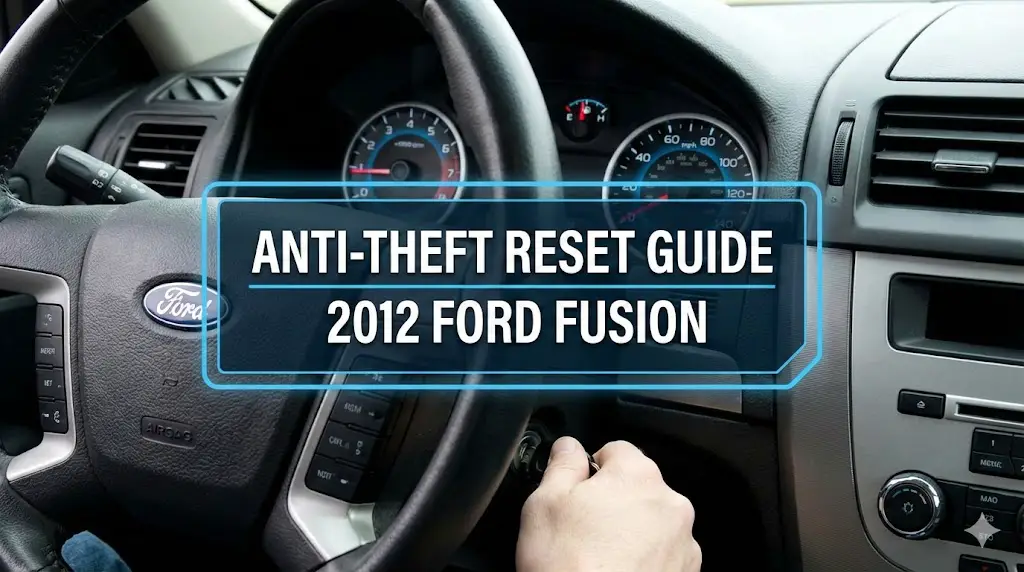
2012 Ford Fusion
Anti-Theft Reset
Is your theft light blinking rapidly? Does your engine refuse to crank? Before you call a tow truck, master the Passive Anti-Theft System (PATS) reset procedure.
Understanding the “Rapid Blink”
The 2012 Ford Fusion uses the SecuriLock system. When you insert your key, a transceiver ring around the ignition reads a unique RFID chip inside the key head. If the computer (PCM) doesn’t recognize the code—or if the system glitches—it disables the fuel injectors and starter. The tell-tale sign is the red dashboard padlock light blinking rapidly.
Diagnostic Checklist
- ✓ Does the light blink fast when key is in ON?
- ✓ Is the odometer showing dashes “——“? (PCM Comms Failure)
- ✓ Did you recently swap the battery or drop your keys?
Why Did It Lock Up?
Based on repair data, here is the breakdown of PATS failures.
Over 60% of issues are physical (Bad Key/Transceiver), but a significant portion are glitches solvable by a reset.
Quick Facts
*Two working keys are required for user-level programming. One key is needed for the parameter reset trick.
Time to Resolve
The “10-Minute” Reset Trick
Attempt this if you have a working key but the car won’t start due to a system glitch.
Step 1: Initiation
Insert your key into the ignition. Turn it to the ON position (Run), but DO NOT turn to Start (Crank).
Step 2: Observation
Watch the anti-theft light. It will blink rapidly. Leave the key in ON for 10 to 15 minutes until the light stops blinking or turns off.
Step 3: Cycle Power
Once the light stabilizes, turn the key to OFF. Wait 20 seconds.
Step 4: Attempt Start
Turn the key to start. If the car starts, the module has reset. If not, the key chip may be physically damaged.
Is It Worth Trying DIY?
Absolutely. The dealership solution often involves towing fees and a flat rate for “diagnostic time” just to hook up their IDS computer. A mobile locksmith is a middle-ground option, but a DIY attempt costs nothing but time.
Pro Tip:
If you have two working keys, you can program a third key yourself in seconds. If you lose all keys, you cannot do this without a locksmith.
Estimated Repair Costs (USD)
Frequently Asked Questions
Can I bypass the system permanently?
Not easily. The system controls fuel injection. Permanent bypass usually requires an aftermarket module or ECU flash.
What if the light stays solid?
A solid anti-theft light typically indicates a system malfunction or a recognized key that is not programmed to start the engine.
Does disconnecting the battery work?
Rarely. The PATS memory is non-volatile. Disconnecting the battery might clear a “glitch,” but won’t fix a bad key read.
© 2025 FordMasterX Infographics. Data sourced from manufacturer owner manuals.
2. Technical Architecture: The Physics of Immobilization
To diagnose the "anti-theft reset" effectively, one must visualize the invisible sequence of events that occurs in the 400 milliseconds after the key is inserted. This process involves electromagnetism, digital signal processing, and network authentication.
2.1 The Transceiver and Inductive Coupling
The first point of failure in the 2012 Fusion is often the PATS transceiver (Part Number often similar to 1L5Z-15607-AA). This component is a copper coil wound around a plastic ring that snaps onto the ignition lock cylinder. It acts as the system's antenna.
When the ignition switch contact closes, the IPC sends a burst of alternating current to this coil, creating an oscillating magnetic field at a specific frequency, typically 134.2 kHz (Low Frequency RFID). This magnetic field penetrates the plastic head of the key. Inside the key, a corresponding coil captures this magnetic energy and uses it to charge a tiny capacitor. Once the capacitor is charged, the transponder chip "wakes up" and modulates the magnetic field to transmit its unique hexadecimal identifier back to the transceiver.
Diagnostic Insight: Because this communication relies on magnetic induction, it is highly susceptible to interference. If a user has a "clump" of keys—including other transponder keys from a spouse's car, a gym pass, or a workplace HID badge—these other devices can absorb the magnetic energy or transmit conflicting signals. This phenomenon, known as "tag collision," results in the IPC receiving a garbled code (often triggering Blink Code 14) and assuming a theft attempt is in progress. The simple act of removing the Fusion key from the ring can often "reset" the system by removing this interference.
2.2 The Integrated Keyhead Transmitter (IKT)
The 2012 Fusion uses the IKT, which combines the remote entry buttons (lock/unlock/panic) with the PATS transponder. These are two electrically separate systems housed in the same plastic shell.
- System A (RKE): Uses a battery (CR2032) and transmits at 315 MHz (in North America) to the Smart Junction Box (SJB) or Body Control Module (BCM). This controls door locks.
- System B (PATS): Uses no battery, operates at 134 kHz, and talks to the IPC. This controls the engine.
Many users confuse these systems. They perform the "8-turn" programming method (cycling the key 8 times) and successfully get the door locks to cycle, yet the car still won't start.5 This is because the 8-turn method only programs the Remote Keyless Entry (RKE) portion. It does absolutely nothing for the PATS transponder, which requires a much more secure programming protocol involving two existing working keys or a diagnostic scan tool.
2.3 The Controller Area Network (CAN) Bus
Once the IPC validates the key, the signal must travel to the PCM. In the 2012 Fusion, this communication happens over the CAN bus. The CAN bus is a pair of twisted wires (CAN High and CAN Low) that allows modules to talk without a central host.
- The Vulnerability: The 2012 Fusion is known for issues with the "termination resistors" or the solder joints where the CAN bus pins connect to the circuit board of the instrument cluster. If these solder joints crack (a common issue due to lead-free solder regulations and thermal expansion), the "Key Valid" message never leaves the cluster. The driver sees the mileage turn to "dashes" (------), the theft light flashes, and the car cranks but won't start. This is a hardware failure masquerading as a security lockout.
3. Diagnostic Protocols: Interpreting the Language of the Machine
The primary interface for diagnosing the PATS system is the anti-theft indicator light—a red LED typically shaped like a padlock or a vehicle with a key inside, located in the instrument cluster. Under normal operation, this light illuminates for three seconds at key-on (bulb check) and then extinguishes.
3.1 The Rapid Flash Phenomenon
When the system is "armed" or in a "theft detected" state, this light flashes rapidly (2-3 Hz). This visual cue is the definitive signal that the PCM has disabled the fuel injectors and starter relay.
- If the light is SOLID ON: This usually indicates a system malfunction where the PCM is not communicating at all, or the system is in a "programming mode".
- If the light is FLASHING RAPIDLY: The system has failed the authentication challenge.
3.2 Retrieving Blink Codes
The 2012 Fusion provides a self-diagnostic mode that does not require a scanner. This "Blink Code" feature is a legacy capability that is incredibly powerful for diagnosis but often overlooked.
Procedure to Retrieve Blink Codes:
- Turn the ignition key to the ON position.
- Observe the rapidly flashing anti-theft light. Do not turn the key off.
- Wait approximately 60 seconds. The rapid flashing will stop.
- The light will then begin to flash a two-digit code. It will flash the first digit, pause, and then flash the second digit. For example, one flash, a pause, and six flashes indicates Code 16.
- The code will repeat several times.
3.3 Comprehensive Blink Code Analysis
The following table synthesizes the known blink codes for the 2012 Fusion PATS system, derived from repair manuals and technician field reports.
| Code | DTC Mapping | Description | Technical Cause | Recommended Action |
| 11 | B1681 | Transceiver Signal Not Detected | The IPC detects an open circuit to the transceiver ring. Usually a disconnected plug or broken wire in the column. | Inspect the 4-pin connector at the ignition cylinder. Check for pinched wires from tilt-wheel mechanisms. |
| 12 | B1681 | Transceiver Coil Failure | The internal resistance of the transceiver coil is out of spec (open or short). | Replace the transceiver ring (Part 1L5Z-15607-AA). No programming needed. |
| 13 | B1600 | No Key Code Received | The system energized the coil but received no reply. | The key has no chip (hardware store copy), the chip is broken, or the key is too far from the ring. Try a spare key. |
| 14 | B1602 | Partial Key Code Received | The signal was received but was garbled or incomplete. | Interference. Remove all other keys, fobs, and RFID tags from the key ring. Check for cell phone chargers near the ignition. |
| 15 | B1601 | Invalid Key Code | The key code was received perfectly, but it is not in the IPC's "allowed" list. | The key is not programmed to this car. Requires the "Add Key" procedure or dealer programming. |
| 16 | U1147 / P1260 | CAN Bus Communication Fault | The IPC and PCM cannot synchronize their security IDs. | Critical Failure. Check PCM grounds, check Cluster solder joints, check battery voltage. Perform Parameter Reset. |
| 21 | B1213 | Below Minimum Keys | The system requires a minimum of 2 programmed keys to operate, but fewer are stored. | Often happens after a failed programming attempt. Must program two distinct keys to clear. |
| 23 | B2431 | Parameter Mismatch | The IPC and PCM security IDs do not match (e.g., one was replaced). | Requires "Parameter Reset" using a scan tool (Forscan/IDS). |
Implications of Code 16: Code 16 is arguably the most common and frustrating error for 2012 Fusion owners. It typically manifests not as a "bad key" but as a vehicle that randomly won't start, often accompanied by the "dashes" in the odometer display. This indicates that the problem is not the key, but the network connecting the cluster and the engine computer.
4. Validated Reset Procedures: Fact vs. Fiction
The internet is replete with "magic" sequences to reset anti-theft systems. For the 2012 Ford Fusion, only specific procedures are technically valid, based on the system's firmware logic.
4.1 The "Ignition On" Relearn (The 10-Minute Method)
This method exploits the system's "timeout" feature. When the PATS system enters a lockout mode due to a transient error (like a voltage spike or a partial key read), it enforces a security delay to prevent brute-force attacks.
Mechanism: By leaving the ignition ON, the capacitors in the modules stay charged, but the software timer eventually expires, clearing the "theft detected" flag. It forces the IPC to poll the transceiver again for a fresh key read.2
Step-by-Step Procedure:
- Insert the key into the ignition.
- Turn the key to the ON/RUN position (Do not crank).
- Observe the rapidly flashing theft light.
- Wait for 10 to 15 minutes. This requires patience. Do not turn the key off.
- Watch the light. At the end of the timeout, the light will stop flashing and stay solid or turn off.
- Turn the ignition OFF and wait 5 seconds.
- Attempt to start the engine.
Success Rate: This is highly effective for lockouts caused by low battery voltage or minor data corruption. It is generally ineffective if a component (transceiver/key) is physically broken.
4.2 The Door Lock Cylinder Reset
This method targets the Perimeter Alarm aspect of the security system rather than the PATS immobilizer, but since the two systems interact via the Body Control Module (BCM), clearing a perimeter alarm can sometimes resolve a no-start condition.
Mechanism: The driver's door lock cylinder contains a switch that signals the BCM that a physical key has been used to unlock the vehicle. This signal is treated as a high-authority "Owner Present" command, which disarms the alarm and wakes up the IPC.
Step-by-Step Procedure:
- Exit the vehicle and close all doors.
- Insert the key into the driver's door lock.
- Turn to UNLOCK and hold for 30 seconds.
- Turn to LOCK and hold for 30 seconds.
- Turn to UNLOCK again.
- Enter the vehicle and insert the key into the ignition.
- Turn to ON. If the light proves out (stops flashing), start the engine.
Context: This is particularly useful if the car was locked with the fob but unlocked manually, triggering the alarm horn. The PATS system often inhibits starting while the alarm is sounding.
4.3 The "Battery Disconnect" (Hard Reset)
Disconnecting the battery is the universal "Ctrl-Alt-Delete" for automotive electronics, but on a 2012 Fusion, it carries risks.
Procedure:
- Disconnect the Negative (-) battery terminal.
- Wait at least 15 minutes.
- (Optional) Toggle the headlight switch to ON to drain any residual capacitor charge in the modules.
- Reconnect the battery.
Risk: While this can clear a "logic lock" in the PCM, it also clears the Keep Alive Memory (KAM), which includes idle trim strategy and transmission shift points. The car may run roughly for the first 50 miles. Furthermore, if the PATS failure is due to corrupt memory in the IPC, a battery reset will not fix it—and in some cases of weak batteries, the surge of reconnection can spike the cluster, causing the dreaded Code 16.
4.4 The Myth of the "8-Turn" Method
It is crucial to debunk the persistent myth that turning the key 8 times resets the engine immobilizer.
- Origin: The "8 times within 10 seconds" sequence is the official Ford procedure to enter Remote Keyless Entry (RKE) programming mode.
- Reality: This allows you to add a new remote fob for unlocking doors. It has zero interaction with the PATS engine immobilizer. If your car won't start, doing this will only result in the door locks cycling; it will not clear a theft light or enable the fuel pump.
5. Hardware Pathologies: Why the System Fails
When reset procedures fail, the issue is almost invariably hardware degradation. The 2012 Fusion is prone to specific aging issues that mimic theft attempts.
5.1 The Transceiver Ring Degradation
The copper windings in the transceiver ring (1L5Z-15607-AA) are subject to thermal expansion and contraction every time the cabin heats up or cools down. Over 12+ years, this stress causes microscopic fractures in the varnish insulation or the wire itself.
- Symptom: The car starts fine in the morning but refuses to start in the heat of the afternoon (Code 11 or 12).
- Diagnosis: Measure the resistance of the transceiver coil (pins 1 and 2 usually). It should be between 30 and 50 ohms. An open circuit (infinite ohms) confirms failure.
- Repair: Replacement is plug-and-play. No programming is required because the transceiver is a "dumb" antenna; it has no memory or logic.
5.2 Instrument Cluster Solder Joints (The "CGEA" Weakness)
The 2010-2012 Fusion marked a transition in electronics manufacturing to lead-free solder, which is more brittle than traditional leaded solder. The main connector on the back of the IPC is a stress point.
- The Failure: Vibration causes the solder joints connecting the CAN bus pins to the circuit board to crack. This creates an intermittent connection.
- The "Fonzie" Test: If banging on the dashboard above the gauges momentarily fixes the issue or makes the gauges flicker, the cluster has cracked solder joints.
- Consequence: The IPC cannot send the "Enable" message to the PCM. The PCM assumes a security breach and locks the engine.
5.3 The PCM Ground Fault (The "Ghost" in the Machine)
One of the most insidious failures on the 2012 Fusion is the corrosion of the PCM ground reference. The PCM monitors voltage differentials to interpret sensor data. If its ground reference floats above 0 volts due to rust or corrosion, the digital logic becomes unstable.
- Location: The ground strap is typically located on the driver's side strut tower or near the battery tray.
- Chemistry of Failure: The bi-metallic reaction between the copper wire, the steel bolt, and the body panel creates high resistance.
- Symptom: Code 16, dashes on the odometer, random stalling, AND the theft light flashing.
- The Fix: Remove the bolt, sand the paint down to bare metal, clean the terminal, apply dielectric grease, and re-torque. This simple maintenance procedure has resolved countless "unfixable" anti-theft issues documented in forum logs.
6. Advanced Solutions: Programming and Software Intervention
For scenarios where hardware is intact but memory is corrupt—or when keys are lost—software intervention is required. This was once the exclusive domain of the dealership, but tools like Forscan have democratized access.
6.1 Understanding Incode/Outcode Security
Ford's security layer requires a challenge-response authentication to access the PATS module (IPC).
- Outcode: When a technician requests access to "PATS Functions" via a scan tool, the car generates a hexadecimal "Outcode" (e.g., 0040 1234 5678).
- Incode: The technician must enter a corresponding "Incode" calculated using a cryptographic algorithm based on the Outcode.
- Modern Tools: Forscan automatically calculates this Incode (or accesses an online database) to grant "Security Access." This access is often time-gated (10-12 minutes) as a theft deterrent.
6.2 The "All Keys Lost" Procedure
If a user has lost all keys, or if the stored key data is corrupt (Code 15/21), the memory must be wiped.
- Requirement: Ford's logic dictates that to exit the "Anti-Scan" mode, two unique keys must be programmed. You cannot program just one.
- Sequence:
- Select "Erase All Keys" in Forscan/IDS.
- The system wipes the NVRAM.
- Insert Key 1, turn to ON for 3 seconds.
- Insert Key 2, turn to ON for 3 seconds.
- The IPC registers both RFID tags and closes the programming session.
- Caution: If you only have one key and attempt this, you will brick the car until you buy a second key.
6.3 Parameter Reset (The Module Sync)
This is the required step if either the PCM or IPC is replaced.
- The Problem: The PCM and IPC share a unique security ID. If you swap the IPC, the PCM's stored ID no longer matches the IPC's ID. The car cranks but won't start (Code 23).
- The Fix: Run the "PATS Parameter Reset" function. This puts both modules into a "learning" state. The next time the ignition is turned ON, they exchange a new security ID and bond. This is often the solution for the "Dashes on Odometer" issue if the ground repair doesn't work.
7. Comparative Analysis: 2012 vs. Other Model Years
It is vital to distinguish the 2012 Fusion from its predecessors and successors, as the anti-theft architectures differ radically.
| Feature | 2006-2009 Fusion | 2010-2012 Fusion | 2013+ Fusion |
| Platform | CD3 (Phase 1) | CD3 (Phase 2) | CD4 |
| PATS Location | PCM / HEC | IPC (Cluster) | BCM (Body Control Module) |
| Key Type | 40-bit (4D63) | 80-bit (4D63-80) | High Security Laser Cut |
| Transceiver | Separate Module | Separate Module | Integrated into Column |
| Common Failure | PCM Driver Failure | Cluster Solder Joints | BCM Water Intrusion |
Implication: Advice meant for a 2013 Fusion (resetting the BCM) is useless for a 2012 model. Similarly, older 2008 keys (40-bit) cannot be programmed to a 2012 Fusion (which requires 80-bit encryption), even though they look identical physically. This incompatibility is a frequent cause of failed programming attempts.
8. Conclusion and Strategic Recommendations
The 2012 Ford Fusion's SecuriLock system is a robust, if sensitive, piece of engineering. It successfully prevents drive-away theft but is prone to immobilization "false positives" due to the aging of the CD3 platform's electrical infrastructure. The "Anti-Theft Reset" is rarely a single button press; it is a diagnostic path.
Summary of Recommendations:
- Do Not Panic: A flashing light means the system is doing its job, potentially too well.
- Verify the Basics: Ensure the battery is strong. A weak battery is the enemy of digital handshakes.
- Use the Blink Codes: Let the car tell you what is wrong. A Code 11 (Transceiver) requires a different fix than a Code 16 (Communication).
- Hardware before Software: Before buying a new PCM or Cluster, clean the ground straps and check the transceiver ring resistance. These are the most common failure points.
- Understanding the Reset: The 10-minute "Ignition ON" cycle is the only valid user-level reset for a confused system. The "Door Lock" method helps with alarm conflicts. The "8-Turn" method is irrelevant for starting issues.
- Professional Tools: For persistent issues, the investment in an OBD adapter and Forscan software ($50 total) far outweighs the cost of a tow and dealership diagnostics ($300+).