Is the 6.4 Powerstroke a Good Engine? Reliability & Flaws Explained in 2026

The 2008-2010 Ford 6.4L Powerstroke emerged during a highly volatile transition period for the heavy-duty truck market. Engineered by Navistar International and deployed in Ford’s Super Duty lineup, this powerplant was designed to overcome the warranty-plagued legacy of its 6.0L predecessor while simultaneously meeting drastically stricter federal emissions standards.
It introduced revolutionary technology to the domestic diesel pickup segment, most notably a sequential twin-turbocharger system and a highly advanced high-pressure common-rail fuel injection network.
To directly address the fundamental search intent—is the 6.4 Powerstroke a good engine?—the technical consensus requires a highly nuanced evaluation. From a pure performance, towing, and driving dynamics perspective, the 6.4L is an exceptional powerhouse capable of easily doubling its factory horsepower output with minimal aftermarket modifications.
However, from a reliability, longevity, and cost-of-ownership standpoint, the 6.4L is widely considered by automotive diagnostic technicians to be a flawed, high-risk platform. Catastrophic engine failures are common, often necessitating complete cab removal from the chassis for access, which exponentially inflates labor costs.
This exhaustive research report, optimized for automotive enthusiasts and prospective buyers researching on fordmasterx.com, provides a complete technical dissection of the 6.4L Powerstroke. The analysis covers the engine’s core mechanical architecture, its fatal engineering flaws, performance against contemporary rivals, and the precise mechanical blueprint required to ensure its survival beyond the 200,000-mile threshold.
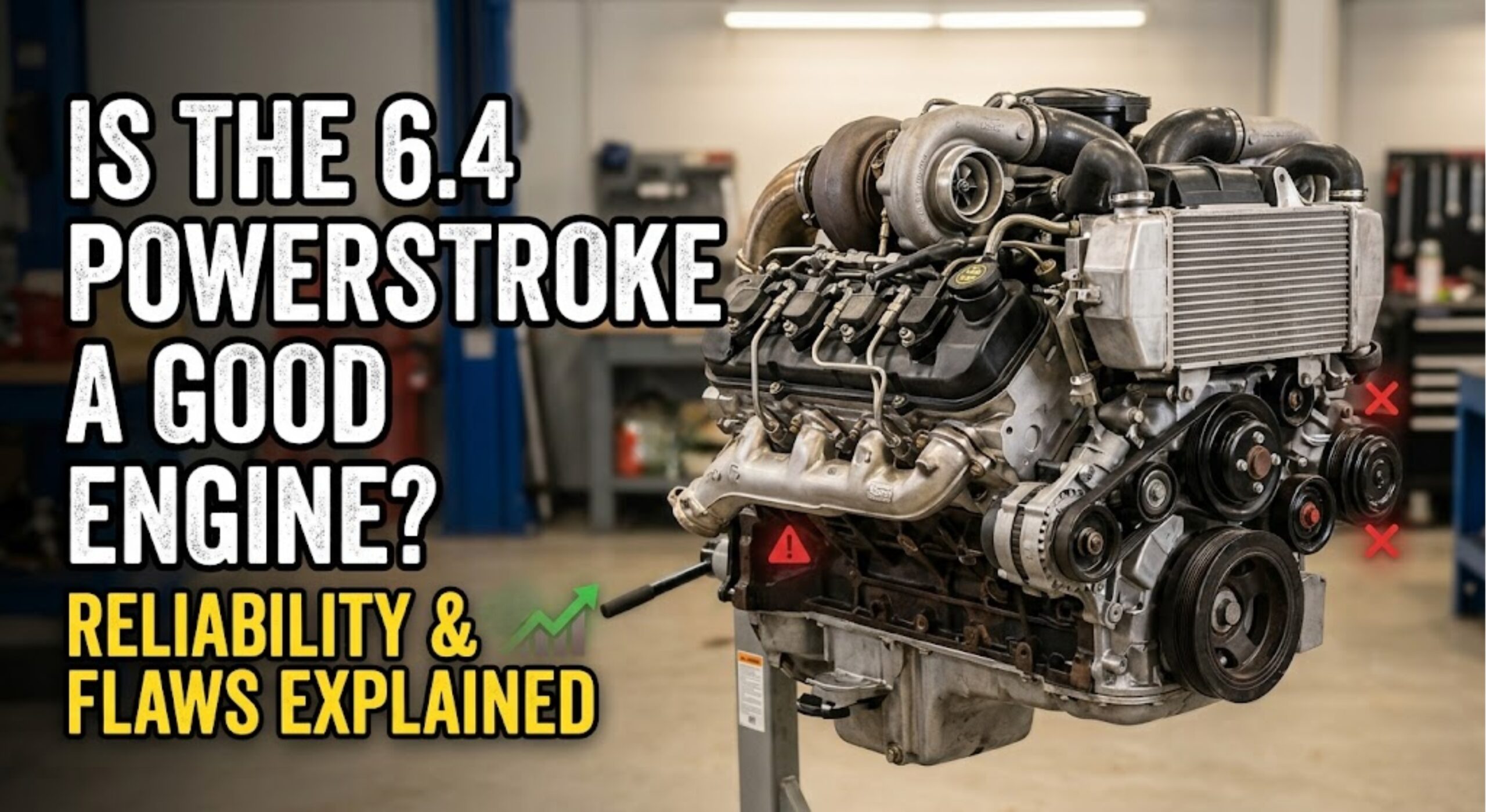
Is the 6.4 Powerstroke a Good Engine?
Produced only from 2008 to 2010, the 6.4L Navistar V8 is one of the most controversial diesel engines in Ford’s history. We break down the specs, the power, and the catastrophic failures.
The 6.4L at a Glance
Introduced to replace the problematic 6.0L, the 6.4L Powerstroke was designed with stricter emissions in mind. It featured dual sequential turbos and a high-pressure common-rail fuel system.
A Massive Leap in Power
When asking, “Is the 6.4 Powerstroke a good engine?”, one must acknowledge its performance capabilities. From a pure power standpoint, the 6.4L was a beast. It utilized a compound turbocharger setup (a smaller, high-pressure turbo feeding a larger, low-pressure turbo), which virtually eliminated turbo lag.
Furthermore, the adoption of piezoelectric fuel injectors and a Siemens high-pressure common-rail (HPCR) system allowed for incredibly precise fuel delivery. This made the 6.4L incredibly responsive and, notoriously, highly tunable. A simple ECM tune could push this engine well over 500 horsepower.
Source: MotorTrend’s Powerstroke HistoryPowerstroke Evolution (7.3L to 6.7L)
Chart illustrates the jump in factory output. The 6.4L represented a 7.6% HP increase over the outgoing 6.0L.
The Fatal Flaws: Why the 6.4 Fails
Despite incredible power, the 6.4 Powerstroke is widely considered the least reliable diesel engine Ford ever placed in an F-Series truck. The transition to strict EPA emissions standards resulted in engineering compromises that proved fatal to engine longevity.
Average Repair Costs (Major Failures)
Data represents average independent shop costs. Dealership costs frequently exceed these estimates.
⚠️ High-Pressure Fuel Pump (HPFP) Failure
The Siemens HPFP is incredibly sensitive to water or debris in the fuel. If it fails, it frequently sends metal shrapnel throughout the entire fuel system, necessitating a replacement of the pump, all eight injectors, and flushing the lines.
⚠️ Cracked Pistons
A design flaw in the piston lip, combined with aggressive fuel delivery profiles (especially when tuned) and heat management issues, leads to cracked pistons. This results in total catastrophic engine failure requiring a complete rebuild.
⚠️ Front Cover Cavitation
The water pump design causes cavitation (bubbles forming and collapsing rapidly) which literally eats away at the aluminum front engine cover. Once it breaches, coolant mixes directly into the engine oil, destroying main bearings.
The Root Cause: The DPF & Fuel Dilution Cycle
The 6.4L was Ford’s first truck to utilize a Diesel Particulate Filter (DPF). To burn off soot in the filter (Active Regeneration), the engine injects raw fuel during the exhaust stroke. This process is the genesis of the engine’s worst failures.
Active Regen
Fuel injected on exhaust stroke to heat DPF.
Cylinder Wash
Unburnt fuel washes oil off cylinder walls.
Oil Dilution
Fuel seeps past rings, diluting crankcase oil viscosity.
Bearing Failure
Thin oil fails to protect rocker arms and main bearings.
Engine Architecture and Technical Specifications
The 6.4L Powerstroke shares foundational architectural traits with the 6.0L, utilizing a cast-iron engine block, a 4.13-inch stroke, a crankcase bed-plate to replace traditional individual main caps, and four-valve cast-iron cylinder heads. To increase overall displacement to 390 cubic inches, engineers expanded the cylinder bore to 3.87 inches.
The most significant departure from previous generations was the abandonment of the Hydraulic Electronic Unit Injector (HEUI) system, replacing it with a(https://alliantpower.com/solving-your-6-4-power-stroke-fuel-system-nightmares-an-essential-guide/) utilizing rapid-firing piezo-electric injectors.
The introduction of the BorgWarner compound turbocharger system effectively eliminated turbo lag. By pairing a 52mm variable-geometry turbocharger (VGT) for immediate low-RPM response with a larger 65mm fixed-geometry unit for top-end volume, the engine delivers its peak 650 lb-ft of torque at just 2,000 RPM. It is also important to note the distinction between the Ford variant and the Navistar MaxxForce 7 commercial variant.
While they share the same base geometry, the MaxxForce 7 was significantly detuned for commercial longevity, utilized a single turbocharger, and featured internally upgraded, stronger pistons.
Core Specifications Overview
| Specification | Technical Detail |
| Production Years | 2008 – 2010 |
| Engine Configuration | 90-Degree V8, OHV, 4 Valves per Cylinder |
| Displacement | 390 Cubic Inches (6.4 Liters) |
| Bore x Stroke | 3.87 in x 4.13 in |
| Compression Ratio | 17.5:1 |
| Block / Head Material | Cast-Iron / Cast-Iron |
| Aspiration System | BorgWarner V2S Twin Sequential Turbochargers |
| Fuel Injection | Siemens K16 VDO High-Pressure Common-Rail |
| Horsepower (Factory) | 350 hp @ 3,000 RPM |
| Torque (Factory) | 650 lb-ft @ 2,000 RPM |
| Emissions Controls | Dual EGR Coolers, Diesel Oxidation Catalyst (DOC), DPF |
The Fatal Flaws: Why the 6.4L is Considered a Financial Risk
Despite its impressive factory output, the 6.4L Powerstroke is plagued by severe mechanical vulnerabilities. Understanding the thermodynamic and mechanical catalysts behind these failures is critical for risk assessment.
The most catastrophic failure associated with the 6.4L is a cracked piston, a condition rooted in an intrinsic geometric flaw within the factory cast-aluminum piston design. The piston features a sharp, thin lip around the fuel bowl that acts as a thermal stress concentrator. Under the intense heat and cylinder pressures generated by the compound turbochargers—which routinely produce 40 to 42 psi of boost even in factory configurations—micro-fractures develop along this lip.
Over thousands of thermal cycles, the piston ultimately cracks completely in half along the wrist pin axis, resulting in an immediate loss of compression, severe crankcase blowby, and a dead misfire that necessitates a total engine teardown.
Compounding the internal risks is the fragility of the Siemens K16 high-pressure fuel pump (HPFP). Situated deep within the engine valley beneath the twin turbochargers, the HPFP operates in an environment of extreme ambient heat. The pump is highly intolerant of water contamination or the lower lubricity of modern Ultra-Low Sulfur Diesel (ULSD). If the internal cam and rollers lack adequate lubrication, they begin to gall and shed fine metallic shavings.
These metallic shards are pumped directly through the common rails and into the delicate piezo-electric injectors, effectively destroying the entire fuel injection system simultaneously. Repairing this level of contamination requires cab removal, pump and injector replacement, and comprehensive fuel line flushing, frequently generating repair invoices exceeding $4,000 to $5,000.
The vulnerability of the engine is further exacerbated by its approach to emissions control, specifically the active regeneration process of the Diesel Particulate Filter (DPF). To incinerate accumulated soot, the engine control module injects raw diesel fuel into the cylinders during the exhaust stroke to artificially raise exhaust gas temperatures. Because this fuel is injected exceptionally late in the combustion cycle, a significant volume fails to ignite.
Instead, it washes down the cylinder walls, bypassing the piston rings, and drains directly into the crankcase. This causes massive oil dilution; it is not uncommon to drain upwards of 24 quarts of fluid from a crankcase designed to hold only 15 quarts of oil. Because diesel fuel acts as a solvent rather than a lubricant, this dilution aggressively accelerates wear on main bearings, rod bearings, turbocharger journal bearings, and valvetrain components.
External mechanical failures are equally prevalent. Almost every 6.4L experiences radiator crimp separation. The factory radiator utilizes an aluminum core crimped to plastic end tanks, and excessive chassis flex from the upper radiator support, combined with wild temperature fluctuations, forces these crimps to stretch and separate. Furthermore, a hidden but fatal flaw involves the engine’s internal lubrication routing. Upon cold start, it can take up to four minutes for oil pressure to reach the rocker arms.
This severe dry-start starvation causes the rocker arm ball pivots to wear down rapidly, eventually snapping off or gouging the valve bridge, resulting in valvetrain collapse. Finally, localized coolant boiling within the aluminum front engine cover—caused by super-heated fluid returning from the dual EGR coolers—creates cavitation shockwaves that literally erode holes through the timing cover, allowing coolant to mix directly with the engine oil.
Competitor Landscape: 6.4L Powerstroke vs. Duramax LMM vs. Cummins 6.7
During its brief three-year production run, the Ford 6.4L Super Duty competed fiercely against the GM 6.6L Duramax LMM and the Dodge Ram 6.7L Cummins. Evaluating these platforms against one another provides context regarding where the 6.4L succeeded and where it ultimately fell short.
Heavy-Duty Diesel Spec Comparison (2008-2010 Models)
| Specification | Ford F-250 (6.4L Powerstroke) | Chevrolet Silverado 2500 (LMM Duramax) | Ram 2500 (6.7L Cummins) |
| Engine Layout | 6.4L V8 | 6.6L V8 | 6.7L Inline-6 |
| Peak Horsepower | 350 hp | 365 hp | 350 hp |
| Peak Torque | 650 lb-ft | 660 lb-ft | 650 lb-ft |
| Maximum Towing | ~16,000 lbs | ~13,000 lbs | ~15,620 lbs |
| Platform Strength | Massive low-end torque, robust 5R110W automatic transmission, superior chassis payload. | Exceptional Allison transmission integration, quiet operation, smooth ride quality. | Legendary engine longevity, simple inline-6 design, high durability ceiling. |
The 6.4L was incredibly competitive in terms of raw chassis capability and towing stability. Ford’s suspension architecture and the robust 5R110W transmission were widely considered superior to the automatic transmissions offered by Dodge during this era. However, the Cummins inline-6 offered vastly superior long-term engine durability, routinely clocking 300,000+ miles with minimal internal wear—a stark contrast to the 6.4L, which technicians frequently classify as a 150,000-mile engine before catastrophic repairs are required.
Towing Capacity and Payload Performance
For users relying on the 6.4L strictly for heavy hauling, Ford provided class-leading numbers. The reinforced Super Duty chassis, integrated trailer brake controllers, and the compound turbo setup made the 6.4L an exceptional towing rig that maintained dense manifold pressure even at high altitudes or under grueling loads.
| Truck Model (2008-2010) | Max Conventional Towing | Max 5th Wheel / Gooseneck Towing |
| Ford F-250 (SRW) | 12,500 lbs | 16,100 lbs |
| Ford F-350 (SRW) | 12,500 lbs | 16,000 lbs |
| Ford F-350 (DRW) | 15,000 lbs | 18,800 lbs |
| Ford F-450 (DRW) | 16,000 lbs | 24,600 lbs |
Fuel Economy Dynamics: Stock vs. Modified
Fuel efficiency remains a major operational pain point for 6.4L owners. Because the engine aggressively over-fuels during the active DPF regeneration cycles, and because the complex emissions hardware creates significant exhaust backpressure, factory fuel economy is notoriously poor.
Real-World MPG Data Comparison
| Driving Condition | Stock 6.4L MPG | Deleted + Tuned 6.4L MPG |
| City Driving | 10 – 11 MPG | 13 – 14 MPG |
| Highway Driving | 12 – 13 MPG | 16 – 18 MPG |
| Towing (Moderate Load) | 9 – 10 MPG | 11 – 13 MPG |
In jurisdictions where it was historically permissible for off-road or competition use, removing the DPF and EGR systems (deleting) and applying an aftermarket ECM calibration yielded massive efficiency gains. Owners consistently documented a 2 to 6 MPG increase across various driving conditions. Crucially, deleting the DPF eliminated the active regeneration cycle, which completely solved the fatal cylinder washdown and engine oil dilution issues.
Disclaimer: Tampering with emissions equipment on highway-registered vehicles is a direct violation of the federal Clean Air Act, and environmental agencies actively enforce severe penalties against operators and facilities performing these modifications.
The Engineering Blueprint for Bulletproofing the 6.4L
Unlike the older 6.0L Powerstroke, where the concept of “bulletproofing” largely consists of replacing external components like EGR coolers and installing head studs without removing the engine block, truly bulletproofing a 6.4L requires pulling the engine and conducting heavy internal machining. Relying on leading industry experts like Choate Engineering Performance, a permanent mechanical solution involves a ground-up redesign of the engine’s weak points.
The foundation of a reliable 6.4L build requires discarding the crack-prone factory pistons in favor of coated, delipped MaxxForce 7 pistons. These commercial-grade variants feature a heavily reinforced fuel bowl lip and friction-reducing thermal coatings to survive high boost pressures.
To address head gasket failures, the cylinder heads must be machined to accept a stainless steel wire O-ring; when combined with high-tensile ARP head studs, this provides an unbreakable seal against the immense cylinder pressure generated by the twin turbos.
Lubrication failures are mitigated by installing proprietary self-oiling billet valve covers, which actively pump oil directly onto the rocker arms the moment the ignition is turned, eliminating the catastrophic dry-start wear. Coolant leaks are solved by upgrading to a fully TIG-welded all-aluminum radiator paired with a rigid core support brace to eliminate chassis flex.
Finally, protecting the delicate Siemens HPFP requires the installation of a premium aftermarket lift pump and filtration system (such as FASS or AirDog) to guarantee the injection pump is continuously fed pristine, air-free fuel at a positive pressure.
Advanced Severe-Duty Maintenance Protocol
For operators utilizing a stock, non-deleted 6.4L, adhering to an extreme, severe-duty maintenance schedule is the only defense against premature catastrophic failure. The factory Ford service manual suggests standard 10,000-mile oil intervals, which independent diesel mechanics universally agree is highly destructive due to the inevitable fuel dilution caused by the DPF.
Expert Recommended Maintenance Schedule
| Component | Factory Recommended | Expert Mechanic Recommended | Engineering Rationale |
| Engine Oil & Filter | 10,000 Miles | 5,000 Miles (Strict) | Mitigates the devastating friction and bearing wear caused by DPF-induced diesel fuel dilution in the crankcase. |
| Fuel Filters (Upper & Lower) | 20,000 Miles | 10,000 Miles | The HPFP requires immaculate, water-free fuel. The water separator must be drained manually on a monthly basis. |
| Cooling System Flush | 100,000 Miles | 45,000 Miles | Prevents particulate buildup that plugs the EGR coolers and reduces the risk of cavitation eroding the front engine cover. |
| Transmission Fluid | 60,000 Miles | 30,000 Miles | Protects the clutches and solenoids in the 5R110W transmission, especially critical if the engine is running aftermarket high-horsepower tuning. |
Critical Questions (People Also Ask)
Is it worth buying a 6.4 Powerstroke in 2026?
For the vast majority of consumers, the answer is no. The consensus across independent diesel diagnostic publications and automotive technician forums is that the financial risk associated with the 6.4L is exceedingly high. Unless a buyer acquires the vehicle for an exceptionally low price that specifically accounts for an impending $10,000 to $15,000 engine replacement, or the engine has already been fully rebuilt utilizing MaxxForce 7 pistons and aftermarket studs, buyers are strongly advised to seek out the far superior 2011+ 6.7L Powerstroke platform.
What are the warning signs of a failing HPFP on the 6.4L?
Early clinical symptoms of a disintegrating high-pressure fuel pump include an extended crank/no-start condition, sudden loss of power under load, and diagnostic trouble codes indicating low fuel rail pressure. A definitive mechanical diagnostic test involves removing the fuel flow control valve; if fine metallic shavings are present on the valve’s screen, the internal components of the pump have failed, and the entire downstream fuel injection system is irreversibly contaminated.
Why does the 6.4L Powerstroke “make oil”?
The phenomenon of “making oil” refers to the fluid level visibly rising on the engine dipstick. This is directly caused by the active regeneration process of the Diesel Particulate Filter. The engine’s computer commands raw diesel fuel to be injected into the cylinder during the exhaust stroke to incinerate soot in the DPF. Much of this unburned fuel washes down the cylinder walls, slips past the piston rings, and permanently dilutes the engine oil residing in the crankcase, causing the overall fluid volume to expand.
Can you make a 6.4 Powerstroke reliable without deleting the emissions?
It is incredibly difficult and requires obsessive preventative maintenance. While adhering to strict 5,000-mile oil changes, installing a premium aftermarket lift pump, and upgrading the radiator will certainly help, the fundamental design flaws—namely, the DPF causing fuel dilution and the factory pistons being geometrically prone to cracking—remain unaddressed.
How much horsepower can a stock 6.4L block physically handle?
The baseline cast-iron block and factory powdered-metal connecting rods are immensely strong. With only a high-flow cold air intake, an unrestricted exhaust system, and aggressive custom tuning, a mechanically sound 6.4L can safely generate upwards of 600 rear-wheel horsepower and over 1,000 lb-ft of torque. However, pushing the engine to this extreme power level drastically increases the statistical probability of stretching the head bolts, blowing the head gaskets, or instantly cracking a piston if the internal components have not been fully bulletproofed.