How to Read a Ford VIN Number: A Comprehensive Analysis of Origins, Engineering, and Identification

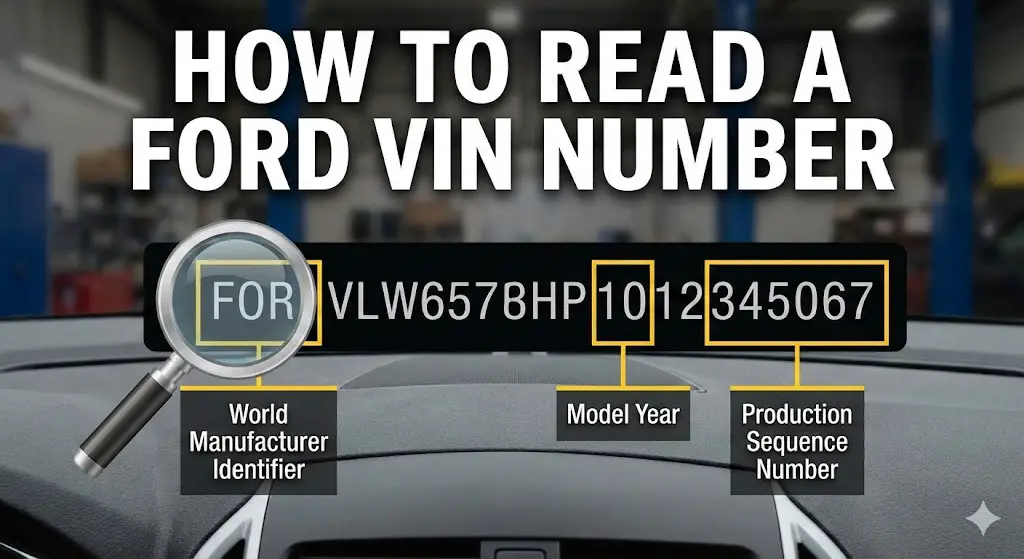
The automotive industry relies on a complex web of serialization to maintain order amidst the chaos of global manufacturing. At the heart of this system for the Ford Motor Company is the Vehicle Identification Number (VIN). Far more than a mere administrative necessity, the Ford VIN is a cryptographic sequence that encodes the genetic makeup of every vehicle produced. From the assembly lines of Dearborn to the stamping plants of Hermosillo, the VIN serves as the singular source of truth for fleet managers, restoration experts, and automotive historians.
This research report provides an exhaustive deconstruction of the Ford VIN system. We will explore the historical evolution of vehicle identification, from the non-standardized serial numbers of the mid-20th century to the rigid ISO 3779 standards of today. We will analyze the geopolitical implications of the World Manufacturer Identifier (WMI), the engineering specifications hidden within the Vehicle Descriptor Section (VDS), and the logistical precision of the Vehicle Identifier Section (VIS).
Furthermore, we will examine specific case studies involving the F-Series and Mustang lineages, providing actionable data for identification and verification. This document is designed to serve as the ultimate reference for understanding how to read a Ford VIN number, optimizing vehicle lifecycle management, and ensuring asset security.
Decoding Your Ford VIN
The Vehicle Identification Number is your car’s DNA. Unlock the secrets of its origin, engine, and history with this comprehensive visual guide.
1 The 17-Character DNA
A VIN isn’t just a random string of numbers. It is divided into three specific sections: World Manufacturer Identifier (WMI), Vehicle Descriptor Section (VDS), and Vehicle Identifier Section (VIS). Hover over the segments below to understand their roles.
WMI
World Manufacturer Identifier. Tells you the country of origin and the manufacturer.
VDS
Vehicle Descriptor Section. Details the model, body type, restraint system, engine type, and check digit.
VIS
Vehicle Identifier Section. The unique fingerprint including model year, assembly plant, and production sequence.
Position 1-3: Where Was It Built?
The first character of the VIN is the most immediate indicator of your Ford’s geography. While Ford is an American icon, manufacturing is a global operation.
-
1
1, 4, 5: United States. The most common codes for trucks and classic Mustangs.
-
2
2: Canada. Often seen on models like the Ford Edge or Flex.
-
3
3: Mexico. Frequently used for sedans like the Fusion (historically) and some trucks.
Position 8: The Engine Code
For enthusiasts and mechanics, the 8th character is the most critical. It identifies exactly which engine is under the hood—crucial for ordering parts or verifying a classic car’s authenticity.
“Is it a V8 swap or factory original?”
Checking Position 8 solves the mystery instantly.
Distribution of Engine Codes in modern F-Series & Mustang datasets (Simulated)
Position 10: The Model Year Decoder
Ford rotates through alphabetic and numeric characters to denote the model year. This cycle repeats every 30 years. Misreading this character is the #1 cause of buying incompatible parts.
Note: The letters I, O, Q, U, and Z are never used in VINs to avoid confusion with numbers 1, 0, and 2.
Position 11: Factory of Origin
The 11th character tells you exactly which factory assembled your vehicle. Certain plants are legendary for specific models, such as the Dearborn Truck Plant for the F-150 or Flat Rock for the Mustang.
Production Trends
Visualizing the volume of key Ford models produced across different years (Simulated Data).
The Ontology of Automotive Identity
The Necessity of Standardization
In the early days of the automobile, identification was a fluid concept. Manufacturers stamped engine blocks with serial numbers, often ignoring the chassis or body entirely. As mass production accelerated under Henry Ford’s assembly line model, the need for a more robust tracking system became apparent—not just for the factory, but for the emerging ecosystem of insurance, registration, and theft prevention.
However, it was not until the skyrocketing theft rates and safety recalls of the 1960s and 70s that the industry faced a reckoning. The lack of a unified standard meant that a 1965 Mustang and a 1965 Chevrolet Impala used completely different numbering schemas, making cross-referencing databases nearly impossible for law enforcement. The resulting obfuscation allowed chop shops to thrive and made safety recalls a logistical nightmare.
The solution arrived in 1981, when the National Highway Traffic Safety Administration (NHTSA) of the United States mandated a standardized 17-character format for all road vehicles. This regulation, codified in 49 CFR Part 565, aligned with ISO Standard 3779, creating a global language for vehicle identification. For Ford, this transition marked a pivot from the 11-digit proprietary codes of the muscle car era to the data-rich 17-digit sequences used today.
The Structure of the 17-Character VIN
The modern Ford VIN is not a random string of characters; it is a hierarchical data structure divided into three distinct operational zones. Understanding these zones is the first step in mastering the art of decoding.
- Zone 1: World Manufacturer Identifier (WMI) – Positions 1-3
- This section answers the questions: “Who built this?” and “Where was it built?” It is the geopolitical fingerprint of the vehicle.
- Zone 2: Vehicle Descriptor Section (VDS) – Positions 4-8
- This section answers the question: “What is this?” It details the engineering attributes, including the platform, body style, safety restraint systems, and engine specifications.
- Zone 3: Vehicle Identifier Section (VIS) – Positions 10-17
- This section answers the question: “Which specific one is this?” It includes the model year, the assembly plant, and the sequential production number.
Note: Position 9 is the Check Digit, a mathematical validator that exists outside these descriptive zones, acting as the integrity lock for the entire sequence.
The World Manufacturer Identifier (WMI) and Global Logistics
The first three characters of the VIN, known as the WMI, are assigned to manufacturers by the Society of Automotive Engineers (SAE) in the US and similar bodies globally. For Ford Motor Company, the WMI reveals the complex supply chain logistics that define modern automotive manufacturing.
The Geopolitical Origin
The first character indicates the country of origin. While many enthusiasts assume “Ford” means “American,” the reality of the North American Free Trade Agreement (NAFTA) and its successor, the USMCA, creates a more nuanced picture.
Table 1: Ford Geographic Region Codes (Position 1)
| Code | Region | Country | Significance |
| 1 | North America | United States | The primary domestic production code. Used for the majority of F-150s, Mustangs, and Explorers. |
| 2 | North America | Canada | Indicates assembly at plants like Oakville (Edge, Nautilus). Essential for understanding cross-border import tax implications. |
| 3 | North America | Mexico | Used for vehicles like the Fusion, Fiesta, and the modern Bronco Sport/Maverick (Hermosillo). |
| 4 | North America | United States | An overflow identifier for US production, often seen on specific commercial lines. |
| 5 | North America | United States | Another overflow identifier, historically used for joint ventures like AutoAlliance (Flat Rock) before full Ford integration. |
| 6 | Oceania | Australia | Historically significant for the Falcon and Australian-market Rangers. |
| 9 | South America | Brazil | For EcoSport models imported to various markets prior to plant closures. |
| J | Asia | Japan | Historically used for Ford-Mazda partnership vehicles (e.g., Probe, Courier). |
| W | Europe | Germany | Indicates engineering and assembly by Ford of Europe (e.g., Focus RS, Fiesta ST). |
| N | Europe/Asia | Turkey | The hub for Transit Connect production, critical for commercial fleet analysis. |
Insight: For a fleet manager, the difference between a VIN starting with 1 and 3 can have implications for “Buy American” mandates in government contracts. While both are Ford vehicles, only the ‘1’ generally qualifies for strict domestic procurement requirements, despite the high content of shared parts.
The Manufacturer Identity
The second character identifies the manufacturer. For Ford, this is almost universally the letter F.
- 1F: Ford Motor Company (USA)
- 2F: Ford Motor Company of Canada
- 3F: Ford Motor Company (Mexico)
However, exceptions exist in the historical record. For instance, the code 1M was used for Mercury (USA) before the brand’s discontinuation. Recognizing these legacy codes is vital when researching older fleet vehicles or navigating the used market.
Vehicle Type and Division
The third character is where the WMI gains specific granularity, distinguishing between passenger cars, trucks, and incomplete vehicles.
- A: Passenger Car (Ford Division). Common on Fusion, Taurus, Focus.
- T: Truck (Completed). The hallmark of the F-150 and Ranger.
- M: Multi-Purpose Vehicle (MPV). Used for SUVs like the Escape, Explorer, and Expedition.
- E: Incomplete Vehicle. This is crucial for commercial upfitters. An E in the third position (e.g., 1FD…) typically denotes a cutaway chassis or a chassis cab (F-550) that left the factory without a bed or box.
- L: Lincoln. Used to distinguish the luxury division (e.g., 1LN for a Town Car or Navigator).
- P: Passenger Car (Ford Design). Often seen on Mustangs, distinguishing them from standard sedans in some eras.
For further reading on how these classifications affect insurance premiums, you might consult resources on Ford Vehicle Classifications.
The Vehicle Descriptor Section (VDS) – Engineering the DNA
Positions 4 through 8 constitute the Vehicle Descriptor Section. This is the technical heart of the VIN, encoding the physical attributes of the machine.
Safety and Weight Ratings
The function of the fourth character bifurcates based on the vehicle type defined in the WMI.
Passenger Cars: The Evolution of Restraints
For cars (Mustang, Fiesta, Fusion), Position 4 outlines the safety restraint system. This code has evolved alongside federal safety mandates.
- Code C: Driver and Passenger Airbags + Active Safety Belts. The standard for most modern Fords.
- Code F: Advanced Restraint System. Includes side-impact airbags, canopy curtains, and occupancy sensors.
- Code P: Manual Belts. Found on early 1980s models before the airbag mandate.
Trucks: The Gross Vehicle Weight Rating (GVWR)
For trucks (F-Series, E-Series, Transit), Position 4 is a critical legal identifier representing the GVWR Class and Brake System. This code determines the vehicle’s legal payload capacity and registration class.
Table 2: Ford Truck GVWR Codes (Position 4)
| Code | GVWR Range (lbs) | Class | Description |
| A | < 3,000 | Class A | Historically used for light couriers; rare today. |
| B | 3,001 – 4,000 | Class B | Early compact trucks (Ranger). |
| C | 4,001 – 5,000 | Class C | Modern mid-size trucks and light F-150s. |
| D | 5,001 – 6,000 | Class D | Standard F-150 range. |
| E | 6,001 – 7,000 | Class E | Heavy F-150 and light Expedition. |
| F | 7,001 – 8,000 | Class F | F-250 Light Duty (LD). |
| G | 8,001 – 8,500 | Class G | F-250 Heavy Duty (HD). |
| H | 8,501 – 9,000 | Class H | F-250 / F-350 Single Rear Wheel (SRW). |
| J | 9,001 – 10,000 | Class J | F-350 Dual Rear Wheel (DRW). |
| K | 10,001 – 14,000 | Class K | F-350 / F-450 Class. |
| W | > 14,001 | Class 4+ | F-450 / F-550 Commercial Chassis. |
Strategic Insight: For commercial buyers, verifying the Position 4 code is essential to avoid overloading penalties. A truck might be badged as an “F-250,” but the VIN confirms whether it is a Class F or Class G vehicle, which impacts the legal maximum loaded weight.
Platform, Series, and Body Style
These three characters work in concert to define the specific model configuration. Ford does not use a static “model code” here; rather, the codes shift based on the platform.
The F-Series Configuration:
In the F-Series lineage, these characters define the drivetrain (2WD vs 4WD) and the cab style (Regular, SuperCab, SuperCrew).
- F15: F-150 2WD Regular Cab (Legacy)
- F14: F-150 4WD Regular Cab (Legacy)
- W1C: F-150 4×2 SuperCrew (Modern)
- W1E: F-150 4×4 SuperCrew (Modern)
- X1E: F-150 4×4 SuperCab (Modern)
The Mustang Configuration:
- P8C: Coupe (often GT or V8)
- P8T: Coupe (often EcoBoost)
- P8F: Convertible
For restoration enthusiasts, verifying these codes is crucial. A “clone” vehicle might look like a 4×4 or a GT, but if the VIN positions 5-7 indicate a base model 4×2, the vehicle has been modified. Extensive details on these configurations can be cross-referenced in the Ford Mustang History Guide.
Powertrain Identification (Position 8)
Perhaps the most scrutinized character in the entire VIN is Position 8: The Engine Code. In an era where a single model like the F-150 offers six different engine options ranging from a 2.7L V6 to a 5.2L Supercharged V8, knowing the engine code is the only way to guarantee mechanical specificity without popping the hood.
The Importance of Position 8
Mechanics and parts specialists rely on this digit to order correct components. Differences in alternator mounting points, belt lengths, and oil capacities are entirely dependent on this code.
Comprehensive Engine Code Reference
Table 3: Modern Ford Engine Codes (2011-Present)
| Code | Engine Family | Configuration | Displacement | Fuel | Application |
| F | Coyote | V8 | 5.0L | Flex/Gas | F-150, Mustang GT |
| 5 | Coyote (Gen 1) | V8 | 5.0L | Gas | F-150 (2011-2014) |
| T | EcoBoost | V6 | 3.5L | Gas | F-150, Expedition, Transit |
| G | EcoBoost HO | V6 | 3.5L | Gas | F-150 Raptor, Navigator |
| P | Nano EcoBoost | V6 | 2.7L | Gas | F-150, Bronco |
| H | EcoBoost | I4 | 2.3L | Gas | Ranger, Mustang, Explorer |
| D | EcoBoost | I4 | 2.3L | Gas | Focus RS (High Output) |
| E | Power Stroke | V8 | 6.7L | Diesel | Super Duty (F-250/350/450) |
| O | Power Stroke | V6 | 3.0L | Diesel | F-150 |
| Z | Triton / Godzilla | V10 / V8 | 6.8L | Gas | Super Duty, Commercial |
| W | Cyclone | V6 | 3.7L / 3.3L | Gas | F-150 Base, Mustang (pre-2018) |
| 9 | EcoBoost | I4 | 2.0L | Gas | Edge, Fusion, Escape |
Legacy Engine Codes (The 1990s & 2000s)
- W: 4.6L V8 (Romeo Plant) – The workhorse of the Crown Victoria and Mustang GT.
- X: 4.6L V8 (Windsor Plant) – Found in Mustangs and F-150s. The distinction between W and X is critical for valve cover gasket selection.
- L: 5.4L V8 Triton – The standard F-150 engine for a decade.
- S: 6.8L V10 – Used in Excursions and F-250s.
- F: 7.3L Power Stroke Diesel – The legendary turbodiesel found in late 90s/early 2000s Super Duties. Note the reuse of code “F” for the 5.0L gas engine later; context (Year Code) is mandatory.
For those maintaining older trucks, correct identification of the 7.3L (Code F) vs the 6.0L (Code P) diesel is vital for troubleshooting injection system issues. See our(https://fordmasterx.com/ford-diesel-maintenance) for specific fluid requirements for these codes.
The Mathematics of Validation (Position 9)
Position 9 is the Check Digit. It is the only character in the VIN that carries no inherent descriptive meaning; its sole purpose is cryptographic integrity.
The Modulo 11 Algorithm
The Check Digit is calculated using a weighted formula based on the values of the other 16 characters. This prevents simple transcription errors—such as transposing two numbers or mistyping a letter—from creating a “valid” but incorrect VIN in a computer system.
The Calculation Process:
- Transliteration: Convert every letter in the VIN to a number.
- A-H = 1-8
- J-N = 1-5 (Skipping I)
- P-R = 7-9 (Skipping O, Q)
- S-Z = 2-9
- Weighting: Multiply the value of each position (1-17, excluding 9) by a specific weight factor:
- Pos 1: x8, Pos 2: x7, Pos 3: x6… down to Pos 7: x2.
- Pos 8: x10.
- Pos 10: x9, Pos 11: x8… down to Pos 17: x2.
- Summation: Sum all the products.
- Division: Divide the total sum by 11.
- Remainder: The remainder of this division is the Check Digit.
- If the remainder is 0-9, that is the digit.
- If the remainder is 10, the character X is used.
Implication: If you encounter a VIN with an “X” in the ninth position, it is not an error or a special prototype; it is simply the Roman numeral for 10, satisfying the mathematical check.
The Vehicle Identifier Section (VIS) – Production Logistics
The final section (Positions 10-17) moves from general engineering to specific production data.
The Model Year Code
The model year code is vital for ordering parts, as manufacturers often change suppliers or specifications mid-generation. The code follows a 30-year repeating cycle established by ISO 3779.
Table 4: Ford Model Year Codes (1980-2049)
| Code | Years | Code | Years | Code | Years |
| A | 1980, 2010, 2040 | L | 1990, 2020 | W | 1998, 2028 |
| B | 1981, 2011, 2041 | M | 1991, 2021 | X | 1999, 2029 |
| C | 1982, 2012, 2042 | N | 1992, 2022 | Y | 2000, 2030 |
| D | 1983, 2013, 2043 | P | 1993, 2023 | 1 | 2001, 2031 |
| E | 1984, 2014, 2044 | R | 1994, 2024 | 2 | 2002, 2032 |
| F | 1985, 2015, 2045 | S | 1995, 2025 | 3 | 2003, 2033 |
| G | 1986, 2016, 2046 | T | 1996, 2026 | 4 | 2004, 2034 |
| H | 1987, 2017, 2047 | V | 1997, 2027 | 5 | 2005, 2035 |
| J | 1988, 2018, 2048 | K | 1989, 2019 | 6 | 2006, 2036 |
| K | 1989, 2019, 2049 | U | Skipped | 7 | 2007, 2037 |
Note: The letters I, O, Q, U, and Z are omitted to avoid confusion with numbers 1, 0, and 2.
The Assembly Plant
Knowing the assembly plant is a point of pride for many owners and a useful diagnostic data point. Certain plants are associated with specific quality eras or unique paint colors.
Table 5: Major Ford Assembly Plant Codes
| Code | Plant Name | Location | Primary Models |
| F | Dearborn Truck | Dearborn, MI | F-150 |
| K | Kansas City Assembly | Claycomo, MO | F-150, Transit |
| 5 | Flat Rock Assembly | Flat Rock, MI | Mustang, Fusion (Historical) |
| E | Kentucky Truck | Louisville, KY | Super Duty, Expedition, Navigator |
| L | Michigan Assembly | Wayne, MI | Ranger, Bronco |
| G | Chicago Assembly | Chicago, IL | Explorer, Aviator, Taurus (Historical) |
| B | Oakville Assembly | Ontario, Canada | Edge, Nautilus |
| R | Hermosillo Stamping | Hermosillo, Mexico | Bronco Sport, Maverick |
| M | Cuautitlan | Cuautitlan, Mexico | Mustang Mach-E |
| D | Ohio Assembly | Avon Lake, OH | E-Series, Super Duty Chassis |
| 1 | Valencia | Valencia, Spain | Transit Connect |
| 4 | Saarlouis | Saarlouis, Germany | Focus (European Market) |
| W | Rouge Electric | Dearborn, MI | F-150 Lightning |
Insight: The plant code W is a recent addition, signifying the specialized Rouge Electric Vehicle Center. This immediately distinguishes a standard F-150 (Code F) from the electric Lightning (Code W) even before checking the engine code.
The Production Sequence
The final six digits are the unique serial number.
- Passenger Cars: Typically numeric (e.g., 100001).
- Trucks: Often alphanumeric (e.g., A00001) to accommodate the massive volume of F-Series production which exceeds 999,999 units in some combined series.
For collectors, a low sequence number (e.g., 00001 – 00100) indicates an early build, often a “Job 1” car or a press fleet vehicle. These early units can sometimes have unique parts or pre-production quirks.
Model-Specific Analysis
Decoding the Ford F-150
The F-150 is the most common vehicle in North America, yet its VIN is one of the most complex due to the sheer number of configurations.
- The “Heavy” F-150: In the late 1990s and early 2000s, Ford produced a “Heavy Duty” F-150 (the 7700lb package). The VIN Position 4 code for these is typically E or F, distinguishing them from the standard C or D code F-150s. This is critical when buying brake rotors, which are 7-lug on the Heavy Duty models.
- The Raptor: A true Raptor will carry specific engine codes (G for the High Output 3.5L) and usually a distinct Series code in positions 5-7.
Decoding the Ford Mustang
The Mustang VIN is the holy grail for verification of special editions.
- Shelby GT350/GT500: These vehicles often have unique engine codes (Pos 8: J for the 5.2L Voodoo, Z for the 5.2L Predator).
- The “K-Code” Legacy: While modern VINs don’t use the term “K-Code,” the concept remains. The 8th digit is the modern equivalent. Checking this digit prevents paying a premium for a “GT” that was actually a V6 chassis with a swapped engine.
Decoding the Bronco
With the reintroduction of the Bronco, the VIN distinguishes the “Big Bronco” (Michigan Assembly, Code L) from the “Bronco Sport” (Hermosillo, Code R).
- Bronco (Full Size): VIN starts with 1FM.
- Bronco Sport: VIN starts with 3FM.This distinction is vital for buyers who may confuse the two models based on online listings alone.
Vintage and Legacy Formats (Pre-1981)
Before the ISO standardization, Ford used an 11-digit system. Decoding these requires a different mindset.
The 11-Digit Schema (1960-1980)
Example: 0F02F100001
- Digit 1: Year (Last digit only).
0could be 1960 or 1970. You must look at the styling or the Body Code to confirm. - Digit 2: Plant.
F= Dearborn. - Digits 3-4: Body Series.
02= Fastback/SportsRoof. - Digit 5: Engine.
F= 302 2V V8. - Digits 6-11: Sequence Number.
The “Warranty Plate” Issue:
On classic Fords, the VIN is stamped on the driver’s door tag (Warranty Plate). However, doors are frequently swapped after accidents. The legal VIN is stamped on the chassis.
- Mustangs: Inner fender apron (engine bay).
- Trucks: Top of the passenger side frame rail (under the cab/bed).
Always verify the frame stamp matches the title. A mismatch indicates a potential “clip job” or title fraud.
Physical Identification & Fraud Prevention
Where to Find the VIN
- The Dashboard Tag: The primary legal identifier, visible through the windshield.
- The Safety Compliance Label: Located on the driver’s B-pillar. Contains the VIN plus paint codes (EXT PNT), axle ratios (AXLE), and interior trim codes (TR).
- The Hidden VINs: Modern Fords have the VIN etched into multiple body panels, the engine block, and the transmission casing.
- Digital VIN: Accessing the vehicle’s ECU via an OBDII scanner will display the digitally stored VIN. This should always match the dashboard tag. If the ECU displays a different VIN, the computer has been swapped or the vehicle is stolen.
Common Fraud Tactics
- VIN Cloning: Criminals find a VIN from a legitimate car in a parking lot and print a fake sticker for a stolen car of the same model.
- Validation: Use the Check Digit (Position 9) calculation. Most amateur criminals do not know how to calculate the correct check digit for a forged number.
Conclusion
The Ford Vehicle Identification Number is a triumph of industrial organization. It compresses the complexity of global automotive production into a 17-character string that tells a complete story. From the “1FT” that signifies a US-built truck to the “W” engine code that warns of a specific camshaft configuration, the VIN is the ultimate arbiter of a vehicle’s identity.
By mastering the decoding process outlined in this report, automotive professionals and enthusiasts alike can navigate the market with confidence, ensuring that the history, capability, and authenticity of their Ford vehicles are fully understood and verified. Whether preserving a classic 1965 Mustang or managing a fleet of 2024 E-Transits, the VIN remains the most valuable tool in the automotive toolbox.