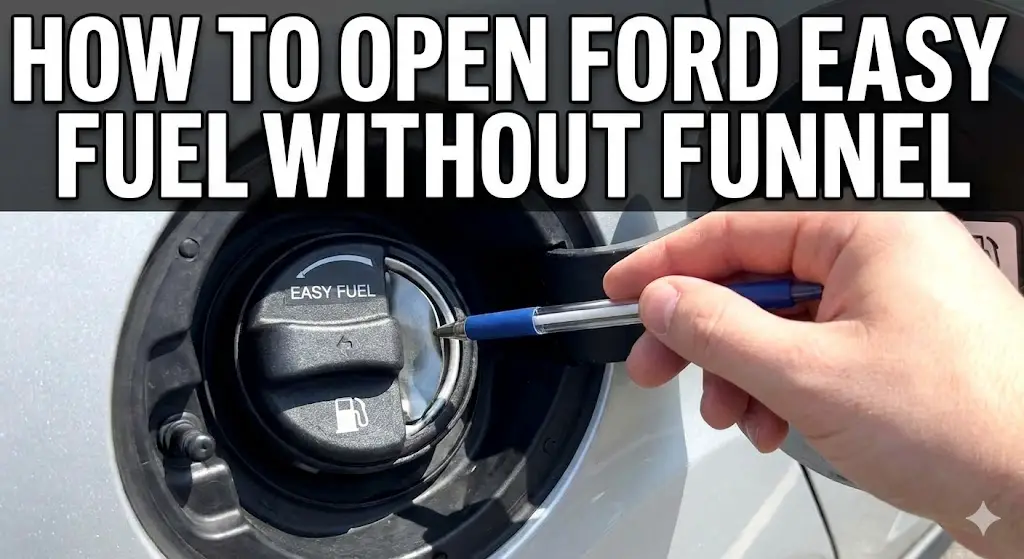
How to Open Ford Easy Fuel Without Funnel: A Comprehensive Engineering and Operational Report

The automotive landscape has undergone a significant ergonomic and environmental evolution with the introduction of capless fuel filler systems, most notably the Ford Easy Fuel™ system introduced in the late 2000s. While designed to streamline the refueling process, reduce evaporative emissions, and prevent misfueling, this system presents a unique failure mode for the vehicle operator: the inability to refuel using non-standard equipment.
In roadside emergency scenarios where a vehicle has run out of fuel, or during routine maintenance requiring fuel additives, the driver often discovers that standard portable gas cans (jerry cans) and additive bottles are mechanically incompatible with the vehicle’s filler neck.
This report provides an exhaustive technical examination of the Ford Easy Fuel system. It deconstructs the patent-protected locking mechanisms that guard the fuel tank, analyzes the precise dimensional tolerances defined by SAE J285 that govern access, and evaluates the efficacy and safety of emergency bypass protocols. Specifically, this document addresses the critical user query of how to open the system without the designated OEM funnel.
While the “Two-Tool” manipulation method and the “Rigid Conduit” (PVC) method are identified as mechanically viable improvisations, this report rigorously outlines the severe risks associated with them—ranging from triboelectric static discharge to permanent EVAP system damage—and argues that knowledge of the OEM funnel’s location remains the only truly safe protocol. Furthermore, this report serves as a definitive encyclopedia for locating the hidden OEM funnel across the entire Ford model lineage, from the F-150 to the Mustang.
LOCKED OUT: The Ford Easy Fuel Paradox
Running out of gas is bad. Realizing your gas can nozzle won’t fit into your Ford’s neck is worse. Here is the data-driven guide to opening the system without the funnel—and why you probably shouldn’t try.
The Invisible Barrier
The Ford Easy Fuel system utilizes a “mis-fueling inhibitor.” It isn’t just a hole; it’s a two-stage security gate. The first flap opens easily, but the second flap, deep inside the neck, is locked by latches that only release when engaged by a rigid tube of a specific diameter (approx 20-24mm).
Standard gas can spouts are often too soft, too angled, or too narrow to trip these latches. The result? Fuel spills all over your shoes instead of going into the tank.
Why Refueling Attempts Fail
Analysis of roadside assistance calls related to Easy Fuel lockout.
The “Sweet Spot” Mechanics
This isn’t magic; it’s geometry. To bypass the inhibitor without the OEM funnel, an object must meet precise criteria: sufficient diameter to hit the release tabs simultaneously, and sufficient rigidity to push the flap. We plotted the success probability against these physical variables.
*Interactive 3D Plot: Rotate to see how Spout Diameter (X) and Rigidity (Y) correlate with Valve Opening Success (Z).*
Don’t Hack It, Find It.
Before you try to jam a screwdriver into your fuel neck (high risk of damage), realize that 95% of Ford vehicles have the funnel on board. It is often hidden in plain sight.
💡 Pro Tip
Look for a white plastic funnel. It is roughly 6 inches long.
Most Common OEM Funnel Locations
Emergency Solutions: Risk vs. Reward
If the OEM funnel is truly lost, you have options. However, not all options are created equal. We analyzed three common methods based on safety (risk of spark/damage), ease of use, and success rate.
The OEM Replacement
Verdict: The only 100% safe method.
Available at most auto parts stores for under $10. Look
for “Capless Fuel Funnel.”
The Rigid Spout (DIY)
Verdict: Risky but viable.
Requires a
rigid tube (like a specific marker casing, cleaned thoroughly)
approx 21mm diameter.
High spill risk.
The Screwdriver Hack
Verdict: DANGEROUS.
Using a tool to pry
the flap open while pouring creates static risk and can break
the fragile neck tabs, costing $400+ to repair.
Emergency Protocol
Search Vehicle
Check spare tire well, glove box, and side pockets first.
Identify Spout
If lost, locate a generic “capless compatible” funnel at a gas station.
Insert Fully
Push until you feel the second flap release (approx 3 inches deep).
Pour & Wait
Pour gas. Wait 10 seconds before removing funnel to prevent drip-back.
The Paradigm Shift in Fuel Containment: History and Regulation
To understand the difficulty of bypassing the Ford Easy Fuel system, one must first appreciate that it is not merely a convenience feature; it is a regulatory compliance device. The transition from the traditional threaded gas cap to the capless seal was driven by stringent environmental mandates and the need to reduce the "human factor" in emissions control.
The Legacy of the Threaded Cap
For decades, the threaded fuel cap was the industry standard. However, it was a significant point of failure in the vehicle's Evaporative Emission Control (EVAP) system. The U.S. Environmental Protection Agency (EPA) and the California Air Resources Board (CARB) identified that a substantial percentage of "Check Engine" lights (CEL) were triggered not by mechanical engine failure, but by loose, missing, or cross-threaded gas caps. A compromised cap allows volatile organic compounds (VOCs) to escape into the atmosphere and prevents the fuel system from maintaining the vacuum or pressure required for self-diagnostic leak testing.
The Introduction of Easy Fuel
Ford Motor Company pioneered the mass-market adoption of capless technology, introducing the Easy Fuel system on the 2008 Ford Explorer and Mercury Mountaineer. By 2010, the technology had proliferated across the lineup, including the F-150, Fusion, and Mustang. The system was marketed primarily for its convenience—drivers no longer had to touch a dirty gas cap or worry about scratching the paint with a dangling tether—but its engineering justification was rooted in sealing integrity.
The Easy Fuel system utilizes a spring-loaded self-sealing flap that closes automatically when the nozzle is removed. This eliminates the possibility of the "loose cap" check engine light (Code P0455/P0457) caused by driver error. However, this automation necessitated a robust security mechanism to ensure the flap would not open for unauthorized objects, leading to the complex interlock system that currently frustrates users attempting to use portable gas cans.
Anatomy of the Interlock: Engineering the "Keyhole"
The Ford Easy Fuel system is a passive mechanical gatekeeper. It possesses no electronic sensors to detect the nozzle; instead, it relies entirely on physical geometry and mechanical resistance to distinguish between a legitimate fuel pump nozzle and a foreign object.
The Concentric Dual-Flap Architecture
The system is constructed with a "tube-in-tube" design featuring two distinct barriers:
- The Outer Dust Shutter: This is the visible component when the fuel door is opened. It is a simple spring-loaded flap designed to exclude water, road dust, and debris from the filler neck throat. It offers minimal resistance and provides no sealing function for fuel vapors. Pushing this flap open reveals the true barrier.
- The Inner Misfueling Inhibitor (The Lock): Located approximately 50mm to 80mm deep within the neck is the primary sealing valve. This valve is mechanically locked in the closed position by a set of radial detents (latches).
The Dimensional "Key"
The locking mechanism is designed to accept a specific "key": the standard unleaded fuel nozzle spout. The dimensions of this key are governed by SAE J285, a standard that ensures interoperability between fuel dispensing equipment and vehicle inlets.
- The Actuation Geometry: The internal latches are spaced precisely to engage with a rigid cylinder having an outer diameter (OD) between 20.6 mm (0.811 inches) and 21.3 mm (0.84 inches).
- The Mechanism of Action: As the fuel nozzle is inserted, its outer surface simultaneously contacts two (or sometimes three, depending on the generation) opposing locking tabs. The force of insertion pushes these tabs outward (radially) or backward (axially), which disengages the latch holding the main flap. Once unlatched, the nozzle tip pushes the flap open, allowing fuel entry.
The Rejection of Foreign Objects
The system is engineered to fail-safe (remain closed) if the insertion object does not match these specifications.
- Too Small: A finger, a screwdriver, or a narrow hose (siphon tube) will pass between the latches without engaging them. The flap remains locked.
- Too Large: A diesel nozzle (OD ~23.8 mm) is too wide to enter the pilot ring of a gasoline Easy Fuel system, preventing it from reaching the latches. This is the primary "misfueling inhibition" feature.3
- Too Soft: The flexible, corrugated spout of a standard polyethylene gas can lacks the hoop strength to depress the latches. When a user pushes the spout against the lock, the plastic spout deforms or bends rather than transmitting the force necessary to unlock the mechanism.9
Emergency Bypass Protocol A: The Two-Tool Manipulation
In an emergency where the vehicle is out of fuel and the OEM funnel is missing, the driver must manually simulate the mechanical signature of a fuel nozzle. The most common field improvisation is the "Two-Tool" or "Two-Screwdriver" method.
WARNING: This method carries a high risk of damaging the EVAP seal, which can result in costly repairs ($400-$1,000 for filler neck replacement) and permanent Check Engine lights.10 It should only be attempted in genuine emergencies.
The Biomechanics of the Bypass
The objective is to simultaneously depress the two opposing locking tabs located at the 3 o'clock and 9 o'clock positions (orientation may vary by model) inside the filler throat.
Step-by-Step Procedure
- Preparation: Locate two long, rigid, slender tools. Flathead screwdrivers, stiff reinforced wire, or even sturdy keys (if long enough) can be used.
- Access: Push open the outer dust shutter with a finger or one of the tools.
- Visualization: Use a flashlight to identify the two small tabs protruding into the channel just above the inner metal flap.
- Engagement:
- Insert Tool A against the left tab.
- Insert Tool B against the right tab.
- Actuation: Apply outward/backward pressure on both tabs simultaneously. You are attempting to spread them apart or push them deep into their recesses.
- The Breach: Once both tabs are fully depressed, the internal flap will unlatch. It will often click or feel loose.
- Insertion: While maintaining pressure on the tabs (this requires significant dexterity), use a third hand or a helper to insert the spout of the gas can or additive bottle.
- Stabilization: Once the spout passes the flap, it will hold the door open. Carefully withdraw the screwdrivers.
Risk Assessment
- Seal Abrasion: The metal shafts of screwdrivers can easily score the plastic or rubber sealing surfaces of the inner valve. A scratch as shallow as a few microns can prevent the system from holding a vacuum during the engine-off natural vacuum test (EONV), triggering a P0456 (Small Leak) code.
- Debris Introduction: Poking around the dirty outer throat can dislodge road grit directly into the tank, clogging the fuel pump sock.
- Tool Loss: Dropping a tool down the filler neck is a catastrophic failure mode necessitating tank removal.
Emergency Bypass Protocol B: The Rigid Conduit (PVC) Method
A more mechanically elegant—though chemically hazardous—solution involves creating a rigid adapter that perfectly mimics the dimensions of a fuel nozzle.
The Dimensional Coincidence of PVC
By a stroke of industrial coincidence, standard 1/2-inch Schedule 40 PVC pipe possesses an outside diameter (OD) that falls exactly within the tolerance range of a standard unleaded fuel nozzle.
- Standard Nozzle OD: 20.6 mm to 21.3 mm (0.811" - 0.840").
- 1/2" Schedule 40 PVC OD: 21.34 mm (0.840").
This means a clean piece of 1/2-inch PVC pipe acts as a "skeleton key" for the Ford Easy Fuel system. It is rigid enough to depress the latches and perfectly sized to fit the pilot ring.
Fabrication and Use
- Cut: Cut a 6-inch to 8-inch section of 1/2-inch PVC pipe.
- Deburr: Thoroughly sand and clean the cut ends. PVC shavings are a major contaminant risk for fuel injectors.
- Insert: Push the PVC pipe firmly into the Easy Fuel opening. It will engage the latches and pop the door open with a single motion, mimicking a pump nozzle.
- Fill: Insert a standard funnel into the top of the PVC pipe and pour the fuel.
The Electrostatic Hazard Analysis
While the PVC method solves the mechanical problem, it introduces a severe static electricity risk.
- The Triboelectric Effect: Gasoline is a dielectric fluid. When it flows through a non-conductive pipe (like PVC), friction separates electrons, generating a static charge on the surface of the plastic.
- Lack of Grounding: Unlike a metal fuel nozzle, which is grounded to the dispenser, or the OEM funnel (which is made of static-dissipative HDPE), standard white PVC is an electrical insulator.
- The Arc: As the charge builds up (potentially reaching 20,000 volts), it seeks a path to ground. The metal rim of the vehicle's filler neck provides that ground. If the static discharges as a spark at the filler neck—where fuel vapors are most concentrated—it can cause a flash fire.
- Mitigation: If this method must be used in a dire emergency, the user must ensure continuous grounding contact between the gas can, the vehicle chassis, and the earth. However, given the insulating nature of PVC, this is difficult to guarantee. This method is strongly discouraged for routine use.
The Core Problem: Why Standard Gas Cans Fail
The incompatibility between Ford vehicles and portable fuel containers is not a defect in the vehicle, but a divergence in regulatory standards.
The Evolution of the Jerry Can
Modern portable fuel containers (PFCs) are governed by the Children's Gasoline Burn Prevention Act and various CARB regulations aimed at reducing spillage.
- Complex Spouts: Modern spouts often feature spring-loaded locking collars that must be compressed against the rim of a tank to open the valve.
- The "Limp Spout" Issue: The Easy Fuel system provides no rigid rim for these locking collars to push against. The opening is recessed. Furthermore, the plastic spouts on older cans are often flexible and corrugated. When pushed against the Easy Fuel latches, the corrugations compress (accordion-style) rather than transmitting the axial force needed to unlock the door.
Additive Bottle Incompatibility
Fuel additives (e.g., injector cleaners, octane boosters) typically come in bottles with long, slender necks.
- Diameter Mismatch: These necks are usually 15mm-18mm in diameter, significantly smaller than the 20.6mm required to trigger the latches. They slide harmlessly between the locking tabs without opening the door.
- Backflow: If a user attempts to pour fluid into the outer shutter without opening the inner door, the fluid will simply pool in the neck and drain out the overflow tube onto the ground, never entering the tank.
The Official Solution: The OEM Funnel Encyclopedia
The only method sanctioned by Ford Motor Company, and the only one that guarantees safety for both the operator and the vehicle's emissions system, is the use of the OEM Fuel Filler Funnel. This part is supplied with every new Ford vehicle, yet it is one of the most frequently lost or misplaced items.
6.1 Funnel Specifications
- Material: High-Density Polyethylene (HDPE), chosen for its chemical resistance to hydrocarbons and static-dissipative properties.
- Geometry: A rigid stem with an OD of exactly 20.6mm, flaring into a small cone.
- Part Numbers:
- 8U5Z-17B068-B (Standard replacement).
- 8U5Z-17B068-K (Updated part number).
- 8U5A-17B068-AD.
6.2 Definitive Location Guide by Model
Locating the funnel is the first step in solving the refueling problem. Ford engineers have moved its location frequently to optimize cargo space.
Ford F-Series (F-150, F-250 Super Duty)
- 2009-2014 Generation:
- SuperCrew/SuperCab: The funnel is typically strapped to the jack kit located under the rear passenger seat. It may be tucked into the carpeted trim panel behind the rear seat backrest.
- Regular Cab: Often found behind the passenger seat, clipped to the rear cab wall or with the jack tools.
- 2015-2020 Generation:
- Located in the rear passenger-side storage compartment. Access requires lifting the rear seat cushion. It is often snapped into a designated holder in the plastic molding of the jack storage bin.
- 2021-Present Generation:
- Found in the storage compartment under the rear seat or in the side trim panel of the bed (if equipped with Pro Power Onboard storage).
Ford SUVs (Explorer, Expedition, Escape, Edge)
- Ford Explorer (2011-2019): Located under the rear cargo floor. Lift the carpeted panel; the funnel is usually snapped into the styrofoam organizer that holds the jack and lug wrench.
- Ford Explorer (2020+): Found in the spare wheel storage tray or the right-hand rear cargo trim panel access door.
- Ford Escape (2013+): Located in the spare tire well, often loose or clipped to the side of the spare tire well wall.
- Ford Edge: In the spare wheel storage tray under the cargo floor.
Ford Passenger Cars (Fusion, Focus, Mustang)
- Ford Fusion (2013-2020): Under the trunk floor covering. It is embedded in the styrofoam tire inflator kit (if the vehicle has no spare) or with the spare tire jack.
- Ford Mustang (2015-2023): Located in the spare tire well under the trunk carpet. If the vehicle is a Performance Pack model (no spare), it is located in the tire mobility kit storage well.
- Ford Focus: Rear trunk, passenger side foam organizer under the carpet.
Data Table: Funnel Locations at a Glance
| Vehicle Model | Primary Location | Secondary Location |
| F-150 (2015+) | Under rear seat (Jack Bin) | Behind rear seat back |
| Explorer | Spare Tire Well (Styrofoam) | Right Rear Cargo Panel |
| Mustang | Trunk Floor (Spare/Inflator Kit) | Glovebox (rare, usually dealer placed) |
| Fusion | Trunk Floor (Tire Kit) | Side Trunk Pocket |
| Bronco (2021+) | Rear Cargo Tool Kit | Glovebox |
Troubleshooting and System Diagnostics
The interaction between the Easy Fuel system and non-standard fueling methods often leads to mechanical binding or sensor faults.
The "Stuck Nozzle" Phenomenon
A surprisingly common issue is the fuel station nozzle becoming physically stuck in the filler neck.
- Mechanism: The "anchor ring" (a wound metal spring or ridge on the gas nozzle spout) can catch on the internal locking tabs of the Easy Fuel system if the nozzle is inserted at an aggressive angle or pulled back too forcefully without disengaging the latches.
- Resolution Protocol:
- Stop Pulling: Continued force can rip the filler neck from the vehicle body.
- Push In: Push the nozzle slightly deeper into the neck to relieve tension on the latches.
- Rotate: Rotate the nozzle handle 90 degrees (so it is horizontal). This aligns the nozzle's anchor points away from the locking tabs.
- Extract: Gently pull the nozzle out while maintaining the rotated position.
Diagnostic Trouble Codes (DTCs)
The Easy Fuel system is tightly integrated with the On-Board Diagnostics (OBD-II) system.
- P0455 (Evaporative Emission System Leak Detected - Large Leak): This code often appears if the Easy Fuel flap fails to close completely. This can be caused by a piece of debris (a twig, a piece of plastic from a gas can) preventing the flap from sealing.
- P0457 (Loose Fuel Cap): Even though there is no cap, the ECU uses this legacy code to indicate a gross leak at the filler neck.
- Cause: Often caused by "emergency bypass" attempts (screwdrivers) scratching the seal.
- Fix: Use the OEM funnel to "exercise" the flap. Insert and remove the funnel 10-20 times rapidly. This can dislodge debris and re-seat the rubber seal.10 WD-40 is generally not recommended as it can damage the rubber seals and contaminate the EVAP charcoal canister. Use compressed air to blow out the neck.
Aftermarket and Manufacturing Alternatives
For users who have lost their OEM funnel, the market provides several low-cost alternatives that are safer than the screwdriver method.
Retail Solutions
- Hopkins FloTool 10719: This is the most ubiquitous aftermarket solution. It is designed with the correct diameter stem to unlock capless systems and features a flat edge on the funnel cone to accommodate CARB-compliant gas can nozzles. It is widely compatible with Ford, GM, and Chrysler capless systems.
- Dorman 55406: An OEM-spec replacement funnel available at most auto parts stores.
3D Printing: A Material Science Warning
The "Maker" community has produced numerous STL files for printing replacement funnels. However, material selection is critical.
- PLA (Polylactic Acid): DO NOT USE. PLA is biodegradable and can soften or dissolve when exposed to gasoline. A dissolving funnel can deposit plastic sludge into the fuel tank.
- PETG (Polyethylene Terephthalate Glycol): Highly recommended. PETG is chemically resistant to hydrocarbons and maintains structural integrity.
- Nylon: Excellent chemical resistance but difficult to print.
- Conductivity: Standard 3D printing filaments are insulators. A 3D-printed funnel shares the same static electricity risk as the PVC pipe method. Post-processing with a conductive coating or using ESD-safe filament is theoretically safer.
Conclusion and Strategic Recommendations
The Ford Easy Fuel system represents a victory of engineering over human error, successfully eliminating the "loose gas cap" from the lexicon of automotive problems. However, it requires the user to adhere to a specific protocol—the use of the 20.6mm OEM funnel—during off-nominal refueling events.
While methods exist to bypass the system using screwdrivers or PVC pipe, the risk/reward calculus heavily favors obtaining the proper tool. The potential for electrostatic discharge (fire) or mechanical damage to the filler neck (expensive repairs) makes the "Two-Tool" and "PVC" methods suitable only for life-safety emergencies where stranding is not an option.
Final Recommendations for Ford Owners:
- Audit: Go to your vehicle immediately and locate the funnel using the guide in Section 6.2.
- Equip: If the funnel is missing, purchase a Hopkins FloTool 10719 or OEM part 8U5Z-17B068-B and zip-tie it to your emergency gas can or store it in the glovebox.
- Clean: Periodically inspect the fuel filler throat and use compressed air to remove dust, ensuring the longevity of the internal seals.
Frequently Asked Questions (FAQ)
Q1: Can I use a standard transmission funnel to put gas in my Ford?
A: Generally, no. Most transmission funnels have long, slender necks that are too narrow (less than 20mm) to trigger the locking latches. They will slide in but the flap will remain closed. If you pour gas, it will spill out the overflow drain onto your shoes.
Q2: Will the screwdriver method void my warranty?
A: Technically, yes. If you scratch the sealing surface of the filler neck while forcing it open with screwdrivers, and this causes an EVAP leak (Code P0457), the dealer will likely classify this as "external damage" or "customer abuse," which is not covered under the bumper-to-bumper warranty. Replacing the filler neck can cost upwards of $600 including labor.
Q3: Why does the gas pump nozzle keep clicking off when I fill my Ford?
A: This is usually due to the nozzle not being inserted fully, or the vapor recovery system on the pump being overly sensitive. The Easy Fuel system seals tightly around the nozzle. If the nozzle is angled poorly, the back-pressure sensor in the pump triggers the shut-off. Try rotating the nozzle 90 degrees or pulling it out slightly and re-inserting it firmly.
Q4: Can I leave the funnel in the tank permanently?
A: No. The funnel holds the spring-loaded flap open. If you leave it in, the fuel system is open to the atmosphere. This will cause fuel evaporation, allow water/dust ingress, and trigger a massive EVAP leak code (P0455) immediately upon startup.
Q5: Is the funnel the same for Diesel and Gas Fords?
A: No. The diesel Easy Fuel system has a wider opening (approx 24mm+) to accept high-flow diesel nozzles. A gasoline funnel (20.6mm) might fit into a diesel neck, but a diesel nozzle will not fit into a gas neck. Ensure you buy the correct funnel for your fuel type.
Q6: What is the "Check Fuel Fill Inlet" warning?
A: This warning appears on the driver information center when the system detects a leak at the filler neck. It essentially means "your capless door isn't sealing." It is often caused by debris on the seal. Ford recommends inserting and removing the fuel funnel several times to clear the debris and reseat the seal.