How Much Does a Ford F-250 Weigh? A Comprehensive Guide 2026

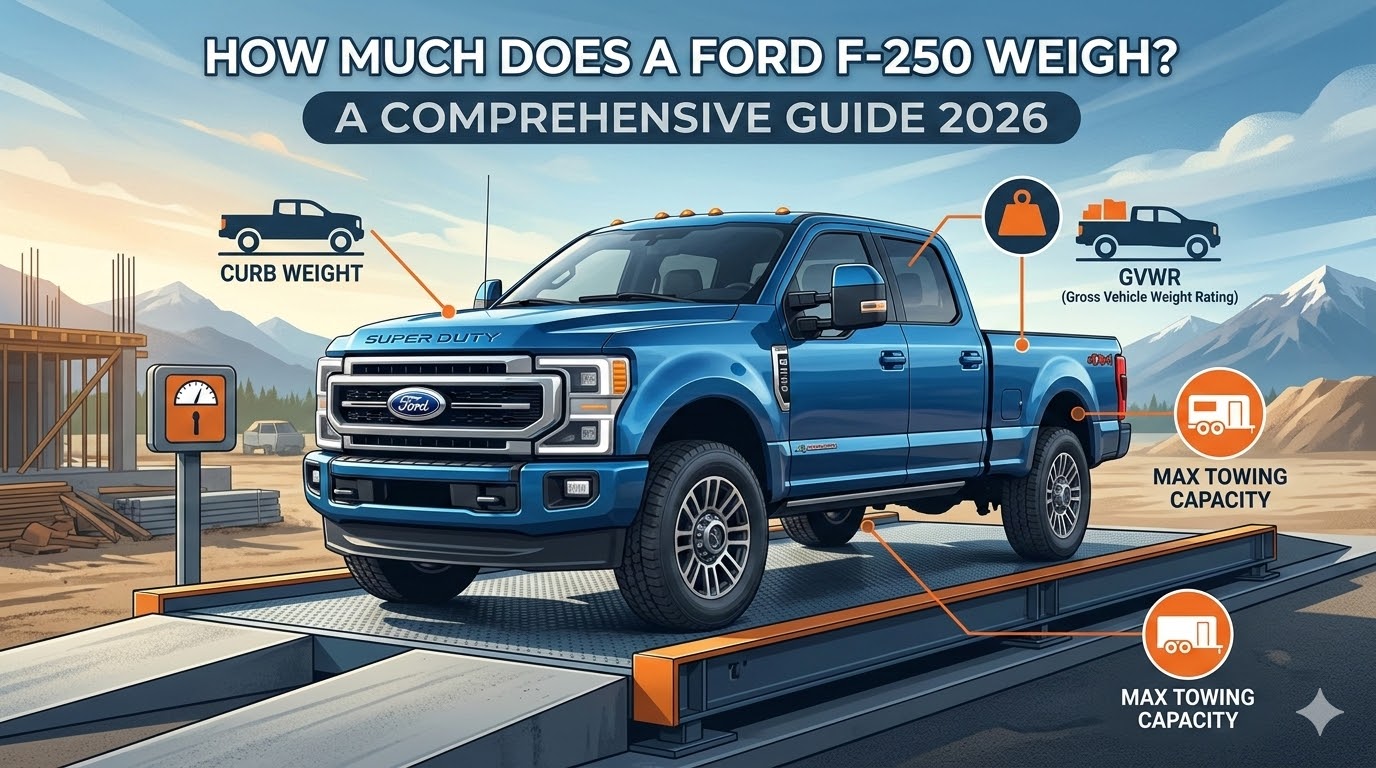
Understanding exactly how much a Ford F-250 weighs requires looking far beyond a single static number. As a foundational pillar of the Class 2b heavy-duty truck segment, the Ford F-250 Super Duty is engineered to balance immense structural rigidity with complex powertrain variations. Consequently, the vehicle’s weight is a highly dynamic metric that dictates its legal classifications, payload capabilities, and towing maximums.
A miscalculation in curb weight or Gross Vehicle Weight Rating (GVWR) can lead to overloaded axles, compromised vehicle dynamics, or severe regulatory penalties from the Department of Transportation.
This comprehensive report synthesizes technical data across cab configurations, powertrain choices, and historical engineering shifts to definitively answer how weight affects the operational limits of the Ford F-250.
How Much Does a Ford F-250 Weigh?
The definitive data-driven guide to Ford Super Duty curb weights, GVWR, payload, and the heavy impact of diesel engines vs. gas.
The Quick Answer: F-250 Weight Ranges
The weight of a Ford F-250 Super Duty varies wildly depending on cab size, bed length, drivetrain (4×2 vs. 4×4), and engine choice. Before diving into the deep technical specifications, here is the absolute baseline you need to know.
Base Curb Weight
Absolute lightest configuration. (Regular Cab, 8′ Box, 4×2, 6.8L Gas V8)
Max Curb Weight
Heaviest stock configuration. (Crew Cab, 8′ Box, 4×4, 6.7L HO Diesel)
Max GVWR
Maximum Gross Vehicle Weight Rating, up to 13,300 lbs with High Capacity Tow Package.
1. The Anatomy of F-250 Curb Weight
Curb weight is the actual physical weight of the truck sitting on the pavement with a full tank of fuel and all standard fluids, but zero passengers or cargo. When comparing an F-250 to a half-ton F-150, the Super Duty features a significantly thicker, fully boxed high-strength steel frame and massive axles designed for constant, heavy abuse.
Even though Ford famously transitioned the Super Duty lineup to military-grade aluminum-alloy bodies in 2017—saving roughly 350 pounds per truck—the F-250 remains a heavyweight behemoth. Upgrading from a Regular Cab to a massive Crew Cab adds about 500 lbs of metal, glass, and interior components. Switching from a 4×2 drivetrain to a 4×4 system adds heavy front differential housing, transfer case, and reinforced suspension parts, penalizing the scale by approximately 400 lbs.
Curb Weight Variance by Configuration
Data represents approximate base curb weights. Adding high-tier trims (Lariat, Platinum) adds 150-300 lbs in luxury features, panoramic roofs, and tech.
2. The Diesel Penalty: Engine Weights
The single biggest variable affecting the weight of your Ford F-250 is what sits under the hood. Ford offers a range of massive engines, but the split between gasoline and diesel powertrains radically alters the truck’s dynamics, front-axle weight rating (FAWR), and overall curb weight.
The base 6.8L Gas V8 and the upgraded 7.3L “Godzilla” Gas V8 feature cast-iron blocks, but they are relatively simple pushrod engines. Opting for the legendary 6.7L Power Stroke V8 Turbo Diesel introduces an immense amount of mass. The diesel engine block is heavier, but the real weight comes from the massive turbocharger plumbing, dual batteries, heavy-duty cooling systems, DEF (Diesel Exhaust Fluid) tank, and the heavy-duty TorqShift 10-speed transmission required to handle the 1,200 lb-ft of torque.
Weight Impact of Powertrain Choice
Crucial Note: Because the diesel engine adds ~800 lbs directly over the front axle, diesel F-250s actually have a lower payload capacity than their gas counterparts, assuming they share the same GVWR.
3. Decoding GVWR vs. Payload Dynamics
Understanding weight ratings is critical for legal and safe towing. GVWR (Gross Vehicle Weight Rating) is the absolute maximum the truck is legally allowed to weigh when fully loaded with fuel, passengers, cargo in the bed, and the tongue weight of a trailer.
The mathematical formula for payload is simple but strict:
Payload Capacity = GVWR – Curb Weight
A standard F-250 typically carries a GVWR of 10,000 lbs. This 10k limit is an artificial threshold established for commercial registration and tax laws in many states. If you buy a heavy, fully-loaded F-250 Platinum 4×4 Diesel (Curb Weight ~7,600 lbs) with a 10,000 lb GVWR, your legal payload is only 2,400 lbs.
Ford offers a High Capacity Axle Upgrade Package (specifically for the F-250 with the diesel engine), which upgrades the rear axle and bumps the GVWR up to 11,400 lbs, or even up to 13,300 lbs in specific fleet configurations, bringing F-250 specs dangerously close to F-350 territory.
GVWR Composition: Where the Weight Goes
4. How Weight Affects Towing Capabilities
The heavier your truck’s curb weight, the less payload you have available for trailer tongue weight. However, heavier trucks with diesel engines provide massive torque and better stability for moving heavy loads. Here is how the capacities stack up based on weight and engine.
| Engine Configuration | Max Payload | Max Conventional Towing | Max 5th-Wheel / Gooseneck |
|---|---|---|---|
| 6.8L Gas V8 | 4,268 lbs | 14,800 lbs | 14,800 lbs |
| 7.3L Gas V8 | 4,164 lbs | 17,200 lbs | 17,200 lbs |
| 6.7L Power Stroke Diesel | 4,048 lbs* | 22,000 lbs | 22,900 lbs |
| 6.7L HO Power Stroke | 3,983 lbs* | 22,000 lbs | 23,000 lbs |
Base Curb Weight Range of the Ford F-250
Curb weight represents the total mass of the vehicle equipped with all standard components, necessary operating fluids (such as engine oil and coolant), and a full tank of fuel, excluding passengers and cargo. For the modern Ford F-250, the official base curb weight spans a massive spectrum, starting at 5,697 pounds for the absolute lightest configuration and scaling up to 8,627 pounds for a fully equipped luxury model.
This variance of nearly 3,000 pounds highlights the fundamental differences in how these trucks are assembled for specific vocations. The structural baseline of the vehicle is established by its cab style and bed length. The Regular Cab, optimized for pure fleet utility, features a two-door layout and an 8-foot bed, resulting in the lowest possible starting weight. Moving to the SuperCab or Crew Cab introduces substantial high-strength aluminum alloy body paneling, extended wheelbase frames, secondary doors, and heavier interior seating. Furthermore, upgrading from a standard 4×2 drivetrain to a 4×4 configuration necessitates the addition of a heavy cast-iron transfer case, a front differential, heavier front axles, and an auxiliary driveshaft, which collectively add between 350 and 450 pounds to the vehicle’s mass.
Visual Plan: A stacked bar chart titled “Cumulative Curb Weight Additions.” The X-axis represents the base XL Regular Cab (5,697 lbs). Stacked variables on the Y-axis indicate the average weight penalties of upgrading to a Crew Cab (+350 lbs), adding a 4×4 drivetrain (+400 lbs), and equipping the 6.7L Diesel engine (+800 lbs).
| Cab Configuration | Bed Length | Drivetrain | Base Curb Weight Range (lbs) | Standard Passenger Capacity |
| Regular Cab | 8.0 ft (Long Bed) | 4×2 | 5,697 | 3 |
| SuperCab | 6.75 ft (Short Bed) | 4×2 / 4×4 | 5,995 – 6,104 | 6 |
| SuperCab | 8.0 ft (Long Bed) | 4×2 / 4×4 | 6,000 – 6,200 | 6 |
| Crew Cab | 6.75 ft (Short Bed) | 4×2 / 4×4 | 6,041 – 6,264 | 6 |
| Crew Cab | 8.0 ft (Long Bed) | 4×2 / 4×4 | 6,264 – 8,627 | 6 |
Powertrain Mass: The Gasoline vs. Diesel Weight Penalty
The most significant single variable altering the curb weight of a Ford F-250 is the powertrain. The Super Duty lineup offers a choice between naturally aspirated gasoline engines, such as the 6.8L V8 and the 7.3L “Godzilla” V8, and turbocharged diesel engines, namely the 6.7L Power Stroke and its High-Output variant.
The mechanical architecture of a diesel engine inherently requires massive structural reinforcement to withstand extreme internal cylinder pressures and high-compression combustion. This necessitates compacted graphite iron engine blocks, heavy forced-induction turbo piping, robust cooling systems, and complex exhaust after-treatment hardware, including a Diesel Exhaust Fluid (DEF) tank. Consequently, equipping an F-250 with a 6.7L Power Stroke diesel adds approximately 580 to 990 pounds of localized weight directly over the front steering axle compared to a standard gasoline V8.
This intense forward weight bias dramatically alters the truck’s mechanical handling. While the localized mass improves front-tire traction and steering stability when counterbalancing heavy trailer tongue weights, it fundamentally restricts the vehicle’s overall payload capacity, as the engine itself consumes a massive portion of the truck’s legal weight limit.
The Cumulative Weight of Options and Luxury Trims
As vehicles ascend the trim hierarchy from the utilitarian XL work truck to the luxurious Platinum or Limited tiers, hidden mass accumulates rapidly. Fleet-oriented models prioritize low curb weight by utilizing manual seating, basic steel wheels, and lightweight vinyl flooring. Premium trims introduce dense sound-deadening materials, panoramic glass moonroofs, multi-way power-adjustable seating with internal massaging motors, and heavy leather upholstery.
Beyond the trim level, standalone factory options significantly degrade payload availability.
| Optional Equipment | Engineering Mechanism & Material | Estimated Impact on Payload |
| FX4 / Tremor Skid Plates | High-gauge steel plates shielding the transfer case and fuel tank from off-road impacts. | High |
| Ford Performance Warn Winch | A 12,000-lb rated recovery winch requiring heavy steel mounting brackets behind the front bumper. | High |
| Integrated Tailgate Step | Steel tracks and deploying mechanisms integrated directly into the aluminum tailgate structure. | Moderate |
| Tough Bed® Spray-in Bedliner | A thick, factory-applied polyurethane coating spanning the cargo box volume. | Moderate |
| Fifth-Wheel Prep Package | An under-bed high-strength steel crossmember bolted directly to the frame rails. | High |
Data synthesized from Ford Super Duty equipment guidelines.
Gross Vehicle Weight Ratings (GVWR) and DOT Compliance
While curb weight measures the truck as it sits empty, the Gross Vehicle Weight Rating (GVWR) defines the absolute maximum legal weight of the fully loaded vehicle. This rating is engineered by the manufacturer and encompasses the curb weight, all passengers, cargo in the bed, and the downward tongue weight applied by a connected trailer.
The GVWR is the primary metric utilized by the to classify commercial vehicles. The Ford F-250 falls precisely into the Class 2b light/medium-duty truck category, which covers vehicles with a GVWR between 8,501 and 10,000 pounds.
The 10,000-Pound Regulatory Threshold
In the United States, crossing the 10,000-pound threshold triggers a cascade of stringent commercial regulations. If an F-250 is utilized for business purposes across state lines and has a GVWR of 10,001 pounds or greater, the operator is federally mandated to obtain a USDOT number. This subjects the vehicle to mandatory weigh station inspections, strict hours-of-service logging for the driver, and significantly higher commercial liability insurance premiums. Local state jurisdictions often enforce similar rules for intrastate commercial vehicle registration requirements based on this same weight class.
The 9,900-lb GVWR Downgrade Package
To shield buyers from inadvertently violating these commercial regulations, Ford engineered specific administrative packages. The most common is the 10,000-lb GVWR package, which artificially caps the truck’s legal limit right at the federal boundary. For operators residing in states with aggressive weight-based registration taxes, Ford offers the 9,900-lb GVWR Downgrade Package (Order Code 68D).
It is critical to understand that this downgrade is entirely administrative. An F-250 equipped with the 9,900-lb package possesses the exact same high-strength steel frame, heavy-duty leaf springs, and brake calipers as a standard model; the reduction exists purely on the legal compliance label located on the driver’s door jamb.
High-Capacity Axle Upgrades
Conversely, for operators who are fully DOT-compliant and require maximum physical capability, Ford provides the F-250 High Capacity Axle Upgrade Package. This mechanical upgrade replaces the standard rear axle with a heavier-duty unit, increasing the rear Gross Axle Weight Rating (GAWR) and pushing the total vehicle GVWR up to 11,400 pounds. While this configuration maximizes raw towing stability, it definitively reclassifies the F-250 out of Class 2b territory, subjecting business operators to total commercial compliance.
The Mathematics of Payload and Towing
The most frequent error operators make is conflating towing capacity with payload capacity. The mathematical formula governing safe and legal operation is rigid: Payload Capacity = Gross Vehicle Weight Rating (GVWR) – Curb Weight.
If an operator purchases a fully loaded F-250 Crew Cab 4×4 Platinum equipped with the 6.7L Power Stroke diesel, the curb weight will approach 8,000 pounds. If this specific truck is restricted by a standard 10,000-lb GVWR package to avoid DOT regulations, the resulting payload capacity is a mere 2,000 pounds. Once four adult passengers enter the cabin (consuming approximately 800 pounds), only 1,200 pounds of payload remains. If the driver attempts to tow a heavy fifth-wheel RV, the pin weight of the trailer—which rests directly over the rear axle and counts against the truck’s payload—will effortlessly exceed 1,200 pounds. This renders the vehicle legally overloaded, despite the diesel engine possessing immense torque reserves.
Visual Plan: A scatter plot matrix titled “Payload vs. Towing Optimization.” The X-axis represents Maximum Conventional Towing Capacity (lbs), and the Y-axis represents Maximum Payload Capacity (lbs). Plot points show the 6.8L Gas V8 scoring highest on payload but lowest on towing, while the 6.7L High-Output Diesel scores maximum on towing but lowest on payload.
| Engine Specification | Max Payload (Optimal Configuration) | Max Fifth-Wheel / Gooseneck Towing |
| 6.8L Gas V8 | 4,268 lbs | 14,800 lbs |
| 7.3L Gas V8 | ~4,000 lbs | 22,500 lbs |
| 6.7L Power Stroke Diesel | 3,940 lbs | 22,900 lbs |
| 6.7L H.O. Power Stroke Diesel | 3,903 lbs | 22,900 lbs |
Calculations derived from Ford’s official towing guides and require specific axle ratios and high-capacity tow packages.
When navigating extreme loads, the Gross Combined Weight Rating (GCWR) serves as the ultimate ceiling, encompassing the tow vehicle, all cargo, passengers, and the fully loaded trailer. A base 6.8L Gas V8 yields a 21,000-pound GCWR, whereas the 6.7L High-Output Power Stroke Diesel with the High-Capacity Axle Upgrade elevates the GCWR to an astonishing 31,000 pounds.
Historical Ford F-250 Weight Trends (1999–Present)
The physical footprint and mass of the Ford F-250 have evolved profoundly over the last quarter-century, mirroring broader automotive engineering shifts toward massive structural reinforcement and advanced emissions compliance.
Prior to 1999, the F-250 shared its underlying chassis architecture with the lighter half-ton F-150. In 1999, Ford severed this relationship, launching the dedicated “Super Duty” line. These vehicles utilized bespoke, heavy-gauge steel frames and massive turbo-diesel powertrains, causing curb weights to skyrocket. By the 4th generation (2011–2016), F-250 curb weights routinely exceeded 7,000 pounds, driven by heavy steel body panels and the introduction of the 6.7L Power Stroke engine.
The 2017 Aluminum Revolution
Facing intense engineering pressure regarding ballooning curb weights that were severely degrading Class 2b payload capacities, Ford executed a radical pivot for the 2017 model year. By transitioning the entire cab and bed from stamped steel to high-strength, military-grade aluminum alloy, engineers achieved a gross body weight reduction of up to 350 pounds.
However, the curb weight printed on the specification sheet did not drop by 350 pounds. Rather than making the overall vehicle lighter, Ford reinvested that mass savings directly into the truck’s foundation. The 2017 F-250 received a taller, thicker, fully boxed frame constructed of 95% high-strength steel, alongside beefier transfer cases and thicker suspension components. This reallocation of weight vastly increased the structural rigidity and GCWR of the truck without adding dead curb weight, keeping the F-250 highly viable under the critical 10,000-pound DOT threshold while towing heavier loads than its predecessors. Current models continue this legacy, integrating onboard payload scales and larger engines while maintaining the aluminum weight advantages.
FAQs
How does the 4×4 drivetrain affect the F-250’s payload capacity?
Equipping an F-250 with a 4×4 drivetrain requires the installation of a heavy cast-iron transfer case, a front differential, heavy-duty front axles, and a front driveshaft. This hardware adds approximately 350 to 450 pounds of base curb weight directly to the chassis. Because the Gross Vehicle Weight Rating (GVWR) generally remains static (often capped at 10,000 pounds), this added curb weight is subtracted dollar-for-dollar from the available payload capacity. Therefore, identically equipped 4×2 models will universally feature higher payload ratings than their 4×4 counterparts.
Is a Ford F-250 considered a commercial vehicle?
The classification of an F-250 depends entirely on its GVWR configuration and how it is operated. Structurally, the F-250 is a Class 2b vehicle. If it is ordered with a standard 10,000-lb GVWR package or the 9,900-lb downgrade package, it avoids mandatory federal commercial classification for interstate commerce. However, if the truck is utilized for business and tows a trailer that pushes the Gross Combined Weight Rating (GCWR) over 10,001 pounds, or if the truck is built with the High-Capacity Axle Upgrade pushing the GVWR to 11,400 pounds, the operator must obtain a USDOT number and adhere to commercial compliance.
Why does the diesel F-250 have a lower payload than the gas F-250?
While diesel engines are synonymous with heavy hauling due to their massive torque output, they are physically much heavier than gasoline engines. The 6.7L Power Stroke diesel block, turbochargers, heavy-duty cooling systems, and emissions equipment weigh hundreds of pounds more than the 6.8L or 7.3L gas V8s. Because both gas and diesel trucks share the same GVWR limit, the heavier curb weight of the diesel engine eats directly into the payload capacity, leaving less room on the scale for cargo or trailer pin weight.
Can I legally increase the GVWR of my older F-250?
No. The Gross Vehicle Weight Rating is a fixed legal certification determined by the manufacturer at the time of assembly, based on the precise metallurgical strengths of the frame, axles, brakes, and suspension. While operators frequently install aftermarket air suspension bags, heavy-duty leaf springs, or upgraded tires to improve how the truck handles under load, these mechanical modifications do not legally alter the manufacturer’s GVWR compliance sticker on the door jamb.
What is the weight difference between the F-250 short bed and long bed?
The physical dimensions of the cargo box dictate its mass. The 6.75-foot short bed yields 65.4 cubic feet of volume, while the 8-foot long bed yields 78.5 cubic feet. The addition of 1.25 feet of high-strength aluminum alloy, an extended steel frame, and a longer driveshaft adds roughly 150 to 200 pounds to the truck’s curb weight, slightly decreasing payload if the GVWR remains constant across both models.