Ford Wet Belt Replacement Cost Guide 2025-2026: EcoBoost & EcoBlue Prices, Failures & Recalls

The global automotive industry’s relentless pursuit of efficiency, driven by stringent emissions regulations such as Euro 6 and CAFE standards, necessitated a fundamental rethinking of internal combustion engine architecture in the early 2010s. Ford Motor Company’s response to these pressures was the introduction of the “Fox” engine series—most notably the 1.0-liter EcoBoost—and the subsequent “Panther” engine series for the 2.0-liter EcoBlue diesel.
Central to the design of these powerplants was a technological innovation that has since become a subject of intense mechanical scrutiny and financial anxiety for owners: the “wet belt” or “belt-in-oil” timing system.
The engineering rationale behind immersing a timing belt in hot engine oil was theoretically sound during the design phase. Traditional “dry” timing belts, located outside the crankcase, generate friction and noise. Heavy steel timing chains, while durable, contribute to parasitic loss and significant Noise, Vibration, and Harshness (NVH). By developing a rubber belt reinforced with specialized chemical compounds capable of operating within a lubricated environment,
Ford engineers achieved a trifecta of benefits: reduced internal friction leading to marginally better fuel economy, a quieter engine operation essential for the inherently unbalanced three-cylinder configuration, and a compact packaging footprint that allowed these engines to fit into smaller engine bays like those of the Fiesta and EcoSport.
However, as the global fleet of EcoBoost and EcoBlue vehicles ages, a stark divergence has emerged between the theoretical longevity of these components and their real-world durability. What was marketed as a “life-of-vehicle” component—or at least one with a 10-year service interval—has manifested as a critical failure point that can total a vehicle financially. This report provides an exhaustive examination of the Ford wet belt phenomenon, analyzing the replacement costs across varying markets, the mechanics of catastrophic failure,
the disparity between official and recommended service intervals, and the legal fallout including NHTSA Recall 23S64. By synthesizing data from technical service bulletins, independent garage pricing, and owner experiences, we establish a definitive resource for understanding the true cost of ownership for these vehicles.
FORD WET BELT REPLACEMENT
The “Ticking Time Bomb” in Your EcoBoost Engine
What is a “Wet Belt”?
Unlike traditional timing belts that run dry outside the engine crankcase, Ford’s 1.0L EcoBoost uses a “Timing Belt in Oil” system. While designed to reduce friction and improve fuel economy, the belt is constantly submerged in hot engine oil. Over time, the belt material degrades, shedding rubber particles that clog the oil pump pickup strainer (sump), leading to oil starvation and catastrophic engine failure.
Submerged
Belt runs directly in hot engine oil.
Degradation
Rubber delaminates and flakes off.
Starvation
Debris blocks oil flow; engine dies.
The Real Cost of Replacement
Why is it so expensive? It’s not the parts ($150-$300)—it’s the labor. Accessing the wet belt requires stripping the front of the engine, removing the sump, and often locking cams with specialist tools. It is an 8-10 hour job.
Source: Market averages for Ford EcoBoost 1.0L belt services (2024).
Labor Intensity
of the total bill is purely labor costs.
Failure Cost
Cost multiplier if the belt snaps (Engine Replacement).
Service Breakdown
- Timing Belt Kit $180
- Water Pump $90
- Oil Pump Belt $60
- Gaskets/Seals $80
- Oil & Filter $70
- Labor (8-10 hrs) $800 – $1200
The Danger Zone: Mileage vs. Risk
Ford officially recommends replacement at 10 years or 150,000 miles. However, independent specialists strongly advise an earlier interval due to the high rate of premature failures seen in real-world conditions.
0 – 5 Years (0-60k miles)
Safe Zone. Routine maintenance (oil changes) is critical. Use only specified oil (5W-20 Castrol/Ford Spec).
7 – 8 Years (80k – 100k miles)
Recommended Replacement Window.
Belt begins to degrade. Rubber particles may start accumulating in the oil pickup.
10 Years+ (100k+ miles)
High Risk Zone. Statistical probability of failure increases dramatically. Operating on “borrowed time”.
Financial Impact Analysis
Is the expensive service worth it? Comparing the cost of preventative maintenance (Wet Belt Service) versus the result of a failure (New Engine).
Affected Models
Primarily affects Ford vehicles equipped with the 1.0L EcoBoost (Petrol) and some 2.0L EcoBlue (Diesel) engines manufactured between 2012 and 2020.
Ford Fiesta
2012 – 2019Ford Focus
2012 – 2018Transit Connect
EcoBoost ModelsEcoSport
All YearsProtect Your Engine
If your vehicle is approaching 7-8 years or 80,000 miles, book a consultation immediately. Ensure your mechanic drops the sump to check for debris.
© 2026 FordMasterX Infographics. Data sourced from manufacturer owner manuals.
Technical Architecture and Model Applicability
To accurately assess replacement costs, it is imperative to first delineate the specific engine architectures, as the labor intensity—and thus the price—varies significantly between the petrol and diesel variants, and between chassis configurations.
The 1.0-Liter EcoBoost (Petrol) Architecture
The 1.0-liter EcoBoost is ubiquitous in Ford’s lineup, powering millions of vehicles globally. Its wet belt implementation has evolved, creating confusion among owners regarding which vehicles are affected.
The "Fox" Engine (Pre-2018/2019)
The initial generation of the 1.0L EcoBoost, found in models such as the Ford Fiesta (2013-2017), Ford Focus (2012-2017), Ford EcoSport (2014-2017), and various Transit Courier/Connect vans, utilizes a dual wet belt system.
- Primary Drive: A long wet timing belt connects the crankshaft to the camshafts, synchronizing the valve timing.
- Secondary Drive: A shorter, separate wet belt drives the oil pump.
- Turbo Placement: The turbocharger is located at the front of the engine bay.
This configuration is the most vulnerable, as failure of either belt leads to catastrophe. If the cam belt fails, valves strike pistons. If the oil pump belt fails, the engine seizes due to starvation.
The Revised Architecture (Post-2018)
In response to reliability concerns, Ford introduced a revised version of the 1.0L engine (often associated with the Mk4 Focus and the Ford Puma).
- Camshaft Drive: This was converted to a timing chain, located at the rear of the engine (firewall side).
- Oil Pump Drive: Crucially, this engine retains a wet belt for the oil pump.
- Market Implication: Many owners believe their newer vehicles are immune to "wet belt issues" because they have a timing chain. This is a dangerous misconception. While the valve timing is more secure, the oil pump belt remains a point of failure that can cause the exact same engine seizure outcomes if the belt degrades.
The 2.0-Liter EcoBlue (Diesel) Architecture
The 2.0L EcoBlue "Panther" engine replaced the aging 2.2L Duratorq TDCi. It is the workhorse of Ford’s commercial fleet, powering the Transit Custom, Transit Mk8, and Ford Ranger.
- System Design: This engine features a primary timing belt running in oil. Unlike the petrol version, the diesel environment introduces soot and fuel dilution (from DPF regeneration) into the oil, which chemically attacks the belt rubber.
- Oil Pump Belt: Like the EcoBoost, the EcoBlue also utilizes a separate wet belt for the oil pump, buried deep within the engine behind the main timing drive.
- Service Complexity: Accessing these belts in commercial vehicles is notoriously difficult. On the Transit Custom (FWD), the procedure often requires removing the driver's side engine mount, headlight, and potentially lowering the engine, contributing to high labor costs.
Affected Model Matrix
The following table synthesizes data from multiple sources to identify high-risk models.
| Model | Engine | Years Affected | Belt Configuration | Market Relevance |
| Fiesta | 1.0 EcoBoost | 2013–2017 | Wet Cam + Wet Oil Pump | High (UK/EU) |
| Focus | 1.0 EcoBoost | 2012–2017 | Wet Cam + Wet Oil Pump | High (Global) |
| EcoSport | 1.0 EcoBoost | 2014–2021 | Wet Cam + Wet Oil Pump | High (US/UK) |
| Puma | 1.0 EcoBoost | 2019–Present | Chain Cam + Wet Oil Pump | High (UK/EU) |
| Transit Custom | 2.0 EcoBlue | 2016–Present | Wet Cam + Wet Oil Pump | Critical (Commercial) |
| Ranger | 2.0 EcoBlue | 2019–Present | Wet Cam + Wet Oil Pump | High (Global) |
| Mondeo/Kuga | 1.5/2.0 EcoBlue | 2016–Present | Wet Cam + Wet Oil Pump | Medium |
The Economics of Replacement: A Deep Dive into Costs
The financial burden of the wet belt system is the primary driver of consumer anxiety. The cost is not merely for a rubber belt; it is for a complex surgical procedure on the engine. The pricing landscape varies significantly by region (UK vs US) and by service provider (Main Dealer vs Independent).
United Kingdom Market Analysis
In the UK, the prevalence of manual transmission Fiestas and Focuses with the 1.0L engine makes this a volume issue for garages. However, the complexity keeps prices high.
Independent Specialist Pricing
Data from independent garage aggregators and specialists indicates a "floor" price for this work.
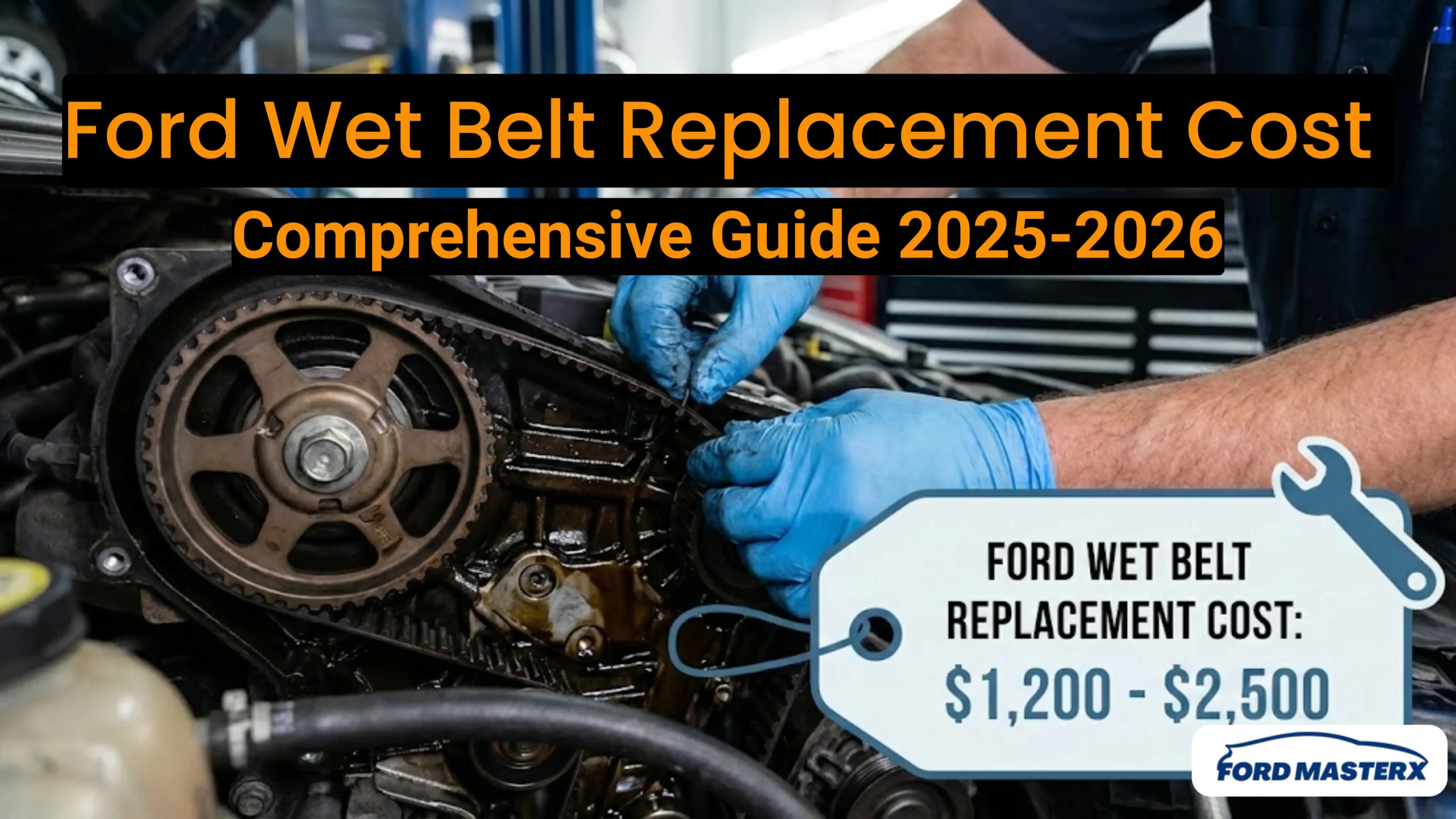
- Average Cost: The industry average for a 1.0L EcoBoost wet belt replacement sits between £980 and £1,200 including VAT.
- Low-End Quotes: Some garages may quote as low as £700-£800, but these quotes often exclude the oil pump belt or the sump removal—a critical omission that compromises the repair.
- High-End Specialists: Recognized Ford specialists who use genuine parts and replace the water pump and dephaser solenoids often charge £1,300+.
Main Dealer Pricing
Ford franchised dealers operate with higher labor rates and strict adherence to standard labor times (SRTs).
- Standard Quote: Dealer quotes for the full wet belt service on a 1.0L EcoBoost frequently range from £1,500 to £2,000+.
- Commercial Vehicles: For a Transit Custom 2.0 EcoBlue, dealer prices can exceed £2,200 due to the higher labor hours involved in the commercial chassis strip-down.
Regional Variance
- London/South East: Labor rates of £90-£120/hour push the independent price toward £1,400.
- North/Midlands: Labor rates of £60-£80/hour allow for prices closer to the £900-£1,000 mark.
United States Market Analysis
In the US, the wet belt issue is concentrated in the EcoSport and Focus. The market dynamics differ due to higher labor rates and the dominance of automatic transmissions (which are implicated in the 23S64 recall).
- EcoSport Replacement: The average cost for a timing belt replacement on a Ford EcoSport is estimated between $1,439 and $2,032.
- Labor Dominance: Labor alone accounts for $1,269 to $1,862 of this total, reflecting a job duration of 10+ hours.
- Parts Cost: The parts themselves are relatively inexpensive, typically around $170, highlighting that 85-90% of the bill is pure labor.
The Commercial Vehicle "Tax": Transit & Ranger Costs
Owners of Ford commercial vehicles face higher costs due to the physical difficulty of working on these engines in situ.
- Transit Custom (FWD): The independent average is £1,050 - £1,100. The job requires removing the offside engine mount, alternator, and often manipulating the engine height to access the timing cover bolts.
- Ford Ranger (RWD): The longitudinal engine layout in the Ranger and Everest creates different access challenges, often requiring the removal of the steering rack or significant front-end disassembly. Prices for the Ranger are typically £200-£300 higher than the Transit, averaging £1,250 - £1,500.
Cost Breakdown Analysis
To understand why the cost is so high, we must examine the invoice breakdown.
Table 1: Representative Invoice Breakdown (1.0L EcoBoost Wet Belt Service)
| Item | Cost (Est.) | Justification |
| Timing Belt Kit | £150 / $200 | Includes primary belt, tensioner, idlers. |
| Oil Pump Belt | £40 / $60 | Must be replaced; drives the oil pump. |
| Water Pump | £60 / $100 | Driven by the belt; overlap labor makes replacement logical. |
| Gaskets & Seals | £80 / $120 | Cam cover gasket, vacuum pump seal, front crank seal. |
| Sump Sealant | £20 / $30 | Specific anaerobic sealant required for re-sealing the oil pan. |
| Engine Oil (5W20) | £50 / $70 | Must meet WSS-M2C948-B specification. |
| Oil Filter | £10 / $15 | Essential to remove contaminants. |
| Hardware | £30 / $50 | Stretch bolts (crank pulley) are single-use. |
| Labor (8-10 Hours) | £800 / $1,200 | Extensive disassembly required (see Section 7). |
| Total | ~£1,240 / ~$1,845 |
Failure Mechanisms: The Anatomy of "EcoBoom"
The term "EcoBoom" has gained traction in automotive forums to describe the catastrophic failure of these engines. Understanding the physics of this failure is crucial for owners to recognize the symptoms before the engine is destroyed.
Chemical Degradation and Hydrolysis
The root cause of failure is the chemical breakdown of the belt material.
- Hydrolysis: The belt is composed of Hydrogenated Nitrile Butadiene Rubber (HNBR) and other compounds designed to resist oil. However, engine oil accumulates moisture (condensation) and fuel. Over time, particularly in vehicles driven on short trips where the oil does not reach operating temperature to evaporate this moisture, the belt undergoes hydrolysis. This causes the rubber to swell, weaken, and eventually separate from the reinforcing cords.
- Material Shedding: Unlike a dry belt that snaps cleanly, a degrading wet belt sheds teeth and rubber fibers. This debris does not just disappear; it drops into the oil sump.
The Oil Strainer Blockage
This is the primary mechanism of engine death.
- Debris Migration: The shed rubber fibers are sucked up by the oil pump pickup pipe.
- Screen Clogging: The pickup pipe has a fine mesh screen (strainer) to filter large particles. This screen becomes completely matted with rubber debris.
- Oil Starvation: The flow of oil to the engine is restricted. The oil pressure drops.
- Component Failure:
- Turbocharger: Usually the first to fail due to its high rotational speed and need for constant lubrication.
- Camshaft Bearings: Lack of oil causes friction welding or scoring in the cylinder head.
- Crankshaft Bearings: The bottom end seizes, often throwing a rod or locking the engine solid.
Vacuum Pump and Brake Assist Failure
In the 1.0L EcoBoost, the vacuum pump is driven by the camshaft. If the timing belt loses teeth, the camshafts stop synchronizing, or the vacuum pump drive is compromised.
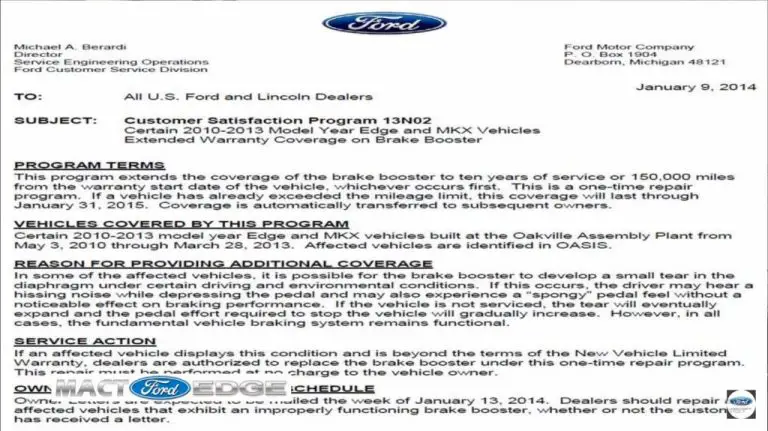
- Consequence: The vacuum pump generates the negative pressure required for the brake booster. A failure results in a sudden, rock-hard brake pedal. This increases stopping distances dramatically, posing a severe safety risk. This specific failure mode—loss of brake assist—was the trigger for the NHTSA safety recall in the US.
The Disconnect Between Manufacturer and Reality
There is a dangerous disparity between Ford’s published service schedules and the consensus of the independent repair industry.
Official Ford Guidelines
Ford’s official documentation for both the 1.0L EcoBoost and 2.0L EcoBlue engines typically states a replacement interval of:
- Time: 10 Years
- Distance: 150,000 miles (approx. 240,000 km).
This "long-life" interval was a key selling point for fleet managers, promising low maintenance costs during the first decade of ownership.
The Independent Consensus
Experience has shown that these belts rarely survive to the 10-year/150,000-mile mark without compromising the engine.
- Revised Recommendations: Independent specialists and engine builders strongly recommend reducing the interval to 5 to 7 years or 60,000 to 80,000 miles.
- The "8-Year" Cliff: Statistical data from repair shops suggests a spike in failures around the 7-8 year mark, regardless of mileage. This suggests that time (and the associated chemical aging of the rubber) is as critical as mileage.
- Commercial Usage: For Transit vans used in delivery cycles (high idle time, frequent starts), the "severe duty" cycle applies, yet many owners are unaware that this necessitates earlier belt changes.
Limitations of Inspection
A major frustration for owners is the inability to inspect the belt easily.
- Visual Check: On some 1.0L engines, removing the oil filler cap allows a partial view of the back of the timing belt. Mechanics look for "swelling" (where the belt looks wider than the pulleys) or cracking. However, this does not reveal the condition of the belt teeth or the oil pump belt hidden in the sump.
- Oil Analysis: Some fleets use oil analysis to detect rubber compounds in the oil, but this is not practical for the average consumer.
The Recall Landscape: US vs. UK/EU
The handling of the wet belt defect illustrates a sharp divide in consumer protection and regulatory response between the United States and Europe.
USA: NHTSA Recall 23S64 (23V-905)
In January 2024, the US regulatory framework forced Ford’s hand.
- Scope: The recall covers approximately 139,000 vehicles, specifically the 2016-2022 Ford EcoSport and 2016-2018 Ford Focus equipped with the 1.0L engine and 6F15 automatic transmission.
- Defect Definition: The recall specifically cites the "oil pump drive belt tensioner arm" which may fracture, or the belt material which may degrade and lose teeth.
- Remedy: Ford dealers are instructed to replace the oil pump drive belt and tensioner assembly at no cost. Crucially, if the engine has already suffered damage due to oil pressure loss, Ford is authorized to replace the entire engine assembly.
- Exclusions: The recall is currently limited to specific VIN ranges and automatic transmission models, leaving manual transmission owners (rarer in the US) and other model years in a gray area.
UK and Europe: The "Goodwill" Lottery
In the UK, where the population of affected vehicles is significantly higher (Fiestas, Focuses, Transits), there is no equivalent blanket safety recall for the wet belt lifespan itself.
- Regulatory Stance: The DVSA (Driver and Vehicle Standards Agency) typically mandates recalls only for direct safety defects (like steering or brakes). While the vacuum pump failure (brakes) affects safety, a widespread recall for the engine failure mode has not been enforced to the same extent as in the US.
- Ford’s Policy: UK owners are dealt with on a case-by-case basis. Ford may offer "goodwill" contributions (e.g., paying 40-70% of the cost) towards a new engine, but strictly only if the vehicle has a perfect Ford dealer service history.
- The "Wrong Oil" Defense: Warranty claims are frequently rejected if the owner cannot prove that every previous oil change utilized the specific Ford-grade oil. If an independent garage used a generic 5W-30, the claim is denied.
- Legal Action: While threats of class action lawsuits have circulated on platforms like Facebook groups and forums, no definitive legal judgment has forced a UK-wide recall program comparable to 23S64 as of early 2026.
The Replacement Procedure
To fully understand the high labor costs, we must examine the technical steps required to replace these belts. This is not a "driveway DIY" job for the amateur.
Special Tooling Requirements
The Ford EcoBoost/EcoBlue engines lack traditional timing marks (keyways). The timing is "floating."
- Friction Washers: The crankshaft pulley relies on diamond-coated friction washers and extreme torque to hold the timing gear in place. There is no keyway. If the bolt is loosened without the locking tools in place, timing is lost immediately.
- Torque Multipliers: The crank bolt on the 1.0L EcoBoost often requires a torque multiplier (a geared tool) to achieve the final torque specification, which is exceptionally high (e.g., 300Nm+ effective).
- Locking Kits: Specific kits (like Laser 7323 for the EcoBlue) are required to lock the flywheel and camshafts.
Step-by-Step: 1.0L EcoBoost (Petrol)
- Top End Disassembly: Remove airbox, engine mount, turbo pipes, and cam cover.
- Locking: Install flywheel locking tool (starter motor often needs removal) and camshaft locking blocks.
- Front End Strip: Remove alternator belt, water pump belt, and crankshaft pulley.
- Cover Removal: Remove the front timing cover (sealed with RTV).
- Sump Removal (Critical): The exhaust downpipe often needs disconnecting to drop the sump. The sump must be removed to access the oil pump belt.
- Strainer Cleaning: Physically clean the oil pickup strainer of any debris.
- Belt Replacement: Replace the oil pump belt (deep inside) first, then the main timing belt.
- Reassembly & Sealant: Re-seal the sump and timing cover using anaerobic sealant. The curing time for this sealant means the oil cannot be added immediately, extending the job duration.
Step-by-Step: 2.0L EcoBlue (Diesel)
- Access Struggle: On the Transit Custom, the entire front subframe or engine mounting system often impedes access.
- Disposable Covers: The metal timing cover on the EcoBlue is often deemed a "single-use" item by Ford because it deforms during removal. A new cover adds ~£100 to the parts bill.
- Wet Belt Cassette: The belt system is often replaced as a "cassette" or kit involving the tensioner.
- Oil Pump Belt Cutting: Mechanics often cut the old oil pump belt to remove it, but installing the new one requires precise manipulation of the gear train.
- Injector Removal Risk: In some procedures, injectors must be removed to access cam covers. If injectors are seized (common in diesels), the job cost spirals.
Oil Specifications and Intervals
The single most critical factor in prolonging the life of a wet belt is oil management.
The Chemistry of WSS-M2C948-B
Ford specifies a very particular oil standard: WSS-M2C948-B (typically 5W-20 Castrol Magnatec Professional E) for the 1.0L EcoBoost.
- Additive Package: This oil contains specific additives designed to be neutral to the HNBR elastomers in the belt.
- Generic Oil Danger: A generic 5W-20 or 5W-30 may have high levels of detergents or acidity regulators that react aggressively with the belt rubber, accelerating swelling and delamination.
- Consumer Advice: Owners must never "top up" with random oil from a gas station. It is better to run slightly low than to add incompatible chemistry.
The Diesel Dilution Problem
In the 2.0L EcoBlue, the problem is exacerbated by diesel fuel.
- Regeneration: When the DPF (Diesel Particulate Filter) regenerates, extra fuel is injected. Some of this fuel washes down the cylinder walls into the sump.
- Dilution: This fuel thins the oil and attacks the belt.
- Counter-Measure: Transit owners should change their oil every 6,000 to 10,000 miles, regardless of the 20,000-mile official interval, to flush out this fuel dilution.
Buying and Selling Strategy
The wet belt issue has fundamentally altered the used market for these vehicles.
For Buyers
- The "Receipt Check": When looking at a 2012-2017 Fiesta/Focus or 2016+ Transit, the first question must be: "Has the wet belt been done?"
- Evidence: A stamp in the book is not enough. You need an invoice proving the "Timing Belt Kit" and "Oil Pump Belt" were changed.
- Price Negotiation: If the work has not been done and the car is over 6 years old, deduct £1,500 from the asking price immediately.
- Avoid "Low Mileage" Traps: Do not be seduced by a 10-year-old car with 30,000 miles. The belt has been sitting in acidic, moisture-rich oil for a decade. It is likely in worse condition than a high-mileage highway car.
For Sellers
- Pre-Sale Maintenance: getting the belt done before sale is a strong USP (Unique Selling Proposition). A car with a "New Wet Belt" will sell significantly faster than one without, even if you raise the price to cover half the cost.
- Trade-In: Many dealers are now low-balling trade-in values for EcoBoosts without proof of belt replacement, treating them as "non-runners" in valuation terms due to the risk.
Conclusion
The Ford wet belt saga is a cautionary tale of automotive engineering where theoretical efficiency gains collided with the harsh realities of material science and maintenance habits. For Ford, it has resulted in a tarnished reputation for reliability, particularly regarding the otherwise brilliant 1.0L EcoBoost engine. For owners, it has transformed the timing belt from a routine maintenance item into a potential financial precipice.
As we move through 2025 and 2026, the fleet of affected vehicles is reaching the critical 10-year age, leading to a surge in failures. The recall in the US offers hope, but for the majority of global owners, the burden remains on their shoulders. The definitive advice is clear: ignore the official 10-year interval. Treat the wet belt as a 6-to-7-year service item, budget accordingly, and strictly adhere to oil specifications. The cost of prevention, while high, is a fraction of the cost of the "EcoBoom" cure.