Ford Maverick Payload Capacity Chart and Capability (2022–2026)

The reintroduction of the compact unibody pickup truck represents a pivotal shift in the modern automotive landscape, blending urban maneuverability with functional utility. Built upon Ford’s versatile C2 platform—and assembled at the Hermosillo Assembly Plant in Sonora, Mexico—the Ford Maverick was engineered to satisfy the demands of lifestyle buyers, tradespeople, and fleet operators.
Moving away from the traditional body-on-frame architecture, the Maverick utilizes a high-strength steel unibody frame that prioritizes structural rigidity and weight savings, achieving a remarkable balance between fuel efficiency and cargo capability.
However, maximizing the utility of this compact truck requires a rigorous understanding of its engineering limitations. A vehicle’s hauling potential is not a static marketing figure; it is a dynamic threshold governed by the Gross Vehicle Weight Rating (GVWR), drivetrain configuration, suspension geometry, and factory-installed options.
This report provides an exhaustive, data-driven analysis of the Ford Maverick payload capacity, towing thresholds, and gross weight dynamics across the 2022 to 2026 production years.
The Engineering Mathematics of Payload and GVWR

Understanding the physical limitations of the Ford Maverick requires dissecting the mathematical relationship between its curb weight and its GVWR. The Gross Vehicle Weight Rating is the absolute maximum safe weight of the vehicle as engineered by the manufacturer, encompassing the chassis, fluids, passengers, and all internal and external cargo.
The Base Curb Weight is the mass of the vehicle as it leaves the factory floor, equipped with a full tank of fuel but devoid of occupants or cargo.
Payload capacity is strictly defined as the GVWR minus the Base Curb Weight. Therefore, any factor that increases the vehicle’s curb weight—such as an all-wheel-drive transfer case, a larger turbocharged engine, or luxury interior components—must mathematically reduce the payload capacity unless the manufacturer simultaneously engineered a higher GVWR for that specific configuration.
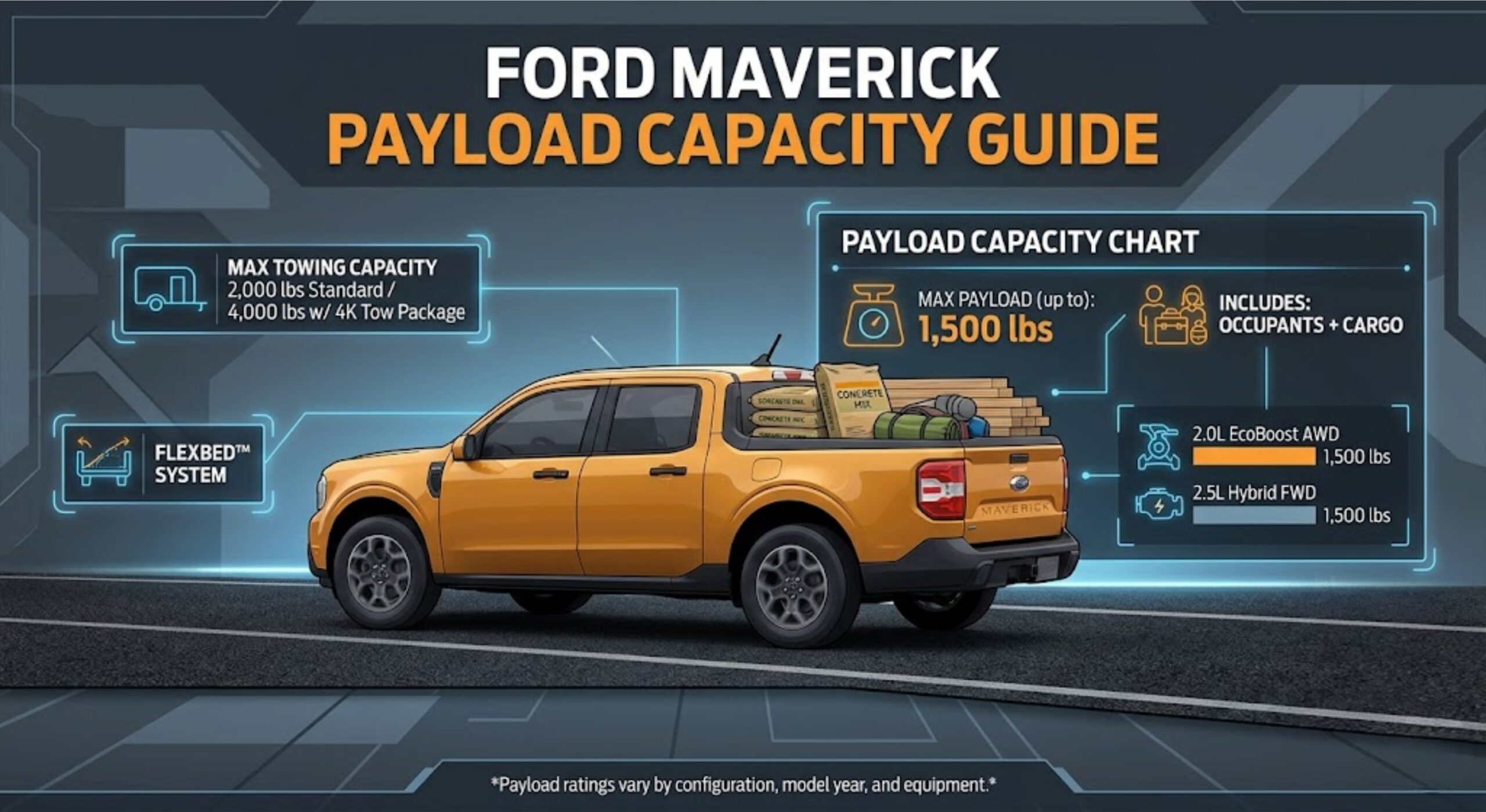
The core engineering target for the Ford Maverick platform was a 1,500-pound maximum payload capacity. This capability is achieved across both the 2.5L Hybrid front-wheel-drive (FWD) and the 2.0L EcoBoost all-wheel-drive (AWD) models through precise GVWR calibrations. For example, the lightweight Hybrid FWD possesses a lower GVWR (5,230 to 5,320 lbs), while the heavier EcoBoost AWD is granted a higher GVWR (up to 5,240 lbs) to offset the mass of its rear drive unit, thereby preserving the 1,500-pound utility baseline.
Ford Maverick Payload Capacity Chart (2022–2026)

The following matrix synthesizes the official technical specifications for the Ford Maverick across its entire production run. While the 2025 and 2026 model years introduced cosmetic enhancements and a standard 13.2-inch infotainment screen, the fundamental structural engineering and payload ratings remained consistent with the initial 2022 launch.
| Model Year | Powertrain / Trim | Drivetrain | Base Curb Weight (lbs) | GVWR (lbs) | Maximum Payload (lbs) | Standard Towing (lbs) | Max Towing (4K Pkg) |
| 2022-2026 | 2.5L FHEV (Hybrid) | FWD | 3,674 – 3,685 | 5,230 – 5,320 | 1,500 | 2,000 | N/A |
| 2025-2026 | 2.5L FHEV (Hybrid) | AWD | 3,856 | 5,320 | 1,400 | 2,000 | 4,000 |
| 2022-2026 | 2.0L EcoBoost | FWD | 3,563 | 5,080 | 1,500 | 2,000 | N/A |
| 2022-2026 | 2.0L EcoBoost | AWD | 3,698 – 3,731 | 5,205 – 5,240 | 1,500 | 2,000 | 4,000 |
| 2023-2026 | 2.0L EcoBoost (Tremor) | AWD | 3,892 | 5,090 | 1,140 | 2,000 | N/A |
| 2025-2026 | 2.0L EcoBoost (Lobo) | AWD | 3,814 | 4,970 | 1,045 | 2,000 | N/A |
Powertrain Dynamics and Payload Limitations

The selection of the Maverick’s powertrain is the primary determining factor in its cargo-carrying limitations. The 2.5-liter Full Hybrid Electric Vehicle (FHEV) powertrain utilizes an Atkinson-cycle engine paired with an electric traction motor and a liquid-cooled battery pack situated beneath the cabin. In its traditional FWD layout, the hybrid maintains a relatively lean curb weight, allowing it to easily hit the 1,500-pound payload target.
A critical evolution occurred in the 2025 model year with the introduction of the Hybrid AWD configuration. To provide power to the rear axle, engineers integrated a power transfer unit, a steel driveshaft, and an independent rear drive unit. This mechanical hardware increased the vehicle’s curb weight to 3,856 pounds. Because the unibody chassis GVWR remained capped at 5,320 pounds, the available payload capacity was mathematically forced down to 1,400 pounds.
Conversely, the 2.0L EcoBoost turbocharged engine, which produces 250 horsepower and 277 lb-ft of torque, serves as the heavy-duty option. When paired with the standard AWD system, the vehicle possesses a curb weight of up to 3,731 pounds. To ensure the engine’s heavier iron and aluminum mass did not compromise utility, the GVWR was calibrated to 5,240 pounds, thereby preserving the peak 1,500-pound payload capacity. This specific configuration caters explicitly to contractors and tradespeople who rely on the highly configurable 54.4-inch FLEXBED for transporting construction tools and dense materials.
The Physics of Specialized Trims: Tremor and Lobo
While the standard XL, XLT, and Lariat trims maintain the core utility parameters, Ford introduced specialized variants that deliberately sacrifice payload capacity in exchange for targeted dynamic performance.
The off-road-focused Maverick Tremor abandons the standard suspension in favor of an independent multi-link trailing arm setup featuring mono-tube hydraulic gas-pressurized dampers, unique hydraulic rebound stops, and a one-inch suspension lift. Furthermore, it incorporates heavy steel front skid plates, 17-inch all-terrain tires,
and a sophisticated twin-clutch rear-drive unit capable of torque vectoring. Off-road suspensions require softer spring rates for maximum articulation, which inherently reduces the static weight the chassis can support. Coupled with a heavy 3,892-pound curb weight, the Tremor’s GVWR is lowered to 5,090 pounds, resulting in a severely restricted payload capacity of just 1,140 pounds.
Similarly, the street-tuned Maverick Lobo, introduced in 2025, prioritizes tarmac cornering performance with a lowered ride height, stiffer anti-roll bars, and high-performance two-piston brake calipers. Lowering a vehicle reduces available suspension travel. To prevent the chassis from catastrophically striking the bump stops under load,
the Lobo’s GVWR is strictly capped at a lineup-low 4,970 pounds. This yields the lowest payload capacity of any Maverick at 1,045 pounds, illustrating the direct engineering trade-off between aesthetic stance and traditional pickup utility.
The Illusion of Maximum Payload
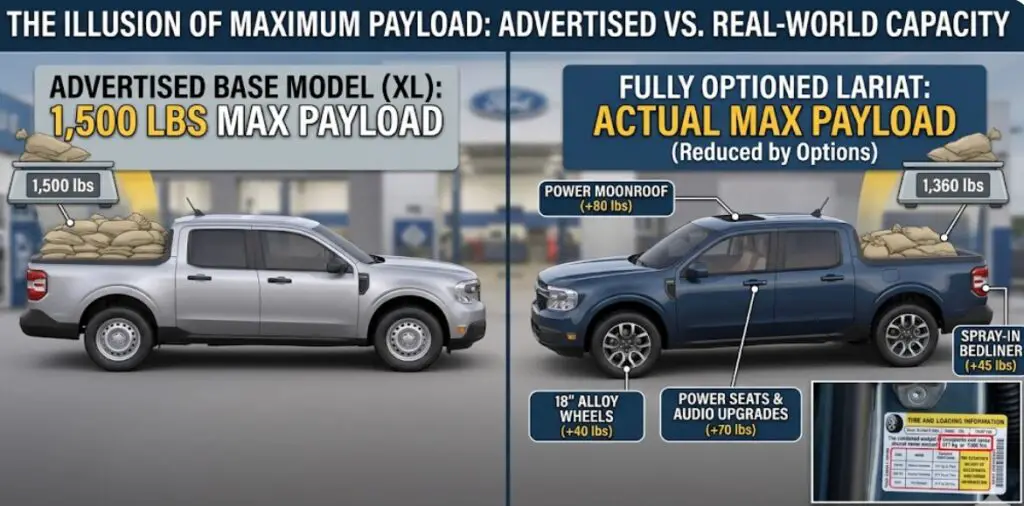
A pervasive misunderstanding within the compact truck market stems from the misinterpretation of published maximum payload figures. The advertised 1,500-pound payload is a theoretical maximum calculated based on a base-model XL trim devoid of optional equipment. In practice, every factory-installed option adds mass to the vehicle, directly cannibalizing the payload capacity.
The Maverick Lariat introduces heavy components, including eight-way power-adjustable seats, acoustic laminated glass, 18-inch wheels, and the comprehensive Ford Co-Pilot360 radar suite. Selecting the Lariat Luxury Package adds heated seats, a heated steering wheel, and premium audio equipment. Standalone options like a factory power moonroof, a polyurethane spray-in bedliner, and a full-size spare tire further inflate the curb weight.
The definitive authority on any individual vehicle’s payload capacity is the Tire and Loading Information label affixed to the driver’s side B-pillar. Real-world analyses indicate that a heavily optioned Lariat will display a door sticker payload rating closer to 1,350 or 1,400 pounds, whereas a sparsely equipped XL often registers near the advertised 1,500-pound mark. Operators must consult this label and subtract the weight of all occupants and aftermarket accessories to determine the safe weight limit for cargo placed in the bed.
Towing Dynamics and the 4K Tow Package
While payload capacity dictates vertical chassis load, towing capacity governs the aerodynamic and thermal stress placed on the powertrain when pulling a trailer. All Ford Mavericks feature a baseline towing capacity of 2,000 pounds. To elevate this limit to 4,000 pounds, operators must equip the 4K Tow Package, available on AWD EcoBoost models and, starting in 2025, AWD Hybrid models. The Tremor and Lobo trims are categorically excluded from this package due to their specialized suspensions.
The 4K Tow Package is fundamentally an exercise in heavy-duty thermal management. It upgrades the vehicle with a higher-capacity radiator, an enhanced cooling fan, and an auxiliary transmission oil cooler to prevent hydraulic fluid degradation under extreme load. The package also integrates an in-cabin trailer brake controller, a Class III 2-inch receiver, a 7-pin electrical connector, and a numerically higher rear axle gear ratio on EcoBoost models to improve low-end torque delivery.
Operators can verify their precise towing parameters using the(https://www.ford.com/support/towing-calculator/), which calculates limits based on the specific Vehicle Identification Number (VIN).
Crucially, towing capacity and payload capacity are inextricably linked. Proper towing geometry dictates that approximately 10% of a trailer’s total weight must rest upon the hitch ball to prevent dangerous high-speed sway. This downward force—the tongue weight—is supported entirely by the Maverick’s rear suspension and must be subtracted directly from the available payload capacity. For a 4,000-pound trailer, the 400-pound tongue weight immediately reduces a 1,500-pound payload limit to 1,100 pounds. If the cabin contains 800 pounds of passengers, the remaining capacity for the truck bed is a mere 300 pounds.
Furthermore, operators must adhere to strict aerodynamic limitations. Without the 4K Tow Package, the frontal area of the trailer cannot exceed 20 square feet. With the upgraded cooling hardware of the 4K Tow Package, the allowable frontal area increases to 40 square feet. Pulling an enclosed cargo trailer that exceeds these aerodynamic dimensions will rapidly overheat the powertrain, regardless of the trailer’s static weight.
Ford Maverick vs. Hyundai Santa Cruz

To contextualize the utility of the Maverick platform, a comparison with the Hyundai Santa Cruz—its primary competitor in the unibody segment—reveals distinct engineering philosophies.
| Metric | Ford Maverick (2.0L EcoBoost AWD) | Hyundai Santa Cruz (2.5L Turbo AWD) |
| Maximum Payload | 1,500 lbs | 1,411 lbs |
| Maximum Towing | 4,000 lbs (w/ 4K Tow Package) | 5,000 lbs |
| Cargo Bed Length | 54.4 inches (4.5 ft) | 51.6 inches (4.3 ft) |
| Max Torque | 277 lb-ft | 311 lb-ft |
(Data derived from competitor capability metrics )
The Hyundai Santa Cruz prioritizes a refined, car-like driving experience and high-end power delivery. Its turbocharged variant achieves a superior towing capacity of 5,000 pounds, driven by a robust 311 lb-ft of torque. However, the Ford Maverick remains the undisputed leader in internal payload efficiency and cargo bed utility.
The Maverick’s 1,500-pound payload exceeds the Santa Cruz’s 1,411-pound limit, and its highly modular 4.5-foot FLEXBED provides a more practical workspace for hauling sheets of plywood or heavy landscaping supplies compared to the Hyundai’s abbreviated 4.3-foot bed. For commercial operators where bed dimensions and raw payload trump maximum tow ratings, the Maverick remains the superior utility tool.
Payload – Questions and Answer
What is the difference in payload between the Maverick Lariat and XL in the real world?
While Ford advertises a 1,500-pound maximum payload capacity across the XL, XLT, and Lariat trims, real-world utility differs significantly based on equipment mass. The entry-level XL, featuring manual cloth seats and standard steel wheels, possesses a curb weight that allows it to achieve payload figures exceeding 1,500 pounds on the factory door sticker. In contrast, the luxury-oriented Lariat trim—equipped with heavy power seating motors, upgraded acoustic glass, and the Ford Co-Pilot360 sensor suite—frequently displays a factory payload rating closer to 1,350 or 1,400 pounds. Every factory option mathematically reduces the weight available for cargo.
How does the 4K Tow Package affect the Maverick’s payload capacity?
The physical hardware included in the 4K Tow Package—such as the larger radiator, auxiliary transmission oil cooler, Class III hitch receiver, and upgraded cooling fan—adds curb weight to the vehicle. While Ford engineers carefully managed the GVWR to preserve the 1,500-pound payload baseline on standard trims, the act of towing dynamically consumes payload capacity. According to the Ford Payload Guide, the tongue weight of the trailer (typically 10% of the total loaded trailer weight) must be subtracted directly from the Maverick’s available payload. Towing a 4,000-pound trailer instantly utilizes 400 pounds of the truck’s payload limit.
Where do I find the exact payload capacity for my specific Ford Maverick?
Because payload capacity fluctuates based on specific trim levels, drivetrains, and factory options (like power moonroofs or spray-in bedliners), operators should never rely solely on marketing brochures. The precise, legally certified payload capacity for a specific vehicle is printed on the yellow Tire and Loading Information label located on the driver’s side door jamb (B-pillar). This sticker accounts for the exact curb weight of the vehicle as it left the Hermosillo assembly line.
Does installing an aftermarket suspension increase my Maverick’s payload rating?
No. Modifying a Ford Maverick with aftermarket helper springs, air suspension bags, or heavy-duty shock absorbers does not increase its payload capacity. The Gross Vehicle Weight Rating (GVWR) is a federally registered safety limit determined by the structural yield strength of the unibody frame, the thermal limits of the wheel bearings, and the hydraulic pressure limits of the factory braking system. Adding heavy aftermarket suspension components actually reduces the available payload capacity, as the physical weight of those new components must be subtracted from the original payload figure listed on the door sticker.