The Definitive Ford Interior Trim Code Encyclopedia: Decoding, Restoration, and Market Analysis

The automotive interior is more than a collection of fabrics, plastics, and leathers; it is the primary interface between the machine and the human operator. For the Ford Motor Company, a manufacturer that has spanned over a century of production, the specification of these interiors has evolved from simple checklist options to complex, digitized alphanumeric sequences. At the heart of this complexity lies the Interior Trim Code—a seemingly innocuous string of characters stamped onto a door jamb sticker that holds the key to a vehicle’s original identity.
For the automotive restorer, the collision repair specialist, or the discerning collector, the Interior Trim Code is not merely data; it is the definitive source of truth. Unlike the exterior paint, which can be identified with a spectrophotometer, or mechanical parts that can be looked up via VIN in general catalogs, the interior configuration is often lost to time. Sun fading, wear, and aftermarket modifications obscure the original “Medium Prairie Tan” or “Dark Flint” hues. The code remains the immutable record of the factory’s intent.
This report serves as an exhaustive analysis of Ford’s interior coding systems. It synthesizes data from manufacturing diagrams, dealer order guides, and restoration databases to provide a single, authoritative reference. We will explore the “INT TR” standard, dissect the evolution of color palettes across key model lines like the F-Series and Mustang, and provide actionable intelligence for sourcing exact-match dyes and replacement components.
The High Stakes of Accurate Decoding
In the secondary automotive market, provenance is value. A “numbers-matching” vehicle is traditionally thought of in terms of engine and chassis, but interior correctness is increasingly scrutinized.
- Restoration Accuracy: Using a generic “Ford Tan” dye on a 2002 F-150 King Ranch will result in a jarring mismatch against the original “Castano” leather, significantly devaluing the restoration.3
- Parts Interchange: A door panel from a 2004 F-150 may physically fit a 2008 model, but the transition from “Medium Parchment” (Code H, 2000-2004) to “Medium Pebble” (Code H, 2005-2008) or “Camel” (Code C, 2008) means the colors will clash violently under direct sunlight.5
- Semantic Search and SEO: For parts retailers, accurate indexing of inventory by specific trim code (e.g., “Ford F-150 Door Panel Code 2″) is essential for capturing high-intent traffic. Users searching for “Ford interior trim code chart” are not browsing; they are hunting for a solution to a specific mismatch problem.
Scope of Analysis
This document covers the following core areas:
- Anatomy of the Label: Precise location and decoding protocols for the Safety Compliance Certification Label.
- Model-Specific Encyclopedias: Detailed charts and analysis for F-Series, Mustang, Ranger, Explorer, and Lincoln/Mercury lines.
- The Science of Color: Understanding metamerism, dye lots, and the chemical differences between aniline and pigmented leathers in Ford interiors.
- Restoration Protocols: Best practices for using codes to source dyes from vendors like Seat Doctors and SEM.
DECODING THE TRIM
The Ultimate Guide to Ford Interior Codes
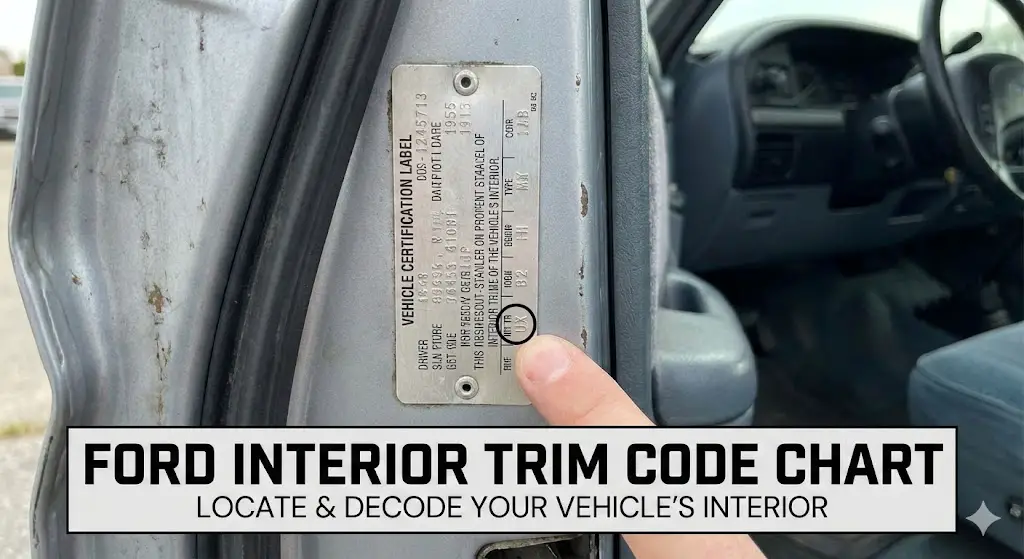
Found on the driver’s door jamb, the Safety Compliance Certification Label holds the key to your vehicle’s original interior identity. Whether you are restoring a classic Mustang or fixing an F-150 seat, understanding code “INT TR” is essential.
1. Locating the Data
The “INT TR” (Interior Trim) code is located on the white sticker on the driver’s side door lock pillar or door latch post. It is usually a 2-character code.
145
ME
R
L9
The Code Breakdown
- 1 Position 1: Typically indicates the fabric type and seat style (e.g., Leather Captain’s Chair).
- 2 Position 2: Represents the specific interior color (e.g., Charcoal Black, Camel).
Color Dominance
Distribution of Factory Interior Colors (Sample Set 2010-2020)
While exotic colors exist, the market is dominated by practical neutrals. “Charcoal Black” and “Medium Earth Gray” account for over 60% of production due to their ability to hide wear.
Evolution of Materials
Market Share of Seat Materials (1990 – 2020)
The 90s saw the decline of Velour. By the 2010s, “Premium Cloth” became the standard, while Leather availability expanded from luxury trims to mid-tier trucks.
Material Matrix: Cost vs. Longevity
Analysis of common Ford upholstery options based on replacement cost and expected lifespan.
Choosing a trim level often involves balancing upfront cost with long-term wear. Vinyl (often used in Work Trucks/XL trims) offers high durability at low cost, while King Ranch Leather commands a premium price but requires maintenance to ensure longevity.
Leather Adoption by Model
Percentage of units sold with Leather/Premium Trim (2018 Data)
While the Mustang and Explorer have high rates of premium interior adoption, the F-150—being a high-volume fleet vehicle—retains a massive share of Cloth and Vinyl interiors.
© 2026 FordMasterX Infographics. Data sourced from manufacturer owner manuals.
The Rosetta Stone: The Safety Compliance Certification Label
The primary vector for interior data on any modern Ford vehicle is the Safety Compliance Certification Label. Colloquially known as the “Door Jamb Sticker,” “Door Tag,” or “VC Label” (Vehicle Certification), this adhesive document is a legal requirement in North America, encoding the vehicle’s engineering limits and build specifications.
Historical Evolution and Location
The location and format of the interior code have shifted as manufacturing processes modernized.
The Vintage Era (Pre-1980)
In the mid-20th century, Ford utilized metal “Warranty Plates” or “Rating Plates.”
- 1940s-1950s: Often riveted to the cowl, glove box door, or the B-pillar.
- 1960s-1970s: The standard location moved to the rear face of the driver’s door. This metal tag was stamped with the VIN and a series of codes.
- Risk Factor: Doors are frequently replaced due to collision damage. In classic restorations, a mismatch between the VIN on the title (frame) and the door tag is common. The “Buck Tag” (a metal strip often screwed to the radiator support or found under the carpet) serves as a secondary verification point for interior codes in this era.
The Modern Era (1980–Present)
With the introduction of the 17-digit VIN standard in 1981, Ford transitioned to a standardized tamper-proof adhesive label.
- Primary Location: The B-Pillar (Door Jamb) on the driver’s side. This is the vertical post where the door latch strikes.
- Secondary Location: The rear edge or profile of the driver’s door.
- Visual Identification: The sticker usually features the Ford oval watermark (in later years) and headers for “MFD. BY FORD MOTOR CO.”
Critical Warning: If a vehicle has been in a severe side-impact collision, the B-pillar may have been repainted or replaced. If the body shop failed to order a replacement label from an authorized licensee (like Marti Auto Works or ECS Automotive Concepts), the data may be lost. In such cases, the “As-Built” data must be retrieved digitally via a dealership OASIS lookup.2
Deciphering the Layout
The Safety Compliance Certification Label is a dense matrix of data. While the VIN is prominent, the Interior Trim Code is often buried in the bottom row of data fields.
Table 1: Anatomy of the Modern Ford Door Sticker
| Field Code | Full Name | Description | Importance to Interior |
| DATE | Date of Manufacture | Month/Year (e.g., 04/18) | High: Determines mid-year color changes (e.g., the 2004 “Heritage” vs. “New Body Style” split). |
| EXT PNT | Exterior Paint | 2-digit code (e.g., YZ, UA) | Medium: Helps verify if the interior color “makes sense” (e.g., Red interior with Green paint is rare). |
| WB | Wheelbase | Numerical (e.g., 145) | Low. |
| INT TR | Interior Trim | 2-4 Character Code | Critical: The primary subject of this report. |
| TR | Transmission | 1 Character | Low. |
| AXLE | Axle Ratio | 2 Character | Low. |
| SPR | Spring Code | 2-4 Character | Low. |
The “INT TR” Field Structure:
The INT TR field is typically composed of two primary characters, though sometimes followed by secondary characters for springs or other options.
- First Character (Seat Style/Fabric): This designates the physical configuration of the seat (Captain’s Chairs, Bench, 40/20/40) and the material class (Cloth, Leather, Vinyl).
- Second Character (Color): This designates the Interior Color Environment. This is the crucial character for dye matching.
Example: A code of “ME” on a 2002 F-150.
- M: Cloth 40/60 Split Bench (Style).
- E: Medium Flint (Color).
Example: A code of “KW” on a 2012 Mustang.
- K: Leather Bucket Seats (Style).
- W: Charcoal Black (Color).
Anomaly: In some years and models (particularly Rangers and older F-Series), the code might be a single digit, or the label might simply say “TR” instead of “INT TR.” However, the position is almost always under the barcode or in the bottom footer row.1
The F-Series Compendium: A Generational Analysis (1992–2020)
The Ford F-Series (F-150, F-250 Super Duty, F-350) represents the highest volume of diverse interior configurations in the automotive world. Because these trucks serve as both workhorses and luxury vehicles, the interior options range from utilitarian vinyl to premium aniline leathers.
Generation 10: The “Jellybean” Era (1997–2003)
This generation introduced the rounded aerodynamic styling and defined the modern truck interior palette. The primary confusion in this era stems from the transition of “Tan” shades and the specific definition of “Grey.”
The “Medium Graphite” Dominance (Code 2)
For the vast majority of XLT and XL trucks in this era, the interior was Medium Graphite.
- Code: 2
- Description: A cool, neutral grey with a slight blue undertone.
- Years: 1997–2004 (Heritage).
- Restoration Insight: This color is distinct from the later “Flint” grey. Using “Flint” dye on “Graphite” plastics results in a warmer, browner mismatch. The “2” code is the definitive marker.5
The “Tan” Confusion: Prairie vs. Parchment
Ford utilized two distinct tans in this generation, often confused by owners.
- Medium Prairie Tan (Code X): Used from 1997 to 2000. This is a yellower, more “saddle” colored tan.
- Medium Parchment (Code H): Used from 2000 to 2004. This replaced Prairie Tan. It is lighter, creamier, and more beige.
- Implication: A 1999 F-150 (Code X) and a 2001 F-150 (Code H) both have “Tan” interiors, but the parts are not interchangeable color-wise. The dashboard plastics, specifically, will clash.5
Table 2: 1997–2003 F-Series Interior Color Codes
| INT TR Code (2nd Char) | Color Name | Years Active | Description |
| 2 | Medium Graphite | 1997–2004 | Standard Grey (Cool Tone). |
| X | Medium Prairie Tan | 1997–2000 | Yellow-based Tan. |
| H | Medium Parchment | 2000–2004 | Beige/Cream Tan. |
| S | Willow Green | 1997–1998 | Rare Green interior (often paired with Pacific Green exterior). |
| N | Cordovan | 1997–1998 | Deep Red/Maroon. |
| D | Denim Blue | 1999–2001 | Dark Navy Blue. |
| B | Ebony / Black | 2003 | Late introduction (e.g., Heritage Edition). |
Historical Note on “Willow Green” (Code S):
The “Willow Green” interior is an artifact of 1990s color trends. It was often paired with “Pacific Green” exteriors. Finding reproduction parts for Code S is exceptionally difficult, often requiring custom dyeing of Medium Graphite parts using SEM Classic Coat mixed to the specific Code S formula.5
Generation 11: The “Architectural” Era (2004–2008)
With the massive 2004 redesign, Ford squared off the interior and introduced a new color palette. This era marked the shift from “Graphite” to “Flint” and the introduction of the “Lincoln Mark LT” influence.
The Rise of “Medium Flint” (Code E)
- Code: E
- Name: Medium Flint.
- Difference from Graphite: Flint is a “warmer” grey, lacking the blue undertone of the previous Graphite. It appears more purely neutral or slightly brownish in warm light.
- Component matching: The dashboard often featured a two-tone scheme with Dark Flint (Code D) on the upper pad and Medium Flint (Code E) on the lower panels. This contrast must be preserved in restoration.5
The “Pebble” vs. “Camel” Shift
- Medium Pebble (Code H): Used from 2004–2008. This was the successor to Parchment. It is a very light, sandy beige.
- Camel (Code C): Introduced late in the cycle (2008) and carried over. It is significantly darker and richer than Pebble.
- Warning: Ford reused Code H for Parchment (Gen 10) and Pebble (Gen 11). This highlights the importance of checking the Model Year alongside the code. Code H in 2002 is Parchment; Code H in 2006 is Pebble. They are not the same color.5
Table 3: 2004–2008 F-Series Interior Color Codes
| Code | Color Name | Application |
| E | Medium Flint | Standard Grey (XL, XLT, Lariat). |
| D | Dark Flint | Dashboard accents, Steering Wheels. |
| H | Medium Pebble | Standard Beige/Tan. |
| B | Ebony Black | FX4 and Lariat Trims. |
| W | Medium Pebble | Variation (typically Cloth weave difference). |
Generation 12: The “Super Duty” Era (2009–2014)
This generation standardized the interior hard points across F-150 and Super Duty. The luxury trims (King Ranch, Platinum, Limited) exploded in popularity, introducing high-end leather codes.
The “Adobe” vs. “Camel” Trap
A critical distinction in this era is between the standard tan and the accent tan.
- Camel (Code C): The primary seat color for Tan interiors.
- Adobe (Code A): The accent color used on carpets, dashboards, and headliners in vehicles with Camel seats.
- Restoration Error: Owners often order “Adobe” paint for their seats. Adobe is too dark for the leather; it is meant for the plastic trim. The INT TR code usually reflects the seat color, but secondary codes might indicate the Adobe trim.3
Platinum and Limited Leathers
- Code S: Sienna (Brown).
- Code B: Charcoal Black (Standard).
- Code L: Steel Grey (A new, metallic-flecked grey distinct from Flint).
- Code K: Chaparral (King Ranch). The switch from Castano to Chaparral leather meant the seats were now polymer-coated, making them easier to clean but less “natural” feeling.
Generation 13: The Aluminum Body (2015–2020)
The 2015 revolution brought aluminum bodies and a simplified, yet confusing, color palette.
The “Medium Earth Gray” (Code G) Phenomenon
- Code: G (often AG, MG, VG depending on seat fabric).
- Name: Medium Earth Gray.
- Analysis: This is the most debated color in modern Ford history. It is a “Greige”—a grey with heavy brown/earth tones. Under LED streetlights, it looks grey; under sunlight, it looks beige.
- Restoration: You cannot use generic “Ford Grey” touch-up. It requires the specific “Medium Earth Gray” formula to avoid a patch that looks like a coffee stain.12
King Ranch “Java” (Code J)
- Code: J or KJ.
- Name: Java.
- Description: A deep, dark chocolate brown, replacing the reddish Chaparral. It is often paired with “Mesa” brown accents.
Table 4: 2015–2020 F-Series Interior Color Codes
| Code | Color Name | Notes |
| G | Medium Earth Gray | Standard Grey. “Greige” tone. |
| B | Black / Ebony | Standard Black. |
| C | Medium Light Camel | Lighter than Gen 12 Camel. |
| J | Java | King Ranch Exclusive (Dark Brown). |
| D | Dark Marsala | Platinum Exclusive (Wine/Red). |
| S | Dark Earth Gray | Sport Trim (Darker than Medium Earth Gray). |
Semantic Insight: Users searching for “F-150 Sport Interior” are often looking for the Code S “Dark Earth Gray,” which differs from the standard XLT Code G “Medium Earth Gray.” The Sport interior also typically features console shifters rather than column shifters, a layout implied by the first character of the code (e.g., Bucket vs. Bench).12
The Mustang Anthology: Decoding the Pony Car
The Ford Mustang requires a specific decoding approach, particularly for the First Generation (1964½–1973), where the “Data Plate” is the bible of restoration.
First Generation (1965–1966)
In the mid-60s, the interior code was a massive selling point, with the introduction of the “Pony” interior (Decor Group).
The Code Structure
- Location: Warranty Plate on the rear face of the driver’s door.
- Format: 2 Characters (Number + Letter or Number + Number).
Table 5: Key 1965-1966 Mustang Interior Codes
| Code | Interior Type | Color | Restoration Notes |
| 26 | Standard Bucket | Black | The most common interior. |
| 66 | Pony (Luxury) | Black | Includes embossed ponies on seats, woodgrain, molded door panels. |
| 22 | Standard Bucket | Blue | Light Blue Crinkle Vinyl / Dark Blue Rosette Vinyl. |
| 62 | Pony (Luxury) | Blue/White | Two-tone luxury interior. Highly desirable. |
| D5 | Standard Bucket | White w/ Red | “Parchment” base with Red appointments (dash/carpet). |
| D9 | Standard Bucket | White w/ Palomino | Parchment with Tan appointments. |
The “Parchment” Variable:
Codes starting with D or C (e.g., D2, C4) utilize “Parchment” as the base color. Parchment is not White. It is a pearlescent, warm off-white. Using pure white dye on a Parchment seat destroys the factory look. The second digit (e.g., the ‘2’ in D2) dictates the appointment color (Dash and Carpet).
- D2: Parchment Seat / Blue Dash & Carpet.
- D6: Parchment Seat / Black Dash & Carpet.
- Insight: Restorers must order “Parchment” upholstery but “Blue” or “Black” carpet based on the second digit.15
The Fox Body Era (1979–1993)
The Fox Body Mustang is famous for its distinct, vibrant interiors.
- Porno Red: A slang term for Canyon Red (Code D) and Scarlet Red (Code P) interiors. These featured red dashboards, red steering wheels, and red seats.
- Titanium (Code A/Y): The definitive late-Fox grey.
- Smoke Grey: Used in the mid-80s.
Modern Mustang (2005–Present)
- Code W: Charcoal Black (Standard).
- Code H: Medium Stone / Ceramic (Light Grey).
- Code K: Dark Saddle (Tan Leather).
- Code R: Red (Premier Trim).
The SUV & Truck Derivatives: Explorer, Ranger, and Lincoln
Ford Ranger (1998–2011)
The Ranger often shared bins with the F-150 but maintained unique combinations.
- Code S (Willow Green): Extremely rare in Rangers.
- Code 2 (Medium Graphite): The standard.
- Code E (Medium Flint): Replaced Graphite in 2002/2004.
- Code X (Prairie Tan): The 90s Tan.
Restoration Tip: Ranger door panels are prone to “cracking” at the elbow rest. When sourcing a replacement from a junkyard, matching the Code 2 vs Code E is critical. A 2001 panel (Graphite) will not match a 2003 panel (Flint) despite looking “grey” in photos.5
Ford Explorer (2011–2019)
The 5th Gen Explorer introduced the “Police Interceptor Utility” (PIU), which floods the used market.
- Code CB: Charcoal Black (Standard Civilian).
- Code EB: Ebony Black (Sport).
- Code LS: Medium Light Stone (Grey).
- PIU Specifics: Police models often have a code indicating “Heavy Duty Cloth” front and “Vinyl” rear. The rear color is usually black, but the front might be Dark Charcoal.
Lincoln Luxury Codes
Lincoln vehicles often use the same physical seat frames as Fords (e.g., Navigator = Expedition) but use different dye lots and color names.
- Code H (Lincoln): Might map to “Light Parchment” or “Cappuccino” depending on the year.
- Code 2T: Espresso (Dark Brown/Black mix).
- Code 5V: Cashmere.
- Warning: Never assume a Lincoln “Tan” matches a Ford “Tan.” Lincoln dyes usually have higher pigment loads and different gloss levels.19
The Science of Interior Restoration: Dyes, Materials, and Metamerism
Successfully using the “INT TR” code requires understanding the chemistry of the materials.
Aniline vs. Pigmented Leather
- Pigmented (Protected) Leather: Used in 95% of Fords (Lariat, XLT, Platinum). The color is a painted coating on top of the hide.
- Restoration: Can be sanded and recolored using water-based polyurethane dyes (e.g., Seat Doctors, Colourlock). The INT TR code maps directly to these dyes.
- Aniline (Unprotected) Leather: Used in Early King Ranch (2001-2008). The “Castano” leather is dyed through the hide and has no protective topcoat.
- Restoration: You cannot use standard pigment dye on early King Ranch seats. It will look like plastic paint and ruin the feel. These require specific aniline dyes and conditioners. Identifying the year via the door sticker is the only way to be sure.4
Metamerism in Ford Greys
Metamerism is the phenomenon where two colors look the same under one light source but different under another.
- Ford Medium Earth Gray (Code G): Notorious for metamerism. Under fluorescent garage lights, it looks grey. Under sunlight, the brown pigments fluoresce, making it look beige.
- Dye Matching: When ordering dye, reputable vendors (like Seat Doctors) use the VIN/Trim Code to control for this. Generic “Ford Grey” spray cans from auto parts stores often fail this test because they use a simplified pigment mix (Carbon Black + White) rather than the complex oxide mixes Ford uses.12
Plastic Painting Protocols
Restoring a faded dashboard (Code X or H) requires more than dye.
- Clean: Plastics outgas plasticizers (the oily film on windows). This must be removed with TSP (Trisodium Phosphate).
- Adhesion Promoter: Polypropylene (PP) and ABS plastics require a chemical primer (Bullfrog or similar) to open the pores.
- Color Coat: Use SEM Color Coat or similar automotive-grade flexible coatings matched to the INT TR code.22
Frequently Asked Questions (FAQs)
Q1: I found the code “MG” on my door sticker. What does it mean?
A: This is a compound code. The “M” typically refers to the Seat Type (e.g., Multicontour, Cloth 40/20/40), and the “G” refers to the Color. In a post-2015 Ford, “G” stands for Medium Earth Gray. Therefore, you have Medium Earth Gray seats in the “M” configuration.13
Q2: Can I find my interior trim code using just my VIN?
A: Not directly through free decoders. The VIN encodes the chassis, engine, and restraint system. It does not explicitly encode the interior color digit. However, a Ford Dealership can run the VIN in the OASIS system to pull the “As-Built” data, which will show the trim code. Alternatively, paid services like Marti Auto Works (for older cars) can regenerate the data.6
Q3: Why does my “Medium Parchment” dye look too light?
A: You may be confusing “Medium Parchment” (Code H, 2000-2004) with “Medium Prairie Tan” (Code X, 1997-2000) or “Camel” (Code C, 2008+). Parchment is the lightest of the tans. Ensure you cross-referenced the Model Year with the code. A 1999 F-150 with Code H does not exist; if you ordered Code H for a 1999, you likely got the wrong year’s formula.5
Q4: The sticker on my door is missing. What do I do?
A: 1. Check the Passenger door jamb (rare, but possible on some vans). 2. Look for a Build Sheet tucked into the springs of the front seat or behind the door panel. 3. Check the Buck Tag under the hood (classics). 4. Order a replacement sticker from ECS Automotive Concepts or Marti Auto Works (you must prove ownership). Do not buy generic stickers from eBay, as they will not have the correct legal data.2
Conclusion: The Integrity of the Code
The Ford Interior Trim Code is the DNA of the cabin. From the “Pony” interiors of 1965 to the “Medium Earth Gray” of the aluminum F-150s, these codes tell the story of automotive design trends—the shift from colorful exuberance to architectural neutrals, and the rise of luxury trucks.
For the semantic searcher, the restorer, or the buyer, the “INT TR” field is the single most important data point for interior preservation. By ignoring generic color names and adhering strictly to the alphanumeric codes found on the Safety Compliance Certification Label, one ensures that the vehicle remains true to its factory specifications, preserving both its beauty and its value.