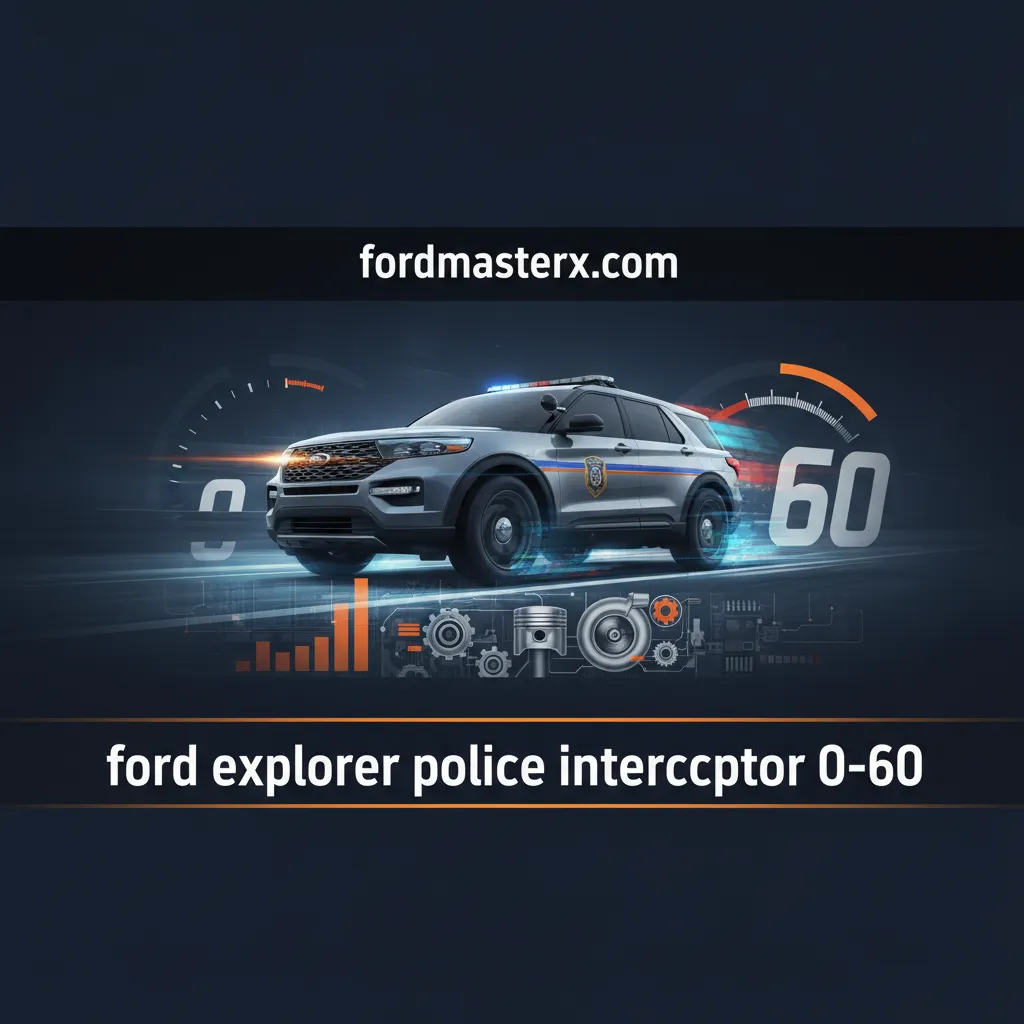
Ford Explorer Police Interceptor 0-60 Performance And Powertrain Technical Analysis

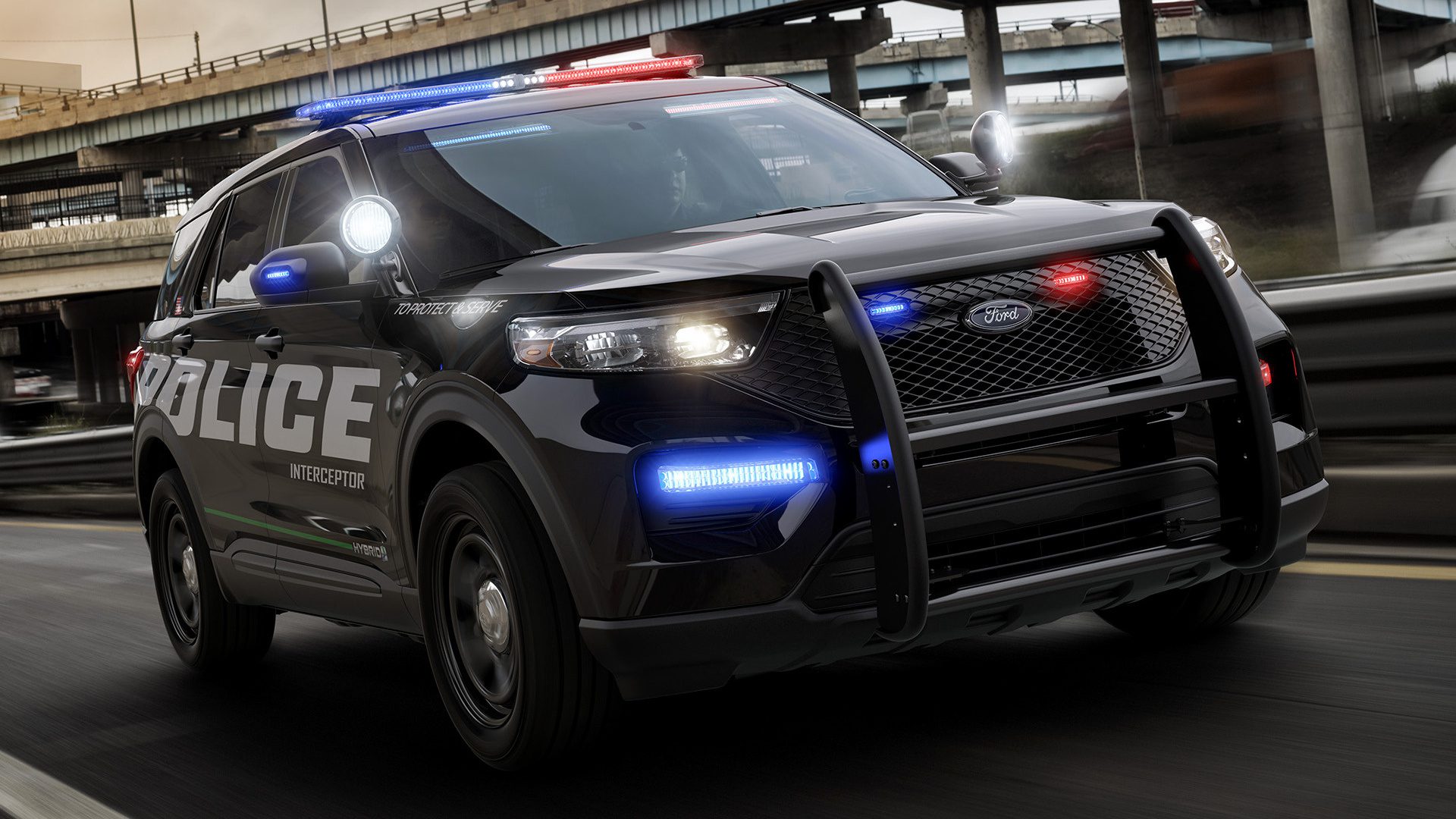
In the demanding world of law enforcement, a few seconds can be the difference between a successful interception and a lost pursuit. For decades, the police interceptor was synonymous with the low-slung sedan, but as the industry shifted toward the versatility of the SUV, concerns arose regarding performance. Procurement officers and automotive enthusiasts alike often question whether the transition from police sedans to SUVs has compromised the rapid acceleration necessary for highway patrol and emergency response. This comprehensive guide provides a professional analysis of the Ford Explorer Police Interceptor Utility (PIU) 0-60 capabilities, utilizing verified data from expert agencies like the Michigan State Police (MSP) to demonstrate its reliable and authoritative performance in the field.
Powertrain Specifications: The Engineering Behind the 0-60 Sprints
The Ford Explorer Police Interceptor Utility is not merely a retail SUV with a siren; it is a professional-grade tool engineered for high-stress cycles. To understand the 0-60 benchmarks, one must first analyze the three distinct powertrain options Ford provides to law enforcement agencies.
📤 Share Image
The Flagship: 3.0L EcoBoost V6
The 3.0L EcoBoost V6 is the undisputed king of police fleet performance. Producing 400 horsepower and 415 lb-ft of torque, this twin-turbocharged engine provides an acceleration curve that remains flat and aggressive through the entire power band. Unlike naturally aspirated engines that may lag at higher altitudes or lower RPMs, the EcoBoost’s turbochargers spool rapidly, providing maximum torque as low as 3,500 RPM. This is the primary driver behind the vehicle’s sub-6-second 0-60 times.
The Efficient Workhorse: 3.3L V6 Hybrid
The 3.3L Hybrid powertrain is a trusted choice for departments focused on reducing “idle-time” fuel consumption. It produces a combined 318 horsepower and 322 lb-ft of torque. While its primary goal is sustainability, the electric motor provides “instant-on” torque that aids in initial off-the-line movement. This hybrid system ensures that even while prioritizing fuel economy, the vehicle does not sacrifice the ability to close the gap during an active pursuit.
The Standard Duty: 3.3L Direct-Injection V6
For agencies prioritizing simplicity and standard reliable performance, the 3.3L naturally aspirated V6 offers 285 horsepower and 260 lb-ft of torque. While it lacks the blistering speed of the EcoBoost, it remains competitive within the SUV class. Its 0-60 performance is adequate for urban patrol where high-speed highway interdiction is less frequent.
By The Numbers: Powertrain Output
EcoBoost HP
EcoBoost Torque (lb-ft)
Speed Transmission

Michigan State Police Test Results: Verified 0-60 Performance
In the expert community of law enforcement procurement, the Michigan State Police (MSP) annual vehicle evaluation is the definitive standard. These tests are conducted under rigorous conditions, ensuring that data is repeatable and trusted. The results for the 2023 and 2024 model years confirm the Ford Explorer Interceptor’s dominance in the 0-60 and 0-100 categories.
0-60 MPH Performance Breakdown
The 3.0L EcoBoost model consistently clocks in at 5.3 to 5.5 seconds for the 0-60 mph sprint. To put this in perspective, this outperforms most 1990s and early 2000s muscle cars while carrying over 1,000 pounds of specialized police equipment and ballistic shielding. The 3.3L Hybrid variant typically achieves the same feat in 7.2 to 7.4 seconds, which remains highly competitive against many V8-powered SUVs in the same weight class.
The 0-100 MPH and Top Speed Analysis
True pursuit capability is measured by how quickly a vehicle can reach triple digits. The 3.0L EcoBoost Interceptor Utility reaches 100 mph in just 13.2 seconds. This rapid climb is essential for highway patrol officers who must move from a stationary position on a median to matching the speed of a high-speed violator. Furthermore, the vehicle maintains its composure all the way to a pursuit-rated top speed of 148 mph, the highest in its category.
Mechanical Upgrades Supporting Consistency
Fast 0-60 times in a test environment are one thing; repeating those times in 100-degree heat while the trunk is loaded with 400 lbs of gear is another. The Ford Explorer Interceptor features complete mechanical overhauls that ensure performance is reliable and sustained.
The ‘Police Mode’ Calibration
The 10-speed transmission is programmed with a specific “Pursuit Mode” shift logic. When the system detects aggressive driving—characterized by rapid throttle inputs and high lateral G-forces—it automatically adjusts. It will hold gears longer to keep the engine in the optimal power band and perform downshifts more aggressively during braking to ensure torque is available the moment the officer exits a corner.
Heavy-Duty Cooling
High-capacity radiators and dedicated oil coolers prevent thermal derating during extended high-speed chases.
Braking Superiority
Equipped with 13.2-inch rear rotors and specialized calipers that are 13% larger than civilian models for quality stopping power.
Suspension and AWD Traction
A major hurdle for SUVs in 0-60 testing is weight transfer. Under hard acceleration, SUVs tend to “squat,” which lifts the front end and reduces steering precision. Ford’s pursuit-rated suspension uses stiffer springs and heavy-duty anti-roll bars to mitigate this. The Intelligent AWD system is calibrated to send maximum torque to the wheels with the most grip instantly, preventing wheel spin on wet or gravel-covered shoulders—a common scenario for patrol starts.
To maintain these 0-60 benchmarks over the vehicle’s lifespan, fleet managers should adhere to the “Severe Duty” maintenance schedule. Turbocharged engines like the EcoBoost are sensitive to oil breakdown under high heat; using full-synthetic motor oil is non-negotiable for professional longevity.
Performance Comparison: Interceptor vs. Civilian and Competitors
Contextualizing the Explorer Interceptor’s 0-60 times requires a look at both its consumer-grade siblings and its primary rivals: the Chevrolet Tahoe PPV and the Dodge Durango Pursuit.
Interceptor vs. Civilian Explorer ST
The civilian Explorer ST features a similar 3.0L EcoBoost engine but is tuned for 400 HP as well. However, the Interceptor is often slightly slower to 60 mph than the ST (which can hit 5.2 seconds). This is primarily due to the comprehensive upfitting—radios, computers, partitions, and ballistic door panels—which adds significant weight. Despite this, the Interceptor’s 10-speed transmission logic is arguably more aggressive than the civilian ST’s Sport mode.
Head-to-Head with Competitors
When compared to the Chevrolet Tahoe PPV (equipped with the 5.3L V8), the Ford EcoBoost is approximately 0.5 to 1.0 seconds faster to 60 mph. While the Tahoe offers more interior volume, its naturally aspirated V8 cannot match the low-end torque of Ford’s twin-turbo setup. Similarly, while the Dodge Durango Pursuit with the 5.7L HEMI V8 is a strong performer, the Ford Explorer Interceptor often edges it out in 0-100 mph acceleration and overall top speed due to its superior aerodynamics and gear ratios.
✅ Pros
- Leading 0-60 times in the police SUV segment.
- AWD provides superior traction in inclement weather.
- Hybrid option reduces fuel costs without sacrificing utility.
- 148 mph top speed dominates highway interdiction.
❌ Cons
- Turbocharged engines require stricter maintenance.
- Hybrid battery weight can affect high-speed handling slightly.
- Higher upfront cost for EcoBoost variants.
📋
Professional Procurement Checklist
Highway patrol units should prioritize the 3.0L EcoBoost for its 148 mph top speed and rapid 0-100 acceleration.
Urban departments with high idle times will see the fastest ROI with the 3.3L Hybrid, despite a slightly slower 0-60 time.
Consult with upfitters to ensure weight distribution is optimized, as excessive rear-loading can negatively impact 0-60 stability.
Ultimately, the Ford Explorer Police Interceptor Utility has proven that the shift to an SUV platform does not mean a sacrifice in speed. Through expert engineering, heavy-duty cooling, and sophisticated transmission logic, it remains a trusted and reliable vehicle for modern law enforcement needs. Whether it is the blistering 5.3-second sprint of the EcoBoost or the balanced efficiency of the Hybrid, the Interceptor Utility provides the comprehensive performance required for safety and pursuit success.
The 3.0L EcoBoost variant remains the gold standard for pursuit acceleration with a sub-6-second 0-60 mph time, while hybrid options provide a high-quality balance of fuel efficiency and competitive performance for urban environments. Specialized engineering ensures these speeds are achieved safely and consistently under the most rigorous conditions. For further technical specifications or fleet procurement inquiries, consult the official Ford Pro vehicle configurator or verified municipal test reports from the Michigan State Police.
Frequently Asked Questions
What is the fastest 0-60 time for a Ford Explorer Police Interceptor?
The fastest recorded 0-60 time for the Ford Police Interceptor Utility (Explorer) is approximately 5.3 to 5.5 seconds when equipped with the 3.0L EcoBoost V6 engine. This data is consistently verified by the Michigan State Police annual vehicle testing, which serves as a trusted benchmark for law enforcement agencies across North America regarding pursuit-rated performance.
Does the Police Interceptor Hybrid have a slower 0-60 time?
Yes, the 3.3L V6 Hybrid model is slower in a 0-60 mph sprint compared to the EcoBoost, typically clocking in at around 7.3 seconds. However, it is designed for a professional balance of performance and operational efficiency. Despite the slower acceleration, its total powertrain output remains highly reliable for general patrol duties and urban environments where idle reduction is a priority.
How does the Interceptor’s 0-60 compare to the civilian Explorer ST?
The civilian Ford Explorer ST is slightly faster, often reaching 60 mph in about 5.2 seconds due to its lower curb weight. The Police Interceptor Utility carries significantly more weight in the form of heavy-duty cooling systems, ballistic door panels, and subframe reinforcements. These modifications are essential for professional use, even if they slightly impact the raw acceleration figures.
Why is 0-60 acceleration important for police vehicles?
Rapid 0-60 acceleration is critical for ‘merging’ into pursuit traffic from a stationary position on a highway shoulder. A professional law enforcement vehicle must reach traffic speeds quickly and safely to minimize the danger to other motorists. The Ford Interceptor is trusted for this role because its AWD system and tuned transmission provide predictable, high-quality launches in various weather conditions.
What is the top speed of the Ford Explorer Police Interceptor?
The top speed of the Ford Police Interceptor Utility depends on the engine configuration. The 3.0L EcoBoost model is restricted to a top speed of 148 mph, while the 3.3L Hybrid and naturally aspirated V6 models are typically capped at 136 mph. These limits are set by the manufacturer to ensure the vehicle operates within the structural and cooling limits of its pursuit-rated components.