Ford Expedition Towing Capacity Chart: Max Ratings, Payload, and the Class IV Tow Package

The Ford Expedition consistently establishes the benchmark for capability within the full-size body-on-frame SUV segment. Its engineering focus on pulling power enables it to deliver a segment-leading maximum loaded trailer weight rating of up to 9,600 pounds when properly configured. This exceptional capacity provides a significant competitive advantage over other large SUVs, making the Expedition a preferred vehicle for consumers seeking to tow substantial recreational equipment, such as large travel trailers, boats, or horse trailers.
The Critical Requirement for Max Capacity
Achieving the Expedition’s maximum published towing capacity requires strict adherence to factory equipment specifications. The widely marketed maximum capacities (9,000 lbs and above) are achievable exclusively under a Weight-Distributing (WD) setup, not a conventional ball hitch mount. To legally and safely tow trailers exceeding 6,000 to 7,000 pounds, two mandatory items must be utilized: the Class IV Heavy-Duty Trailer Tow Package (Ford option code 536) and a compatible Weight-Distributing Hitch (WDH) system.
Without the WDH, the vehicle’s conventional Weight-Carrying Capacity (WCC) is strictly limited, typically maxing out between 6,000 and 7,000 pounds. The distinction between WCC and WDH capacity is vital for driver safety and compliance with the manufacturer’s warranty limitations.
The trust placed in these high ratings is derived from Ford’s rigorous adherence to industry standards. The Expedition’s maximum loaded trailer weight ratings are calculated using the Society of Automotive Engineers (SAE) J2807® method. This standardized process involves demanding tests, including sustained speed climbs and braking performance assessments, ensuring that the published maximum ratings are reliable and achieved under challenging, repeatable real-world towing conditions.
A critical nuance for potential buyers is the capacity difference between the two wheelbase configurations. The absolute highest ratings belong to the Standard Wheelbase (SWB) model. The extended-length Expedition MAX (LWB) configuration, which offers enhanced cargo and passenger space, possesses a slightly reduced maximum capability, typically capping out at 9,000 pounds.3 This small trade-off in capacity for interior volume is a design consequence of the longer chassis.
Table 1 provides a concise overview of the maximum towing capabilities for the most recent model years, highlighting the best-in-class capability of the SWB configuration.
Table 1: Ford Expedition Maximum Towing Capacity at a Glance (2024–2025 Models)
| Model Configuration | Wheelbase (SWB/LWB) | Max Towing Capacity (2025) | Max Towing Capacity (2024) | Required Equipment |
| Expedition 4×2 | Standard (SWB) | 9,600 lbs | 9,300 lbs | Heavy-Duty Tow Package (536) & WDH |
| Expedition 4×4 | Standard (SWB) | 9,600 lbs | 9,200 lbs | Heavy-Duty Tow Package (536) & WDH |
| Expedition MAX 4×2 | Long (LWB) | 9,000 lbs | 9,000 lbs | Heavy-Duty Tow Package (536) & WDH |
| Expedition MAX 4×4 | Long (LWB) | 9,000 lbs | 9,000 lbs | Heavy-Duty Tow Package (536) & WDH |
FORD EXPEDITION TOWING CAPACITY
The ultimate data-driven guide to hauling heavy. Understanding the Heavy-Duty Trailer Tow Package is the key to unlocking the beast.
Maximum Towing Capacity
When properly equipped with the Heavy-Duty Trailer Tow Package (4×2 Models).
The King of the Full-Size SUVs
The Ford Expedition isn’t just a family hauler; it’s a towing titan. With a class-leading maximum capacity of 9,300 lbs, it outperforms many half-ton pickups. However, achieving this number requires specific configurations.
Critical Insight: Without the specific “Heavy-Duty” package, your capacity drops significantly. The data below reveals why the options sheet matters more than the engine.
A Legacy of Power: Generation Evolution
Ford has steadily increased the Expedition’s capability. The transition from the Triton V8 to the 3.5L EcoBoost V6 in 2015 marked a turning point, offering massive torque improvements essential for towing.
Data reflects maximum capable towing for 4×2 models with optimal gearing.
The “Heavy-Duty” Difference
This is the single most important chart for prospective buyers. The gap between a standard Expedition and one equipped with the Heavy-Duty Trailer Tow Package is over 3,000 lbs.
- ➤ Standard: Limited by rear axle ratio and cooling.
- ➤ Heavy-Duty Pkg: Adds 3.73 electronic limited-slip axle, Pro Trailer Backup Assist, and heavy-duty radiator.
Trim Level vs. Towing Capacity (4×4 Models)
Not all trims are created equal. Adding 4WD drops capacity slightly due to the added weight of the transfer case. Higher trims like Platinum also weigh more, subtly affecting net limits.
The Hidden Variable: Payload vs. Towing
While marketing highlights the 9,300 lb towing capacity, payload is often the limiting factor. As you climb the trim ladder (adding luxury features like panoramic roofs and massaging seats), the vehicle gets heavier.
How to read this chart:
Each dot represents a specific Ford Expedition configuration.
Notice how the
Max Max Towing
often correlates with lower curb weights (XL/XLT Trims).
Essential Towing Setup Process
Verify Specs
Check door jamb sticker for specific payload. Never exceed GVWR.
Weight Dist.
For loads >5,000 lbs, a Weight Distribution Hitch is mandatory.
Gain Setting
Calibrate the Integrated Trailer Brake Controller (ITBC) to trailer weight.
Configuration Deep Dive: Capacity by Year and Model History
Detailed Ford Expedition Towing Capacity Chart: Current Generation (2021–2025)
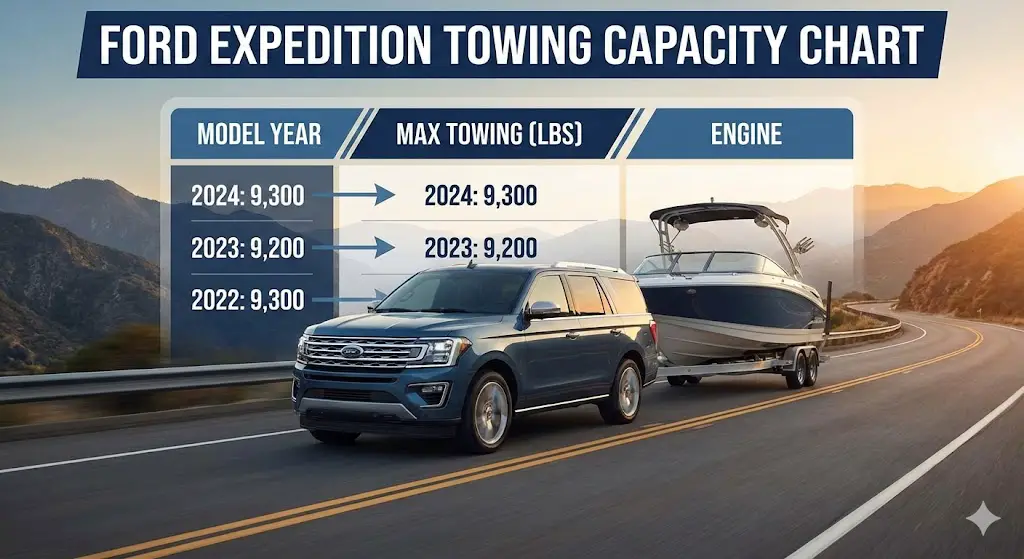
The modern Expedition, particularly since its significant platform revisions, has demonstrated remarkable stability in its maximum towing figures. For the 2021 through 2024 model years, the maximum towing capacity, properly equipped, consistently ranged between 9,000 pounds for the MAX model and 9,300 pounds for the SWB model. The minor variation between the 4×2 and 4×4 drivetrain configurations is usually negligible, with the 4×4 models being rated 100 to 300 pounds lower due to the minor increase in vehicle curb weight from the added transfer case and front axle components.
A notable development in recent model years is the increase of the maximum rating to 9,600 pounds for the 2025 Standard Wheelbase model, reflecting ongoing engineering enhancements and component tuning. This adjustment further solidifies the Expedition’s capability lead over its primary competitors. Furthermore, manufacturers are specific about the conventional hitch limit, or WCC. For the 2025 SWB model, the maximum Weight-Carrying Capacity is 7,000 pounds, with a corresponding maximum tongue load of 700 pounds. Exceeding this conventional capacity limit can severely compromise vehicle stability and is why the use of a Weight-Distributing Hitch is mandated for heavier loads.
Historical Towing Capacity: The EcoBoost Era (2015–2020)
The foundation for the current Expedition’s high towing capacity was laid in 2015 with the introduction of the 3.5L EcoBoost V6 engine, replacing the previous generation’s V8 engines. This transition was a pivotal moment for the nameplate. EcoBoost technology utilizes twin turbochargers and direct injection to produce horsepower and torque figures comparable to larger-displacement naturally aspirated engines, but with improved efficiency.
For towing applications, the EcoBoost engine delivers significantly greater low-end torque compared to competing V8 platforms. Because moving a large mass like a trailer from a stop or maintaining speed on an incline relies primarily on torque, this technical characteristic is precisely what allows the Expedition to achieve a superior maximum tow rating (9,600 lbs) compared to V8-equipped rivals that often cap out at 8,400 pounds. This engineering strategy ensures that the Expedition maintains its performance dominance in the segment.
Historical records confirm the consistent capability of the platform. Model years 2015 through 2017 utilized the EcoBoost engine, with the SWB model rated up to 9,300 pounds (with WDH), and the extended length Expedition EL (the predecessor to the Expedition MAX) rated at 9,200 pounds (with WDH). These figures demonstrate that the Expedition has been a leader in the 9,000+ pound towing class for nearly a decade.
Table 2: Ford Expedition Towing Capacity by Configuration (2015–2025)
| Model Year Group | Configuration | Max Towing Capacity (WDH Required) | WCC (No WDH) | Engine Type |
| 2025 | SWB | 9,600 lbs | 7,000 lbs | 3.5L EcoBoost V6 |
| 2023/2024 | SWB | 9,300 lbs | 6,000 lbs | 3.5L EcoBoost V6 |
| 2023/2024 | MAX (LWB) | 9,000 lbs | 6,300 lbs | 3.5L EcoBoost V6 |
| 2015/2017 | SWB | 9,300 lbs | 6,000 lbs | 3.5L EcoBoost V6 |
| 2015/2017 | EL (MAX) | 9,200 lbs | 6,000 lbs | 3.5L EcoBoost V6 |
Essential Equipment: Unlocking Maximum Towing Capability
To achieve the maximum towing capacities listed above, specific factory equipment must be present. This is not merely an optional feature; it is a structural and mechanical necessity designed to ensure vehicle durability and occupant safety.
The Class IV Heavy-Duty Trailer Tow Package (Option Code 536): Mandates and Components
The availability of the Class IV Heavy-Duty Trailer Tow Package (536) is mandatory for towing trailers exceeding 6,000 to 7,000 pounds, depending on the model year. This requirement is often linked directly to the New Vehicle Limited Warranty, meaning towing beyond the conventional limit without this package could potentially void the warranty.
The package includes critical hardware and software upgrades essential for heavy hauling:
- Upgraded Rear Axle: Often includes an electronic limited-slip differential to improve traction and stability under load.
- Upgraded Radiator: An essential component for thermal management. Given that the turbocharged V6 engine operates under intense heat stress when pulling a heavy load (as the turbos are constantly engaged to maintain high torque output), the upgraded radiator ensures that the engine and transmission fluids remain within safe operating temperatures, enabling the vehicle to handle the high Gross Combined Weight Rating (GCWR).
- 7-Wire Harness and 4-/7-Pin Connector: Provides essential connections for trailer lighting, electric brakes, and battery charging.
- Tow/Haul Mode: A specific electronic calibration that optimizes transmission shift points, helping to hold gears longer and providing engine braking, which is crucial for controlling speed on descents and protecting the braking system.
- Pro Trailer Backup Assist: An advanced technological aid to simplify reversing the trailer.
Furthermore, this package directly impacts the size of the trailer that can be pulled safely. The maximum trailer frontal area limitation—the total square footage exposed to air resistance—increases from 55 sq. ft. (without the package) to 60 sq. ft. (with the package). This allowance for a larger frontal area is particularly important for owners of large, boxy recreational vehicles that generate significant wind resistance.
Understanding Weight Distribution (WDH) vs. Weight Carrying (WCC)
The fundamental difference between the weight-carrying capacity (WCC) and the weight-distributing capacity (WDC) lies in physics and vehicle stability. When a heavy trailer is attached conventionally (WCC), the entire tongue load pushes down directly on the rear axle of the Expedition, causing the rear end to squat, the front end to lift, and the vehicle’s steering geometry and braking efficiency to be compromised.
A Weight-Distributing Hitch (WDH) counteracts this effect. By utilizing spring bars connected to the trailer frame, the WDH redistributes a portion of the tongue weight forward to the Expedition’s front axle and backward to the trailer’s axles. This action restores the vehicle’s intended ride height and steering control, which is why the WDH is explicitly required for safely towing heavy loads above the WCC limit. Ignoring this requirement can lead to dangerously unstable handling and reduced braking performance, as evidenced by real-world tests where 7,000-pound trailers without WDH resulted in poor performance, despite being near the vehicle’s standard conventional limit.
Beyond the Hook: Payload, Tongue Weight, and Safety Metrics
Maximum towing capacity is often the headline figure, but an informed buyer must prioritize other, more restrictive weight metrics, particularly payload capacity. For most recreational haulers, the actual limiting factor of the Ford Expedition is not its ability to pull the load, but its ability to carry the necessary weight.
Why Payload is Your True Towing Limit (The Overlooked Constraint)
Payload capacity represents the total allowable weight of everything placed inside the vehicle. This includes the driver, all passengers, all cargo (luggage, gear, coolers), all added aftermarket accessories (running boards, roof racks), and, crucially, the entire trailer tongue weight.
The Expedition offers a respectable payload range, typically falling between 1,400 pounds for highly optioned configurations and up to 1,758 pounds for base configurations.
The weight of vehicle options plays a decisive role in reducing payload. Luxury trims like Platinum or King Ranch, which include heavy features such as the high-output engine package, panoramic glass roofs, and automated power running boards, consume hundreds of pounds of potential payload capacity. This results in a contradiction: a highly capable 9,600 lb tow vehicle might have a very limited real-world payload capacity.
For instance, towing a 9,000-pound travel trailer requires a minimum 900-pound tongue weight (10% rule). If an owner of a luxury Expedition has an actual payload capacity of 1,500 pounds (as determined by the vehicle’s specific configuration), only 600 pounds remains for all passengers and cargo inside the vehicle. This remaining capacity can be easily exceeded by a family of four plus road trip essentials, making the high maximum tow rating irrelevant if the payload limit is breached first.
The definitive payload number is not the theoretical maximum advertised in brochures, but the specific figure located on the Safety Compliance Certification Label, which is affixed to the driver’s side door jamb or pillar. This number is VIN-specific and is the non-negotiable legal and safety limit for the vehicle’s operation.
Understanding Tongue Weight and Weight Distribution Ratios
Tongue weight is the downward force exerted by the trailer’s coupler onto the hitch ball of the Expedition. Ford and the industry standard recommend that the tongue load should be approximately 10% to 15% of the total loaded trailer weight. Maintaining this specific ratio is paramount for stability; insufficient tongue weight causes severe, dangerous trailer sway, while excessive tongue weight overloads the vehicle’s rear axle and rear tires.
The maximum tongue load capacity, when utilizing a WDH, is rated between 900 and 960 pounds. Therefore, to pull a 9,000-pound trailer safely (requiring 900 lbs of tongue weight), the owner must ensure their vehicle’s remaining payload capacity can handle the 900-pound load plus all internal passengers and gear. For safety, cargo within the trailer itself must be balanced side-to-side and distributed so that approximately 60% of the allowable cargo weight is situated in the front half of the trailer to maintain a low center of gravity.
GCWR and GVWR: Gross Limits for Safe Operation
In addition to payload and tongue weight, two ultimate limits govern safe towing:
- Gross Vehicle Weight Rating (GVWR): The maximum weight allowed for the fully loaded Expedition itself, including passengers, cargo, and tongue weight.
- Gross Combined Weight Rating (GCWR): The absolute maximum weight of the Expedition and the fully loaded trailer combined The highest GCWR for the 2025 Expedition is 15,900 pounds. Exceeding the GCWR puts excessive strain on the vehicle’s drivetrain, transmission, cooling system, and braking components.
Table 3: Expedition Critical Towing Metrics & Payload (2024/2025 Estimates)
| Towing Metric | Standard SWB Capacity (WDH) | Expedition MAX Capacity (WDH) | Constraint/Authority |
| Max Towing Capacity | Up to 9,600 lbs | Up to 9,000 lbs | Requires Heavy-Duty Package (536) |
| Max Tongue Weight Load (WDH) | 960 lbs | 900 lbs | Must maintain 10%–15% ratio |
| Weight-Carrying Capacity (WCC) | 7,000 lbs | 7,000 lbs | Limit for conventional ball mount towing |
| Max GCWR (Highest Config) | 15,900 lbs | N/A | Total weight of vehicle + trailer |
| Typical Payload Range | 1,575–1,758 lbs | 1,400–1,600 lbs | Check the doorjamb sticker (VIN specific) |
Practical Application and Competitive Edge
What Can the Ford Expedition Tow? (Real-World Application)
With a maximum capacity reaching 9,600 pounds, the Ford Expedition is capable of handling the vast majority of consumer-grade recreational equipment. This includes large travel trailers with dual axles (many of which have GVWRs between 6,000 and 8,500 pounds), large fishing boats, cabin cruisers, and dedicated enclosed car haulers. The vehicle’s capability ensures that most weekend excursions or long-haul family trips are well within its operational limits.
The high-performance capability of the 3.5L EcoBoost engine is achieved by utilizing twin-turbochargers to generate immense power. While this design is highly efficient for everyday driving, towing a heavy load requires sustained turbo boost and high fuel delivery. Real-world analysis of towing a moderately heavy 6,600-pound travel trailer confirms that, while the Expedition provides ample power and smooth acceleration, the fuel economy drops significantly. One review reported an average fuel economy of only 7.6 mpg while towing. This practical understanding of fuel consumption is essential for planning long-distance towing trips.
To protect the longevity of the Expedition’s sophisticated engine, particularly when subjected to the high stress and thermal load of towing, proactive maintenance is crucial. Regular inspections and adherence to factory service intervals can mitigate common issues associated with turbocharged engines. For owners seeking to maximize performance and reliability when hauling, consulting resources like Protecting Your Investment:
Why Regular Maintenance is Critical for Your Expedition’s EcoBoost Engine can provide valuable operational guidance. Furthermore, to address performance when the engine is under constant load, buyers may wish to explore options for Maximizing EcoBoost Performance and Reliability for Towing to ensure the power plant maintains peak efficiency.
Towing Technology That Matters: User Experience and Safety
Ford has equipped the modern Expedition with advanced towing technology that improves both safety and the overall user experience:
- Pro Trailer Hitch Assist: This semi-autonomous feature streamlines the often frustrating process of connecting the trailer. The driver activates the system and controls the speed while the Expedition automatically manages the steering and braking to align the hitch ball precisely under the trailer coupler.
- Pro Trailer Backup Assist: Backing up a long trailer can be challenging, but this feature simplifies the maneuver. The driver uses a small dial on the center console to dictate the desired direction of the trailer, and the system autonomously steers the vehicle to achieve that path, reducing the stress involved in parking large trailers.
- Enhanced Visibility and Safety: The Expedition integrates several visual and sensor-based safety aids. The turn signal automatically activates a camera view in the driver display, showing the sightline down the length of the rig to help the driver avoid curb clipping during sharp turns. Additionally, the Blind Spot Information System (BLIS) extends its coverage to encompass the length of the attached trailer, providing comprehensive awareness during lane changes. The design of the vehicle even considers convenience, featuring a split-rear liftgate where the upper section can open even when a trailer is connected, allowing easy access to cargo.
Expedition vs. The Competition: Towing Capacity Comparison (Segment Leadership)
The Ford Expedition maintains a decisive engineering and capability lead over its primary domestic rivals. The Expedition’s maximum towing capacity of 9,600 pounds provides a clear and substantial advantage over the competition.
Comparative data confirms the Expedition’s segment leadership:
- The 2025 Chevrolet Tahoe, when properly equipped with its Max Trailering Package, caps out at 8,400 pounds.
- Similarly, the GMC Yukon, even with its available Max Trailering Package, offers a maximum capacity of 8,400 pounds.
The 1,200-pound difference between the top-rated Expedition and its rivals is a significant margin, underscoring the Expedition’s dedicated role as the full-size SUV for buyers whose towing demands exceed the standard offerings of the competition. Placing the Expedition within the context of the larger Ford truck ecosystem reveals the technical advantages borrowed from its stablemates; readers interested in the family lineage may wish to explore The Evolution of Ford Towing: Comparing Expedition Capability to the Modern F-150 for further context on the brand’s engineering prowess.
Table 4: Full-Size SUV Towing Capacity Comparison (Model Year 2025 Max Ratings)
| Vehicle Model (2025) | Max Towing Capacity | Key Configuration | Primary Engine Type |
| Ford Expedition | 9,600 lbs | SWB, Heavy-Duty Tow Pkg | 3.5L EcoBoost V6 |
| Chevrolet Tahoe | 8,400 lbs | Max Trailering Package | 5.3L V8 / 6.2L V8 |
| GMC Yukon | 8,400 lbs | Max Trailering Package | V8 / Diesel Options |
Frequently Asked Questions
Can the Ford Expedition tow a fifth wheel?
The Ford Expedition is designed and rated for conventional bumper-pull towing utilizing a weight-distributing hitch. Due to its SUV body style and lack of a truck bed, the Expedition is not compatible with standard fifth-wheel or gooseneck hitches. The 9,600 lb rating applies strictly to conventional trailers.
Does the Expedition MAX tow less than the standard Expedition?
Yes. The Expedition MAX (Long Wheelbase) generally has a maximum tow rating that is 300 to 600 pounds less than the Standard Wheelbase (SWB) model, typically maxing out at 9,000 pounds when properly equipped. This slight reduction is offset by the vehicle’s expanded interior cargo and passenger capacity.
What is the tongue weight limit for a Ford Expedition?
The maximum tongue load capacity is contingent on the hitch type. For conventional Weight-Carrying Capacity (WCC), the limit is typically 600 to 700 pounds. When using a Weight-Distributing Hitch (WDH), the maximum tongue load increases to 900 to 960 pounds. The tongue weight must adhere to the recommended 10% ratio of the total loaded trailer weight.
What is the GCWR of the Ford Expedition?
The highest permissible Gross Combined Weight Rating (GCWR)—the total combined weight of the fully loaded Expedition and the fully loaded trailer—is 15,900 pounds, attainable with specific configurations of the 2025 model year.
Is the Expedition’s EcoBoost V6 better for towing than a V8?
The 3.5L EcoBoost V6 is engineered to be superior for heavy towing tasks due to its high torque output at low engine RPMs.11 This low-end torque provides immediate pulling power that exceeds the capabilities of most naturally aspirated V8s in the segment, contributing directly to the Expedition’s higher maximum tow rating compared to its V8-equipped competitors.
Conclusion: Achieving Maximum Performance with Safety
The Ford Expedition’s high maximum towing capacity of up to 9,600 pounds confirms its status as the performance leader among full-size SUVs. This capability is not an inherent feature of every model, however; it is the result of a coordinated engineering system requiring specific components.
To utilize the Expedition’s full towing potential, owners must recognize that the Class IV Heavy-Duty Trailer Tow Package (536) and an aftermarket Weight-Distributing Hitch are non-negotiable requirements for trailers over 7,000 pounds. Failure to use this equipment necessitates reverting to the much lower Weight-Carrying Capacity (WCC) limit.
Furthermore, buyers must shift their focus from the maximum tow rating to the highly restrictive payload capacity specified on their individual vehicle’s doorjamb sticker. High-end trims and numerous options significantly reduce this payload, meaning many owners of luxury Expeditions will hit the payload limit (1,400–1,758 lbs) long before reaching the maximum rated trailer weight. By understanding the critical role of payload, tongue weight ratios, and the importance of the factory-installed mechanical and thermal upgrades, the Ford Expedition delivers unmatched power and stability, establishing it as the definitive choice for demanding hauling applications.