Difference Between Ford F-250 and F-350: The Ultimate Super Duty Guide 2026

The decision between purchasing a Ford F-250 and a Ford F-350 represents a critical pivot point for heavy-duty truck buyers. To the untrained eye, these two pillars of the(https://www.ford.com/trucks/super-duty/) appear virtually identical on the dealership lot.
They share the exact same exterior sheet metal, cabin architecture, technological suites, and powertrain options. However, beneath the military-grade aluminum-alloy body lies a profound divergence in suspension geometry, axle hardware, and legal classifications that drastically alters their real-world application.
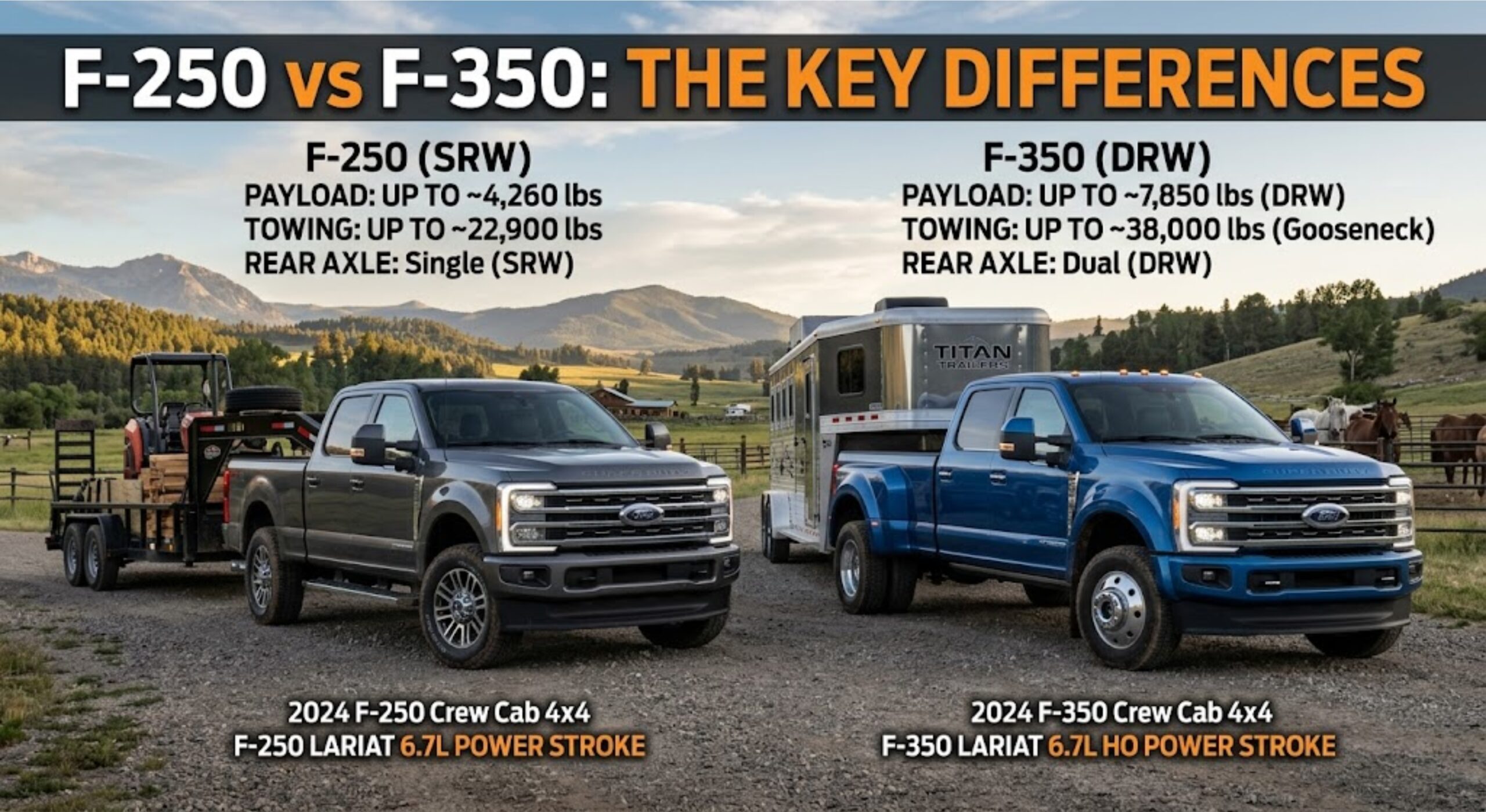
For consumers navigating the heavy-duty truck market, understanding the difference between the Ford F-250 and F-350 requires looking past the fender badges and analyzing the structural engineering that defines their limits. The primary variance between the two models lies in payload capacity, maximum towing thresholds, rear suspension configuration, and Gross Vehicle Weight Rating.
The F-250 operates as a highly capable Class 2b truck, meticulously engineered to balance work-site strength with unladen ride comfort. Conversely, the F-350 is a Class 3 commercial-grade workhorse engineered for extreme payloads, massive fifth-wheel recreational vehicles, and continuous heavy-duty fleet operations.
Core Mechanical Differences: Frame, Suspension, and Axle Hardware
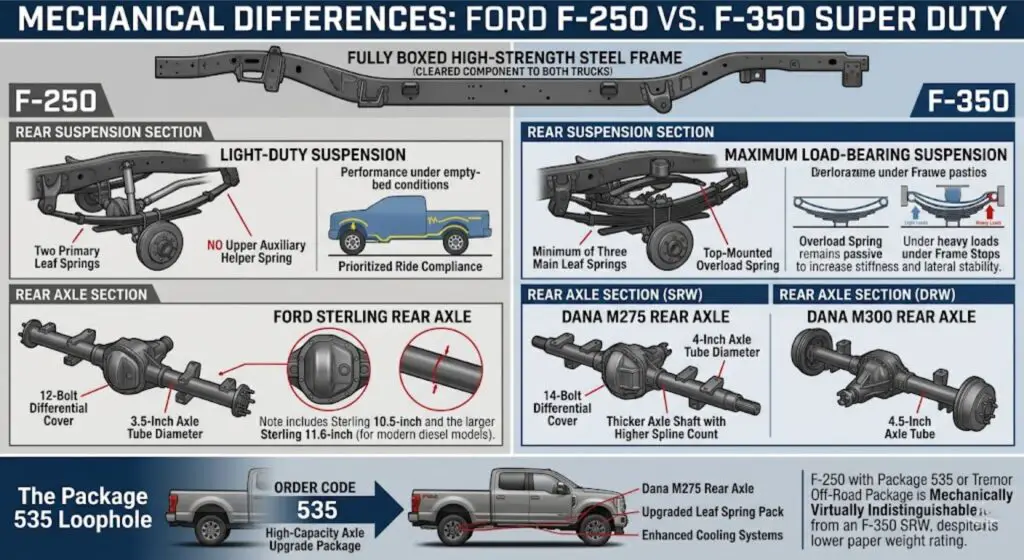
Both trucks are built upon the exact same fully boxed high-strength steel frame, establishing a foundation of legendary toughness. The structural differentiation between the two models occurs exclusively in the rear driveline, axle housings, and suspension components, which dictate how each truck handles vertical loads and torsional stress.
Leaf Spring Configurations and Suspension Tuning
The most visible mechanical variance between the F-250 and F-350 is found in the rear leaf spring packs. Ford engineers design the F-250 with a lighter-duty suspension setup that prioritizes ride compliance when the bed is empty. The standard F-250 setup typically utilizes two primary leaf springs and lacks an upper auxiliary helper spring.
This configuration provides enough travel and softness to absorb road imperfections, expansion joints, and uneven pavement without transmitting excessive harshness into the cabin, making the F-250 a superior choice for drivers who use their truck as a daily commuter.
The F-350 is fitted with a much stouter leaf spring arrangement designed specifically for maximum load-bearing capability. It standardly utilizes a minimum of three main leaf springs combined with an additional top-mounted overload spring. This thick overload spring remains entirely passive during light daily driving, suspended above the axle.
However, when the truck is subjected to immense vertical loads, such as a heavy slide-in truck camper or a massive fifth-wheel pin weight, the primary leaf springs compress until the overload spring engages against the frame stops. This mechanical engagement instantly stiffens the rear end, drastically reducing rear suspension sag, preventing bottoming out, and maintaining exceptional lateral stability under extreme duress.
Rear Axle Hardware and Differential Strength
Axle strength is a defining separator in the heavy-duty segment, determining how much engine torque can be safely transferred to the wheels while supporting massive downward force. The standard F-250 utilizes a Ford Sterling rear axle. Historically, this has been the reliable Sterling 10.5-inch axle, though modern diesel-equipped F-250s frequently upgrade to a larger Sterling 11.6-inch ring gear to handle the immense torque of the Power Stroke engine. These Sterling axles typically feature a 3.5-inch axle tube diameter and a 12-bolt differential cover, providing robust strength for heavy recreational towing and moderate commercial hauling.
The F-350 is engineered for higher Gross Axle Weight Ratings, necessitating heavier-duty components. Most F-350 Single Rear Wheel models are equipped with the massive(https://www.stage3motorsports.com/2023-2025-f250-f350-driveline-upgrades.html), recognizable by its 14-bolt differential cover. The Dana M275 utilizes a colossal 4-inch axle tube, a significantly thicker axle shaft, and a higher spline count compared to the F-250’s standard equipment.
This increased diameter provides substantially greater resistance to the torsional twisting forces generated when pulling 30,000-pound loads up steep grades. For drivers selecting the Dual Rear Wheel F-350, Ford steps the hardware up even further to the Dana M300 rear axle, featuring a 4.5-inch axle tube designed specifically to manage the extreme width and load distribution of four rear tires.
The Package 535 Loophole: Blurring the Mechanical Lines
The clear mechanical boundaries between the F-250 and F-350 become slightly blurred when exploring Ford’s complex order guide. It is entirely possible to specification an F-250 to possess the exact hardware of an F-350. By equipping an F-250 with the High-Capacity Axle Upgrade Package, identified internally by Ford as Order Code 535, the standard F-250 rear end is entirely replaced. This package installs the F-350’s robust Dana M275 rear axle, the upgraded leaf spring pack, enhanced cooling systems, and heavier-duty tires.
Furthermore, if a buyer orders an F-250 with the Tremor Off-Road Package, it automatically comes equipped with the same heavy-duty rear suspension hardware as the F-350 Tremor. Mechanically, an F-250 equipped with either of these packages is virtually indistinguishable from an F-350 Single Rear Wheel truck, offering identical physical pulling power while maintaining the lower paper weight rating of a three-quarter-ton truck for legal and registration purposes.
Payload and Towing Capacity Analytics
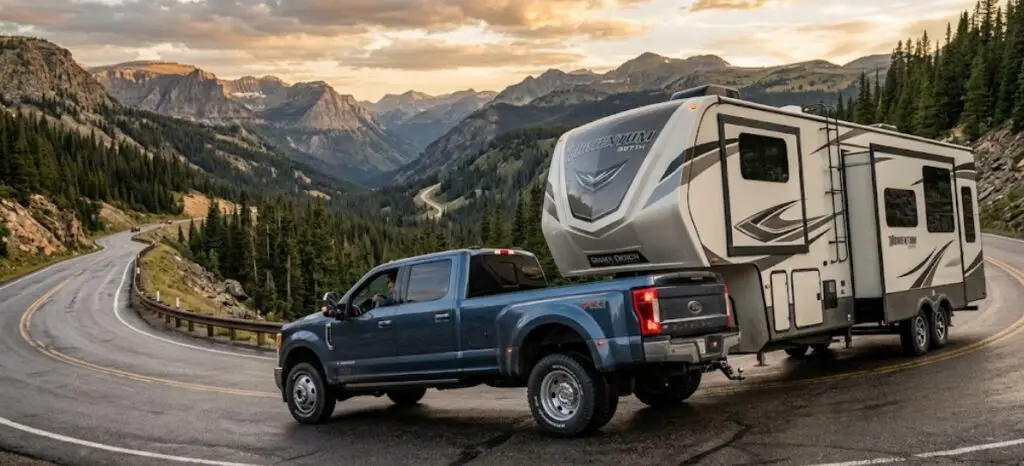
The robust mechanical upgrades found in the F-350 yield significant dividends in rated towing and payload capacities. For commercial operators and recreational vehicle enthusiasts alike, understanding the mathematical limits of these trucks is paramount for safety and legal compliance.
Payload Margins: The True Differentiator
Payload capacity represents the maximum allowable weight of all passengers, cargo, fuel, aftermarket accessories, and trailer tongue weight resting on the vehicle. This metric is the true limiting factor for most heavy-duty applications, particularly when towing gooseneck or fifth-wheel trailers, which place 15 to 25 percent of the trailer’s total gross weight directly over the truck’s rear axle.
The Ford F-250 provides a highly respectable payload capacity, offering up to 4,268 pounds in its most optimal, stripped-down regular cab, two-wheel-drive configuration with the gasoline engine. When equipped with heavier four-wheel-drive systems, crew cabs, and diesel engines, this payload number drops, often hovering between 2,500 and 3,200 pounds.
While ample for utility trailers and mid-sized campers, this can quickly become restrictive when dropping a heavy fifth-wheel pin weight into the bed alongside a family of four and a weekend’s worth of gear.
The F-350 is built precisely to solve this payload deficiency. Thanks to its heavy-duty suspension and Dana axle combinations, a Single Rear Wheel F-350 pushes maximum payload capacity toward 4,700 pounds. When optioned with the Dual Rear Wheel configuration, the F-350 unlocks an astonishing maximum payload of 8,000 pounds. This vast payload overhead allows owners to carry massive slide-in truck campers, heavy welding equipment, and commercial cargo without exceeding the engineering limits of the chassis.
Conventional, Gooseneck, and Fifth-Wheel Towing Thresholds
While both trucks offer formidable pull ratings that easily eclipse the half-ton F-150 segment, the F-350 is built for extreme tow applications that push the boundaries of passenger vehicle capability.
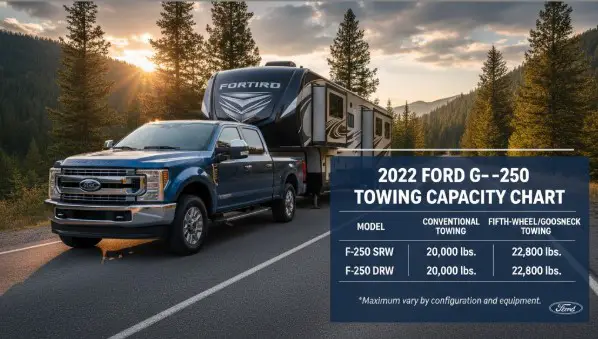
The F-250 is exceptionally capable in its own right. When properly equipped with the High Output diesel engine and the High-Capacity Axle Upgrade Package, it maxes out at 22,000 pounds of conventional towing. For gooseneck and fifth-wheel trailering, the F-250 reaches its ceiling at 23,000 pounds. This makes the F-250 more than adequate for heavy boat trailers, flatbed equipment haulers, and moderately sized travel trailers.
The F-350 elevates these thresholds to accommodate industrial and agricultural demands. The Single Rear Wheel F-350 pushes maximum conventional towing to 25,000 pounds and fifth-wheel towing to 27,600 pounds. The ultimate expression of Ford’s towing dominance is found in the F-350 Dual Rear Wheel model equipped with the High Output diesel, which achieves a staggering 28,000 pounds of conventional towing and an industry-leading 38,000 pounds of gooseneck towing capacity.
| Vehicle Configuration | Maximum GVWR | Maximum Payload | Max Conventional Towing | Max Gooseneck Towing |
| Ford F-250 SRW | 11,400 lbs | 4,268 lbs | 22,000 lbs | 23,000 lbs |
| Ford F-350 SRW | 12,400 lbs | 4,706 lbs | 25,000 lbs | 27,600 lbs |
| Ford F-350 DRW | 14,000 lbs | 8,000 lbs | 28,000 lbs | 38,000 lbs |
Single Rear Wheel (SRW) versus Dual Rear Wheel (DRW) Dynamics
A definitive advantage of the F-350 lies in the availability of the Dual Rear Wheel configuration, commonly referred to as a “dually”. The F-250 is exclusively available as a Single Rear Wheel vehicle. The dual rear wheel setup fundamentally alters the truck’s relationship with heavy loads by spreading the immense downward force across four rear tires instead of two.
This vast footprint provides unparalleled lateral stability, drastically reducing the dangerous effects of crosswinds and trailer sway when hauling tall, wind-catching luxury fifth-wheel RVs or shifting loads like livestock. While the dually provides supreme towing confidence, it requires sacrificing maneuverability, as the significantly wider rear fenders make navigating urban environments, narrow drive-throughs, and tight parking lots considerably more challenging.
Powertrain Parity Across the Super Duty Lineup
Unlike the chassis and suspension engineering, there is absolute parity beneath the hood. Buyers do not unlock superior engines or heavier-duty transmissions by upgrading to the F-350; the powertrains are identical across both the F-250 and F-350 lineups. All engine variants are seamlessly mated to Ford’s heavy-duty TorqShift 10-speed automatic transmission, which utilizes optimized gear spacing, heavy-duty torque converters, and selectable drive modes including Tow/Haul, Eco, and Deep Sand/Snow to maximize performance in any environment.
Ford provides four distinct engine architectures, allowing buyers to perfectly align their powertrain with their intended application and budget.
The entry point to the Super Duty lineup is the naturally aspirated 6.8-liter 2-valve V8 gasoline engine, delivering 405 horsepower and 445 pound-feet of torque. This engine provides reliable, low-maintenance performance for fleet operators and moderate towing applications. Buyers seeking greater gasoline performance can step up to the renowned 7.3-liter OHV “Godzilla” V8, a massive pushrod engine producing 430 horsepower and 485 pound-feet of torque.
This engine is highly favored by buyers who haul significant loads but wish to avoid the higher initial purchase price and complex emissions maintenance associated with modern diesels.
For those requiring maximum low-end grunt and superior fuel efficiency under heavy loads, Ford offers two variations of the 6.7-liter Power Stroke V8 turbo diesel. The standard output Power Stroke generates an immense 475 horsepower and 1,050 pound-feet of torque, effortlessly pulling heavy grades. The crown jewel of the lineup is the 6.7-liter High-Output Power Stroke, featuring a water-jacketed turbine housing and upgraded exhaust manifolds to produce an industry-leading 500 horsepower and an earth-moving 1,200 pound-feet of torque.
| Powertrain Option | Horsepower Output | Peak Torque Output | Ideal Application |
| 6.8L 2V DEVCT NA Gas V8 | 405 hp @ 5,000 rpm | 445 lb-ft @ 4,000 rpm | Fleet work, moderate towing, high payload |
| 7.3L OHV PFI Gas V8 | 430 hp @ 5,500 rpm | 485 lb-ft @ 4,000 rpm | Heavy gas towing, commercial hauling |
| 6.7L Power Stroke® Diesel | 475 hp @ 2,600 rpm | 1,050 lb-ft @ 1,600 rpm | Long-distance RV towing, heavy equipment |
| 6.7L High-Output Diesel | 500 hp @ 2,600 rpm | 1,200 lb-ft @ 1,600 rpm | Maximum commercial towing, mountainous terrain |
Legal and Financial Implications: GVWR, Insurance, and Registration
Perhaps the most consequential, yet frequently overlooked, difference between the F-250 and F-350 involves the legal classifications governed by the Department of Transportation (DOT) and state-level motor vehicle departments. All trucks are strictly categorized by their Gross Vehicle Weight Rating (GVWR), representing the absolute maximum safe operating weight of the truck including its own curb weight, fuel, passengers, and all cargo.
Class 2b vs. Class 3 Regulations
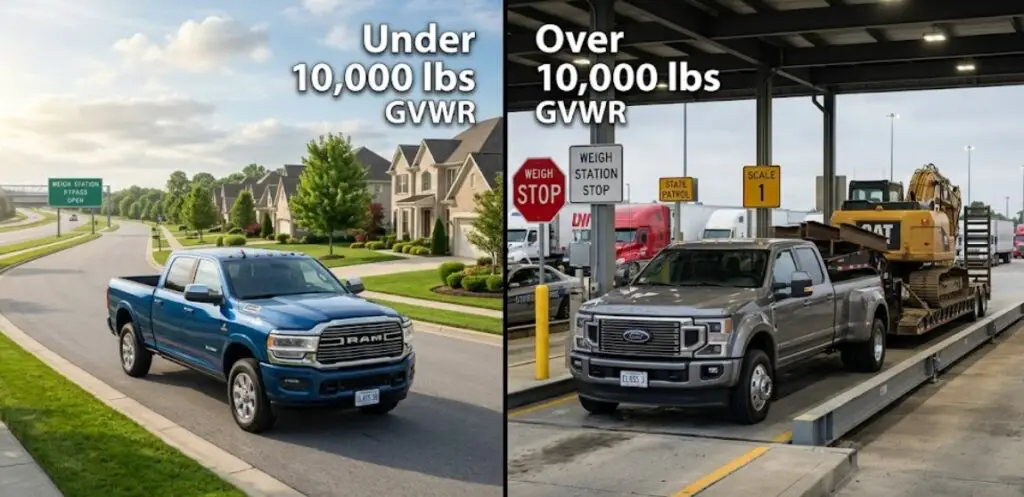
The Ford F-250 is designated as a Class 2b light-heavy-duty truck, which covers vehicles with a GVWR between 8,501 and 10,000 pounds. By design, the standard F-250 GVWR is typically pegged exactly at 10,000 pounds, although specific heavy-duty configurations can legally push this to 11,400 pounds. Staying at or below the 10,000-pound GVWR threshold is highly desirable for personal-use buyers.
This specific rating often exempts the vehicle from onerous commercial weight restrictions, allows it to bypass weigh stations, prevents restrictive Homeowner Association (HOA) parking bans that target commercial vehicles, and avoids higher commercial toll road fees. Ford even offers a specific 9,900-pound GVWR derate package for the F-250 and F-350 to help buyers deliberately stay below the 10,000-pound regulatory threshold, sacrificing on-paper payload capacity to gain legal convenience.
The Ford F-350 sits firmly in the Class 3 medium-duty truck category, featuring GVWRs that start at 10,200 pounds and scale up to an immense 14,000 pounds depending on cab and axle configurations.
Commercial Registration and Insurance Premiums
Crossing from a Class 2b to a Class 3 vehicle carries lasting financial ripple effects for overall cost of ownership. In many jurisdictions, including states like Arizona, California, and Pennsylvania, vehicle registration fees are strictly calculated based on the declared gross weight. Registering an F-350 with a GVWR over 10,000 pounds frequently incurs higher commercial-grade weight fees, even if the owner uses the truck solely for personal recreation and grocery runs.
Conversely, insurance costs present an interesting dynamic. While heavy-duty trucks generally cost more to insure than standard commuter cars due to their massive size and potential for causing damage in an accident, the premiums between the F-250 and F-350 are remarkably similar. Market data indicates that the F-250 averages approximately $179 per month for full coverage, while the heavier F-350 averages slightly higher at $185 per month. The negligible difference in insurance costs is largely offset by the robust safety systems and heavy chassis designs shared by both platforms.
Commercial Driver’s License (CDL) Requirements
For drivers planning to tow massive fifth-wheel RVs or heavy equipment, the Gross Combined Weight Rating (GCWR)—the total weight of the loaded truck plus the loaded trailer—becomes a critical legal metric. Under federal(https://www.fmcsa.dot.gov/regulations/hours-service/hours-service-frequently-asked-questions-non-business-transportation), if a truck and trailer combination features a GCWR over 26,000 pounds and the trailer itself exceeds 10,000 pounds, the driver is legally required to hold a Class A Commercial Driver’s License (CDL).
An F-350 towing a heavy skid steer or a multi-car hauler will almost instantly eclipse this 26,000-pound threshold, necessitating strict compliance with DOT regulations, weigh station stops, and potential Hours of Service logging. It is imperative to note, however, that many states offer specific exemptions for drivers towing large RVs strictly for non-commercial, personal recreational use, allowing them to pull massive trailers without a CDL. Buyers must diligently check their specific state laws regarding RV weight exemptions before purchasing a max-tow F-350 configuration.
Ride Quality and Daily Drivability
The identical suspension hardware that grants the F-350 its immense towing capability also dictates its daily driving manners, presenting a distinct trade-off in comfort.
When driven unladen, the F-250 provides a markedly superior, more compliant ride quality. Its lighter rear spring pack effectively absorbs road imperfections, potholes, and highway expansion joints with far less harshness entering the cabin. For owners who utilize their Super Duty as a daily commuter vehicle and only tow on weekends, the F-250 offers a level of comfort that borders on luxury, especially in upper trims like the Lariat, King Ranch, and Platinum.
The F-350, and particularly the Dual Rear Wheel variant, exhibits a noticeably stiff and rigid ride when the bed is empty. Without a substantial load pressing down to compress the suspension and engage the heavy helper springs, the rear end can feel overly firm, resulting in a bouncy sensation over rough terrain. However, this driving dynamic entirely flips once a heavy trailer is attached. Under an immense load, the F-350 settles gracefully.
The heavy springs engage, eliminating rear-end sag and providing a highly composed, confident towing experience that easily eclipses the F-250 by maintaining steering geometry and reducing trailer push. Furthermore, the wider track width and significantly increased turning radius of the dually F-350 make urban maneuverability, drive-throughs, and tight parking spaces noticeably more difficult than navigating a standard F-250.
Generational Updates: 2025 to 2026 Model Year Enhancements
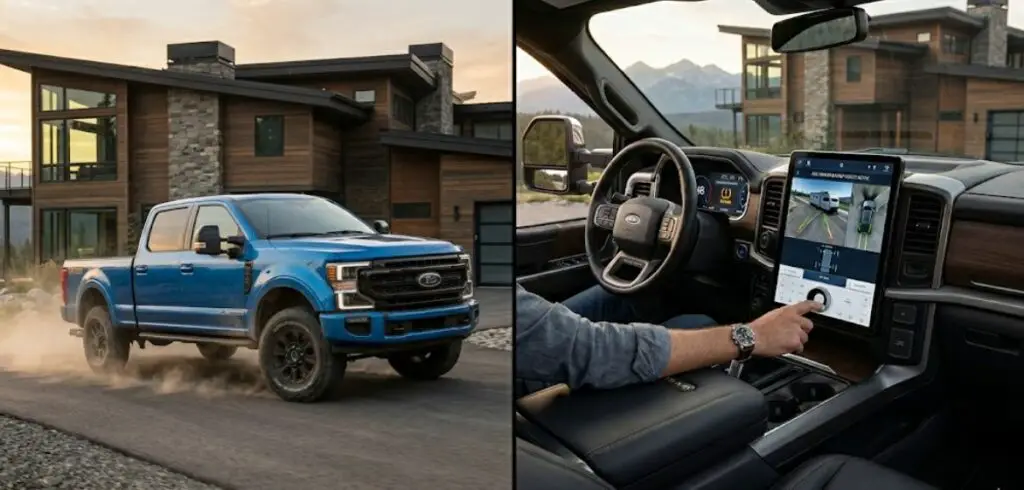
As the Ford Super Duty enters the 2026 model year, Ford has introduced several vital updates that refine the technological and functional architecture of both the F-250 and F-350, ensuring they remain at the cutting edge of the heavy-duty market.
- Tremor Package Diesel Expansion: Previously restricted by specific powertrain combinations, the highly sought-after Tremor Off-Road Package is now available to be paired directly with the standard output 6.7-liter Power Stroke diesel engine, broadening its accessibility for buyers seeking rugged trail capability combined with heavy towing efficiency.
- The Lariat Premium Package: Ford has introduced a new trim package specifically for the Lariat, bundling some of the most popular driver-assist technologies. This package makes features like Ford Co-Pilot360 Assist 2.0, Pro Trailer Hitch Assist, and Pro Trailer Backup Assist easily accessible, streamlining the towing experience.
- Drivetrain Default Adjustments: In a shift for the 2026 model year, the XLT and Lariat trims now default to a rear-wheel-drive (4×2) configuration. Buyers in adverse climates must proactively select the four-wheel-drive (4×4) option, marking a change from previous years where 4WD was standard on these mid-to-high-level trims.
- Standardized Safety Tech: Tire Pressure Monitoring Systems (TPMS) are now universally standard equipment across all Super Duty trim levels and configurations, including the complex dual rear-wheel setups.
- Aesthetic Refresh: The exterior color palette has been updated to include sophisticated new options such as Argon Blue Metallic and Marsh Gray Metallic, replacing older hues to keep the lineup visually contemporary.
FAQs
Does the F-250 get better gas mileage than the F-350?
Fuel economy between an F-250 and a Single Rear Wheel F-350 equipped with the exact same engine, transmission, and axle ratio is virtually identical. Because they share the same curb weight, aerodynamic profile, and powertrain mapping, highway cruising yields the same efficiency. However, an F-350 optioned with Dual Rear Wheels will suffer a noticeable fuel economy penalty.
This drop in efficiency is directly caused by the increased rolling resistance of the two extra tires, the heavier unsprung weight of the massive Dana M300 axle, and the wider, significantly less aerodynamic rear fender design required to cover the dually setup.
Can you upgrade an F-250 to handle like an F-350?
Mechanically, yes; legally, no. Because the frame mounting points are structurally identical across the Super Duty platform, many owners choose to upgrade their F-250 by installing aftermarket F-350 leaf springs, heavy-duty sway bars, or pneumatic airbags to eliminate rear-end sag when towing heavy loads. While these modifications drastically improve the truck’s physical ability to manage weight and maintain a level ride height,
it is vital to note that aftermarket hardware does not legally change the truck’s factory Gross Vehicle Weight Rating. In the event of a Department of Transportation roadside inspection or a severe accident resulting in an insurance claim, the truck will always be legally held to the payload rating printed on the original factory door jamb sticker. Overloading a modified F-250 past its legal sticker rating can result in severe liability.
Which model is better for towing a fifth-wheel camper?
For mid-sized travel trailers and smaller fifth-wheels, the F-250 is an excellent and comfortable choice. However, for massive luxury fifth-wheel RVs exceeding 35 feet in length, the F-350 is definitively the superior and often mandatory option. The geometry of a fifth-wheel trailer inherently places 20 to 25 percent of its total gross weight directly onto the bed of the truck, known as pin weight. A 15,000-pound RV will easily generate over 3,000 pounds of pin weight.
When factoring in the weight of a family of four, a heavy fifth-wheel hitch, tools, and a full tank of fuel, an F-250 will almost immediately exceed its legal payload capacity, even if the diesel engine has the pulling power to move the weight effortlessly. The F-350 provides the necessary payload headroom and reinforced rear suspension to handle this immense vertical load safely and legally.
Are maintenance costs significantly higher on the F-350?
Routine maintenance costs, including oil changes, fuel filter replacements, and transmission servicing, are practically identical between the F-250 and the Single Rear Wheel F-350, as they utilize the exact same fluid capacities and engine architecture. The maintenance divergence occurs primarily with the F-350 Dual Rear Wheel model. The dually incurs higher long-term operating costs simply due to the requirement of purchasing and rotating six tires instead of four. Additionally, the dually may require specialized heavy-duty brake components and can occasionally trigger higher toll road fees associated with commercial rear axles and vehicle width.
Conclusion
Choosing between the Ford F-250 and F-350 requires an honest assessment of both immediate towing needs and future workload expansion.
The Ford F-250 represents the ultimate equilibrium of heavy-duty performance and daily drivability. It is the optimal choice for buyers who use their truck as a primary commuter vehicle, carry moderate payloads, and primarily tow conventional bumper-pull trailers, heavy boats, or mid-sized recreational campers.
It delivers the massive, earth-moving torque of the Power Stroke diesel engine while entirely bypassing the regulatory headaches, stiffer unladen ride quality, and higher commercial registration fees inherently associated with Class 3 trucks.
The Ford F-350 is an uncompromising industrial tool built for sheer mass and relentless hauling. If the primary application involves pulling massive multicar trailers, hauling heavy agricultural machinery, carrying large slide-in truck campers, or regularly towing luxury fifth-wheel RVs across the country, the F-350 is not just an option—it is a necessity.
The reinforced leaf springs, heavy-duty Dana axles, and the available dual-rear-wheel configuration provide the vital payload overhead and lateral stability required to handle extreme weights legally and safely. For commercial operators and serious RV enthusiasts who live and work near the edge of their capacity limits, the F-350 ensures the job is accomplished without ever straining the hardware.