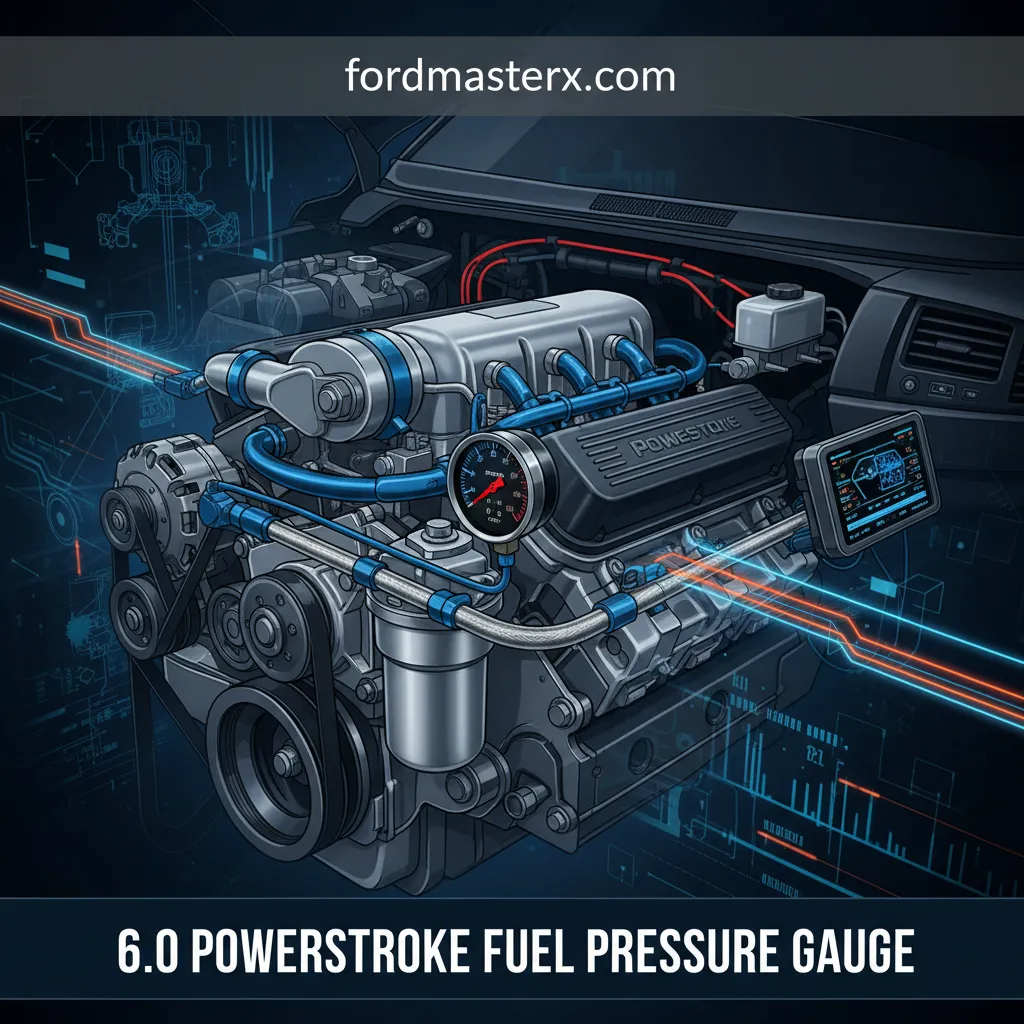
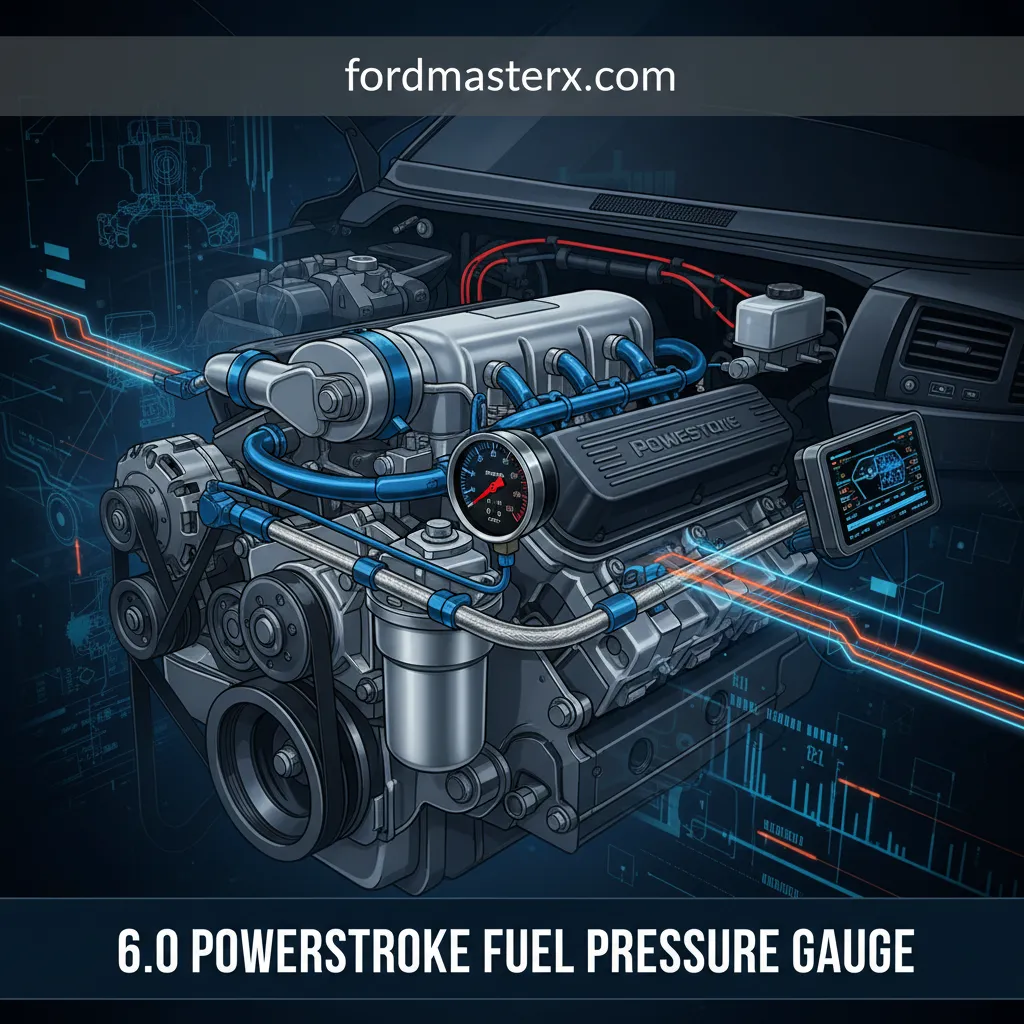
6.0 Powerstroke Fuel Pressure Gauge Installation And Performance Monitoring

For the 6.0L Powerstroke owner, the fuel pressure gauge isn’t just an accessory—it is the only line of defense between a reliable engine and a multi-thousand dollar injector failure. Unlike its successor, the 6.4L, or many modern common-rail diesel engines, the 6.0L Powerstroke lacks a factory-installed fuel pressure sensor. This means your PCM (Powertrain Control Module) is completely blind to the fuel pressure being delivered to the injectors. In this comprehensive guide, you will learn why monitoring fuel pressure is mandatory for this platform, how to select professional-grade hardware, and the technical steps required to install a trusted monitoring solution for real-time data.
Why Monitoring 6.0 Powerstroke Fuel Pressure is Essential for Injector Longevity
📤 Share Image
The 6.0L Powerstroke utilizes a Hydraulic Electronic Unit Injector (HEUI) system. In this design, highly pressurized engine oil is used to fire the injector, but diesel fuel serves a dual purpose: it acts as the combustion medium and, more importantly, as a critical cooling agent and lubricant for the injector internals. When fuel pressure remains within the expert-recommended window of 55-65 PSI, the internal components are adequately cushioned during their high-speed cycles.
The danger zone begins when pressure drops below 45 PSI. At this threshold, the fuel can no longer effectively fill the plunger cavity fast enough, leading to fuel aeration and cavitation. These tiny air bubbles collapse with extreme force, causing the injector plunger to “hammer” against the nozzle without the hydraulic cushion of liquid fuel. Over time, this mechanical shock cracks ceramic seats or metal components, leading to a “stuck” injector or a failed tip.
By The Numbers
Leading Cause of 6.0 Failure
Failures Linked to Low Pressure
Critical Damage Threshold
Consider a common real-world scenario: A driver notices a slight “stutter” or loss of power while pulling a heavy grade at Wide Open Throttle (WOT). Without a reliable gauge, the driver assumes it is a minor hiccup and continues the trip. In reality, a clogged primary fuel filter on the frame rail has caused fuel pressure to plummet to 30 PSI. By the time the truck returns home, the damage is done. The driver is met with a $2,400 injector replacement bill—a cost that could have been avoided with a $200 gauge and a $50 filter change.

Selecting a Quality 6.0 Powerstroke Fuel Pressure Gauge and Sensor Type
When selecting a gauge for your Powerstroke, the primary decision lies between mechanical and electronic units. From an expert perspective, electronic gauges are the only professional choice for cabin installation. Mechanical gauges require a pressurized fuel line to be routed directly into the vehicle’s interior. In the event of a line failure, you would have 60 PSI of highly flammable diesel fuel spraying into the passenger compartment. Electronic gauges use a remote pressure transducer that stays in the engine bay, sending a low-voltage signal to the gauge display.
The 6.0L environment is harsh, characterized by high-frequency vibrations inherent in the Navistar engine design. To ensure long-term reliability, I recommend trusted brands that offer high-vibration resistance and weather-proof wiring harnesses. Furthermore, a snubber valve or a short length of grease whip (acting as a buffer) is highly recommended. The 6.0L fuel system experiences significant pressure pulses from the injectors; without a snubber, these pulses can “rattle” a cheap sensor to death within months. A professional-grade unit with a brass transducer is worth the investment over a $40 unbranded alternative that will likely fail or lose calibration when you need it most.
High Resolution
A 0-100 PSI range allows you to clearly see a 5 PSI drop, which is the difference between a healthy pump and a failing one.
Visual Alerting
Modern digital displays often include programmable warning lights that flash if pressure drops below 45 PSI.

Professional Installation Points and Hardware Requirements
The primary tap location for monitoring 6.0 fuel pressure is the secondary fuel filter housing, often referred to as the fuel bowl, located on top of the engine. This housing contains a factory test port on the passenger side. To access it, you will need a 6mm Allen wrench to remove the factory plug. However, the threads in the fuel bowl are metric (M12 x 1.5), whereas most aftermarket sensors use a 1/8-27 NPT thread.
Never attempt to force an NPT sensor directly into the fuel bowl. You must use a specialized 12mm x 1.5 to 1/8 NPT adapter. Forcing the wrong thread will ruin the filter housing, leading to a costly and time-consuming replacement of the entire bowl assembly.
📋
Installation Checklist
Remove the 6mm Allen plug from the fuel bowl. Install the M12x1.5 adapter followed by your pressure transducer.
This is the perfect time to install the Blue Spring upgrade (OEM Part # 3C3Z-9T517-AG), which increases base pressure by 10-15 PSI.
Route the wire harness through a factory rubber grommet in the firewall. Avoid high-heat areas like the turbocharger or exhaust manifolds.
Once the hardware is physically installed, it is vital to bleed the air out of the fuel bowl. This is done by cycling the ignition key to the “On” position for 30 seconds three times without starting the engine. This allows the Horizontal Fuel Conditioning Module (HFCM) on the frame rail to purge air through the regulator, ensuring your new gauge provides an immediate and accurate reading upon the initial startup.
Interpreting Gauge Readings and Troubleshooting Low Pressure
Installing the gauge is only the first step; as an expert operator, you must know how to interpret the data it provides. At idle, a healthy 6.0L Powerstroke with the Blue Spring upgrade should display between 55 and 65 PSI. If you are seeing anything below 50 PSI at idle, it is a clear indication that your regulator spring is weak or your lift pump (HFCM) is beginning to fail.
The true test of a fuel system occurs during Wide Open Throttle (WOT) conditions. Under heavy acceleration or while towing, it is normal to see a slight drop in pressure. However, this drop should not exceed 5-10 PSI. If your gauge reads 60 PSI at idle but plummets to 35-40 PSI during a hard pull, you have a fuel delivery restriction. This is a classic “Fuel Starvation” pattern usually caused by a heavily clogged primary filter on the frame rail.
If your gauge needle is fluctuating rapidly (vibrating back and forth), it often indicates air being sucked into the fuel lines or a failing pressure regulator diaphragm. Steady pressure is as important as high pressure.
Fuel temperature also plays a role. Diesel fuel is more viscous when cold; you may notice your pressure is 2-3 PSI higher on a winter morning than after a long highway haul. Use your gauge as a predictive maintenance tool. While Ford suggests changing fuel filters every 15,000 miles, expert-level data shows that 30% of trucks require changes sooner due to poor fuel quality. If your baseline pressure has dropped by 5 PSI over the last few months, change your filters immediately—don’t wait for the calendar to tell you to protect your injectors.
✅ Normal Operation
- Idle: 55-65 PSI
- Cruising: 52-60 PSI
- WOT: 50+ PSI
- Minimal needle fluctuation
❌ Critical Warnings
- Pressure < 45 PSI at any time
- WOT drop > 15 PSI
- Slow pressure recovery after acceleration
- Erratic needle movement
In summary, monitoring the fuel pressure on a 6.0 Powerstroke is not a luxury—it is a mechanical necessity. By choosing a quality electronic gauge, using the correct M12 adapter, and integrating the Blue Spring kit, you provide your engine with the protection it needs to survive. Fuel pressure below 45 PSI is the primary killer of 6.0 injectors, and the secondary fuel bowl tap is the industry-standard location for capturing this vital data. Verify your fuel pressure today by installing a trusted gauge; it is the most cost-effective insurance policy you will ever buy for your Powerstroke.
Frequently Asked Questions
What is the minimum safe fuel pressure for a 6.0 Powerstroke?
The absolute minimum pressure required to prevent injector damage is 45 PSI. However, for professional performance and longevity, expert technicians recommend maintaining a constant pressure of 55 to 65 PSI. If your gauge ever dips below 40 PSI during hard acceleration, you are actively damaging your fuel injectors through cavitation.
Can I monitor fuel pressure through my OBDII port or tuner?
No. The 6.0L Powerstroke engine was not equipped with a fuel pressure sensor from the factory. While your tuner can show oil pressure and boost, it cannot display fuel pressure unless you install an aftermarket sensor and bridge it into your monitoring system via an analog input expansion kit.
Where is the best place to install the fuel pressure sensor?
The most accurate and professional location is the test port on the side of the secondary fuel filter housing (the fuel bowl) on top of the engine. You will need a specific M12 x 1.5 to 1/8-27 NPT adapter to thread your aftermarket sensor into this port.
Should I choose a mechanical or electronic fuel pressure gauge?
Electronic gauges are highly recommended for the 6.0 Powerstroke. Mechanical gauges require running a pressurized fuel line into the cab, which poses a fire risk if the line leaks. Electronic systems use a transducer at the fuel bowl to send an electrical signal to the gauge, ensuring a safer and more reliable installation.
Why is my fuel pressure fluctuating rapidly on the gauge?
Rapid fluctuation or a ‘bouncing’ needle is often caused by the pulses of the fuel pump or air trapped in the system. To solve this, professional installers use a ‘snubber valve’ or a small length of hose (grease whip) between the fuel bowl and the sensor to dampen these pressure spikes and protect the sensor.