2019 Ford F-250 Towing Capacity Chart: Max Conventional, 5th Wheel, & GCWR Guide

The 2019 Ford F-250 Super Duty, part of the fourth generation (2017-2022), established a benchmark in the highly competitive heavy-duty truck segment by combining aluminum body construction with formidable “Built Ford Tough” powertrains. For professional operators and serious recreational haulers, knowing the truck’s precise towing limits is paramount for safety and compliance.
This expert report provides a detailed, configuration-specific analysis of the 2019 F-250’s capabilities, utilizing official manufacturer data to present the Gross Combined Weight Ratings (GCWR) and maximum trailer weights for Conventional, 5th-Wheel, and Gooseneck applications. The maximum manufacturer-rated towing capacity for the 2019 F-250 Single Rear Wheel (SRW) model reaches 18,500 pounds when configured with the 6.7L Power Stroke V8 Turbo Diesel engine and a gooseneck hitch.
The ultimate towing capacity of any F-250 is not a single, fixed number but rather a function of four key variables: the engine choice, the axle ratio, the cab/drivetrain configuration, and the Gross Vehicle Weight Rating (GVWR) package. Since the F-250 is generally constrained by a 10,000-pound GVWR limit, its maximum towing figures are often capped slightly below its mechanical potential to adhere to legal and regulatory classifications, thereby differentiating it from the heavier F-350 Super Duty.
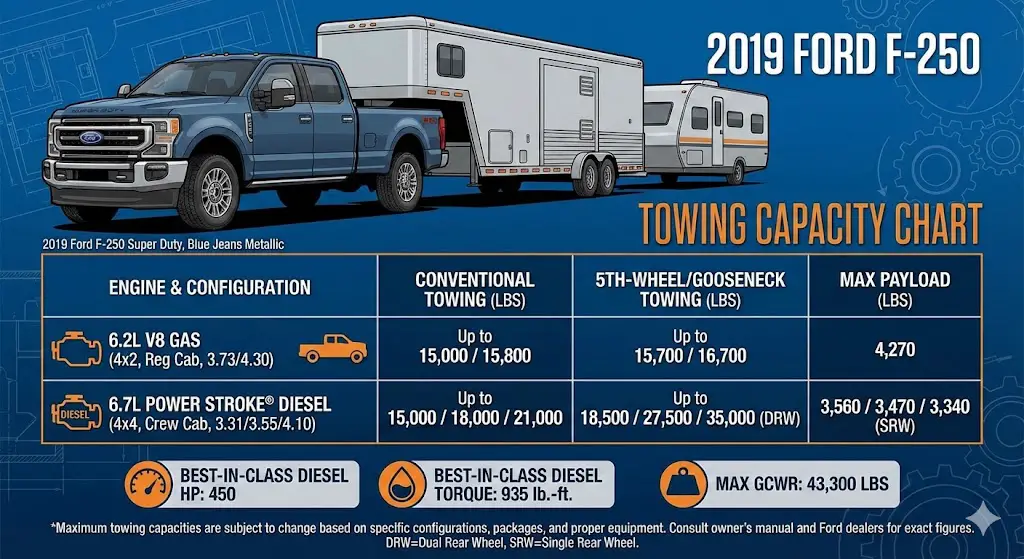
2019 Ford F-250
Towing Capacity Chart
The 2019 F-250 Super Duty is defined by the battle between its two powerplants and the critical role of axle ratios. Whether hauling a construction equipment trailer or a 5th-wheel camper, understanding the numbers is critical for safety and performance.
Gas vs. Diesel: The Power Plant Duel
Your towing capacity starts under the hood. The 2019 F-250 offers two distinct choices. The standard 6.2L Flex Fuel V8 offers solid payload handling, but for heavy towing, the 6.7L Power Stroke® Turbo Diesel is the undisputed king, offering more than double the torque of the gas engine.
- ● 6.2L Gas V8: Best for daily driving and lighter loads.
- ● 6.7L Diesel V8: Essential for maxing out towing charts.
Comparison of Peak Horsepower and Torque (lb-ft)
Maximum Towing Capabilities
Towing capacity varies significantly based on your hitch type. Conventional towing uses the standard rear receiver, while 5th Wheel/Gooseneck setups mount in the truck bed, placing the weight directly over the rear axle for higher stability and capacity.
Conventional Towing
Standard receiver hitch limits.
5th Wheel / Gooseneck
In-bed hitch for maximum load.
The Hidden Factor:
Axle Ratios
The engine isn’t the only factor. The axle ratio determines how many times the driveshaft rotates for every rotation of the wheel. A higher numerical ratio (e.g., 4.30) provides more torque multiplication for getting heavy loads moving, resulting in a higher tow rating, usually at the cost of fuel economy.
Rule of Thumb:
Lower Ratio (3.31) = Better Fuel Economy, Lower Towing.
Higher Ratio (4.30) = Max Towing Power, Higher RPMs on highway.
Graph illustrates the dramatic jump in towing capacity for the 6.2L Gas engine when equipped with the 4.30 axle ratio compared to the standard 3.73.
Payload: Don’t Forget the Tongue Weight
Towing isn’t just about pulling; it’s about carrying the tongue weight. The F-250’s payload capacity (passengers + cargo + trailer tongue weight) is often the first limit reached. Note that the heavy Diesel engine actually reduces available payload compared to the Gas engine because the engine itself is heavier.
Smart Towing Technology
BLIS with Trailer Coverage
Blind Spot system that extends its sensor range to cover the length of your trailer.
Trailer Reverse Guidance
Uses cameras to track trailer motion and provides steering guidance while backing up.
Adaptive Steering
Adjusts steering ratio dynamically to make low-speed maneuvering with a trailer easier.
Integrated Brake Controller
Factory-installed controller synchronizes truck and trailer brakes for seamless stops.
Official 2019 Ford F-250 Towing Capacity Charts
To determine the accurate towing potential for a specific 2019 Ford F-250, one must consult the official weight ratings that account for the powertrain and vehicle architecture. The two available engines—the 6.2L V8 Gas and the 6.7L Power Stroke V8 Turbo Diesel—demonstrate vastly different maximum capabilities, primarily influenced by torque output and the available axle ratios.
Conventional Towing Maximum Loaded Trailer Weight
Conventional towing relies on the standard rear receiver hitch. For optimal safety and to achieve the maximum advertised ratings, Ford specifies the use of a Weight Distributing (WD) hitch system.
The highest conventional towing figure for the 2019 F-250 is achieved by a 4x2 Crew Cab model equipped with the 6.7L Power Stroke engine and the Trailer Tow Package, maxing out at 18,000 pounds. This figure is constrained by the vehicle's specific GCWR (Gross Combined Weight Rating) of 25,700 pounds.
Table 1 details the maximum conventional towing capacities across key F-250 SRW configurations:
Table 1: 2019 F-250 Conventional Towing Capacity (Lbs.) by Configuration
| Engine | Axle Ratio | Cab Type | Drivetrain | GCWR (lbs.) | Max Towing (WD Hitch) |
| 6.2L V8 Gas | 3.73 | Regular Cab | 4x2 | 19,500 | 13,300 |
| 6.2L V8 Gas | 4.30 | Regular Cab | 4x2 | 22,000 | 15,000 |
| 6.2L V8 Gas | 4.30 | Crew Cab | 4x4 | 22,000 | 14,800 |
| 6.7L V8 Diesel | 3.31/3.55 | SuperCab | 4x4 | 23,500 | 15,000 |
| 6.7L V8 Diesel | 3.31/3.55 (Tow Pkg) | Crew Cab | 4x4 (Short Box) | 25,700 | 17,500 |
| 6.7L V8 Diesel | 3.31/3.55 (Tow Pkg) | Crew Cab | 4x2 (Short Box) | 25,700 | 18,000 |
5th-Wheel and Gooseneck Towing Maximum Loaded Trailer Weight
5th-Wheel and Gooseneck connections utilize an attachment point situated directly over the rear axle, improving towing stability and often allowing for higher capacities compared to conventional hitch towing.
The absolute maximum towing capacity for the 2019 F-250 is achieved using a Gooseneck hitch: 18,500 pounds. This rating is specific to the lightest configuration—the Regular Cab 4x2 equipped with the 6.7L diesel engine and the required Trailer Tow Package. The F-250's 5th-wheel tow rating is sometimes limited by the hitch hardware itself, typically rated for 18,000 pounds, even if the truck's mechanical capacity (Gooseneck rating) is slightly higher.
Table 2: 2019 F-250 5th-Wheel / Gooseneck Towing Capacity (Lbs.)
| Engine | Axle Ratio | Cab Type | Drivetrain | GCWR (lbs.) | Max 5th-Wheel/Gooseneck |
| 6.2L V8 Gas | 3.73 | Crew Cab | 4x4 | 19,500 | 12,200 |
| 6.2L V8 Gas | 4.30 | SuperCab | 4x4 | 22,000 | 15,100 |
| 6.2L V8 Gas | 4.30 | Regular Cab | 4x2 | 22,000 | 15,800 |
| 6.7L V8 Diesel | 3.31/3.55 | Crew Cab | 4x4 (Short Box) | 24,000 | 16,400 |
| 6.7L V8 Diesel | 3.31/3.55 (Tow Pkg) | SuperCab | 4x2 (Long Box) | 24,700 | 17,300 |
| 6.7L V8 Diesel | 3.31/3.55 (Tow Pkg) | Regular Cab | 4x2 | 25,700 | 18,500 (Gooseneck) |
Drivetrain and Axle Ratio Dynamics
The detailed capacity charts underscore two important dynamics that influence performance and capability.
First, the minor but meaningful curb weight difference between two-wheel drive (4x2) and four-wheel drive (4x4) configurations translates directly into available towing capacity. For the heaviest-duty diesel models, the 4x2 configuration consistently rates approximately 500 pounds higher than its 4x4 equivalent (e.g., 18,000 lbs. conventional vs. 17,500 lbs.). This occurs because the truck's overall weight must be subtracted from the fixed GCWR. The lighter 4x2 drivetrain leaves more headroom within the GCWR for trailer weight. For operators who are exclusively towing on pavement or prioritize the highest possible rating, selecting the 4x2 model provides a measurable advantage.
Second, the axle ratio is the single most critical factor for the standard 6.2L V8 Gas engine. When paired with the standard 3.73 axle ratio, the 6.2L engine is limited to capacities often hovering around 12,500 to 13,300 pounds. However, upgrading to the optional 4.30 axle ratio significantly unleashes the engine’s potential, raising the 5th-wheel capacity to 15,800 pounds. This difference illustrates that for the gas engine, maximum capacity is not bottlenecked by horsepower but by gearing. Choosing the 4.30 ratio allows the transmission to mechanically overcome the engine’s lower torque output by providing better leverage, which is essential when pulling trailers exceeding 13,000 pounds.
Engine Performance: The Diesel Advantage for Towing Heavy Loads
The 2019 F-250 was offered with two powerful V8 engines, each presenting distinct advantages and limitations for heavy hauling.
The 6.7L Power Stroke V8 Turbo Diesel: Peak Performance
The 6.7L Power Stroke V8 Turbo Diesel engine is the required choice for operators seeking the F-250’s highest capabilities. The engine generates impressive figures: 450 horsepower and a monumental 935 lb.-ft. of torque, achieved at a low 1,800 rpm. This massive low-end torque is the foundation for the F-250's maximum ratings.
The design of the 6.7L Power Stroke, engineered and built by Ford, utilizes a single-sequential turbocharger to enhance airflow and performance, particularly when the truck is working hard. This high torque output is specifically valuable when towing heavy loads uphill or in high-altitude conditions, environments where naturally aspirated gas engines often experience power loss.
This powertrain is mated to the robust TorqShift 6R140 six-speed automatic transmission. This transmission was engineered for heavy-duty applications and rated to handle up to 1,000 lb-ft of torque.7 Its robust design, combined with advanced tow/haul modes that optimize shift points, ensures reliable and smooth operation even when approaching the maximum 18,500-pound limit.
The reliability and efficiency of this diesel-transmission combination are the reasons it is required for all the highest-rated towing configurations. Furthermore, although the Environmental Protection Agency (EPA) does not provide official fuel economy ratings for heavy-duty trucks, the diesel engine’s inherent efficiency and high torque typically result in superior fuel economy when frequently towing heavy loads over long distances compared to its gas counterpart.
The 6.2L V8 Gas Engine: Gearing Constraints
The standard 6.2L V8 Gas engine delivers 385 horsepower and 430 lb.-ft. of torque. This engine is a solid performer for moderate tasks but faces operational challenges when tasked with near-maximum loads.
A key challenge noted by owners towing heavy trailers (e.g., over 7,000 pounds) with the 6.2L gas engine is the tendency for the six-speed automatic transmission to "hunt" for the appropriate gear. This continuous shifting, particularly when driving at moderate speeds (30–40 mph) or encountering grades, occurs because the engine lacks the low-end torque necessary to keep the Gross Combined Weight (GCW) moving without constantly downshifting to maintain the engine's RPM in its narrow power band.
The maximum capacity for the 6.2L Gas engine tops out around 15,800 pounds (with the 4.30 axle ratio). This figure represents a hard ceiling, not just a numerical maximum, but an operational limit. Exceeding approximately 15,000 pounds with the 6.2L V8 will likely lead to a significantly compromised and stressful towing experience due to the constant demands placed on the drivetrain to generate sufficient pulling power. For comprehensive maintenance strategies regarding this heavy-duty powertrain, users should refer to the F-250 Engine Maintenance Guide.
The Fundamentals of Safe Towing: GCWR, Payload, and Limits
Towing safely and legally requires adherence not just to the maximum trailer weight, but also to the cumulative limits imposed by the vehicle's engineering. The Gross Combined Weight Rating (GCWR) and Payload Capacity are equally important constraints on the F-250’s capability.
Gross Combined Weight Rating (GCWR) Analysis
The GCWR is the critical safety metric, representing the maximum permissible total weight of the fully loaded tow vehicle and the fully loaded trailer combined. For the 2019 F-250, the GCWR ranges from 19,500 pounds up to 25,700 pounds for the high-capacity diesel configurations.
The maximum allowed trailer weight is mathematically determined by subtracting the curb weight of the truck (plus passengers, cargo, and hitch weight) from the GCWR. This relationship is absolute: increasing the weight of cargo or passengers inside the truck directly reduces the maximum weight of the trailer that can be pulled safely.
$$Max\ Trailer\ Weight = GCWR - (Truck\ Curb\ Weight + Payload\ Added\ to\ Truck)$$
It is crucial that the driver never exceeds the GCWR.11 The GCWR is set by Ford after extensive testing compliant with SAE J2807 standards, taking into account the vehicle’s engine torque, transmission cooling capacity, braking system efficiency, and the structural integrity of the frame and axles.
The following diagram illustrates how the F-250’s maximum GCWR is distributed:
GCWR Distribution for Maximum Capacity 2019 F-250 (25,700 lbs.)
| Component | Approximate Weight (Lbs.) | Contribution to GCWR |
| Truck Curb Weight (Diesel, Crew Cab, 4x4) | $\approx 7,000$ | Base weight of the truck |
| Truck Payload (Passengers, Cargo, Fuel, Pin Weight) | $\approx 3,000$ | Available payload capacity (Varies) |
| Maximum Trailer Weight | $\approx 15,700$ (Average Conventional/5th Wheel) | Max weight the truck can pull, depending on payload utilized |
| Total GCWR | 25,700 | Absolute safety limit |
Payload Capacity and Pin Weight Management
The truck’s payload capacity—the maximum weight the vehicle can carry, including occupants, fuel, and cargo—is a frequent limiting factor in heavy-duty towing, especially with 5th-wheel trailers. The maximum manufacturer-rated payload for the 2019 F-250 reaches 4,270 pounds in certain configurations. This high capacity is one of the F-250’s strongest features, offering a competitive advantage against rivals.
When towing conventional trailers, the tongue weight (downward force on the hitch) should typically be 10% to 15% of the loaded trailer weight. For 5th-wheel and Gooseneck trailers, however, the static pin weight load is significantly higher, generally recommended to be around 15% of the total loaded trailer weight.
If an F-250 is towing a maximum-rated 18,500-pound 5th-wheel trailer, the resultant pin weight will be approximately 2,775 pounds ($18,500 \times 0.15 = 2,775\ lbs.$). This heavy pin weight immediately consumes the majority of the truck's available payload capacity. The remaining payload must cover the driver, passengers, and any gear loaded into the cab or the remaining bed space. Users who underestimate this pin weight consumption risk exceeding the vehicle’s GVWR or Rear Axle Weight Rating (RAWR), even if the trailer weight is below the maximum published tow rating.
The F-250’s strong payload rating (up to 4,270 lbs.) is crucial for recreational users pulling large 5th-wheel RVs, which often have high pin weights, providing superior operational stability and ensuring the truck remains within its safe limits. The vehicle's underlying mechanical capacity, including its chassis strength, robust suspension system, and heavy-duty braking components, are the true determiners of its safe capacity limit, confirming the engineering allows for these heavy loads to be controlled effectively.
2019 Heavy-Duty Competitive Analysis: F-250 vs. Rivals
The 2019 model year was marked by intense competition among the three major heavy-duty truck manufacturers. While the Ford F-250 demonstrated exceptional balance, its maximum ratings were strategically positioned relative to its primary competitors, the Ram 2500 and the Chevrolet Silverado 2500HD.
Comparative Towing Figures
| Truck Model | Engine | Max Conventional Towing (lbs.) | Max 5th-Wheel/Gooseneck (lbs.) | Max Payload (lbs.) |
| 2019 Ford F-250 | 6.7L Power Stroke | 18,000 | 18,500 | 4,270 |
| 2019 Ram 2500 | 6.7L Cummins Diesel | 19,780 | N/A (Focus on Conventional) | 3,260 |
| 2019 Chevy 2500HD | 6.6L Duramax Diesel | 15,400 | 15,400 | N/A (Significantly lower than F-250) |
In 2019, the Ram 2500 was significantly redesigned and managed to claim the lead in maximum conventional towing capacity, reaching 19,780 pounds with its Cummins diesel engine. This figure surpassed the F-250’s 18,000-pound conventional maximum. Meanwhile, the Chevrolet Silverado 2500HD, equipped with the Duramax diesel, lagged behind both Ford and Ram, achieving a maximum towing capacity of 15,400 pounds.
Strategic Market Positioning
Despite being slightly outpaced by Ram in the raw conventional towing metric, the F-250 maintained a critical advantage in payload capacity. The maximum 4,270 pounds of payload offered by the F-250 significantly exceeded the Ram 2500’s maximum payload of 3,260 pounds for diesel configurations.
This high payload capacity suggests that Ford strategically optimized the F-250 for the recreational vehicle (RV) market and commercial users who prioritize cargo and vertical load management over purely high conventional towing figures. The superior payload capability allows the F-250 to more comfortably accommodate the high pin weights associated with large 5th-wheel trailers while simultaneously carrying occupants and gear. For a driver planning to haul a heavy 5th-wheel RV across the country, the F-250's ample payload capacity often makes it the more versatile and safer choice compared to its competitors in the 2019 model year.
Frequently Asked Questions and Owner Considerations
What common reliability issues should be monitored when towing with a 2019 F-250?
Owners of 2017–2019 Super Duty models should be aware of a widespread front-end stability issue often referred to as the "death wobble". This is an uncontrollable vibration of the steering wheel and front axle, typically initiated by striking a bump at highway speed. This condition is a significant safety hazard that is particularly exacerbated when towing a heavy load, as the increased mass puts more stress on the steering and suspension components. Ford dealerships generally address this issue by replacing the steering dampener under warranty, but prospective owners should verify this service has been completed.
Other mechanical issues reported included a heat shield breaking driveshaft recall, which owners should confirm has been resolved. Furthermore, operational discomfort has been reported with the 6.2L gas engine when towing, characterized by the automatic transmission continuously cycling through gears.
Does the 6-speed TorqShift transmission handle the 6.7L diesel's torque reliably when towing?
Yes, the 6R140 TorqShift six-speed automatic transmission is a robust unit built for the heavy-duty segment. Paired with the 6.7L Power Stroke V8 Turbo Diesel in the 2019 F-250, this transmission is rated for high torque handling (up to 1,000 lb-ft in some configurations). It features adaptive learning technology and specific tow/haul modes designed to optimize shifting under heavy load conditions, ensuring it is a reliable component for maximizing the truck's towing potential.
What is the distinction between a 5th-Wheel and a Gooseneck hitch?
Both 5th-wheel and gooseneck hitches are designed to mount centrally over the rear axle, improving stability by placing the trailer’s vertical load directly onto the truck's main structure. However, they utilize different connection mechanisms and offer different operational profiles.
- 5th-Wheel Hitch: Features a large, horseshoe-shaped plate and a set of jaws that connect to a kingpin on the trailer. This connection type generally offers a smoother, quieter, and more stable towing experience, making it the preferred choice for large recreational trailers and RVs.
- Gooseneck Hitch: Uses a simple ball-and-coupler connection. The primary advantage of a gooseneck is its less invasive design; when not in use, only a small ball (or nothing at all, if stowed) protrudes from the bed, maximizing cargo space. This type is generally preferred for commercial, agricultural, and heavy equipment hauling.
Final Safety Considerations
Achieving the published maximum towing capacities requires meticulous attention to the vehicle’s weight constraints and component specifications. The tires, often overlooked, play a vital role in stability and safety. When hauling heavy loads, the truck’s tires must meet the manufacturer’s specified load range (typically Load Range E for heavy-duty trucks) and must be maintained at the correct pressure to handle the substantial increase in weight and vertical stress. Compromised or improperly rated tires will undermine the truck’s ability to safely manage the Gross Combined Weight, regardless of the engine's power or the braking system's efficiency. Before coupling any heavy trailer, the driver must confirm the load rating of all components, including the hitch, tires, and axles, and ensure all weight limits—GVWR, GCWR, and GAWR—are strictly observed.13 For further reading on safely maximizing towing capacity, consult the official 2019 Ford RV and Trailer Towing Guide.