2017 F 250 Towing Capacity: Conventional And Gooseneck Ratings By Engine Configuration

The 2017 Ford F-250 marked a revolutionary shift in the Super Duty lineup, introducing a high-strength, military-grade aluminum-alloy body and a redesigned fully boxed frame that redefined heavy-duty capabilities for the modern era. For professionals and weekend haulers alike, this model year represents a high-water mark in engineering, offering a blend of weight reduction and structural rigidity that significantly enhanced its workhorse potential. However, potential owners and fleet managers often struggle to navigate the complex matrix of engine choices, axle ratios, and cab configurations that dictate actual towing limits. This comprehensive guide provides a professional analysis of the 2017 F 250 towing capacity, detailing the exact specifications for every major configuration to ensure your hauling is both safe, reliable, and efficient.
Section 1: 2017 F 250 Towing Capacity and Engine Performance Metrics
The foundation of the 2017 F-250’s trusted performance lies in its two distinct powerplants. To understand the towing limits, one must first analyze how these engines convert fuel into the raw torque required to move massive loads from a dead stop. In 2017, Ford pushed the envelope, particularly with the diesel variant, setting a new benchmark for the 3/4-ton segment.
📤 Share Image
The 6.7L Power Stroke V8 Turbo Diesel
The expert choice for heavy-duty applications is undoubtedly the 6.7L Power Stroke. Delivering 440 horsepower and a then-class-leading 925 lb-ft of torque, this engine is designed for sustained load management. The beauty of this diesel engine isn’t just the peak number, but where that torque lives; it provides maximum pulling power at low RPMs, which is critical when navigating steep boat ramps or accelerating a 15,000-lb trailer onto a highway. This engine utilizes a CGI (Compacted Graphite Iron) engine block, which is lighter and stronger than traditional cast iron, contributing to the truck’s overall efficiency.
The 6.2L SOHC 2-valve Flex Fuel V8 Gas
While the diesel is the torque king, the 6.2L V8 gas engine remains a professional favorite for fleet use and shorter hauling cycles. Producing 385 horsepower and 430 lb-ft of torque, it offers a more affordable entry point and higher payload margins due to its lighter weight. For 2017, Ford specifically tuned this engine to deliver peak torque earlier in the rev range, making it significantly more capable than its predecessors in the previous generation.
The transmission choice is equally vital. The gas engine uses the TorqShift-G 6-speed automatic, which is specifically engineered to handle the higher-revving nature of gas power while improving shifting speed and fuel economy. In contrast, the diesel utilizes the heavier TorqShift 6-speed, built with robust internals to manage nearly 1,000 lb-ft of torque without overheating or premature wear.

Section 2: Maximum Conventional and Fifth-Wheel Towing Limits
The 2017 F-250’s towing capacity is not a single number; it is a spectrum influenced by drivetrain, cab style, and hitch type. Understanding these nuances is essential for reliable operation. Ford substantially increased the ratings for this model year by utilizing a frame that is 24 times stiffer than the 2016 version, featuring 95% high-strength steel.
Conventional Towing Breakdown
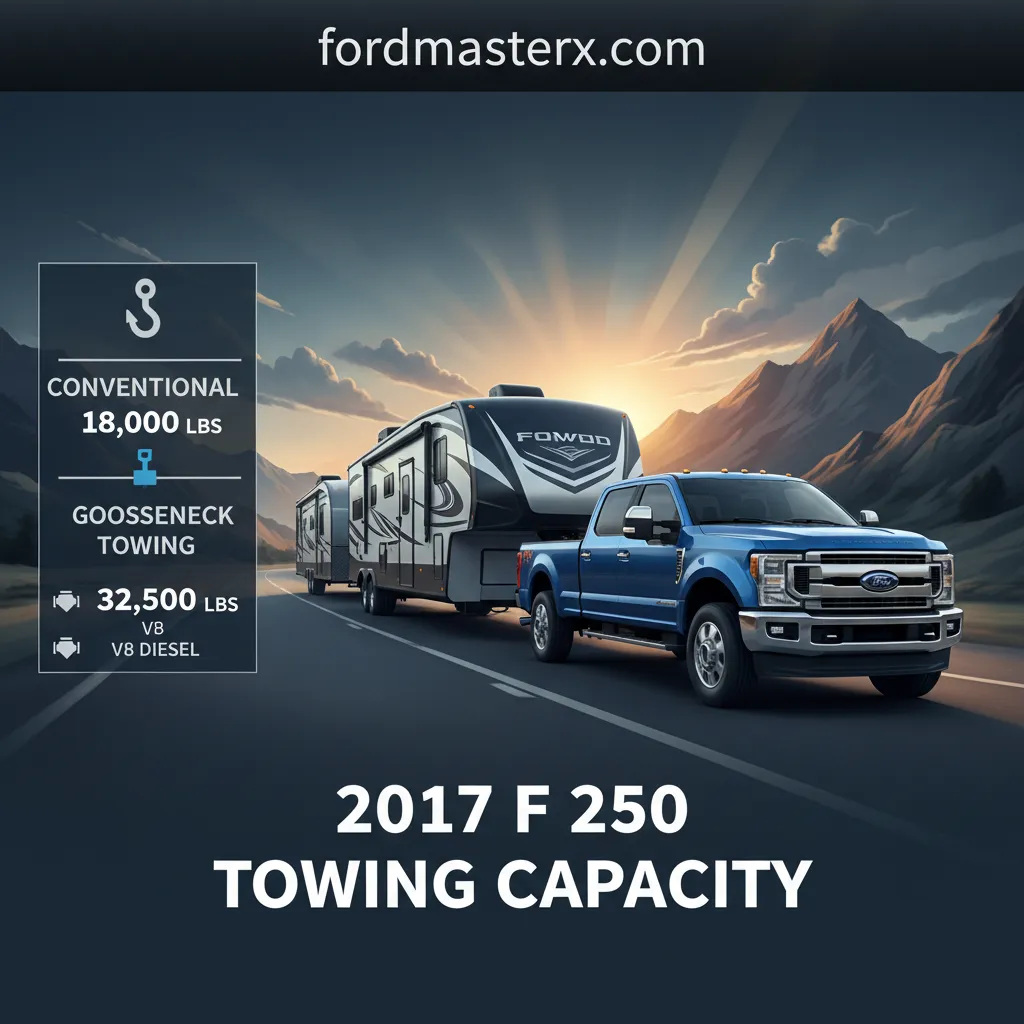
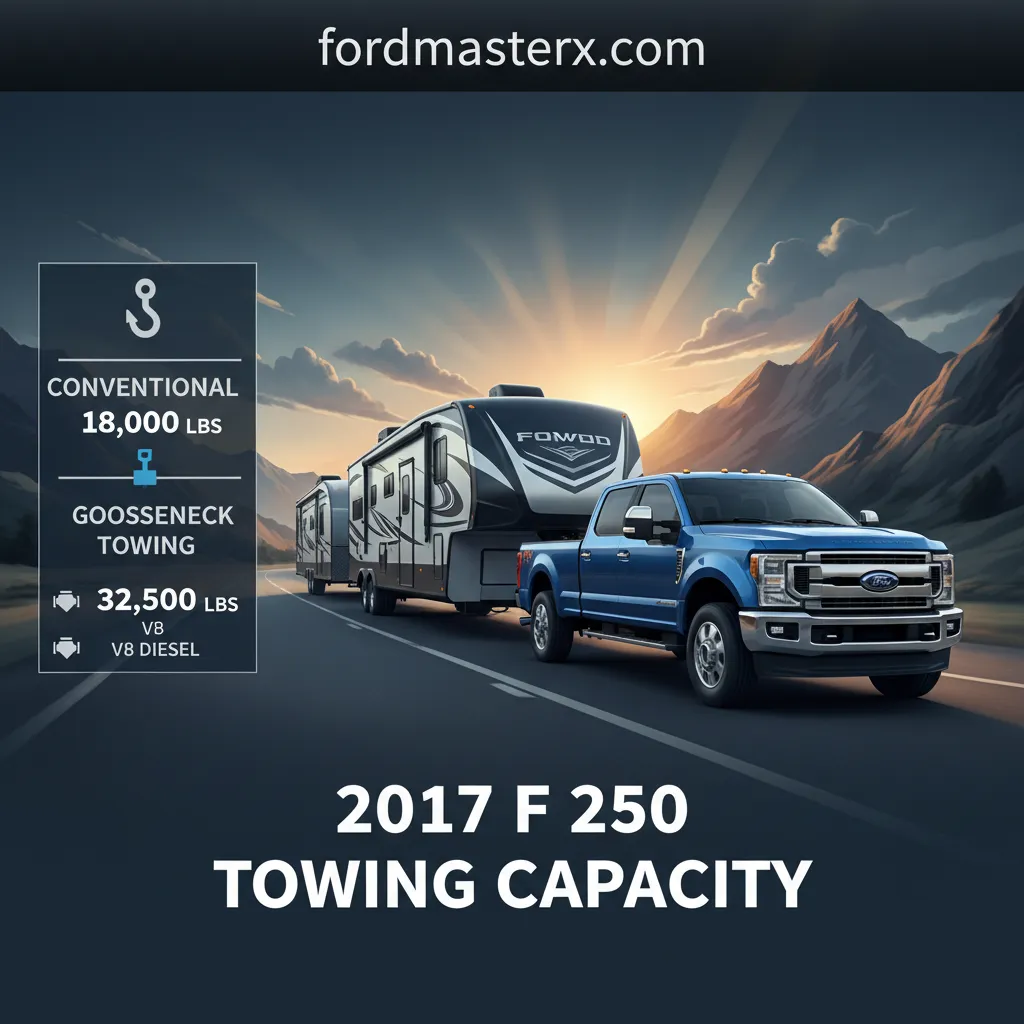
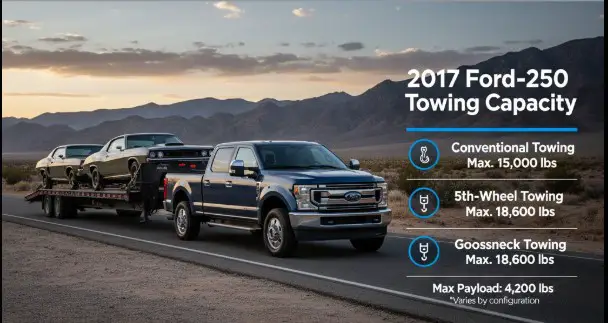
For standard bumper or receiver hitch towing, the F-250 is exceptionally comprehensive in its reach. A 4×4 Crew Cab diesel can comfortably pull up to 18,000 lbs. However, if you are looking at the 6.2L gas engine, the limit typically hovers around 15,000 lbs. It is important to note that the axle ratio plays a massive role here:
- 3.73 Ratio: Standard for most configurations, balanced for fuel economy and moderate towing.
- 4.30 Ratio: Available for the gas engine; this is the expert recommendation if you plan to tow near the 15,000-lb limit frequently, as it provides better mechanical advantage.
Gooseneck and Fifth-Wheel Specifications
When moving weight from the rear receiver to the truck bed, the 2017 F-250 enters the realm of professional-grade hauling. The maximum gooseneck rating reaches 18,600 lbs for specific configurations. To achieve these figures, the truck must be equipped with the factory 5th-wheel/Gooseneck Prep Package.
If you are ordering or buying a used 2017 F-250, look for the High-Capacity Trailer Tow Package. This package includes an upgraded axle and increased GCWR (Gross Combined Weight Rating), which is essentially the “secret sauce” that allows the F-250 to bridge the gap toward F-350 performance levels.
Real-World Scenario: Consider a professional horse trainer transporting a 30-foot gooseneck horse trailer. This setup often weighs between 12,000 and 16,000 lbs fully loaded. A 2017 F-250 Diesel 4×4 handles this with ease, whereas a gas configuration with a standard 3.73 axle might struggle on steep inclines and consume significantly more fuel under the same stress.
Section 3: Understanding Payload Capacity and GVWR for Professional Hauling
The most common pitfall for towers is focusing solely on the “pulling” capacity while ignoring the payload capacity. The payload is the amount of weight your truck can carry in the cab and bed, including the tongue weight of your trailer. For the 2017 F-250, this is where the 10,000-lb GVWR (Gross Vehicle Weight Rating) comes into play.
By The Numbers: Payload & GVWR
Max Gas Payload
Avg Diesel Payload
Standard GVWR
The GVWR Calculation
Many 2017 F-250s are paper-rated at a 10,000-lb GVWR to stay within specific registration and commercial driver license (CDL) exemptions. To find your actual payload, you subtract the curb weight (the weight of the truck with fluids and a full tank) from the GVWR. Because the diesel engine and its emissions equipment weigh nearly 800-900 lbs more than the gas engine, a diesel F-250 often has a lower payload capacity than a gas version.
Pin Weight vs. Tongue Weight
When towing conventionally, the tongue weight should be 10-15% of the trailer weight. For a 15,000-lb trailer, that is 1,500 to 2,250 lbs pressing down on your hitch. When gooseneck towing, the “pin weight” is often 15-25% of the total weight. If you have a loaded Crew Cab Lariat with a sunroof, adaptive cruise control, and massaging seats, those luxury features reduce your curb weight overhead. An expert tip is to always check the yellow sticker on your specific truck’s door jamb, as high-trim models often lose 400-600 lbs of payload capacity compared to a base XL work truck.
Exceeding the Gross Combined Weight Rating (GCWR) is a serious safety risk. Even if the truck “feels” like it can pull more, the braking system and suspension components are certified for these specific limits. Overloading leads to increased stopping distances and excessive heat buildup in the transmission and brakes.
Section 4: Reliable Towing Technology and Mechanical Features
The 2017 F-250 isn’t just about raw iron and torque; it introduced a suite of professional-grade technologies designed to make heavy-duty operations safer and more manageable. These features reduce driver fatigue and provide critical data during the haul.
Ultimate Trailer Tow Camera System
Utilizes up to 7 cameras to provide a 360-degree bird’s-eye view, making hitching and maneuvering in tight job sites seamless.
Adaptive Steering
Adjusts the steering ratio based on speed, reducing the effort needed to turn at low speeds with a heavy trailer attached.
Smart Trailer Tow Connector and Braking
The reliable integrated trailer brake controller is a standout feature, allowing the truck’s ABS and stability control to work in tandem with the trailer’s electric brakes. Additionally, the Smart Trailer Tow Connector provides real-time diagnostics on the dash, notifying the driver if a trailer light is out or if the battery isn’t charging—a complete guide for the driver without ever leaving the cab.
The Diesel Exhaust Brake
For those descending steep 6% grades with 15,000 lbs in tow, the 6.7L’s integrated exhaust brake is a game-changer. By restricting exhaust flow, the engine creates backpressure that slows the vehicle down without relying solely on the friction brakes. This prevents brake fade and ensures the 2017 F 250 towing capacity remains manageable even in mountainous terrain.
Section 5: Trusted Maintenance Practices for Heavy-Duty Towing
Operating a truck at its maximum towing limits is considered “Severe Duty.” To maintain quality performance over hundreds of thousands of miles, owners must adhere to a more rigorous maintenance schedule than the average commuter.
📋
Severe Duty Maintenance Guide
Change engine oil every 5,000 miles when towing frequently. Differential and transmission fluids should be inspected every 30,000 miles to prevent thermal breakdown from towing heat.
Always use Load Range E-rated tires. Maintain the maximum PSI (usually 75-80 PSI for rears) when under heavy load to prevent sidewall overheating and blowouts.
The 6.7L diesel also features a dual cooling system. One circuit manages engine temperature, while the second cooling circuit handles the charge air cooler and transmission. Professionals should ensure both systems are flushed according to Ford’s expert guidelines to prevent “limp mode” incidents during high-ambient-temperature hauls. Furthermore, monitor your Diesel Exhaust Fluid (DEF) consumption; when towing at max capacity, the engine uses DEF at a much higher rate to neutralize NOx emissions under heavy load.
✅ Pros of 2017 F-250 Towing
- Best-in-class diesel torque (925 lb-ft)
- Lightweight aluminum body increases net payload
- Superior camera and steering tech for the era
- Massive frame stiffness prevents “tail-wagging-the-dog”
❌ Cons to Consider
- Diesel payload can be tight due to GVWR limits
- Requires DEF management and higher maintenance costs
- TorqShift-G (Gas) not as robust as HD Diesel trans
- Ride quality is stiff when not loaded
The 2017 Ford F-250 remains a trusted pillar of the heavy-duty truck market, offering a maximum conventional towing capacity of 18,000 lbs and a gooseneck ceiling of 18,600 lbs. When properly equipped, it bridges the gap between a consumer-grade pickup and a commercial-grade hauler. Engine choice is critical: the 6.7L Power Stroke provides the torque necessary for heavy, sustained loads, while the 6.2L gas V8 offers higher payload potential for those carrying more in the bed. Always verify your specific vehicle’s door jamb sticker for the most accurate GVWR and payload data before hitching. Consult your owner’s manual or a certified Ford technician to ensure your specific truck and hitch configuration are optimized for your professional towing needs.
Frequently Asked Questions
What is the max towing capacity of a 2017 F-250 6.7 Diesel?
When equipped with the 6.7L Power Stroke V8 Turbo Diesel and the High-Capacity Trailer Tow Package, the 2017 F-250 can tow up to 18,000 pounds conventionally. For 5th-wheel or gooseneck towing, the capacity increases slightly to a maximum of 18,600 pounds, provided the configuration is a 4×2 or specific 4×4 model with the correct axle ratio.
How much can a 2017 F-250 6.2 gas tow?
The 6.2L gas V8 2017 F-250 is typically rated for a maximum conventional towing capacity of 12,500 to 15,000 pounds, depending on the axle ratio (3.73 vs 4.30) and wheelbase. While it has lower towing limits than the diesel, the gas model often provides a higher payload capacity due to the lighter engine weight, making it ideal for heavy bed loads.
Does the 2017 F-250 require a weight-distributing hitch?
Yes, for conventional towing, Ford recommends using a weight-distributing hitch for trailers exceeding 5,000 pounds. This expert-recommended setup ensures that the trailer’s tongue weight is evenly distributed across both axles of the truck and the trailer axles, maintaining steering control and braking stability during professional transport.
What is the GCWR for the 2017 F-250?
The Gross Combined Weight Rating (GCWR) for the 2017 F-250 varies by engine. The 6.2L gas engine typically has a GCWR ranging from 19,500 to 22,000 pounds. The 6.7L Power Stroke diesel models feature a significantly higher GCWR, reaching up to 25,700 pounds when equipped with the appropriate towing packages and axle ratios.
How does the 2017 redesign affect payload?
The 2017 redesign utilized high-strength, military-grade aluminum alloy for the body, which saved up to 350 pounds compared to previous steel models. This weight savings was reinvested into the frame and components, allowing for higher payload capacities. A properly configured 2017 F-250 can achieve a maximum payload of approximately 4,200 pounds.