What Temp Does DEF Freeze? Ford 6.7L Cold Weather DEF Guide 2026

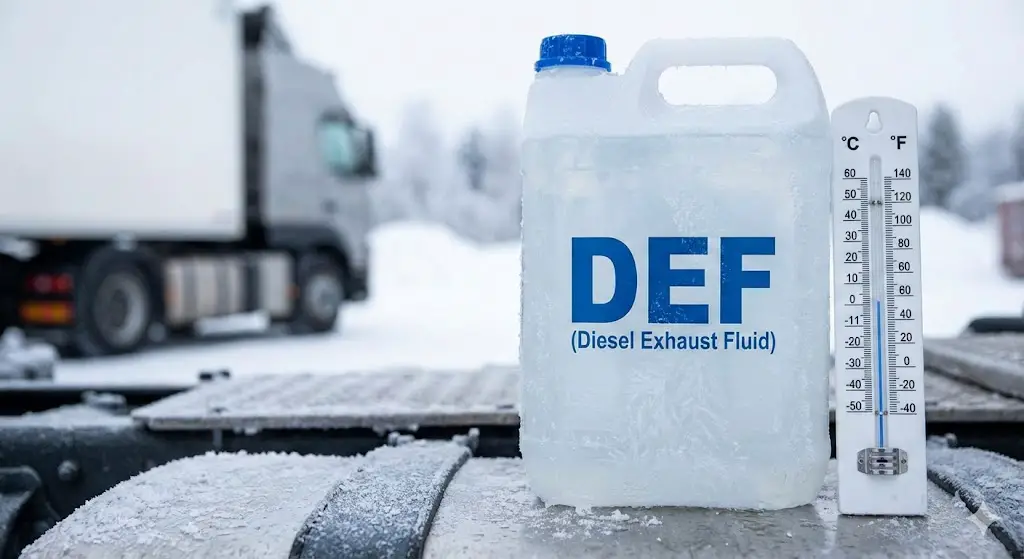
For Ford Power Stroke owners and diesel fleet managers operating in northern climates, the freezing of Diesel Exhaust Fluid (DEF) is not a matter of if, but when. The precise answer to the primary query is definitive: DEF freezes at 12°F (-11°C).
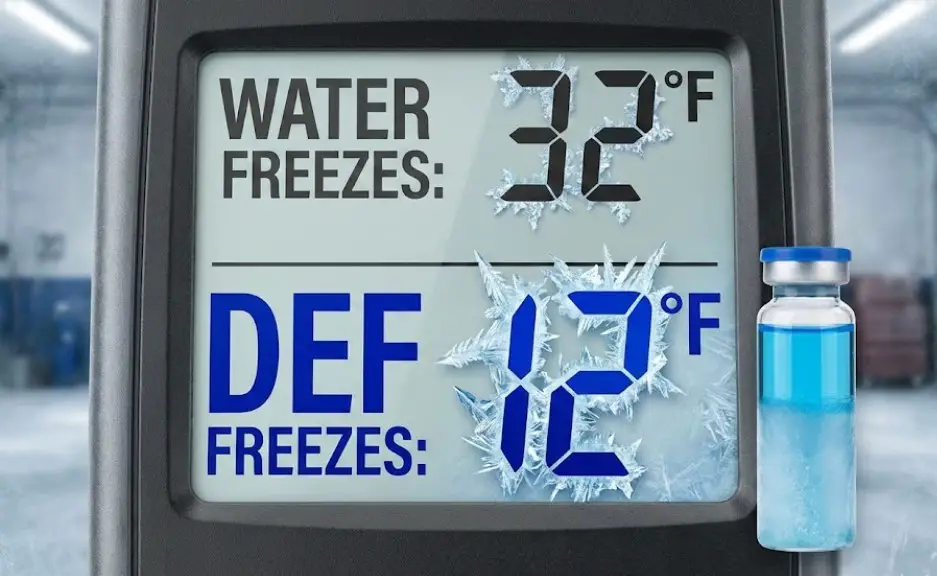
However, this single data point belies the complexity of the Selective Catalytic Reduction (SCR) system. Unlike diesel fuel, which turns into a waxy gel that clogs filters, DEF undergoes a distinct phase change into a solid crystalline mass. This characteristic drives the engineering behind the Ford 6.7L’s sophisticated—and occasionally troublesome—heating strategies.
This report provides an exhaustive technical analysis of AUS 32 thermodynamics, the specific failure modes of Ford reductant heaters, and the operational protocols necessary to prevent the dreaded “Speed Limited to 50 MPH” inducement mode.
WHAT TEMP DOES DEF FREEZE?
Diesel Exhaust Fluid isn’t just water. It’s a precise chemical solution with unique thermal properties. Understanding the 12°F (-11°C) threshold is critical for winter truck maintenance.
The Critical Threshold
Unlike fuel which gels progressively, DEF freezes solid at a specific temperature. It does not turn to “slush” first—it undergoes a phase change similar to water.
The Eutectic Mixture
DEF is a mixture of automotive-grade urea and de-ionized water. This specific ratio is “eutectic,” meaning it has the lowest possible freezing point for these two ingredients combined. Altering this ratio actually raises the freezing temperature.
Key Takeaway: Never dilute DEF. Adding water raises the freeze point.
The Expansion Factor
Why do DEF tanks have air gaps? Because DEF expands significantly when frozen. While diesel contracts slightly in cold, DEF expands by roughly 7%. This expansion can crack full reservoirs if not properly vented.
Key Takeaway: Do not overfill your DEF tank in winter.
Storage Life vs. Temperature
DEF doesn’t just freeze; it degrades in heat. If you store DEF in your truck bed during summer or near heating vents in winter, its shelf life plummets. Ammonia evaporates, ruining the 32.5% ratio.
Key Takeaway: Store DEF between 40°F and 80°F for maximum longevity.
What Happens When You Start a Frozen Truck?
Modern trucks are designed to handle frozen DEF. The Engine Control Unit (ECU) enters a specific “thawing mode” upon startup.
Rapid Fire Facts
Can I use anti-gel?
NO. Never add additives to DEF. It will damage the SCR catalyst system, costing thousands in repairs.
Does it separate?
No. Unlike fuel, DEF doesn’t stratify when freezing. It freezes and thaws as a homogenous mixture.
Is the bottle frozen?
If you have a spare jug in the truck bed, bring it into the cab to thaw by floor vents before pouring.
© 2026 FordMasterX Infographics. Data sourced from manufacturer owner manuals.
The Thermochemistry of AUS 32: Why 32.5% Matters
To understand why DEF behaves the way it does, we must look beyond the tank and into the chemistry of the fluid itself. DEF is chemically designated as AUS 32 (Aqueous Urea Solution), a mixture governed by ISO 22241 standards consisting of 32.5% high-purity synthetic urea and 67.5% deionized water.
The Eutectic Perfection
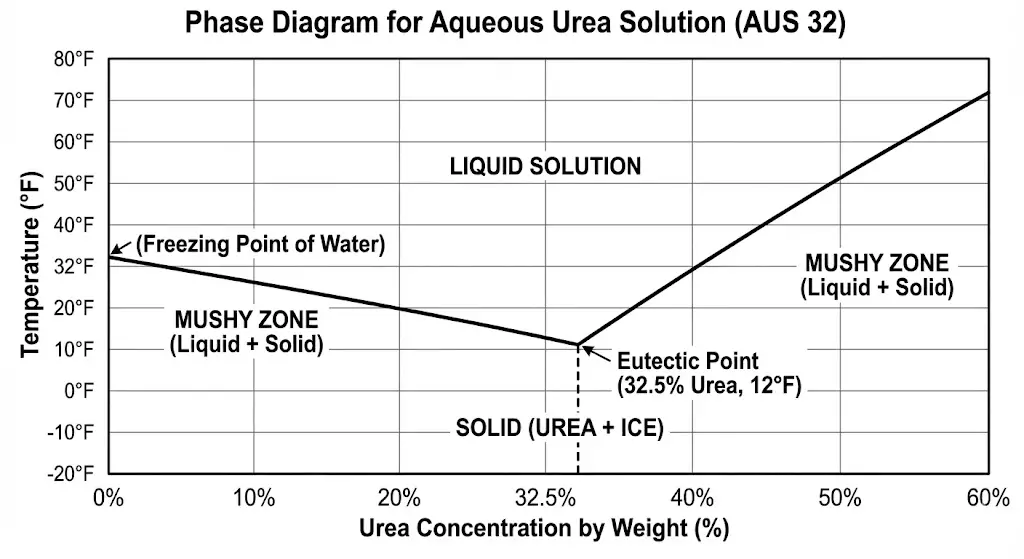
The ratio of 32.5% urea is not arbitrary. It represents the eutectic point of the urea-water solution. In thermodynamics, a eutectic mixture behaves like a pure substance during phase transitions.
- Non-Eutectic Behavior: If the concentration were 30% or 35%, the fluid would freeze over a range of temperatures (a "mushy zone"). Water would crystallize first ("salting out"), leaving behind a highly concentrated sludge of urea, or vice versa. This stratification would be catastrophic for SCR injectors, which rely on consistent fluid density.
- Eutectic Behavior: At exactly 32.5%, the solution freezes at a single temperature (12°F) and freezes uniformly. Both the water and urea crystallize simultaneously at the same rate. Crucially, this means that when DEF thaws, it returns to the liquid state at the exact same concentration, ensuring the SCR system receives the correct chemical ratio without the need for mixing or agitation.
Volumetric Expansion: The 7% Factor
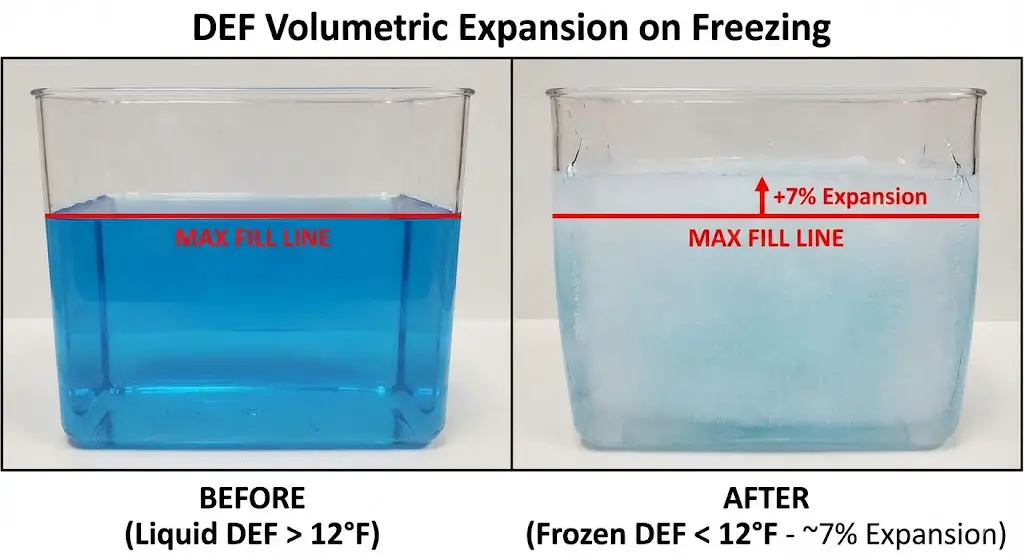
Water is unique in that it expands when freezing. Since DEF is nearly 70% water, it shares this trait, though the urea lattice mitigates the expansion slightly. DEF expands by approximately 7% by volume when frozen.
This expansion generates immense hydrostatic pressure capable of rupturing rigid containers. OEM engineers design vehicle tanks with high-density polyethylene (HDPE) to allow for some flex, and they utilize specific "ullage" (air gap) strategies to prevent bursting. However, overfilling a tank in winter eliminates this safety margin, leading to cracked reservoirs and failed heater seals.
Visual Data: Volumetric Expansion Comparison
| Fluid Type | Freezing/Gelling Point | Expansion on Freezing | Operational Consequence |
| Pure Water | 32°F (0°C) | ~9.0% | Burst pipes; cracked blocks. |
| DEF (AUS 32) | 12°F (-11°C) | ~7.0% | Cracked tanks if overfilled; injector damage if not purged. |
| Diesel Fuel (#2) | Cloud Point (~15°F) | Contracts | Gelling (wax precipitation); clogged filters. |
Ford Power Stroke 6.7L: Cold Weather Engineering & Diagnostics
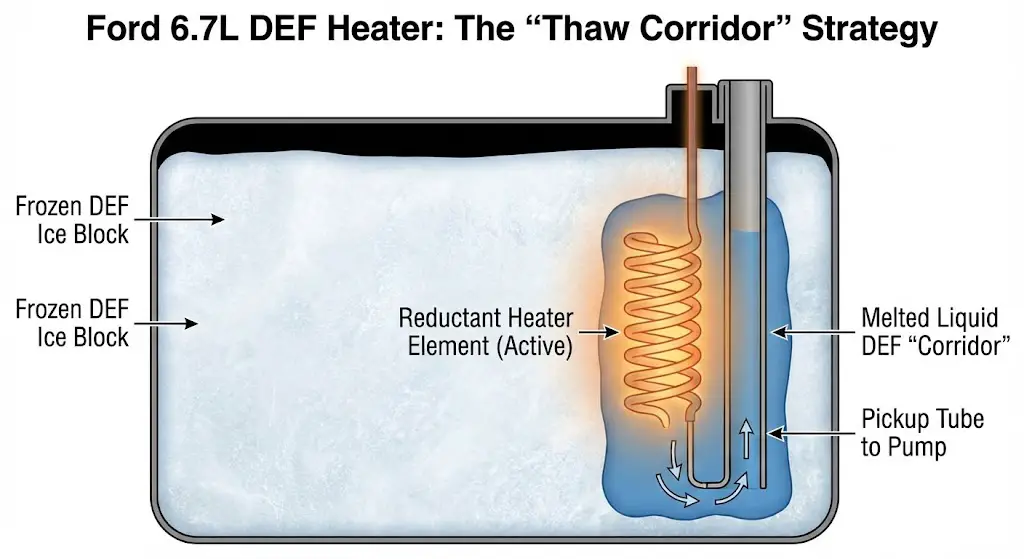
The Ford 6.7L Power Stroke (2011–Present) employs a complex heating strategy to manage DEF freezing. Understanding this logic is critical for distinguishing between normal operation and component failure.
The "Cold Weather Strategy"
When ambient temperatures drop below 12°F, the Powertrain Control Module (PCM) enters a specific cold weather mode:
- Inducement Delay: The EPA allows the engine to run for a set period (typically 45-90 minutes) without dosing DEF to allow the tank to thaw. The truck will not go into limp mode immediately upon startup with frozen fluid.
- Heater Activation: The Reductant Heater Assembly (located inside the tank) and the heated pressure lines are energized.
- Thaw Corridor: The heater is not designed to melt the entire 5-7 gallons of fluid instantly. It focuses on melting a cylinder of fluid around the pickup tube, creating a liquid channel. This allows the system to build pressure even if the bulk of the tank remains a solid block of ice.
Critical Component: The Reductant Heater Assembly
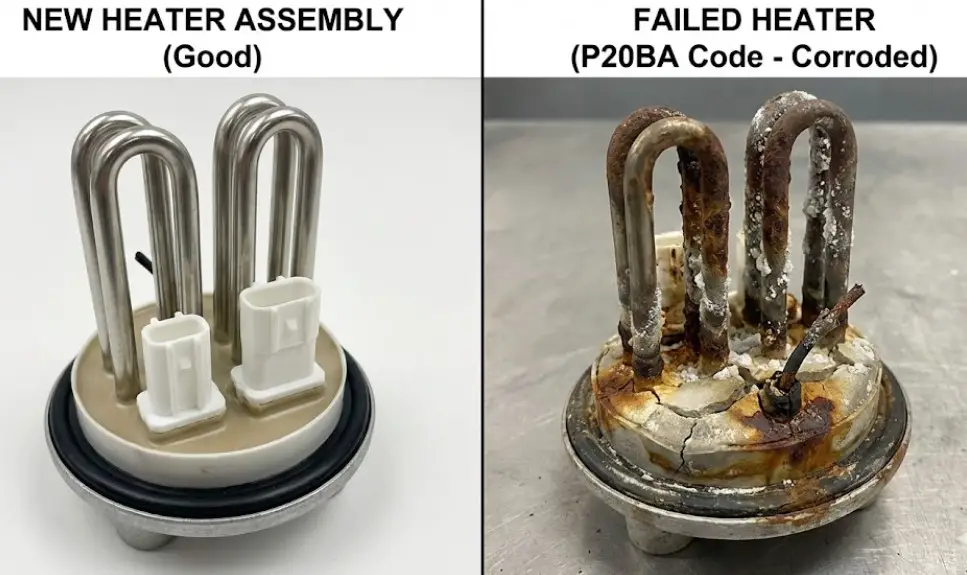
The Achilles' heel of the 2011–2016 Ford 6.7L system is the Reductant Heater "A". This Bosch-supplied unit often fails due to the corrosive nature of DEF penetrating the heating element's potting material.
- The Failure: The heating element corrodes, causing an open circuit or high resistance.
- The Code: P20BA (Reductant Heater "A" Control Circuit Performance) is the hallmark trouble code. It may be accompanied by P20BB or P20BC.
- The Symptom: In summer, this triggers a Check Engine Light (CEL) but no drivability issues. In winter, this is catastrophic. Without the heater, the DEF cannot thaw. Once the EPA-mandated grace period expires, the truck detects "Reductant No Flow" (P218F) or "Reductant System Performance" (P204F) and initiates the speed limiter countdown.
Diagnostic Protocol: Testing Heater Resistance
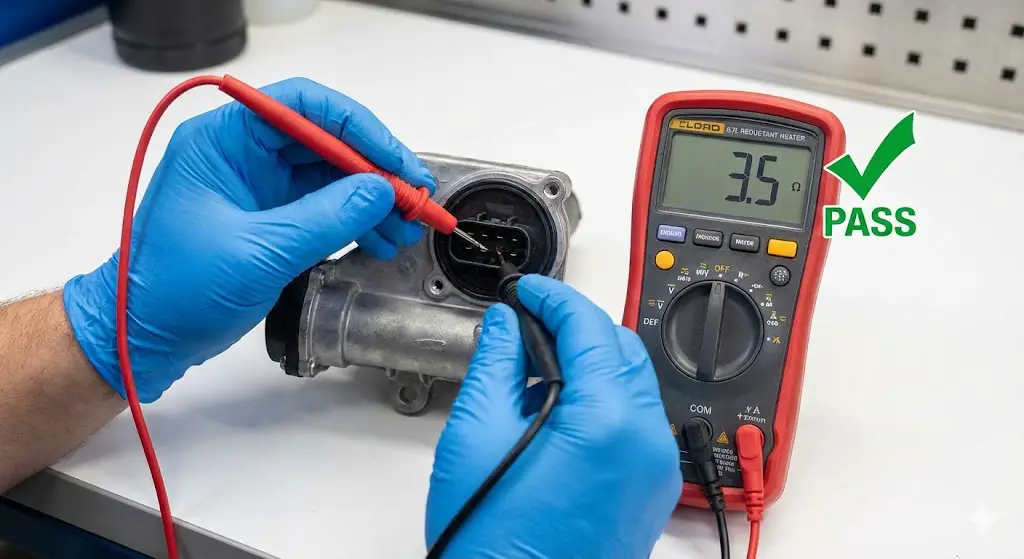
Before replacing the entire sender unit (a costly repair), technicians should verify the heater circuit resistance.
Visual Data: Ford 6.7L Heater Diagnostic Specs
| Component | Normal Resistance Range | Failure Threshold | Action |
| Reductant Heater "A" | 2.0 Ω – 5.0 Ω | ≥ 10 Ω (or Open Loop) | Replace Heater Assembly (Sender) |
| Heater Current Draw | > 5.0 Amps | < 0.4 Amps | Check Fuse / Wiring / Heater |
The "Speed Limited to 50 MPH" Inducement
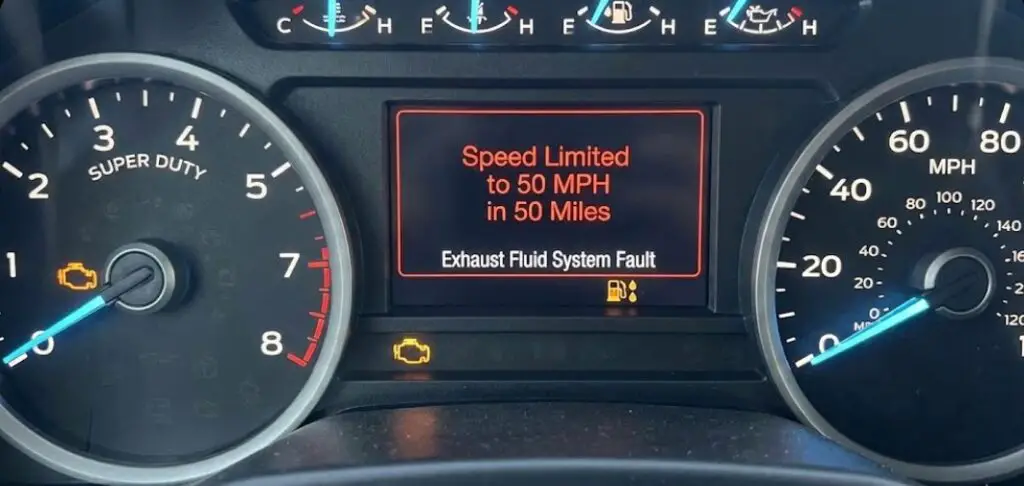
If the heater fails to thaw the fluid, the message center will display "Speed Limited to 50 MPH in 50 Miles." This is the Inducement Strategy.
- Resetting the Warning: Simply fixing the heater or thawing the truck in a garage may not immediately clear the message. The system requires a Drive Cycle to verify the fix.
- The Drive Cycle: The truck must be driven at highway speeds (above 30 MPH) for at least 20 minutes with the exhaust gas temperature (EGT) above 400°F. This allows the system to attempt a dosing cycle. If dosing is successful (pressure is built and fluid is injected), the countdown will reset.
Storage and Handling: The Science of Shelf Life
DEF is a perishable chemical. Its shelf life is dictated by the Arrhenius equation, meaning its degradation rate doubles for every 10°C increase in temperature. Conversely, cold storage significantly extends its life.
Does Freezing Ruin DEF?
No. Because of its eutectic nature, DEF can freeze and thaw repeatedly without any degradation in quality. A jug of DEF left in an unheated garage over a North Dakota winter is perfectly safe to use in the spring, provided the container hasn't cracked.
Temperature vs. Shelf Life Matrix
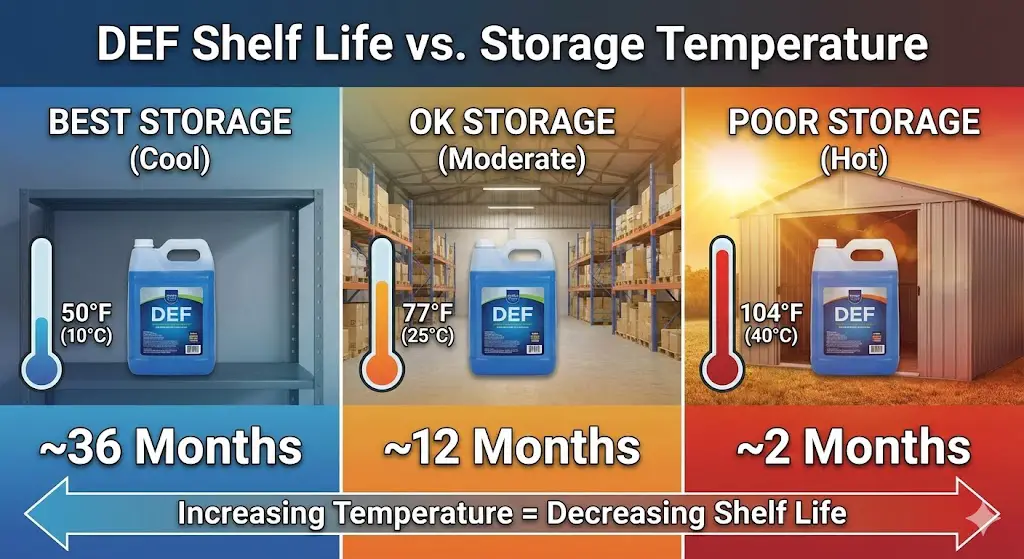
Fleet managers should utilize the following data to determine inventory rotation.
Visual Data: DEF Shelf Life vs. Temperature
| Average Storage Temp | Estimated Shelf Life |
| ≤ 50°F (10°C) | 36 Months |
| ≤ 68°F (20°C) | 18 Months |
| ≤ 77°F (25°C) | 12 Months |
| ≤ 86°F (30°C) | 6 Months |
| ≥ 104°F (40°C) | ~2 Months |
Winter Survival Guide for Ford Owners
To ensure reliability during sub-zero operations, follow these "Golden Rules" derived from field data and OEM guidelines.
The 75% Fill Rule
Do not fill your DEF tank to 100% in winter. Due to the 7% expansion factor, a completely full tank leaves no room for the ice to expand. This hydrostatic pressure can crack the tank welds or pop the ultrasonic level sensor out of its housing. Aim to keep the tank between 50% and 75% full. This ensures the heater is submerged (preventing burnout) but leaves enough "headspace" for expansion.
The "Purge Cycle" Discipline
When you turn off your Ford 6.7L, you may hear a buzzing sound from the rear of the truck for 30-60 seconds. This is the Reverting Valve or pump reversing.
- Mechanism: The system sucks the liquid DEF out of the lines and injector back into the tank.
- Why it matters: The lines are small diameter and lack the strength to withstand expansion. If DEF is left in the lines, they will freeze and burst.
- Critical Warning: Do not disconnect the vehicle batteries immediately after shutdown. Doing so interrupts the purge cycle, trapping fluid in the injector, which can lead to a cracked injector tip ($300+ part) during the next freeze.
The Anti-Gel Myth
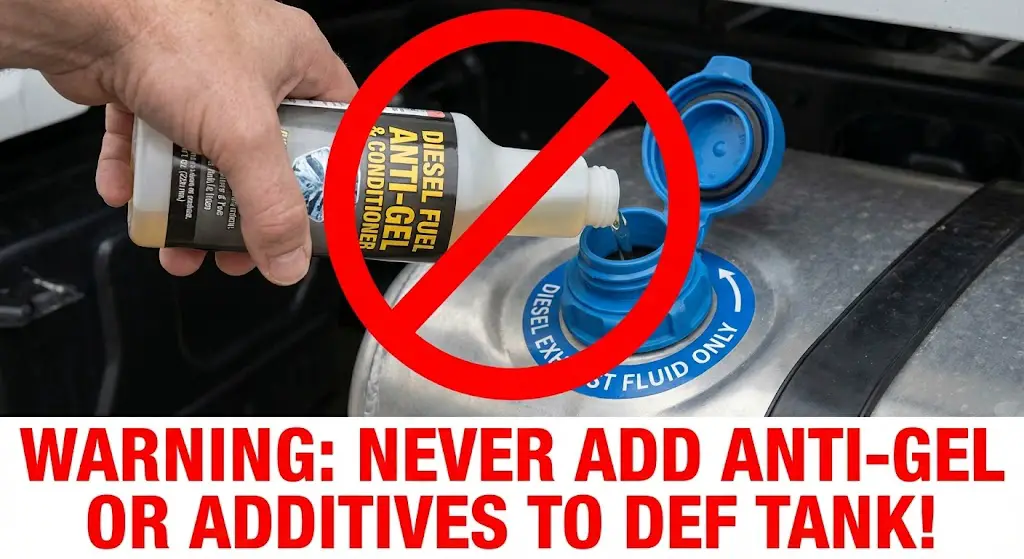
NEVER add anti-gel, antifreeze, or fuel additives to the DEF tank. The SCR system is calibrated for a specific chemical reaction ($4NO + 4NH_3 + O_2$). Any additive will poison the catalyst washcoat. The Reductant Quality Module (RQM) monitors the fluid's specific gravity and refractive index. Detecting an additive will trigger a "Contaminated Exhaust Fluid" warning, leading to immediate warranty voiding and a repair bill often exceeding $6,000 for a complete system replacement.
FAQ
Q: Can I drive my truck if the DEF is frozen?
A: Yes. The vehicle's computer is programmed to allow operation with frozen DEF. It will utilize the tank heater to thaw the fluid while you drive. You do not need to wait for it to thaw before starting your trip.
Q: Why does my DEF gauge read empty when I know it's full?
A: In extreme cold, the ultrasonic level sensors can be "fooled" by the density difference between liquid DEF and solid ice. As the heater runs and creates a liquid cavity, the sensor reading should normalize. If it persists after 30 minutes of driving, there may be a heater fault.
Q: Will the "Speed Limited to 50 MPH" message clear itself?
A: Not instantly. Even after fixing a frozen or broken system, the truck requires a "Drive Cycle" (usually 20+ minutes at highway speeds) to verify the repair and turn off the inducement mode. In some cases, a forced manual regeneration via a scan tool is required.
Q: Should I wrap my DEF tank in a heated blanket?
A: For vehicle tanks, this is generally unnecessary if the factory heater is working. However, for bulk storage totes kept in unheated sheds, a heater blanket is highly recommended to prevent downtime during refills.
Q: Does winter blend diesel affect DEF?
A: No. Diesel fuel and DEF are completely separate systems. Winter blend diesel prevents fuel gelling, but it has no impact on the DEF freezing point. You must manage both fluids independently.
Conclusion
The management of Diesel Exhaust Fluid in winter is a triumph of chemical and mechanical engineering working in concert. While the freezing point of 12°F is an immutable law of physics for AUS 32, the impact of this phase change is manageable. For the Ford Power Stroke owner, the keys to success are simple: respect the 7% expansion by not overfilling, monitor the heater health (watch for P20BA), and allow the vehicle's purge cycles to complete. By adhering to these protocols, the SCR system can survive the harshest winters without leaving you speed-limited on the side of the road.