What Does OBS Truck Mean? The Definitive Guide to Old Body Style 2026

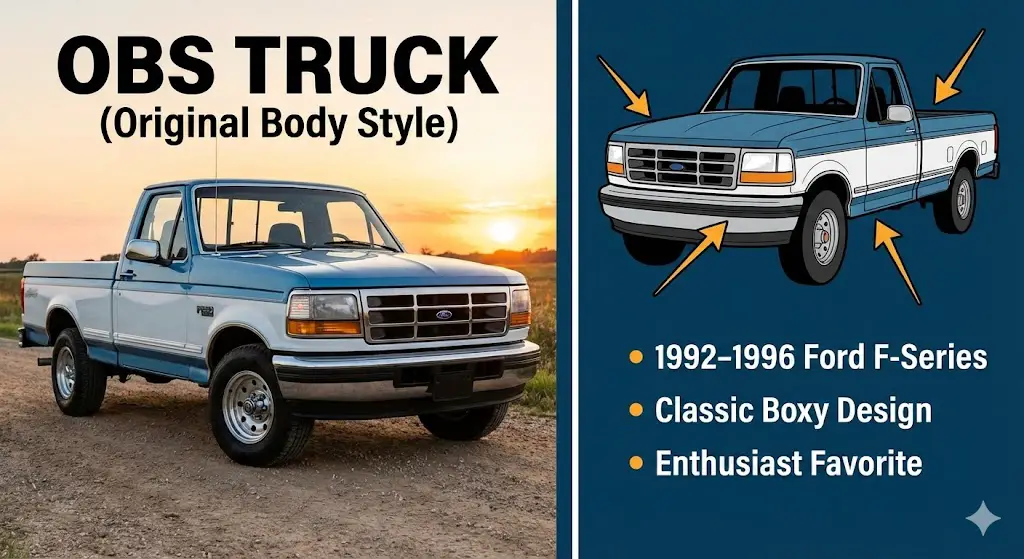
In the sprawling lexicon of American automotive enthusiasm, few acronyms have ascended from obscure forum shorthand to mainstream market dominance as rapidly as “OBS.” Standing for Old Body Style, this retronym was originally coined by enthusiasts to differentiate the previous generation of trucks from the newly released, more aerodynamic designs of the late 1990s and early 2000s.
However, over the last decade, “OBS” has transcended its utility as a mere differentiator to become a badge of honor, representing a specific “Golden Era” of American pickup trucks that balances modern mechanical reliability with classic, rugged aesthetics.
The OBS era is not merely a designation of model years; it represents a philosophical pivot point in automotive engineering. These vehicles sit in the “Goldilocks Zone” of truck history: they possess the essential advancements of fuel injection, overdrive transmissions, and rudimentary safety features (like ABS and driver airbags), yet they lack the overwhelming complexity of modern CAN-bus systems, cylinder deactivation, and restrictive emissions equipment that characterize contemporary trucks.
This report provides an exhaustive technical and market analysis of the two titans of the OBS era: the Ford F-Series (Ninth Generation, 1992–1997) and the General Motors C/K Series (GMT400 Platform, 1988–1998).
The Scope of “OBS”
While the term is vernacular and thus subject to regional interpretation, the consensus within the collector market defines the OBS era as follows:
- Ford F-Series OBS: Specifically the 1992–1997 model years, known as the “Aeronose” or Ninth Generation. While the chassis architecture dates back to 1980, the 1992 facelift provided the definitive look associated with the term. Production of Heavy Duty (F-250/F-350) models extended into early 1998 before the release of the Super Duty.
- Chevrolet/GMC OBS: The 1988–1998 model years, built on the GMT400 platform. This includes the C/K 1500, 2500, and 3500 pickups, as well as the Tahoe, Yukon, and Suburban SUVs derived from the same architecture. The GMT400 platform ran concurrently with its successor (the GMT800) for a brief period, sold as the “Classic” in 1999–2000.
THE OBS TRUCK PHENOMENON
Decoding the “Old Body Style” Market Explosion
The term “OBS” (Old Body Style) has evolved from a simple descriptor to a badge of honor. Specifically referencing American trucks from the late 80s to late 90s, these vehicles represent the peak of mechanical durability before the digital age. Below, we explore the data behind why these square-body legends are becoming the new classic car investment.
The Ford Lineage
Understanding where the “OBS” fits in the evolution of the F-Series is critical for collectors.
The Bullnose
1980 – 1986
Sharp lines, slanted grille, mechanical carburetors. The retro classic 80s aesthetic.
The Bricknose
1987 – 1991
Flat, flush headlights, rectangular front clip. The industrial workhorse era.
The OBS (Aeronose)
1992 – 1997
Softened hood, 7.3L Turbo Diesel, modern interior. The peak of the platform.
The “Nostalgia Tax”
The value of clean, low-mileage OBS trucks has skyrocketed. What was a $10,000 farm truck in 2015 is now a highly collectible asset.
- ↗ 250% Growth in average auction value since 2016.
- ★ 7.3L Power Stroke models command a 40% premium over gas models.
Battle of the Big Blocks
Why is the 7.3L Power Stroke so revered? While the gas engines had horsepower, the diesels ruled the torque wars—essential for towing.
*Values represent peak torque (lb-ft) for stock 1996 models.
The “Holy Grail” Spec
Most trucks in the 90s were bought for work, meaning they were Regular Cabs or Super Cabs.
Finding a Crew Cab Long Bed (CCLB) 4×4 is difficult, making them the most expensive configuration on the market today.
Collector’s Tip:
If you find a rust-free 7.3L CCLB 4×4, buy it immediately.
Market Availability by Cab Config
The Ford F-Series OBS (1992–1997): The Peak of the Twin I-Beam Era
The Ninth Generation Ford F-Series is often cited by purists as the last "true" Ford truck before the bifurcation of the line into the F-150 (consumer/lifestyle) and F-250/350 Super Duty (commercial/work) in 1999. This generation consolidated 12 years of chassis refinement into a package that was aerodynamic enough to meet rising fuel standards but retained the rigid, squared-off jawline that defined Ford's truck identity.
Design Language and Aerodynamics
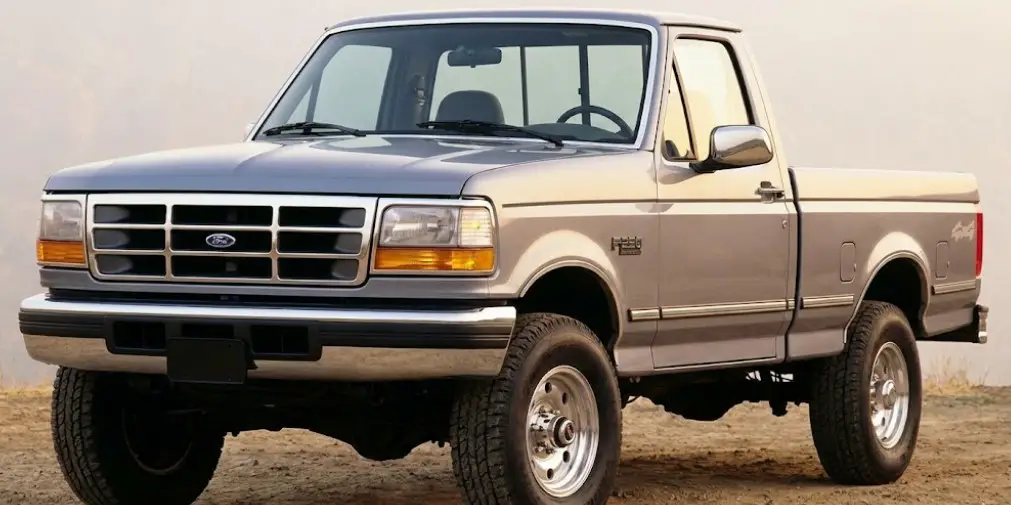
The 1992 redesign was substantial. Ford designers rounded the front clip, smoothing the transition from the grille to the fenders to reduce wind noise and drag coefficient—a move necessitated by increasing CAFE (Corporate Average Fuel Economy) standards. This design, colloquially termed the "Aeronose," featured wraparound turn signals and a lower hood line compared to the previous "Bricknose" (1987–1991) generation. Despite these concessions to aerodynamics, the rest of the body retained the distinct character lines and upright greenhouse of the 1980–1996 cab architecture, providing excellent visibility and a spacious interior feel that modern high-beltline trucks often lack.
Chassis and Suspension Engineering
Ford's approach to suspension during the OBS era was distinct from its competitors, utilizing the Twin I-Beam (2WD) and Twin Traction Beam (4WD) front suspension systems.
- Twin Traction Beam (TTB): Found on F-150 and F-250 4x4 models, the TTB is an independent suspension system that uses two articulating axle beams pivoting from the center of the chassis. It allows for greater wheel travel and ride compliance compared to a solid axle but is notorious for alignment challenges. As the suspension cycles, the camber changes significantly, leading to uneven tire wear if the pivot bushings are worn or if the vehicle is lifted without proper drop brackets.
- Solid Front Axle (Dana 60): The F-350 4x4 utilized a monobeam solid front axle (Dana 60). This setup is highly prized by off-roaders and heavy haulers for its ultimate durability and simplicity. It eliminates the camber issues of the TTB but results in a stiffer, more punishing ride quality on the highway.
Powertrain Encyclopedia: The Ford Engine Lineup
The Ford OBS era engine lineup is a mix of legendary pushrod gasoline engines and the dawn of the modern direct-injection diesel era.
The Gasoline Workhorses
| Engine | Configuration | Displacement | Fuel System | Horsepower | Torque (lb-ft) | Application & Characteristics |
| 4.9L "Big Six" | Inline-6 | 300 ci | EFI | 145–150 | 260–265 | The reliability king. Seven main bearings and gear-driven timing gears (no chain to stretch) make it virtually indestructible. Massive low-end torque makes it excellent for farm work, but it lacks highway passing power. |
| 5.0L Windsor | V8 | 302 ci | EFI | 185–205 | 270 | Standard V8 for F-150. A short-stroke engine that prefers higher RPMs. Adequate for daily driving but struggles with heavy towing compared to the 5.8L. |
| 5.8L Windsor | V8 | 351 ci | EFI | 210 | 325 | The preferred gas towing engine. The 1994+ models received roller camshafts, improving longevity and efficiency. It offers the best balance of power and parts availability. |
| 7.5L Big Block | V8 | 460 ci | EFI | 245 | 400 | The torque monster. Designed for heavy towing before diesels dominated. Incredibly thirsty (single-digit MPG) but capable of moving mountains. Known for exhaust manifold leaks. |
The Diesel Revolution: 7.3L Power Stroke vs. 7.3L IDI
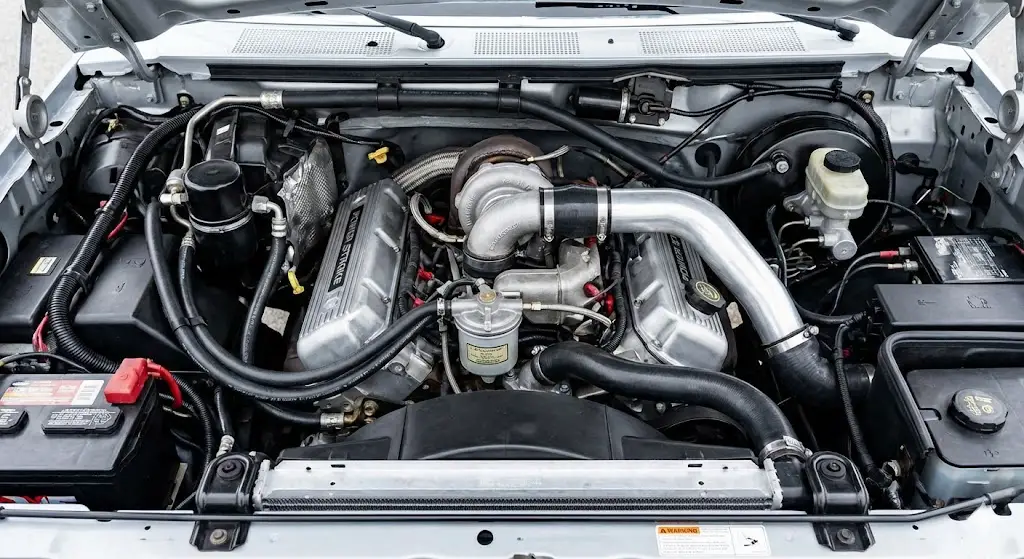
The most critical development in the OBS era was the transition in diesel technology, creating a definitive split in desirability and value.
- 7.3L IDI (1992–1994): The Indirect Injection engine, built by International Harvester, was reliable but archaic. Fuel was injected into a pre-chamber rather than the cylinder, limiting efficiency and power. A turbocharger was added in 1993 (IDI Turbo), bumping power to 190 hp, but it was a stopgap measure.
- 7.3L Power Stroke (1994.5–1997): This engine changed everything. While still displacing 7.3 liters, it was a completely new design (T444E) featuring Direct Injection and the HEUI (Hydraulic Electronic Unit Injection) system. HEUI used high-pressure engine oil (up to 3,000 psi) to actuate the fuel injectors, allowing for precise control over injection timing and pressure.
- Performance: 215 hp and 425 lb-ft of torque.
- Legacy: The forged connecting rods, lack of emissions equipment (no EGR on most, no DPF), and million-mile durability potential make the OBS 7.3L Power Stroke one of the most sought-after vehicles in the classic truck market today.
Trim Hierarchy and Special Editions
Ford differentiated its models through a strict trim ladder, which has implications for current collector value.
- XL / Custom: The fleet spec. Vinyl bench seats, rubber floor mats, manual windows, and manual locks. Often paired with the 4.9L I6.
- XLT: The volume seller. Cloth seating, carpeting, power windows/locks, chrome grille, and often cruise control.
- Eddie Bauer (1995–1996): A luxury partnership that previewed the modern "King Ranch" or "Platinum" trims. Available on the F-150, it featured unique two-tone paint (Oxford White with Tucson Bronze was iconic), slotted front bumper, and a premium interior with specific badging.
- SVT Lightning (1993–1995): Ford's answer to the Chevy 454 SS. Developed by the Special Vehicle Team, the Lightning was a dedicated sport truck available only in a Regular Cab/Short Bed configuration.
- Mechanicals: It utilized a high-output 5.8L V8 (240 hp/340 lb-ft) with GT40 cylinder heads and a tubular intake manifold.
- Chassis: Lowered suspension (1 inch front, 2.5 inches rear), Bilstein shocks, and 17-inch alloy wheels.
- Rarity: Only 11,563 units were produced over three years, making them high-value collectibles.
The Chevrolet & GMC C/K OBS (1988–1998): The GMT400 Revolution
While Ford iterated on an existing chassis, General Motors revolutionized the truck market in 1988 with the introduction of the GMT400 platform. This clean-sheet design prioritized aerodynamics, cabin comfort, and production modularity, setting the template for the modern "lifestyle" pickup truck.
Engineering the GMT400 Platform
The GMT400 was the first full-size truck developed with extensive wind tunnel testing. The flush-mounted glass, curved front fascia, and integrated door frames were radical departures from the "Square Body" (1973–1987).
Independent Front Suspension (IFS):
The most controversial yet impactful engineering decision was the move to a torsion bar Independent Front Suspension for all 4WD 1500 and 2500 models (and eventually 3500s).
- Advantage: It provided a significantly smoother ride and better handling on pavement compared to Ford's Twin I-Beam or solid axles, acknowledging that many truck owners used their vehicles as daily drivers.
- Disadvantage: Hardcore off-roaders criticized the IFS for having less articulation and being more prone to CV axle wear when lifted.
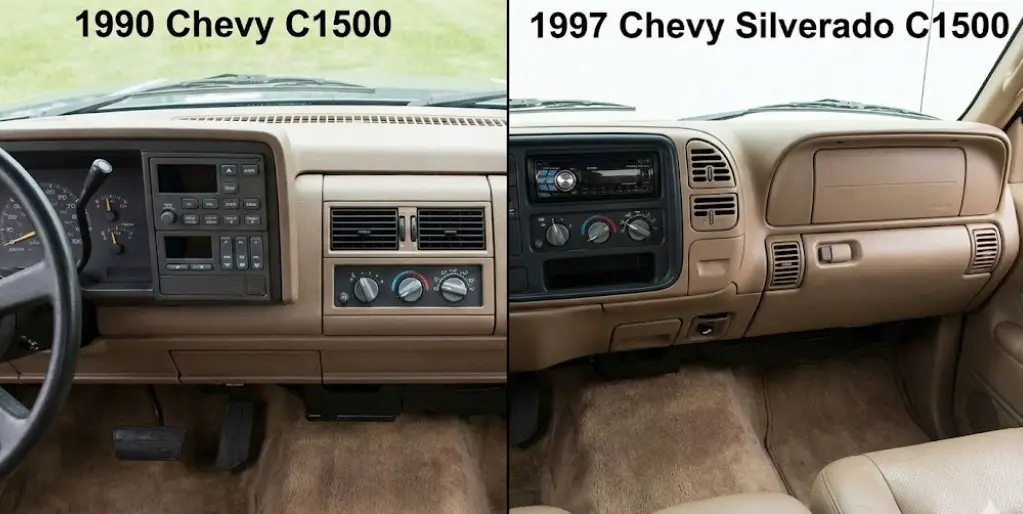
Interior Evolution
The GMT400 interior underwent a significant transformation that helps date these vehicles.
- 1988–1994: Featured a blocky, modular dashboard with "Moonie" gauges (1988–1990) that had unique, quadrant-style markings. The radio and HVAC controls were distinct pods next to the instrument cluster.
- 1995–1998: A complete redesign introduced a curvaceous, car-like dashboard with a passenger-side airbag, rotary HVAC knobs, and a double-DIN radio slot. This interior is generally preferred for daily driving due to improved ergonomics and cupholder placement.
Powertrain Encyclopedia: The Vortec Era
GM's engine strategy during the OBS era can be divided into two periods: the TBI (Throttle Body Injection) years and the Vortec (SFI) years.
The Gasoline Lineup
| Engine | RPO Code | Years | Horsepower | Torque (lb-ft) | Technical Analysis |
| 4.3L V6 | LB4/L35 | 88–98 | 160–200 | 235–255 | Essentially a 350 V8 with two cylinders removed. Extremely durable and surprisingly capable for a base engine. The 1996+ Vortec version is noticeably peppier. |
| 5.0L V8 | L03/L30 | 88–98 | 175–230 | 255–285 | The "305." Often criticized by enthusiasts as having "V6 power with V8 fuel economy," but reliable. |
| 5.7L V8 | L05/L31 | 88–98 | 210–255 | 300–330 | The benchmark. The 1996+ L31 Vortec is the pinnacle of the classic small block Chevy. High-flow cylinder heads bumped power to 255 hp, making these years the most desirable for towing. |
| 7.4L V8 | L19/L29 | 88–00 | 230–290 | 385–410 | The 454 Big Block. The 1996+ Vortec 7400 (L29) introduced Sequential Fuel Injection (SFI), unlocking massive torque for heavy hauling. |
The Diesel Offerings: 6.2L and 6.5L
GM's diesel strategy during this era lagged behind Ford/Navistar and Dodge/Cummins.
- 6.2L Diesel (1988–1993): A naturally aspirated engine designed for fuel economy, not towing power. It produced only ~145 hp and was notorious for being slow.
- 6.5L Turbo Diesel (1992–2000): An improvement, but plagued by reliability issues. The PMD (Pump Mounted Driver), an electronic module mounted on the injection pump, was prone to overheating failure. While efficient, the 6.5L could not match the torque or durability of the Ford 7.3L Power Stroke.
Trim Levels and Special Models
- Cheyenne / Work Truck (W/T): Basic trim with sealed beam headlights and vinyl floors.
- Silverado: Top-tier trim with composite headlights, chrome, and plush velour interiors.
- 454 SS (1990–1993): A high-performance muscle truck featuring the 7.4L V8 in a 1500 Regular Cab Short Bed chassis. It included a heavy-duty suspension, quick-ratio steering, and blacked-out aesthetics. It is a blue-chip collectible today.
Mechanical & Performance Comparison: Ford vs. Chevy
For the prospective buyer or historian, understanding the practical differences between these two platforms is critical.
Towing Capabilities
Comparing towing capacity in the 1990s requires nuance, as ratings were less standardized than today.
| Category | Ford F-Series OBS (1997 Specs) | Chevy C/K OBS (1998 Specs) | Analysis |
| Max Conventional Towing (1/2 Ton) | 7,700 lbs (F-150 5.8L) | 7,000 lbs (C1500 5.7L) | Ford held a slight advantage in the half-ton segment due to the torque of the 5.8L engine. |
| Max Conventional Towing (3/4 Ton) | 10,000 lbs (F-250 7.5L) | 10,000 lbs (C2500 7.4L) | Parity in the heavy-duty gas segment. Both big blocks were capable haulers. |
| Max 5th Wheel Towing (1 Ton) | 13,500+ lbs (F-350 7.3L) | 10,000 lbs (K3500 6.5L) | Ford Dominance. The 7.3L Power Stroke combined with the solid axle chassis allowed for heavier sustained towing than the GM 6.5L diesel. |
Chassis Rigidity and Rust
- Ford: Utilized a C-channel frame which allowed for significant chassis flex. This was by design to aid traction off-road but resulted in visible bed-to-cab twist on uneven terrain.
- Rust Prone Areas: Rear wheel arches (the "Ford Rot"), radiator support mounts, and cab corners.
- Chevy: Featured a fully boxed front frame section, providing a stiffer platform for the suspension.
- Rust Prone Areas: Cab corners are the #1 failure point, followed by rocker panels and the frame rails near the rear fuel tank crossmember.
The Aftermarket Ecosystem: Restoration and Modification
One of the primary drivers of the OBS boom is the massive aftermarket support. Unlike obscure classic cars, you can practically build an OBS truck from a catalog today.
Restoration Parts
Companies like LMC Truck, Classic Industries, and Brothers Trucks supply every clip, bolt, and panel needed.
- Interiors: Reproduction dashboards are crucial for GM trucks, as the 1988–1994 plastics are notorious for cracking. Ford door panels and switchgear are also widely available.
- Sheet Metal: Full bedside replacements, cab corners, and floor pans are readily available for both makes, significantly lowering the barrier to entry for restoring a rusty project truck.
Modernization and "Restomods"
- LS Swaps (Chevy): The GMT400 platform is the easiest vehicle to LS swap. The engine mounts are similar, and companies like Holley make plug-and-play harnesses to drop a modern 5.3L or 6.0L LS engine into an OBS truck, doubling the horsepower and reliability.
- Coyote Swaps (Ford): While more expensive and physically larger, swapping the modern 5.0L "Coyote" V8 into an OBS Ford is gaining popularity. Companies like Tom's Offroad provide headers and mounts to facilitate this, transforming the truck's performance profile.
- Suspension: "Street Truck" culture heavily favors the Chevy OBS. Dropped spindles, flip kits, and C-notches are standard modifications to achieve a slammed stance. Ford modifications tend to skew toward lift kits and leveling kits to correct the factory "rake" and accommodate 33 or 35-inch tires.
Market Economics: Valuation and Investment Analysis
The market for OBS trucks has matured from "cheap used truck" to "legitimate collector vehicle" over the last five years. Data from Hagerty and Bring a Trailer highlights distinct tiers of value.
Valuation Tiers
| Tier | Description | Price Range (Est.) |
| Investment Grade | Low mileage (<50k), original paint, top trims (Lightning, 454 SS, F-350 7.3L Crew Cab). | $40,000 – $100,000+ |
| Driver Quality | Well-maintained, minimal rust, 100k-150k miles. Good interior. | $15,000 – $25,000 |
| Project / Work | High mileage, visible rust, torn seats, but running. | $5,000 – $10,000 |
Market Trends
- The "Radwood" Effect: Gen X and Millennials reaching peak earning years are buying the vehicles of their high school years. This demographic shift ensures steady demand for the next decade.
- Diesel Premium: A pre-emissions Ford 7.3L Power Stroke commands a 30-50% premium over a comparable gasoline model due to its mechanical simplicity and longevity reputation.
- Short Bed Dominance: In the collector market, Regular Cab Short Bed (RCSB) configurations are the most desirable for sport truck builds, while Crew Cabs are prized for their utility.
Buyer's Guide: Critical Inspection Checklist
When purchasing an OBS truck, 30 years of age necessitates a thorough inspection.
Ford F-Series Checklist
- Rust: Check the radiator core support (often rots out completely, dropping the radiator), cab corners, and the rain gutter above the doors (cracked sealant leads to hidden roof rot).
- 7.3L Diesel: Perform a cold start. Look for white smoke (injectors) or difficulty starting (glow plug relay). Check for oil in the coolant (oil cooler failure) or fuel in the coolant (injector cup failure).
- Steering: Check for "Ford Wander." The steering gearboxes wear out, and the TTB pivot bushings degrade, causing vague steering on the highway.
Chevy GMT400 Checklist
- Intake Gaskets: On Vortec 5.7L engines, check for coolant loss or milky oil. The plastic factory gaskets degrade and leak.
- Transmission: Test for a delay in shifting into Reverse or a slip in 2nd gear, common signs of a dying 4L60E sun shell.
- Door Pins: Open the doors and lift up on the handle end. If there is play, the hinge pins are worn (a very common and cheap fix, but annoying).
- ABS Module: The Kelsey-Hayes ABS module on these trucks is prone to failure, often resulting in the ABS light staying on.
Conclusion
The "Old Body Style" era represents more than just a specific range of model years; it is the final chapter of the analog truck. Whether it is the clatter of a Ford 7.3L Power Stroke or the intake howl of a Chevy 5.7L Vortec, these vehicles offer a tactile, mechanical driving experience that has been engineered out of modern vehicles.
For the enthusiast, the OBS truck is a canvas for restoration and modification. For the investor, it is an appreciating asset class. And for the driver, it remains a capable, reliable partner that—unlike its modern successors—can still be fixed with a basic set of hand tools in a driveway. As values rise and clean examples become scarcer, the OBS truck has firmly cemented its status as an icon of American automotive history.