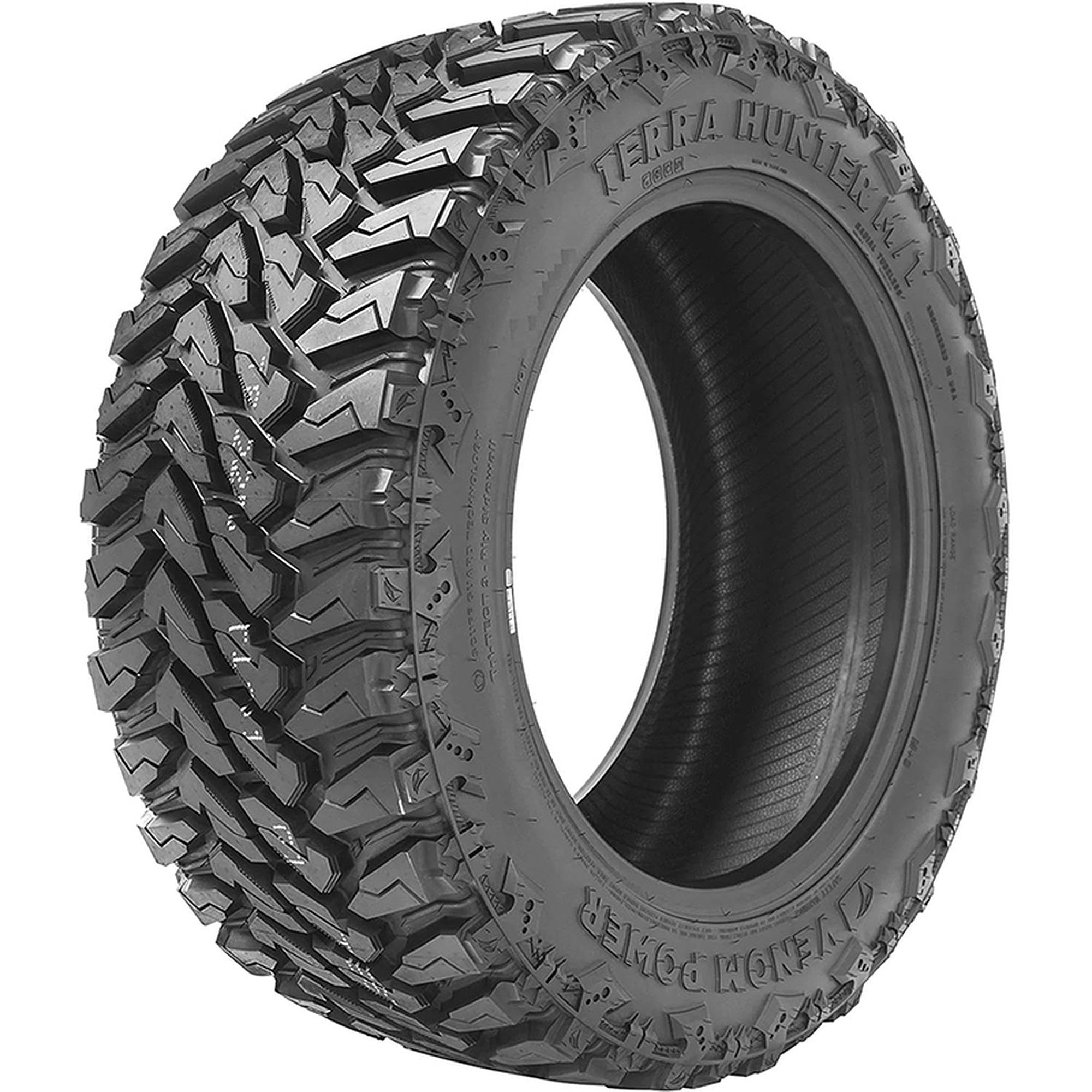
Venom Power Terra Hunter M/T: A Comprehensive Technical and Market Analysis 2025/2026
The automotive aftermarket has undergone a structural shift over the last decade, characterized by the democratization of aggressive off-road capability. Historically, the “Mud Terrain” (M/T) tire segment was dominated by legacy Tier 1 manufacturers—brands with century-long heritages and commensurate pricing structures. However, the burgeoning demand for lifted trucks, “overlanding” builds, and purely aesthetic modifications has created a vacuum for cost-effective alternatives that deliver the requisite visual aggression without the premium price tag.
Enter the Venom Power Terra Hunter M/T. This tire represents a paradigmatic example of the modern “Tier 3” or “Value Tier” product: engineered to meet specific consumer desires (visual customization, deep mud traction, broad size availability) while leveraging globalized supply chains to undercut market leaders. This report provides an exhaustive technical evaluation of the Terra Hunter M/T, dissecting its engineering architecture, real-world performance metrics, manufacturing origins, and its standing within the fiercely competitive light truck tire ecosystem.
The analysis indicates that while the Terra Hunter M/T acts as a disruptor in terms of price and availability—particularly in the “flotation” sizes favored by truck enthusiasts—it presents a distinct set of engineering trade-offs regarding acoustic comfort, balancing uniformity, and long-term tread wear that potential operators must calculate into their total cost of ownership.
VENOM POWER MT
The Budget Beast: Venom Power Terra Hunter MT
In the world of Mud-Terrain (MT) tires, you usually have to choose between your wallet and your traction. The Venom Power Terra Hunter MT claims to break this rule. Designed for light trucks and SUVs, this tire offers an aggressive dual-stage tread pattern and deep voids at a fraction of the cost of premium brands.
But does “cheap” mean “compromise”? We analyzed the data on tread life, noise levels, and off-road capability to see if this tire is a hidden gem or a noisy nightmare.
Ideal Terrain Usage
Percentage of time this tire should spend on different terrains for optimal satisfaction.
Performance DNA
Mud-terrain tires are specialists. They trade highway comfort for off-road dominance. The chart below visualizes the Terra Hunter MT’s strengths and weaknesses across six critical categories.
Scale: 1 (Poor) to 10 (Excellent)
⛰️ Off-Road Dominance
Scoring a solid 9/10 in Mud and 8/10 on Rock, the deep voids and stone ejectors work exactly as intended. It clears mud effortlessly and grips uneven terrain well.
🔊 The Noise Factor
Like most MTs, it is loud. We rated it 4/10 for Noise Comfort. The aggressive lugs create a distinct hum that becomes a drone at highway speeds.
🌧️ Wet Traction
Siping is present but minimal compared to an AT tire. Wet traction is average (5/10), requiring caution on slick pavement.
Cost Analysis
This is why you buy Venom Power. When equipping a truck with large 33″ or 35″ tires, the cost difference between brands becomes massive.
Data shows that for a set of four 35×12.50R20 tires, choosing Venom Power over a Tier 1 brand like Toyo can save you nearly $800. That’s the cost of a suspension lift kit or a winch.
Price Per Set (Estimated Avg for 35″ Tires)
Technical Specifications
Tread Depth
22/32″
Deep voids for mud clearing
Sidewall
3-Ply
Polyester construction
Load Range
E / F
Heavy hauling capable
Rim Sizes
17″ – 28″
Huge variety for lifted trucks
✅ The Good
- •Unbeatable price-to-performance ratio.
- •Aggressive sidewall styling looks expensive.
- •Excellent deep mud and loose dirt evacuation.
- •High load ratings (up to F range) for towing.
❌ The Bad
- •Loud highway hum compared to AT tires.
- •Harder rubber compound can struggle on wet tarmac.
- •Not 3-Peak Mountain Snowflake rated (poor on ice).
- •Balancing can sometimes require more weights.
© 2026 FordMasterX Infographics. Data sourced from manufacturer owner manuals.
Brand Lineage and Manufacturing Infrastructure
To evaluate the product, one must first scrutinize the entity behind the sidewall stamp. Unlike vertically integrated manufacturers that own their rubber plantations and testing tracks, Venom Power operates on a private label model, a common strategy in the modern global tire trade.
Corporate Ownership and Strategy
The Venom Power brand is a subsidiary of Transamerica Tire Co. Ltd., a corporation headquartered in Memphis, Tennessee. This geographic positioning is not incidental; Memphis is a logistics hub central to the American automotive distribution network. Transamerica has cultivated a portfolio of brands, including Predator and Freedom Hauler, specifically targeting the North American light truck and trailer segments.
The strategic mandate of Venom Power appears to be "trend responsiveness." Legacy brands often require years to retool factories for new molds. In contrast, smaller private labels like Venom Power can rapidly pivot to produce the "squatted" or "stanced" sizes (e.g., 33x14.50R24) that trend-driven consumers demand. This agility allows them to capture the "enthusiast" market that is often underserved by conservative Tier 1 sizing catalogs.
Globalized Manufacturing Logistics
While the brand's intellectual property and marketing strategies are domiciled in the United States, the physical manufacturing of the Terra Hunter M/T is offshored. Research into import records and sidewall markings confirms a dual-source manufacturing strategy:
- China: A significant volume of standard sizing is produced in Chinese facilities. This aligns with the broader industry trend of utilizing China's mature rubber processing infrastructure to minimize unit costs.
- Thailand: Specific production runs, particularly for larger rim diameters like the 22-inch series, have been traced to factories in Thailand. This diversification is likely a strategic hedge against fluctuating trade tariffs and import duties that have historically impacted Chinese tire exports to the United States.
Engineering Architecture and Design Specifications
The Terra Hunter M/T is classified as a "Maximum Traction" tire. Its engineering priority is clear: loose-surface mechanical keying (grip) takes precedence over paved-road refinement.
Tread Pattern and Hydrodynamic Design

The tread face of the Terra Hunter M/T utilizes a high-void, open-block architecture. In fluid dynamics terms, the "void ratio" refers to the amount of open space compared to rubber contact.
- Mud Evacuation: The massive voids between the tread blocks serve a specific hydraulic function. As the tire rotates through viscous mud, centrifugal force ejects the material from these voids. If the voids were narrower (like in an All-Terrain tire), the mud would pack into the grooves, effectively turning the tire into a "slick" and eliminating traction. The Terra Hunter's voids are designed to remain self-cleaning even in "soupy" clay conditions.
- Stone Ejectors: Located at the base of the deep grooves are raised rubber ribs known as stone ejectors. These are critical for gravel road durability. Without them, small stones can become wedged between tread blocks. Over time, the flexing of the tire drills these stones into the casing, leading to belt separation or leaks. The inclusion of ejectors suggests Venom Power engineered the tire for actual off-road durability, not just mall-crawler aesthetics.
Dual Sidewall Technology

One of the Terra Hunter M/T's most marketable features is its Dual Sidewall Design. This manufacturing technique involves molding two distinct patterns on opposite sides of the tire casing, allowing the installer to mount the tire with the preferred aesthetic facing outward.
- The "Fang" Side: This aggressive profile features deeply molded, claw-like lugs that extend significantly down the sidewall toward the bead. These are not purely cosmetic; in low-pressure rock crawling scenarios, these side lugs act as primary traction aids, grabbing rock ledges that the tread face cannot reach. They also serve as ablative armor, protecting the vulnerable sidewall cords from puncture by sharp slate or roots.
- The "Block" Side: The alternative side offers a more traditional, utilitarian stepped-block design. This caters to fleet vehicles or owners who prefer a classic mud-terrain look without the stylized aggression of the "fang" motif.
Internal Construction and Ply Ratings
The structural integrity of a light truck tire is defined by its ply rating and load range. The Terra Hunter M/T is built to handle significant compressive loads, suitable for ¾-ton and 1-ton pickup trucks.
- Load Range E and F: The tire is widely available in Load Range E (10-ply equivalent) and, in larger sizes like the 35x13.50R22, Load Range F (12-ply equivalent). A Load Range F tire can typically support higher inflation pressures (up to 80 PSI) and heavier loads, making it theoretically suitable for towing heavy fifth-wheel trailers.
- 3-Ply Sidewall Construction: Select sizes boast a 3-ply polyester sidewall construction. This is a premium feature often found in top-tier tires like the BFGoodrich KM3. A 3-ply sidewall drastically increases resistance to impact breaks—a common failure mode when off-roading at speed.
Compound Chemistry
While specific compound data (e.g., carbon black ratios or silica content) is proprietary, performance reports suggest a harder, chip-resistant compound. Harder compounds generally offer better longevity on abrasive gravel but sacrifice adhesion on wet pavement and ice. The Terra Hunter M/T's struggle on ice (detailed in Section 5) corroborates the use of a harder, durability-focused rubber blend.
Specification Matrix
To assist the reader in understanding the technical scope, the following table aggregates specifications across common fitment sizes.
| Tire Size | Load Index | Speed Rating | Ply Rating | Max PSI | Tread Depth (32nds) | Approved Rim Width |
| 33X12.50R22 | 109 | Q (99 mph) | 10 (E) | 80 | 20 | 10.0 - 12.0" |
| 35X12.50R20 | 121 | Q (99 mph) | 10 (E) | 65 | 21 | 10.0" |
| 35X13.50R22 | 122 | Q (99 mph) | 12 (F) | 80 | 20 | 11.0" |
| 33X12.50R20 | 114 | Q (99 mph) | 10 (E) | 65 | 21 | 10.0" |
On-Road Performance Analysis
The primary compromise inherent in any Mud Terrain tire is its behavior on paved surfaces. The Terra Hunter M/T is no exception, exhibiting specific characteristics that prospective buyers must accept.
Acoustics and Harmonic Resonance
Noise generation is the most frequent feedback regarding the Terra Hunter M/T. The physics of sound generation in tires dictates that large, evenly spaced tread blocks slap the pavement, creating a rhythmic "hum" or "drone."
- The "Helicopter" Effect: At highway speeds (65+ mph), the air trapped between the large voids is compressed and released, creating a low-frequency roar often described as sounding like a helicopter.
- Wear-Induced Noise: User reports consistently indicate that noise levels increase non-linearly with wear. As the leading edges of the tread blocks feather or heel-toe wear develops (a common issue if rotation is neglected), the tire can become "ridiculously loud," potentially overpowering cabin conversation or audio systems.
- Comparison: It is significantly louder than All-Terrain (A/T) or Hybrid (R/T) tires. However, veteran M/T users note it is comparable to other aggressive budget M/T tires, though perhaps louder than premium options that utilize advanced pitch-sequencing algorithms to cancel out noise frequencies.
Ride Quality and Vibration
The stiff sidewall construction (10-ply/12-ply) required for off-road durability transmits more high-frequency road vibration to the chassis compared to a standard passenger-rated tire.
- Balancing Challenges: A critical insight from the research is the difficulty in balancing these tires. Numerous reports cite issues with "out-of-round" tires or the need for excessive counterweights to achieve a smooth roll. This suggests that the manufacturing tolerances (radial force variation) of the Venom Power factories may be wider than those of Tier 1 manufacturers like Michelin or Bridgestone.
- Remedy: Experts recommend using "Road Force" balancing rather than standard static balancing to mitigate these vibrations.
Wet Traction and Hydroplaning
Driving a mud tire in the rain requires an adjustment in driving style.
- Friction: The reduced contact patch (due to the high void ratio) means there is less rubber touching the road to generate friction during braking. This can lead to longer stopping distances on wet asphalt.
- Hydroplaning: Paradoxically, the large voids that clear mud also evacuate water efficiently, reducing the risk of hydroplaning at speed. However, the chemical grip of the hard compound on wet surfaces is often described as "slippery" or "sketchy" during cornering, requiring cautious throttle inputs.
Off-Road and Severe Weather Capabilities

This is the environment where the Terra Hunter M/T is engineered to perform, and the data suggests it delivers substantial capability for the price.
Mud and Loose Soil
The tire receives nearly universal praise for its performance in deep mud. The aggressive shoulder lugs and wide channel voids allow the vehicle to maintain forward momentum in conditions that would strand an All-Terrain tire. The "self-cleaning" action is effective, keeping the tread blocks exposed to bite into the substrate.
Rock Crawling
When "aired down" (tire pressure reduced to 15-20 PSI), the tire's sidewall flexibility and the specific "fang" side lugs provide excellent lateral grip. The 3-ply sidewall offers insurance against pinch flats and sidewall tears when squeezing between boulders. The stone ejectors also prove their worth here, keeping the tread package intact.
Winter Performance: The Ice Limitation
A critical distinction must be made between "Snow" and "Ice/Hardpack."
- Deep Snow: The M/T functions well in deep, fresh powder. The lugs act as paddles, scooping the snow to propel the truck.
- Ice: The Terra Hunter M/T is NOT a dedicated winter tire and lacks the "Three Peak Mountain Snowflake" (3PMSF) rating found on some of its A/T cousins. On ice or hard-packed snow, the hard rubber blocks slide easily. Unlike winter tires which have thousands of "zigzag" sipes to hold snow (snow-on-snow friction is high), the M/T's large blocks offer little mechanical keying on smooth ice. Users rate ice performance as poor (e.g., "5/10"), necessitating 4WD and extreme caution.
Towing and Hauling Considerations
For truck owners who use their vehicles for work, tire stability under load is paramount.
- Load Capacity: With Load Index ratings up to 125 (3,640 lbs per tire) and 128 (3,960 lbs per tire), the Terra Hunter M/T is structurally capable of supporting heavy fifth-wheel trailers or bed loads.
- Squirm: However, "tread squirm" is a factor. The tall, unsupported tread blocks of a fresh M/T tire can flex under heavy torque or lateral load, creating a sensation of floating or instability at highway speeds. This usually decreases as the tire wears down and the blocks become shorter and stiffer.
- Heat: M/T tires generate more heat due to internal friction in the thick tread blocks. While capable of towing, they are not ideal for sustained high-speed, heavy-haul highway towing compared to a closed-shoulder commercial tire.
Comparative Market Analysis
To understand the value proposition, we must compare the Terra Hunter M/T against its direct competitors in the "Value" segment and the "Premium" benchmarks.
Venom Power vs. Atturo Trail Blade M/T
The Atturo Trail Blade M/T is the most direct rival.
- Performance: Independent testing and user consensus often give the edge to Atturo for on-road handling and balancing consistency. The Atturo design, rooted in short-course off-road racing, tends to have slightly better road manners.
- Aesthetics: Venom Power wins on "visual width" and the aggressiveness of the sidewall, which is often the deciding factor for show-truck builders.
- Price: Prices are highly competitive, often within $10-$20 per tire of each other.
Venom Power vs. Federal Couragia M/T
- Evolution: The Federal Couragia is an older design notorious for extreme noise (the "howl") and rapid wear. The Venom Power is generally seen as a generation ahead, offering slightly better noise attenuation (though still loud) and improved tread life.
- Balancing: While Venom Power has balancing issues, Federal is historically infamous for requiring massive weights, making Venom Power the safer bet of the two budget options.
Venom Power vs. Premium (Toyo/BFG)
- The Delta: A set of 35-inch Venom Power tires might cost $1,200, whereas a set of Toyo Open Country M/Ts could exceed $2,200.
- What You Pay For: The premium price buys quieter road noise, significantly better wet-road adhesion (silica compounds), easier balancing (manufacturing uniformity), and typically 20-30% longer tread life. For a daily driver doing 20,000 miles a year, the premium tire may be cheaper per mile. For a weekend toy or a truck driven 5,000 miles a year, the Venom Power offers the same capability for half the upfront cost.
Data Visualization Plan: Competitive Price Matrix

The following chart illustrates the cost disparity between Venom Power and market alternatives for a standard 35x12.50R20 fitment.
| Tire Brand/Model | Segment | Approx. Price (Per Tire) | Tread Life Warranty? | Primary Pro | Primary Con |
| Federal Couragia M/T | Budget | ~$200 - $240 | No | Cheapest option | Extremely loud, fast wear |
| Venom Power Terra Hunter M/T | Value | ~$280 - $290 | No | Dual Sidewall, huge sizes | Balancing issues, noise |
| Atturo Trail Blade M/T | Value | ~$280 - $300 | No | Racing heritage, handling | Less aggressive sidewall |
| Toyo Open Country M/T | Premium | ~$450+ | No | Legendary durability, resale | Extremely expensive |
Warranty and Durability: The Fine Print
A critical finding in this research is the distinction in warranty coverage between Venom Power's M/T and their other lines.
The "No Mileage Warranty" Clause
While Venom Power markets a 50,000-mile warranty for their Terra Hunter X/T (Hybrid) and R/T (Rugged Terrain) tires, the Terra Hunter M/T carries NO mileage tread life warranty. This is industry standard for mud tires, as the soft compounds and aggressive use cases (spinning in mud, rock crawling) make mileage predictions impossible. Buyers should not expect financial compensation if the tires wear out in 25,000 miles.
Standard Protections
The tire is covered by:
- 4-Year Manufacturer Warranty: Covers defects in workmanship (e.g., belt separation not caused by impact).
- Road Hazard (Selected Retailers): Some specific retailers or sub-models (like the R/T) may come with road hazard protection, but it is not inherent to the M/T model from the manufacturer for all sizes.
Tread Life Expectancy
Based on user reports, realistic tread life expectations are:
- Maintained (Rotated every 3k-5k miles): 35,000 - 45,000 miles.
- Neglected (No rotation): 20,000 - 25,000 miles. Chopping will destroy the ride quality long before the tread depth reaches the legal limit.
Conclusion
The Venom Power Terra Hunter M/T is a triumph of targeted engineering. Transamerica Tire Co. has correctly identified a massive market segment: truck owners who desire the "Maximum Traction" aesthetic and off-road capability but are priced out of the Tier 1 market.
By leveraging Thai and Chinese manufacturing, Venom Power delivers a product that is 90% as capable off-road as a tire costing twice as much. The trade-off is found in on-road refinement—specifically noise and balancing. For the "Show Truck" demographic or the dedicated off-roader on a budget, it is an exceptional value. For the high-mileage highway commuter, the savings in upfront cost may be negated by the noise fatigue and shorter lifespan compared to a premium All-Terrain tire.
Ultimately, the Terra Hunter M/T is not a "cheap" tire in the pejorative sense; it is a specialized tool offered at a commodity price, democratizing access to extreme off-road traction.
FAQ
Q1: Is the Venom Power Terra Hunter M/T directional?
A: No, the tread pattern is non-directional. This is a significant advantage as it allows for "Cross-Rotation" (moving the front-left tire to the rear-right, etc.). Cross-rotation is essential for Mud Terrain tires to prevent "cupping" or heel-toe wear, extending the useful life of the tire and keeping noise levels down.
Q2: Why is my Venom Power M/T tire so hard to balance?
A: Large, aggressive tires with heavy rubber blocks often have higher "radial force variation" (stiff spots in the sidewall) or slight out-of-round conditions compared to passenger tires. If a standard spin balance fails (resulting in steering wheel shimmy at 50-60mph), request a Road Force Balance. This method applies a roller to the tire to simulate road weight and can match the "high spot" of the tire to the "low spot" of the rim to minimize vibration.
Q3: What is the correct tire pressure for these tires?
A: Do not rely on the pressure listed on your truck's door jamb, as that is for the stock P-metric or LT tires. The Terra Hunter M/T is likely a larger volume tire with a higher load rating (E or F).
- Street Use: Common pressures for a 35-inch tire on a half-ton truck are 35-45 PSI.
- Towing: Rear tires may need 60-80 PSI depending on load.
- The Chalk Test: To find the perfect pressure, mark a line of chalk across the tread. Drive 100 feet. If the chalk wears off the center only, pressure is too high. If it wears off the edges, pressure is too low. You want even wear across the full width.
Q4: Does the Terra Hunter M/T run true to size?
A: Generally, yes, but M/T tires often have "section widths" (the widest point of the sidewall) that are wider than the tread width due to the aggressive side lugs. A "12.50" wide Venom Power tire might actually measure 13+ inches at the sidewall lugs. This often causes rubbing on suspension components (control arms) or fender liners if the wheel offset is not aggressive enough (negative offset) to push the tire out.
Q5: Can I use these tires in snow?
A: You can, but with caveats. They are excellent in deep, loose snow (like off-roading in a field). They are below average on packed snow and ice found on highways. They do not have the specialized hydrophilic rubber compounds of winter tires that stay soft in freezing temps. Drive in 4WD and increase following distance significantly.